You mean the basic requirements of being a parent? Food, shelter, clothing. That’s not something I owe you pay back for. That’s literally what you sign up for when you have children. I don’t owe you my adult income because you managed to keep me alive to 18. We gave you more than the basics. You gave Miranda more than the basics.
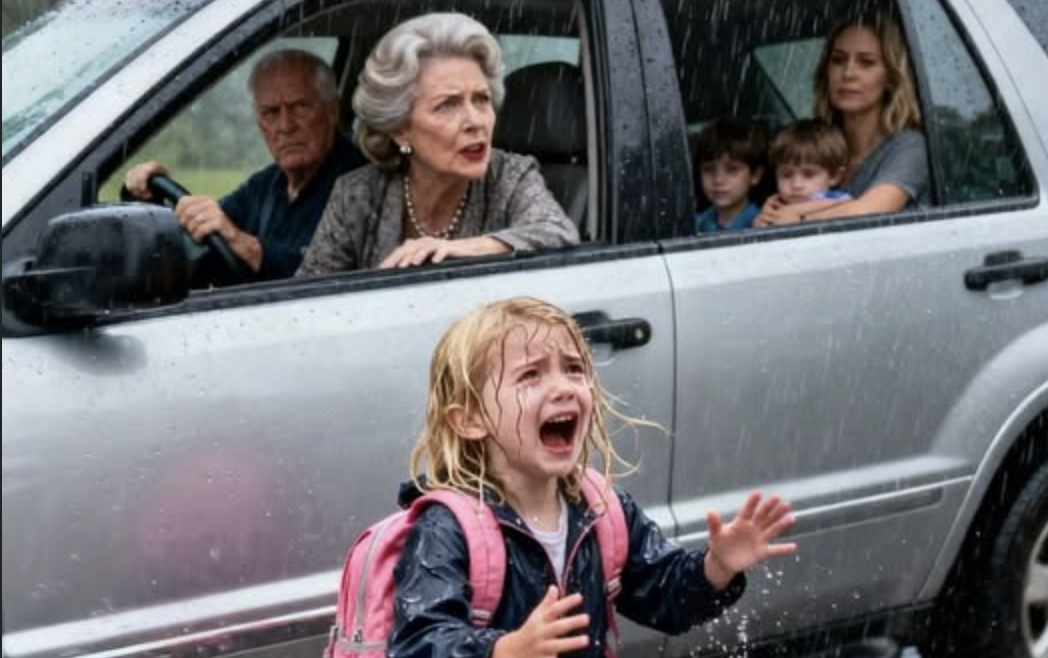
You gave me the basics and a lifetime of feeling like I wasn’t good enough. But sure, let’s pretend you were parents of the year. Even if you were, that still doesn’t give you the right to abuse my child. We didn’t abuse her. You told a six-year-old to walk home alone in a thunderstorm. You looked into her eyes while she begged for help and you drove away.
What do you call that? He had no answer. He stood there in the parking garage, an old man who’d run out of arguments. Finally, he said, “You’re going to regret this. Family is everything. Family is the people who show up for you. Family is the people who protect your children. You failed at both. Now get away from my car before I call security.
” He left, but the encounter shook me more than I wanted to admit. Seeing him look so beaten down triggered old patterns of guilt. For just a moment, I questioned everything. That night, David found me crying in the bathroom. Second thoughts? Guilt? I admit it. All those years of being trained to put them first. It doesn’t just go away. Look at me.
He waited until I met his eyes. You are not responsible for your parents’ financial situation. You are not obligated to light yourself on fire to keep them warm. And you are absolutely not required to maintain relationships with people who hurt our daughter. The guilt you’re feeling isn’t rational. It’s conditioning. I know that logically.
Then trust the logic. Your emotions are going to catch up eventually, but in the meantime, trust that you made the right choice. He was right. Of course, the guilt was a trained response. Decades of being told that my purpose was to take care of everyone else. Breaking that conditioning felt like breaking bones that had healed wrong, necessary, but excruciating.
The situation with Miranda deteriorated even further. When the private school expelled Bryce and Khloe for non-payment, Miranda posted a long rant on Facebook, blaming me for ruining her children’s education. She didn’t mention the part where I’d been paying their tuition for two years out of my own pocket.
She painted herself as the victim of her cruel, vindictive sister. The following week, my mother showed up at my office. Security called my extension to inform me I had a visitor in the lobby. I told them I wasn’t available and to ask her to leave. She apparently refused, making a scene until building security threatened to call the police.
She left, but not before screaming loud enough for the entire lobby to hear that I was an ungrateful daughter who’d abandoned her family. My assistant brought me a coffee afterward with sympathetic eyes. Family stuff? Not anymore, I said. The pressure campaign intensified. My aunt Sylvia called, trying to mediate.
Your parents made a mistake, but you’re being cruel. They’re going to lose their house. They should have thought about that before treating my daughter like garbage, I replied. They made their choice. I’m making mine, but they’re elderly. They need help. Then Miranda can help them. She’s the favorite anyway.
Sylvia tried to guilt me further, talking about family obligations and forgiveness. I ended the call. She’d always enabled my parents behavior, making excuses for why Miranda deserved more attention and resources. I was done with the whole dynamic. Miranda tried a different approach. She sent Quentyn to my house one evening.
David answered the door and dealt with him while I stayed upstairs with Lily. I heard raised voices. Heard David tell him to leave and not come back. When my husband came upstairs, his jaw was tight. He had the nerve to threaten you, David said. Said you were ruining their lives and you’d regret this. Did you tell him to [ __ ] off? In slightly more eloquent terms, yes.
Two weeks after I cut them off, Miranda’s kids were withdrawn from their private school. My mother posted dramatic updates on social media about how they might lose their home due to their ungrateful daughters cruelty. Several relatives reached out to scold me. I blocked them all. A month in, I received a letter from an attorney my parents had hired.
The letter claimed I had made verbal promises to support them financially and that they’d relied on this support to their detriment. The attorney threatened legal action if I didn’t resume payments. I laughed and forwarded the letter to my own attorney, Richard Chen. He called me within the hour. This is nonsense, Richard said.
Gifts aren’t contracts. Unless you sign something promising continued support, they have zero legal standing. Do you want me to respond? Please do. and make it clear that any further contact will be considered harassment. Richard sent a letter that apparently scared them off the legal route.
The attorney never contacted me again. But my parents didn’t give up. They tried to use Lilia’s leverage. My mother sent a card address to Lily with a note inside. Grandma misses you so much. Your mommy is keeping us apart, but I love you very much. I threw it in the trash. When a package arrived a few days later, clearly from my parents based on the return address, I refused delivery and sent it back.
Miranda showed up at Lily’s school one afternoon. She tried to approach Lily at pickup, but I’d already warned the school about my family situation. A teacher intercepted Miranda and informed her she wasn’t on the approved pickup list and needed to leave the premises. Miranda threw a fit, which resulted in the school issuing a formal trespass warning.
The principal, Dr. Martinez, called me that evening to inform me about the incident. Your sister was quite aggressive with our staff. She claimed she had a right to see her niece. When we explained our policies, she became verbally abusive. We’ve documented everything and banned her from campus. I’m so sorry you had to deal with that.
I said, “Don’t apologize. Protecting our students is our priority. I just wanted you to know we’re taking this seriously. If she shows up again, we’ll contact the police immediately.” Knowing the school had Lily’s back gave me some peace of mind, but it also showed me how far my family was willing to go.
Miranda wasn’t trying to see Lily out of love or concern. She was trying to create a situation where I’d have to interact with her, where she could make her case for why I should resume the money flow. Everything they did came back to money. Not one action they took demonstrated genuine remorse or concern for Lily’s well-being.
It was all strategy, manipulation, attempts to find pressure points they could exploit. I started documenting everything. Every message, every encounter, every attempt at contact went into a file Richard maintained. He’d advised me early on that if this escalated to legal action or if they tried anything more aggressive, having documentation would be crucial.
People like this often escalate before they accept reality. Richard warned, “They’re used to you giving in. When you hold firm, they sometimes get desperate.” His words proved prophetic. About 6 weeks after I cut them off, someone slashed two of my tires while my car was parked at work. The security footage was too grainy to identify the culprit, but the timing felt suspicious.
Richard advised filing a police report, which I did, and mentioning my family situation to the investigating officer. Even if we can’t prove it, having it on record establishes a pattern if other incidents occur, she explained. David wanted to install cameras at the house, hire security, take aggressive protective measures.

I convinced him to wait to see if it was truly my family or just random vandalism. But I agreed to the cameras. Better safe than sorry. The cameras caught my mother driving by our house three times one Saturday morning. Just slow passes, not stopping, but clearly surveillance. David wanted to confront her. I stopped him. That’s what she wants.
She wants engagement, conflict, anything that creates an opening for manipulation. We don’t give her that. So, we just let her stalk us. We document it. If it escalates, we get a restraining order, but we don’t engage. It was one of the hardest things I’d ever done. Watching my mother’s car roll past my house, knowing she was trying to find some way back into my life.
The rational part of me knew she didn’t want back in out of love. She wanted back in because I was the golden goose who’d stopped laying eggs. But the irrational part, the little girl who’d spent her childhood trying to earn her mother’s approval, achd watching that car drive away.
Lily asked about her grandparents less and less as weeks turned into months. Kids are resilient in ways adults forget. She’d already been picking up on the favoritism. The way Bryce and Kloe got better presence and more attention. Removing that toxic dynamic from her life let her flourish in ways I hadn’t anticipated. Her teacher mentioned at parent conferences that Lily seemed more confident, more willing to take risks in the classroom.
Whatever changes you’ve made at home, they’re working. Mrs. Palmer said she’s really coming into her own. I didn’t mention that the change was removing her grandparents from her life. Some things didn’t need to be explained. Through friends of friends, I heard updates about my family situation. My parents had listed their house for sale, but couldn’t find buyers at the price they needed.
The market had shifted, and their home needed updates they couldn’t afford. They were trapped in a property they couldn’t pay for but couldn’t sell. Miranda and Quentyn’s relationship was deteriorating publicly. She’d apparently blamed him for the loss of my financial support, claiming that if he’d been a better provider, she wouldn’t have needed her sister’s help.
He pointed out that she was the one who’ chosen to be cruel to a child and trigger the cut off. Their arguments were loud enough that neighbors complained. Hearing these updates, I felt nothing. No satisfaction, no sympathy, no vindication, just a distant awareness that consequences were unfolding exactly as they should.
My own life improved dramatically. Without the constant drain of supporting my parents and sister, David and I paid off our credit card debt completely. We started making real progress on our modest mortgage. The financial breathing room was incredible. More than that, the emotional breathing room changed everything. I hadn’t realized how much energy I’ve been expending on managing their expectations, fielding their requests, juggling their emergencies.
Without that constant background stress, I was sleeping better, feeling more present with Lily, actually enjoying my life. You look different. My colleague Jennifer commented one day at lunch. Lighter somehow. I cut toxic people out of my life. I said simply. Turns out that makes a difference. Family? Former family? She nodded. Understanding.
I did that with my brother 3 years ago. Best decision I ever made. People think blood relation means you owe unlimited chances. But some people burn through all their chances and then some. It helped hearing other people’s stories. Finding out I wasn’t alone in making hard choices about family. There was a whole community of people who had drawn boundaries with relatives and survived even thrived. I wasn’t a monster.
I was a mother protecting her child. Through it all, Lily slowly healed. The nightmares about being abandoned in the rain stopped after a few weeks. She stopped asking when she’d see her grandparents again. She seemed lighter somehow, as if a weight I hadn’t realized she’d been carrying had lifted. 3 months after I cut off payments, my parents house went into foreclosure.
My mother sent me a final text from a number I hadn’t blocked yet. I hope you’re happy. We’re losing everything because of you. I replied once, “You lost everything the moment you drove away from your granddaughter in a storm. The house is just a consequence.” Then I blocked that number, too. Miranda and Quentyn moved into a smaller rental house across town.
She had to get a job for the first time in years, working retail at a local boutique. The social media posts about her fabulous life stopped. So did the photos of expensive dinners and designer handbags. My parents ended up moving into a small apartment in a less desirable part of town. The country club membership obviously ended.
My mother’s tennis friends stopped calling. They downsized to one vehicle, a used sedan that replaced the SUV I’d been paying for. I watched it all happen with zero regret. People who didn’t know the full story judged me harshly. A few colleagues at work heard rumors and gave me disapproving looks. One even had the audacity to say something at a company lunch about how family should come first, no matter what.
You don’t know what you’re talking about, I said quietly. And you should mind your own business. David supported me completely. He’d witnessed years of my parents’ favoritism and Miranda’s entitled behavior. He’d watched me drain my savings and work overtime to support people who barely acknowledged my existence unless they needed money.
“You gave them everything,” he said one night as we sat on the back porch, Lily asleep inside. “Your time, your money, your energy, and they repaid you by being cruel to our daughter. You made the right call. The financial impact on me was significant. I won’t pretend otherwise. $90,000 a year had been a substantial portion of my income.
But without that drain, I started rebuilding my savings. I opened a college fund for Lily that actually had money going into it instead of being perpetually delayed. David and I started planning the kitchen renovation we postponed for years. Life got better without them in it. 6 months after everything imploded, I ran into my father at a grocery store.
He looked older, more worn down. His cart contained generic brands and marked down meat. He saw me before I could turn down another aisle. Please, he said, approaching me with his hands up like I was a wild animal. Can we just talk? There’s nothing to talk about. Your mother is struggling. The apartment is in a rough area.
She’s scared all the time. Then Miranda can take her in. Miranda barely has room for her own family. They’re struggling, too. That sounds like a series of choices you all made, I said, starting to push my cart past him. He grabbed my arm. I stared at his hand until he released me. Were your parents? He said, his voice breaking slightly. You can’t just discard us.
Something in me snapped. All the years of being second best, of watching them do on Miranda while treating me like an obligation, of giving everything I had only to have them hurt. My child came rushing forward. You discarded Lily, I said, my voice low and hard. A six-year-old child who loved you. You left her in a storm and told her to walk home like a stray dog.
You traumatized your own granddaughter because you couldn’t be bothered to make room in a car that fits seven people. So, don’t you dare talk to me about discarding family. It was a mistake. Your mother was upset about something Miranda had said. We weren’t thinking clearly. You had time to think. Lily begged you. She pleaded with you while rain soaked through her clothes. And you drove away.
That wasn’t a mistake. That was a choice. His face crumpled. What do you want from us? We’ve apologized. We’ve tried to make amends. You’ve tried to get your money back. I corrected. Every message, every call, every letter has been about the payments I stopped. Not one of you has genuinely apologized for what you did to Lily.
Miranda certainly hasn’t. She sent a card trying to make me the villain. We’re desperate. Don’t you understand that? I understand that consequences exist. I understand that you showed me exactly how much my daughter matters to you, which is not at all compared to Miranda and her kids. I understand that you took my financial support for granted while treating me like a secondass family member.
And I understand that I’m done. I walked away from him. He called after me, but I didn’t turn around. That night, I told David about the encounter. Do you think I’m being too harsh? I asked. He pulled me close. I think you’re protecting our daughter and refusing to enable people who hurt her. That’s not harsh.
That’s being a good mother. A year after everything happened, my life had settled into a new normal. Lily thrived without the confused dynamic of grandparents who clearly favored her cousins. She made friends at school, excelled in her classes, and stopped having anxiety about family gatherings that never materialized.
David got a promotion that came with a substantial raise. Combined with the money I was no longer sending to my parents and sister, we were actually financially comfortable for the first time in our marriage. We took Lily to Disney World, just the three of us, and the joy on her face in every photo reminded me why I had made the choices I did.
The Disney trip was magical in ways that transcended the park itself. Watching Lily meet her favorite characters, seeing her face light up at the fireworks, holding her hand as we walked through the castle, these moments felt pure in a way family moments hadn’t felt in years. There was no undercurrent of favoritism, no comparisons to cousins, no sense that she was somehow less deserving of joy and attention.
On our last night there, as Lily slept between us in the hotel room, David turned to me. We should have done this years ago. We couldn’t afford it years ago. We couldn’t afford it because you were funding your parents’ retirement and your sister’s lifestyle. He corrected gently. This is what life looks like when you invest in your actual family instead of people who take you for granted. He was right.
This trip cost less than 2 months of what I’ve been sending my parents. two months of support that they’d apparently believed was their right rather than my choice. The resentment I thought I’d moved past flared briefly before settling back down. I’d made my peace with my choices. Most days, I didn’t think about them at all anymore.
When we got back from vacation, there was a letter waiting at our house, not delivered through normal mail, but tucked into our screen door. My mother’s handwriting on the envelope made my stomach clench. David wanted to throw it away unopened. I convinced him to let me read it first to know what we were dealing with.
The letter was six pages long. handwritten on flowered stationery. My mother’s script, once so precise, looked shaky in places. She wrote about her childhood, her own difficult relationship with her parents, her struggles as a young mother. She talked about the pressure she’d felt to favor Miranda, the younger daughter who’ seemed more fragile, more in need of protection.
She admitted that she’d taken me for granted, assuming I was strong enough not to need the same level of attention and support. She acknowledged that this had been unfair and had created a dynamic where Miranda expected to be catered to while I was expected to be the caretaker. Then she got to the incident with Lily. She claimed she’d been having a particularly bad day, that Miranda had been complaining about me during the drive to the school, poisoning her thoughts.
She said she wasn’t thinking clearly when she told Lily to walk home, that the words came out before she could stop them. I see now how cruel it was, she wrote. I see how I hurt my granddaughter. I see how I failed both of you. I’m not asking you to forgive me or to resume helping us financially. I just want you to know that I understand what I did was wrong. I’m sorry.
I read the letter three times, looking for the catch. Looking for the manipulation, the request for money disguised as remorse, but it wasn’t there. The letter ended with I love you and I’m sorry. That’s all I wanted to say. I set the letter on the kitchen counter and stared at it for a long time.
David came up behind me, reading over my shoulder. What do you think? He asked. I think it’s probably genuine. I also think it’s too late. Does she deserve a response? That was the question, wasn’t it? Did sincere remorse, even if belated, deserve acknowledgement? Did my mother’s apparent growth deserve credit, even though it came only after facing consequences? I thought about it for days.
The letter sat on the counter, impossible to ignore. Lily asked what it was. I told her it was something from grandma, but nothing she needed to worry about. She nodded and went back to her homework, unbothered. That response told me everything I needed to know. Lily had moved on. She wasn’t sitting around missing her grandparents or hoping for reconciliation.
She was happy, secure, thriving in an environment where she knew she was loved and valued. Opening the door to my mother again, even just for conversation, would destabilize that security. It would reintroduce uncertainty and anxiety into my daughter’s life. And for what? So my mother could feel absolved so I could feel like I’d been generous and forgiving? No.
Lily’s piece was worth more than my mother’s comfort. I didn’t respond to the letter. I filed it away in the folder Richard maintained just in case it became relevant later, but I didn’t acknowledge it. didn’t engage with it. Didn’t give my mother the closure she was seeking. Richard called me a few weeks after the letter arrived.
Your parents house sold for closure auction. They got about 60% of what they owed on it. How do you know that? Public records. I’ve been monitoring the situation in case they tried anything legal. They’re officially out of the house as of next week. Where are they going? Does it matter? She had a point. Where my parents ended up wasn’t my concern anymore.
They’d made their choices, and those choices had consequences. I was no longer responsible for managing their fallout. Still, I found myself thinking about them living in some small apartment, downsizing from a house they’d lived in for 20 years, my father without his workshop in the garage, my mother without her garden, all of it gone because they’d chosen to be needlessly cruel to a child.
I heard through Aunt Sylvia, who still tried to maintain contact despite my boundaries, that my parents had filed for bankruptcy. Miranda and Quentyn’s marriage was apparently strained to the breaking point by financial stress. Quentyn blamed Miranda for losing the free ride I’d provided. Miranda blamed him for not earning enough.
And the whole situation was apparently explosive. I felt nothing hearing these updates. No satisfaction, no guilt, no sadness, just emptiness where my family used to be. Does it bother you? My friend Jessica asked over lunch one day after I’d shared a brief version of the story. Not having your parents in your life? I considered the question carefully.
I grieve what I thought I had. I grieve the parents I deserved but never actually had. But letting go of what actually existed? No, that doesn’t bother me at all. Sometimes I wondered if I’d done the right thing. If maybe I should have tried harder to repair the relationship, found some middle ground where we could coexist.
But then I’d remember Lily’s face that day, soaked in shivering and heartbroken, and my resolve hardened again. They’d had a choice. They could have made room in that car. They could have treated my daughter with basic human decency. They could have split the kids between vehicles or made two trips. They could have done literally anything except tell a six-year-old to walk home alone in a thunderstorm.
Instead, they chose cruelty, and I chose my daughter. The last contact I had with any of them came 15 months after the initial incident. Miranda sent an email from a new address I hadn’t blocked. The subject line read, “I’m sorry.” The email itself was long and rambling. She admitted that she’d been jealous of my career success and financial stability.
She said watching me support everyone while she struggled had made her resentful. She claimed she’d been the one to suggest leaving Lily behind that day, making some comment to our mother about how I’d been too busy to pick up my own daughter, so why should they help? She apologized for being petty and cruel.
She said her marriage was ending, her kids were struggling in their new school, and she’d finally realized how much she’d taken advantage of my generosity. She asked if there was any way we could rebuild our relationship. I read the email three times. Part of me wanted to believe her. The little girl inside me who’d always wanted her younger sister’s approval perked up at the words.
But I’d learned something over the past year. I’d learned that some burns go too deep to heal. I’d learned that protecting my daughter meant more than maintaining relationships with people who had proven they couldn’t be trusted. I’d learned that I deserved better than spending my life trying to earn love from people who’d made it conditional on my utility to them. I didn’t respond to the email.
I forwarded the email to my attorney to document in case Miranda tried anything legal, then deleted it. Life moved forward. Lily started second grade. David and I celebrated our fourth anniversary. I got promoted to vice president at my firm, a position that came with a significant salary increase, and the respect I’ve been working toward for a decade.
My parents and Miranda faded into background noise, people I used to know, a chapter of my life that had closed. Sometimes people asked about them, extended family at events I couldn’t avoid. I kept my answers brief and non-committal. The people who mattered knew the truth. Everyone else didn’t need to know anything. The rain doesn’t bother Lily anymore.
She splashes in puddles, laughs during thunderstorms, and doesn’t flinch when dark clouds roll in. She’s resilient in a way I hope she never has to be again. And me, I sleep well at night knowing I chose right. I chose the child who needed protection over the adults who demanded support while offering nothing but pain in return.
I chose boundaries over obligations. I chose my real family over people who only claimed the title when they wanted something. They’re still out there somewhere living with the consequences of their choices. And I’m here living with a peace that came from finally putting myself and my daughter first. That’s not revenge.