The room went so still I could hear Lily’s tiny snuffling breaths from the bassinet.
“He never told me that.”
“He didn’t want you girls carrying grown folks’ sins,” Nana said. “Your daddy believed silence kept children safe. Men of his generation believed that a lot.”
It was the kind of information that explains too much too late. Suddenly I could see old moments in a new, uglier light. My mother insisting on handling school paperwork. My missing tax refund one year that she blamed on the IRS. Brenda saying, over and over, “Mom said not to worry, you always land on your feet.”
Always land on your feet.
Like I had not spent years working two jobs in college. Like I had not rationed groceries once after a root canal because I didn’t have enough left over for both copay and food. Like I had not sent money anyway because Brenda’s children shouldn’t suffer.
Derek got off the phone with the utility company just as I hung up with Nana Ruth.
“They confirmed the account service address,” he said.
He didn’t even need to say it.
Brenda’s old apartment.
That afternoon Brenda called.
For a second I considered not answering. Then I did, because avoidance had already cost me enough.
She started crying immediately.
Not the broken kind. The frustrated kind. The kind that sounds like somebody furious you’re making them feel bad.
“I didn’t know about all that old stuff,” she said. “Mom swears she was gonna handle it.”
“Handle what?” I asked.
“Fix it.”
“With what money, Brenda?”
She didn’t answer.
I walked into the bedroom so she wouldn’t wake Lily. Sunlight fell across the bed in a bright square, catching dust in the air. My body still felt tender and unreliable, but rage had a way of holding me upright.
“Were you there when the phones were picked up?” I asked.
A pause.
Then: “Mom said you knew.”
I laughed once, quietly. “That is not what I asked.”
“She said you didn’t want the charges on your own card because of the baby expenses, so she was putting it through the account another way.”
“Were. You. There.”
Brenda sniffed. “Yes.”
The word settled in me heavy and final.
She started talking fast after that, trying to shrink her part in it. She hadn’t known about the loan after Dad’s funeral. She thought the utility thing got paid off. Mom said it was temporary. Mom said I was helping. Mom said I always said yes anyway.
And there it was.
The truth hiding in the grammar.
She had not thought I wanted to help.
She had thought I could be used and would stay quiet.
After I hung up, Patty knocked with a casserole dish she absolutely did not need returned right away and stood on the porch twisting her car keys.
“There’s one more thing,” she said. “I wasn’t sure if I should say it.”
My stomach tightened.
“The day your mama came by with that envelope, she took a picture of the house before she left. Just stood across the street and took one with her phone.”
“Why?”
Patty’s mouth flattened. “Honey, I don’t think it was the house.”
It took me a second.
The front window.
The couch.
The bassinet by the couch.
Lily.
That night, after Derek was finally asleep on top of the blanket with one arm flung over his eyes and Lily in the crib beside us, my phone buzzed with a message from an unknown number.
It was a grainy photo taken through my front window.
You could see the edge of the bassinet.
Underneath it, one line:
Don’t make family do desperate things.
The fear hit cleaner than the anger had.
I sat there in the dark with my daughter breathing softly five feet away and realized this was no longer just about money.
Part 6
We moved in less than a week.
People talk about moving like it’s boxes and labels and pizza on the floor. That is not what moving is with a newborn and a fraud report and a mother who thinks your boundaries are a personal attack. Moving, in that kind of season, feels more like fleeing with paperwork.
Derek found us a rental outside Cincinnati through a coworker whose brother was between tenants. Small three-bedroom house. White siding. Screened porch. Narrow backyard with a tired maple tree and enough distance from Columbus to keep casual cruelty inconvenient.
Before we left, we stopped in Dayton so Nana Ruth could meet Lily properly.
Nana’s house always smelled the same: old wood, lemon polish, coffee brewed too strong, and whatever pie she had decided counted as medicine that day. She held Lily in her lap in the kitchen, her hands spotted and thin and steady as ever, and just looked at her for a long time.
“She’s got your daddy’s serious forehead,” she said.
Then she looked at me over the top of Lily’s head, and because Nana Ruth had never wasted words, she only said, “You don’t owe blood the right to keep bleeding you.”
I sat at her table and cried into a slice of peach pie warm enough to fog my glasses.
By the time we got to Cincinnati, the air smelled like rain and cut grass. The house had scuffed floors and a kitchen with ugly laminate counters, but when I stepped inside, the first thing I noticed was what it didn’t smell like.
It didn’t smell like my mother’s perfume.
I nearly sagged with relief.
For about forty-eight hours, I let myself pretend that starting over might be as simple as distance.
Then the police cruiser pulled into our driveway.
It was early evening. Derek was assembling the crib because of course the screws had vanished into one mislabeled box, and I was on the couch feeding Lily while reheated chili filled the house with cumin and tomato. The cruiser rolled by once, slow enough to make my nerves sit up, then backed in and parked.
My whole body went cold.
The officer on the porch was polite, almost apologetic.
“Ma’am, we received a report concerning the welfare of an infant at this address.”
I stared at him. “From who?”
He shifted his weight. “A woman named Diane Carter.”
Of course.
“She stated her daughter was being isolated from family and that the baby might be unsafe.”
Behind me, I heard Derek set the Allen wrench down very carefully.
The officer was not stupid. One look at our living room full of unpacked boxes, folded baby laundry, the bassinet, the burp cloth over my shoulder, and Derek’s face cycling through several legal reasons not to say exactly what he wanted, and he already knew what kind of call this probably was.
Still, procedure was procedure.
He asked a few questions. Looked around. Confirmed the baby was healthy, fed, and very much not kidnapped by her own parents. He took notes while Lily hiccuped milk onto my shirt and I signed one more form with a hand that wanted to shake.
When he was leaving, he paused by the porch rail.
“Document everything,” he said quietly. “Every text. Every call. Every visit.”
After he drove away, I stood in the kitchen gripping the counter until my knuckles whitened.
Derek came up behind me, laid both hands on my shoulders, and rested his forehead between them. “She won’t stop,” he said.
I swallowed. “I know.”
The next day I gave the detective in Columbus my mother’s full name.
And Brenda’s.
That felt like stepping through glass.
The detective’s name was Lila Moreno, and she had the brisk patience of somebody who had seen too many people apologize for being victimized. We spoke over video first because travel with a newborn and postpartum recovery were not exactly ideal.
“I need to be clear,” she said. “If you want these accounts removed, this can’t stay in the category of family misunderstanding. We pursue the responsible parties, or the debt stays married to your name.”
Responsible parties.
Not my mother and sister.
Responsible parties.
Sometimes language is the only way to hold something long enough to look at it.
I sent her everything. Screenshots. Credit reports. The photo through the window. Patty’s written statement. Derek’s notes from the bank call. My own account of the hospital visit and the missing papers.
Then came the backlash.
One cousin texted me, Hey, maybe don’t involve police. Your mom is saying you’re not well after the birth.
Another sent a screenshot from Facebook.
It was one of those vague, poisonous posts people make when they want the whole town to know they are suffering without having to admit what they did.
Please pray for mothers whose children forget where they came from.
Underneath it, three church ladies had commented praying hands and hearts.
I threw up in the sink after reading that. Not because I was pregnant-sick, not because of hormones. Just disgust. Pure, bitter disgust.
Two days later, my younger cousin Chelsea sent me another screenshot.
This one was Brenda’s.
In the photo, all three kids were at a skating rink in neon birthday hats, grinning so wide their cheeks looked painful. And in front of them on the table were two brand-new phone boxes, the logos visible.
Caption: Best birthday ever. Kids are so blessed.
I zoomed in until the image broke into pixels.
Blessed.
I sent the screenshot straight to Detective Moreno.
My phone rang less than ten minutes later.
“We got store footage,” she said.
I sat down before she even finished the sentence.
“Your mother and sister are both visible at pickup,” Moreno said. “Your sister signed one receipt. Your mother provided the documents.”
I looked across the room at Lily asleep in the swing, her mouth slack, one sock half off her heel.
For weeks, some small weak part of me had still been trying to sort degrees of guilt. Maybe Mom led it. Maybe Brenda just drifted along. Maybe somebody was more wrong than the other.
The footage killed that.
They had stood together under fluorescent store lights and used my name like it belonged to both of them.
That night, I saved every screenshot, every voicemail, every statement in a folder on my laptop labeled simply: Proof.
And still, somehow, the detective had one more thing to tell me.
“There’s enough here to move forward on the phones,” she said. “But the older accounts are where this gets uglier.”
My mouth went dry.
“How ugly?”
Her pause was very short.
“Ugly enough that I think you should sit down before I walk you through the loan taken out the week after your father’s funeral.”
Part 7
There are discoveries that feel like doors opening.
Then there are discoveries that feel like the floor deciding it no longer knows you.
The loan from the week after my father’s funeral was for $4,800.
It had been taken out at a storefront lender on the west side of Columbus, the kind of place squeezed between a tax prep office and a discount tobacco shop, the kind with bright signs promising FAST CASH NOW as if urgency itself were a product. The application used my Social Security number, my old driver’s license number, and an email address that had once been mine in community college.
I had forgotten that email existed.
My mother had not.
The deposit had gone onto a prepaid card, then bled out in pieces over the next week. Rent. Back-to-school clothes. A down payment at a used car lot. Detective Moreno said there were surveillance stills from the lender’s lobby, grainy but usable.
“Your mother is visible,” she said. “We’re still trying to confirm if your sister was involved in that one.”
I could barely hear her over the rush in my ears.
I remembered that week after Dad died. The casseroles. The funeral flowers going brown at the edges. My black dress hanging over the shower rod because I couldn’t stand to put it away. Brenda crying louder than anyone in public, then asking quietly in the kitchen if Mom thought she could keep the car because she had the kids. Me sleeping on Nana Ruth’s sofa because home felt wrong without Dad’s boots by the door.
Grief had been everywhere.
Apparently so had paperwork.
That afternoon I drove to Dayton with Lily in the back seat and Derek beside me because I needed to look at Nana Ruth in person when she answered my next question.
The highway was one long strip of gray under a cloud-heavy sky. Lily slept almost the whole way, making those little sighing noises from the car seat that somehow still felt miraculous to me.
At Nana’s, the screen door slapped shut behind us and the smell of chicken broth hit first. She had something simmering, of course. Nana believed all real conversation should happen with a pot going.
I sat at her kitchen table while Lily dozed in a borrowed Moses basket lined with one of Nana’s old cotton pillowcases. The afternoon light through the curtains made everything soft except the truth.
“Did my mom ever use my name before Dad died?” I asked.
Nana didn’t answer right away. She took off her glasses, folded them, set them on the table.
“Once that I know of,” she said. “A department store account. Your daddy caught it.”
I swallowed. “Did he tell you he thought she’d do it again?”
“He told me he was afraid she had learned the wrong lesson,” Nana said. “Not that theft was wrong. That she needed to be more careful.”
I looked down at my hands. They were still dry and cracked from hospital sanitizer and endless washing.
“She took that loan while I was planning his funeral.”
Nana’s face changed then. Pain. Not surprise. Something older.
“She loved your father,” she said. “But love doesn’t clean a crooked spot out of a person if they’ve been polishing it for years.”
That was Nana Ruth. She could hand you a devastating truth in a sentence that sounded like weather.
Later, while Derek walked Lily around the backyard under the naked branches of Nana’s pear tree, Nana brought me a small tin box from the hall closet.
“Your daddy asked me to keep these,” she said.
Inside were old receipts, two savings bonds, and a folded piece of notebook paper in my father’s blocky handwriting. It wasn’t a letter exactly. More like a list. Jolene tuition. Car repair fund. Emergency savings. He had written amounts beside each one, little plans built out of overtime and discipline. At the bottom was one line circled twice:
Do not let Diane spend Jo’s school money on Brenda again.
I had to put the paper down because my vision blurred so badly.
Again.
That one word carried a whole hidden history I had never been given.
When Derek came back in, muddy shoes at the door, Lily blinking awake against his shoulder, he found me at the table with my father’s handwriting under my hand and Nana standing behind me with one palm between my shoulder blades.
He read the page. His jaw worked once.
“That’s it,” he said.
By evening, Detective Moreno called with the next step.
The prosecutor’s office wanted statements in person.
Also, Brenda had asked through a cousin if I would meet before formal charges were filed.
“She says she wants to explain,” Moreno told me, in the tone of someone who had heard explanations from thieves before.
I almost said no immediately.
Then I thought about every year I had swallowed things to keep peace, every lie that had survived because I was too afraid of hearing it said plainly.
“I’ll meet,” I said. “One time.”
But only if it was at Nana Ruth’s house.
Only if Derek came.
Only if I got to leave the second I smelled manipulation.
Nana approved that plan with a grim nod and put more broth on my plate.
That night, back in Cincinnati, I rocked Lily in the dim nursery while the white-noise machine hissed like distant rain. I watched her eyelids flutter and thought about my father writing my name in careful block letters beside money he had tried to protect for me.
All those years I thought I had simply been overlooked.
It turned out someone had been reaching into my future with both hands.
I agreed to one meeting not because I still hoped they would change, but because I wanted to hear, once and for all, what kind of story they told themselves when they stole from me.
Part 8
Nana Ruth set the meeting for a Sunday at two-thirty, which in her house meant coffee already brewed, pie already cut, and no one allowed to pretend they were too busy for the truth.
The sky that day was the color of dirty cotton. Cold enough that the windows fogged at the corners. Derek drove. I sat in the passenger seat with Lily’s diaper bag by my feet and my pulse flickering too high in my throat.
“I can walk out,” I said, maybe for the tenth time.
“You can,” Derek said. “And I’ll be right behind you.”
Nana opened the door before we knocked, as if she had been standing there waiting with one hand on the latch. She kissed Lily, squeezed my elbow, and said, “Kitchen.”
My mother was already there.
So was Brenda.
Diane sat ramrod straight at the table in a navy coat she had not taken off, pearls at her throat like she was attending a luncheon instead of an accounting. Brenda looked puffy and under-slept, mascara clumped at the corners, phone in both hands like it was something to grip.
No one said hello.
The kitchen smelled like coffee and cinnamon and old anger.
I sat down with Lily in my lap. Derek took the chair beside me. Nana stayed standing by the counter, arms crossed, a dish towel thrown over one shoulder like she might need it for either pie or blood.
Brenda started first.
“I want to say I’m sorry.”
I looked at her and waited.
She licked her lips. “I didn’t know about all of it.”
Not I’m sorry I hurt you.
Not I’m sorry I used your name.
I didn’t know about all of it.
I shifted Lily higher against my chest. She was awake, quietly staring at the hanging lamp as if she had wandered into the wrong play and was deciding whether to cry.
“What did you know about?” I asked.
Brenda glanced at Mom. Mom stared straight ahead.
“The phones,” Brenda said finally. “And one of the utility bills a couple years ago. Mom said you’d agreed.”
I let that sit there.
Then I asked, “When exactly did it stop mattering whether I had agreed?”
Diane made a sound under her breath. “Oh, please.”
That one little sound did more to me than an hour of excuses could have. It was so familiar. So dismissive. The soundtrack of my whole life whenever I had the nerve to describe my own reality.
I turned to her.
“This is your chance,” I said. “So say it clearly.”
She met my eyes and, for one second, I saw actual strain in her face. Not remorse. Effort. The effort of a woman trying to reshape a lie quickly enough to still look decent wearing it.
“I did what I had to do,” she said.
There it was.
Not I made a terrible choice.
Not I betrayed you.
I did what I had to do.
“For who?” I asked.
“For family.”
I laughed because if I hadn’t, I might have thrown the coffee mug in my hand.
“For Brenda,” I said. “You mean for Brenda.”
Diane’s mouth tightened. “Brenda had children. Needs. Real pressure. You have always been the capable one.”
The capable one.
It was wild how a phrase can sound like praise until you realize it’s just the wrapping paper on exploitation.
“So because I worked,” I said quietly, “because I planned, because I didn’t get pregnant at nineteen and drop every responsibility in your lap, you decided I could be robbed?”
Brenda started crying again. “That’s not fair.”
I looked at her so hard she went silent.
“No,” I said. “Fair would have been asking.”
Nana Ruth moved then. She came to the table and laid my father’s folded note in front of Diane.
My mother frowned, opened it, and I watched recognition travel across her face like a shadow.
She remembered his handwriting.
Of course she did.
“Your husband knew you,” Nana said. Her voice was low, steady, terrible in the way honest things are terrible. “He knew you so well he wrote down what you would do to that child if no one stopped you.”
Diane’s face lost color.
Brenda leaned over, reading the line about my school money. “What is that?”
I answered without taking my eyes off my mother. “Proof this didn’t start after he died. It just got easier.”
For the first time all afternoon, Diane looked cornered.
“You don’t understand what it was like,” she said, and now the words came faster, defensive and hot. “Your father was gone. Brenda was drowning. Those children needed things. You always landed on your feet. You had Derek. A good job. Savings. Stability.”
Every sentence was a confession disguised as a defense.
I sat very still because I wanted to remember this exactly.
“So you chose me because you thought I’d survive it,” I said.
“I chose the option that hurt least.”
The room went silent.
Derek made a sound then, low and disgusted, but he didn’t interrupt. He knew some truths need all the space around them.
“The option,” I repeated.
That was what I was to her.
Not daughter. Not person.
Option.
Brenda wiped her face with both hands. “Mom, stop.”
But Diane was in it now, the way people get when they’ve spent so many years justifying themselves they begin to think explanation is absolution.
“I was going to pay it back,” she said.
“With what?” I asked again.
She looked away.
There it was. The hole at the center of every plan. She had never meant to repay me. She had meant to keep the whole machine running on my silence.
Nana Ruth set both palms on the table.
“You buried one child the day you decided the other one was entitled to her life,” she said to Diane. “And you kept shoveling dirt for years.”
My mother flinched like she’d been struck.
I should say that was the moment I stopped loving her. But that’s not true. Love doesn’t always die in one scene. Sometimes it rots slowly and then, one afternoon in your grandmother’s kitchen with a sleeping baby on your chest and your dead father’s warning on the table, you realize the smell has been there a long time.
What died in me that day was hope.
Hope that there was a good explanation.
Hope that enough pain on my face would finally make her choose me.
Hope that blood automatically meant there was something salvageable underneath.
Diane looked at Lily then. Really looked at her for the first time.
“Can I hold my granddaughter?” she asked.
The question was almost obscene in the room we were in.
I stood up.
“No.”
Her eyes flashed. “You would keep a child from her grandmother over money?”
I adjusted Lily against my shoulder and met her stare.
“Over theft,” I said. “Over lies. Over breaking into my house. Over taking pictures through my window. Over sending the police to my door. Over making my daughter’s mother sick enough to hit the floor while you chased a birthday present.”
Brenda started sobbing outright.
My mother sat very still. The pearls at her throat trembled once with her breath.
“Then this family is done,” she said.
I picked up the diaper bag. Derek reached for the car seat.
“It was done a long time ago,” I said. “I’m just the one who finally said it out loud.”
We left while Nana was still speaking to them in that measured, devastating tone of hers. I didn’t stay to hear the rest.
That night, after we got home and Lily was asleep in her crib, my phone rang.
Detective Moreno.
The prosecutor had offered Diane a quiet plea if she admitted the fraud and accepted restitution terms.
“She refused,” Moreno said.
I sat down on the edge of the bed.
“What happens now?”
Her answer came clean and flat.
“Now we seek indictment.”
Part 9
Courtrooms never smell the way you expect.
I thought it would be old paper and dust. Maybe coffee. Instead the courthouse in Columbus smelled like floor polish, wet wool, cheap hand soap, and people trying not to sweat through their good clothes.
By the time the case reached a hearing, Lily was five months old and starting to grab at everything within reach, including my hair, Derek’s beard, and the laminated visitor sticker on my coat. We had a sitter that morning—Patty, who had insisted on driving down from Columbus because “somebody needs to be there who knows where the bodies are buried.” She said it jokingly. Mostly.
Brenda had taken a deal.
That was how I found out exactly where her line had always been. Not at right and wrong. At consequences.
In exchange for reduced charges tied to the phone fraud and utility account, she gave statements, texts, and access to an old email thread I wish I could bleach out of my memory. In one message, my mother wrote: Use Jo’s info. She’ll fuss, then cave.
In another, Brenda replied: Do it after the baby. She’ll be too distracted.
I read those words in my own kitchen with Lily rolling on a blanket at my feet, and for a second the whole room narrowed down to the shape of the sentence.
After the baby.
As if I were not a human being entering the most vulnerable week of my life.
As if motherhood made me easier to rob.
At the hearing, Brenda sat at the far end of the bench in a beige sweater, eyes swollen, twisting a tissue into rope. She wouldn’t look at me. My mother, of course, wore navy again. Hair sprayed into place. Lipstick perfectly lined. She looked like someone heading into a committee meeting at church.
People like Diane often do best when there are folding chairs and fluorescent lights. Institutions mistake neatness for innocence all the time.
The prosecutor laid out the basics first: identity theft, fraudulent use of personal information, unlawful entry, financial harm, pattern of conduct stretching back years. Detective Moreno testified. Then the carrier store manager. Then Patty, who described seeing my mother leave my house with the manila envelope while I was in the hospital.
Then it was my turn.
My legs felt wooden walking to the witness stand.
I swore in, sat down, and saw my mother watching me with that familiar expression I had feared since childhood—the one that said if I made her uncomfortable, I would pay for it later.
Only later had finally arrived, and I was no longer a child.
The prosecutor asked about the birth. The text. The missing documents. The fraud notifications. The older accounts. She had me read the message under the window photo into the record.
Don’t make family do desperate things.
Saying it out loud in that room made it sound exactly as threatening as it had felt in my dark bedroom.
The defense attorney tried hard to paint the whole thing as misunderstanding layered over postpartum sensitivity. He used phrases like emotional family conflict and informal financial patterns. As if years of being shaken down could become harmless if you used enough soft syllables.
“Ms. Mercer,” he said, “isn’t it true you had previously given money to your sister voluntarily?”
“Yes.”
“So financial help was normal in your family.”
“Being asked for money was normal,” I said. “Having my identity stolen was not.”
He tried another direction. “You slapped your mother, correct?”
“Yes.”
A flicker of satisfaction crossed Diane’s face, quick as a fish under water.
I kept my eyes on the attorney.
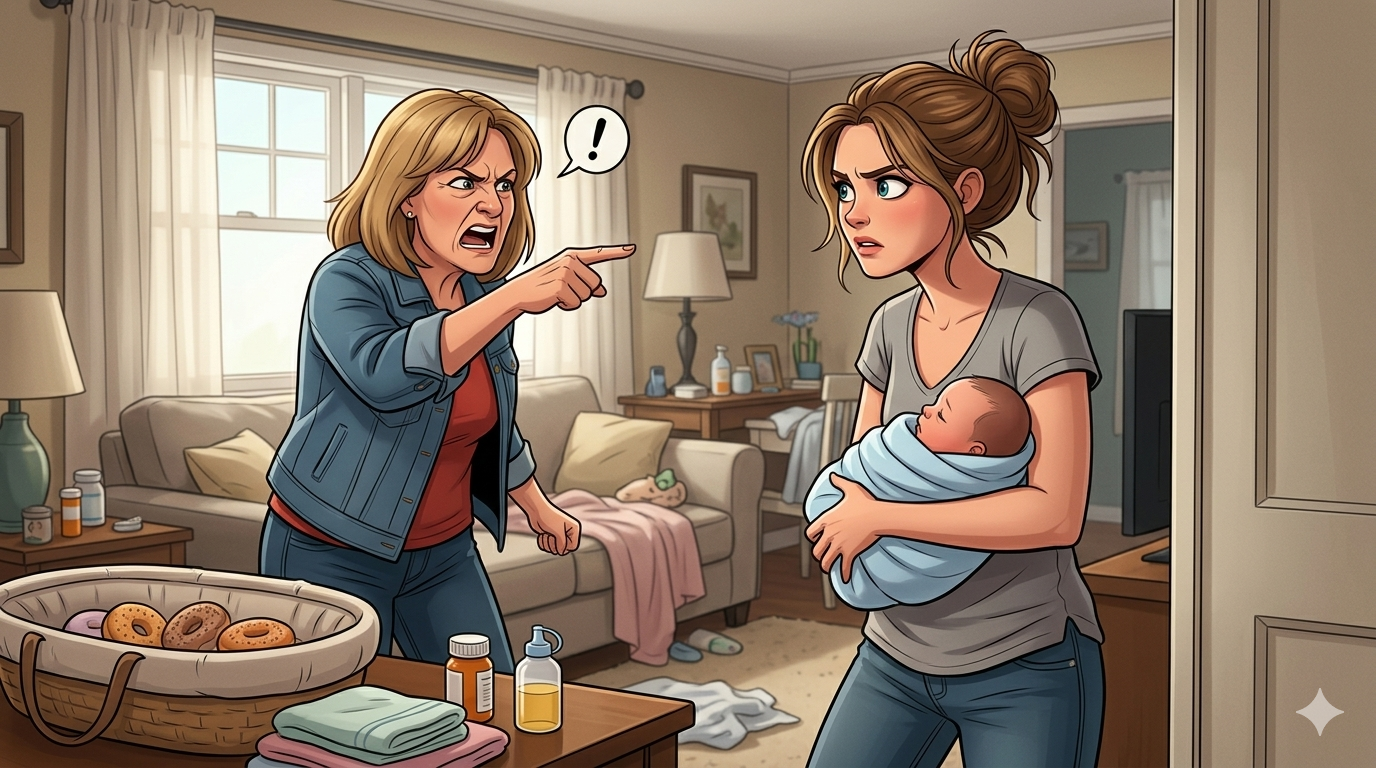
“I slapped my mother after she came into my home a week after I gave birth alone and screamed at me for not funding phones she had already promised with my money,” I said. “If you want to know whether I regret that moment, I regret not changing the locks sooner.”
There was a tiny noise somewhere behind me that might have been Patty choking back a laugh.
When I stepped down, my hands were shaking hard enough that Derek had to hold my coffee cup while I drank from it in the hallway.
The hearing itself was not the end. These things never are. There were continuances. More paperwork. Restitution math. Agreements and refusals and negotiations that felt obscene when measured against the original crime, which was simple: a mother decided one daughter was supply.
But by then the shape of the truth was public.
That mattered more than I’d expected.
At one point during a break, Brenda finally approached me in the corridor near the vending machines. She looked smaller than I remembered. Not humble. Just reduced.
“I am sorry,” she said. “I know that doesn’t fix it.”
I studied her face and saw something complicated there. Shame, yes. Self-pity, definitely. Fear most of all.
“You were waiting for me to have a newborn,” I said.
She burst into tears.
I felt almost nothing.
That surprised me. I had expected fury, or satisfaction, or grief sharp enough to cut. What I felt instead was distance. Like I was looking at weather from inside a house with the door shut.
“No more apologies unless they come with honesty,” I said. “And no honesty that starts only after police get involved counts for much.”
After the hearing, I went to the parking garage alone because I needed one minute without anyone touching me or asking if I was okay.
That was when my mother found me.
She stepped out from behind a concrete pillar in heels that clicked too hard for the space.
“You think you’ve won,” she said.
I did not move closer. I did not move back either.
“This isn’t a game,” I said.
Her eyes were bright and furious. “You’re tearing apart your own family over paperwork.”
I almost smiled at that. Paperwork. Such a small, neat word for years of theft.
“You tore it apart,” I said. “I’m documenting the pieces.”
For a moment her face changed. Not softer. Stranger. Almost offended that I still didn’t understand the logic that made perfect sense to her.
“I would do it again,” she said. “For Brenda’s kids, I would do it again.”
There are sentences that end arguments.
That was one.
Everything in me went still. Even my hurt. Especially my hurt.
Because that was the answer to every question I had ever spent years asking in secret.
Why Brenda?
Why always me?
Why did my needs feel optional in that house?
Because she had decided long ago that my love should come with an open account and no receipts.
I looked at her in that dim garage smelling of oil and cold concrete and said, “Then you will never meet my daughter as anything but a cautionary tale.”
She stared at me, maybe expecting a crack, a plea, one final softening.
I walked around her and kept going.
When I got into the car, Derek took one look at my face and didn’t ask.
I strapped my seat belt on with hands that were finally steady.
The legal process still had months to go.
But forgiveness left the building before I did.
Part 10
The final outcome was both less dramatic and more permanent than I had imagined.
There was no thunderclap. No courtroom confession with tears streaming down powdery cheeks. No cinematic collapse under the weight of truth.
There were signatures.
Restitution orders.
Probation terms.
A protective order.
My mother took a plea once it became clear the state had enough to make trial uglier than surrender. Brenda’s cooperation spared her the worst of it, though “spared” is a relative term when what you lose is your sister and whatever illusion you had about yourself being a decent person.
The older loan tied to the week after Dad’s funeral became the center of everything for me, even if legally the phones were the cleanest charge. That loan told the real story. Not impulsive desperation. Not one bad birthday decision. A practice. A method. A belief.
Once the credit bureaus had the police report, the affidavits, and the case number, the slow cleanup began. Accounts removed. Fraud alerts extended. Passwords changed. A new Social Security card requested. Mail rerouted to a box my mother had never touched. Every step felt boring and holy.
Rebuilding a life often looks like paperwork done by tired people in slippers.
By then we had been in Cincinnati long enough for the house to smell like us instead of cardboard. Chili on the stove. Derek’s cedar soap in the bathroom. Lily’s lotion, faint and powdery, somehow on every blanket in every room. I found small routines and held on to them like handrails. Morning bottle. Walk to the porch swing. One load of laundry. One phone call I actually wanted to answer.
Nana Ruth came once a month when she could, sometimes by bus just to prove eighty-one did not mean retired from loving people stubbornly. She’d sit in the rocking chair by the window and tell Lily stories about my dad as a boy: frogs in his pockets, grass stains on church pants, the summer he tried to sell tomatoes from the backyard and ate half the inventory.
One afternoon in late spring, while Lily napped and Derek was at work, I got a letter in the mail with no return address.
I knew before I opened it.
My mother’s handwriting was unmistakable. The loops too careful, the pressure too hard, like she was trying to control the page.
The letter was three pages long.
Therapy language was all over it. Boundaries. Accountability. Healing. She wrote that she was learning to understand family systems. She wrote that she regretted “the pain caused.” She wrote that no mother is perfect. She wrote that she hoped, in time, I would choose grace.
She never once wrote: I stole from you because I believed you mattered less.
That was the sentence I had earned. That was the one she still could not say.
I folded the pages back up, put them in the envelope, and slid it into the drawer where I kept court documents and Lily’s vaccination records. Not because I planned to reread it. Because I wanted it filed with the rest of the facts.
Brenda sent one text from a new number a few weeks later.
I know I don’t deserve anything. I just wanted you to know the kids ask about you.
I read it while standing barefoot in my kitchen, watching rain bead on the porch screen. For a moment I pictured all three of them. My nieces and nephew. Their voices. Their birthdays. The way the oldest one used to shove extra cheese onto her pizza crust and call it “saving the best for last.”
That hurt.
I let it hurt.
Then I blocked the number.
Because missing children who were used as shields was not the same thing as forgiving the adults who hid behind them.
By Lily’s first birthday, we had bought a little house of our own on the edge of a neighborhood full of maples and cracked sidewalks and people who waved without asking for anything. The backyard was bigger than the rental’s, and Nana Ruth insisted the first thing we plant be lilies.
So we did.
White ones. Yellow ones. A stubborn orange variety she said could survive anything short of plague.
Derek dug the holes. I set the bulbs in with dirt under my nails and Lily in a sunhat wobbling around the grass trying to eat leaves. The air smelled green and damp and alive.
Nana Ruth sat in a lawn chair, directing everybody like a tiny general.
“Deeper,” she told Derek. “You men always think roots are shallower than they are.”
He laughed and saluted with the trowel.
When we finished, I stood there looking at the little disturbed patch of earth and felt something settle in me that had taken a year to arrive.
Not peace.
Peace is too pretty a word.
It was clarity.
My mother was alive. So was Brenda. They were out there somewhere living with the consequences of things they had done on purpose. I did not wish them dead. I did not spend my evenings fantasizing about revenge. I simply no longer volunteered my heart as a worksite.
People think refusing forgiveness means staying angry forever.
It doesn’t.
Sometimes it just means you finally stop handing knives back to people who have already shown you where they like to stick them.
On Lily’s birthday, we had cake in the backyard. Patty came down from Columbus in a sundress with lemon bars. Nana Ruth wore a visor and fed Lily tiny bites of frosting with one wrinkled finger. Derek hung cheap paper lanterns from the fence, and when they lit at dusk, the whole yard glowed soft gold.
At one point, after Lily had finally tired herself out and fallen asleep against my chest, Derek slipped an arm around my waist and looked at the flower bed we’d planted.
“You okay?” he asked.
I looked at our daughter. At the porch. At Nana Ruth laughing with Patty over something I couldn’t hear. At the first green blades of lily leaves pushing up where there had been only dirt a few weeks earlier.
“Yeah,” I said.
And for the first time in my life, I meant it without crossing my fingers behind the words.
I did not forgive my mother.
I did not rebuild anything with my sister.
Some things, once named correctly, stop asking to be mended and start asking to be left behind.
My daughter will grow up knowing that love is not access, blood is not permission, and family is not whoever is best at making you feel guilty for bleeding. She will know that being kind does not require being available for harm. She will know that “no” is a complete sentence and that apologies without truth are just prettier lies.
And every spring, when the lilies come back up through the dirt no matter what winter did to them, I think of the first night I held her in that hospital room and realized the world could be burning around me while something strong and tender still arrived.
That was the beginning.
Not of the betrayal.
Of the part where I finally stopped mistaking survival for love.
THE END!
Disclaimer: Our stories are inspired by real-life events but are carefully rewritten for entertainment. Any resemblance to actual people or situations is purely coincidental.