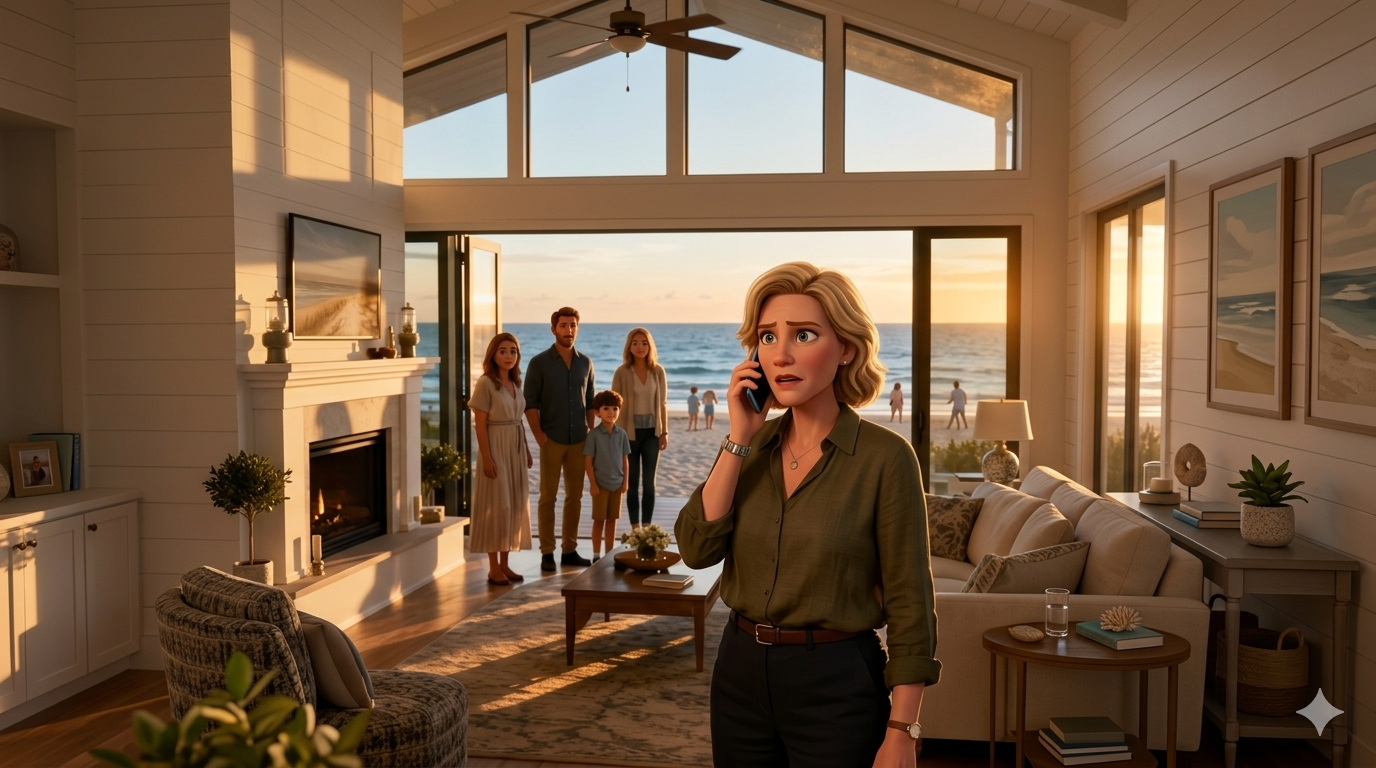
The morning after the party had the kind of silence that only happens when reality sobers everyone faster than coffee.
I walked into the kitchen and found Brandon and Melissa hunched over their phones at my dining table, frantically checking balances, calling banks, whispering numbers like prayers. Empty Dom bottles lined the counter like expensive trophies. The catering invoice sat on the kitchen island exactly where I left it.
Fifteen thousand dollars.
For one night.
Melissa stared at the paper like it might burst into flames. “Fifteen thousand,” she whispered. “For dinner.”
Brandon was on his third call. “I need my limit raised,” he said into the phone, voice tight. “Yes, I understand it’s unusual. It’s… family.”
He ended the call and looked up at me with a face full of panic and anger.
“Mom,” he said, too carefully, “we need to talk about that catering bill.”
“Oh, wasn’t it wonderful?” I asked, pouring myself coffee from the machine they’d commandeered three days ago. “Everyone raved about the lobster.”
“We can’t afford fifteen thousand dollars for one party,” Brandon snapped.
I tilted my head. “That’s strange,” I said. “I was under the impression you were handling all the management decisions for this property now.”
His face drained.
“But Mom, I never—”
“Oh, you did,” I replied. “You told your guests last night you were managing the house. People were impressed. They asked about your business model.”
Melissa’s eyes flicked to him, sharp with sudden suspicion.
Before Brandon could respond, Patricia emerged from my master bedroom wearing my robe and carrying my favorite mug.
“Eleanor,” she said, oblivious to tension, “we need fresh towels. And the Wi-Fi is slow. Can you call someone?”
I stared at her, then at Brandon, then at Melissa.
And right then, my phone rang.
“Eleanor Sterling?” a brisk voice asked. “This is Janet Morrison with Coastal Properties Real Estate. I have questions about the beach house listing.”
Beach house listing.
I put the call on speaker, because clarity is a gift.
“I’m sorry,” I said, “but I haven’t listed any property for sale.”
A pause. “That’s odd,” Janet said. “We received an inquiry yesterday from a Brandon Sterling claiming to represent the owner for a potential sale. He provided detailed details and said he was authorized to handle all real estate decisions.”
The silence that followed was so complete I could hear the ocean through an open window.
Brandon’s face went from panicked to terrified. Melissa stared at him like he’d just confessed to a crime.
“I see,” I said calmly. “Well, Mr. Sterling is not authorized to represent me. If someone has been providing information about my property without permission, that’s concerning. Should I file a report?”
Brandon made frantic no gestures.
I pretended not to notice.
“Let me think about it,” I told Janet. “Thank you for calling.”
When I hung up, Patricia tried again, still clueless. “About those towels—”
“Get out,” I said, quiet but clear.
Patricia blinked. “Excuse me?”
“All of you,” I repeated. “Pack your things and leave my house.”
Brandon stood, anger flaring like he could still bully me. “Mom, you can’t be serious. We’re family.”
“Family doesn’t impersonate the homeowner to real estate agents,” I said. “Family doesn’t threaten nursing homes. Family doesn’t invite strangers into someone else’s house and demand service.”
I walked to the front door, opened it, and held it there.
“You have two hours,” I said. “If you’re not gone, I call the police and I call Janet back.”
The exodus wasn’t graceful. It was chaotic, full of blame-shifting and loud complaints. Patricia muttered about “false advertising.” Kevin’s girlfriend whined about her ruined vacation. Rachel’s teenagers looked relieved, like escaping adults was a reward.
Brandon tried one last intimidation. “You’re making a mistake,” he said. “You think you can live alone in a house this big? What happens when you fall? When you can’t manage it? You’ll need family and we won’t be there.”
He said it like a weapon.
I smiled softly.
“You know what, Brandon?” I said. “You’re right. It is too much responsibility for someone my age.”
His expression shifted into smug satisfaction.
“So,” I continued, “that’s why I sold it.”
The words dropped like a bomb.
Melissa froze mid-fold. Patricia’s mouth opened. Brandon’s face went blank.
“What do you mean sold it?” Patricia demanded.
I walked to my desk and retrieved a folder, thick and official-looking. “I mean I transferred it yesterday morning,” I said. “Quick closing. Convenient timing.”
Brandon stammered. “But you can’t—We’re staying here—We have plans—”
“Had plans,” I corrected gently. “The new owners take possession next week. Professional property managers. Lovely people.”
This wasn’t entirely true. What I actually did—thanks to Sarah and Jim—was move the house into an LLC I controlled and contract with a high-end management firm to run short-term rentals under strict screening.
But the effect was identical.
Brandon no longer had access. No entitlement. No leverage.
No house.
“No,” I said, meeting his eyes. “This was my retirement home. The home you told me I was too old to manage.”
I closed the folder. “You were right about one thing: I do need family I can count on.”
Brandon’s face crumpled.
“I just realized,” I finished, “you’re not it.”
They left in a storm of slammed trunks and muttered threats about lawyers. I watched the last rental car disappear, then stepped onto my deck and breathed in the ocean air like it was medicine.
The peace lasted exactly one day before the next challenge arrived.
A woman in an expensive suit rang my doorbell, holding legal documents.
“Ms. Sterling,” she said. “I’m Rebecca Walsh. I represent your son in a property dispute matter.”
Of course he did.
Rebecca smiled like she expected me to fold. “My client is concerned about irregularities,” she said. “Specifically elder exploitation and emotional distress affecting judgment.”
I almost laughed.
Instead I smiled politely. “Did your client mention the fifteen-thousand-dollar catering bill he authorized?” I asked. “Or his unauthorized communications claiming to represent me?”
Her expression flickered.
“I think,” I continued, “this conversation would be best with my attorney. She specializes in elder law. Particularly cases involving financial exploitation by adult children.”
Rebecca’s face drained.
She left with less confidence than she arrived.
And as her car pulled away, I realized Brandon wasn’t finished.
He wasn’t just angry.
He was desperate.
Which meant he would escalate.
And I would not be caught unprepared.
Part 5
The first sign Brandon was escalating arrived in the kindest voice imaginable: my tenant’s.
The Patterson family had rented the house for two weeks through the management company—soft-spoken parents, two well-behaved teenage daughters who apologized twice for using the pool. They were so polite it made my recent “guests” feel like a fever dream.
Mrs. Patterson approached me on the deck one afternoon, face tight with discomfort.
“Mrs. Sterling,” she said carefully, “a young man came by yesterday claiming to be your son. He seemed upset. He asked about rental rates and booking schedules.”
Cold slid down my spine.
“What did you tell him?” I asked.
“Nothing,” she said quickly. “It didn’t feel appropriate. But he was persistent. He mentioned… concerns about your ability to manage a property this large.”
There it was. The narrative Brandon threatened on the phone: Eleanor is too old, too confused, too vulnerable, someone should step in.
That evening, Brandon called, smugness back in his voice.
“I’ve been researching,” he said. “Do you know you might be running an unlicensed bed and breakfast? Zoning violations could cost you everything. Liability issues if something happens to a tenant.”
He thought he’d found a pressure point.
“Interesting theory,” I said. “Did your research also discover that the property is properly licensed through Dare County and my insurance covers vacation rentals?”
Silence.
“We’ll see about that,” Brandon said, and hung up.
Two days later, the next escalation pulled into my driveway in a van marked Adult Care Services.
A social worker stepped out—Janet Torres—clipboard in hand.
“Mrs. Sterling,” she said professionally, “we received a report of potential self-neglect and possible exploitation. I need to conduct a welfare check.”
My son had called Adult Protective Services on me.
The viciousness took my breath away, but I didn’t show it. I’d been in too many negotiations to let anger drive the steering wheel.
“Of course,” I said calmly. “Come in.”
Janet’s inspection was thorough. She checked food supplies, medications, living conditions, mental state, financial arrangements. She found a well-maintained home, a competent woman, and a business operation documented down to the receipt.
When she asked who filed the report, I told her the truth.
“My son,” I said. “He’s angry I refused to let him use my home as a free resort. When I declined, he threatened nursing homes. Now he’s involving the government.”
Janet’s expression hardened.
“Are you saying the report was filed maliciously?” she asked.
“I’m saying,” I replied, “it was filed by someone who views my independence as an inconvenience.”
Janet closed her folder with a decisive snap. “I’ll be closing this case as unfounded,” she said. “And I’ll be documenting the source.”
When she left, I stood on my deck watching the Patterson girls read in deck chairs, peaceful and unbothered.
Brandon had crossed a line that couldn’t be uncrossed.
It was time to stop playing defense.
I called Mike Santos.
“Go deeper,” I told him. “Full financial forensics on Brandon and Melissa. Legal history. Employment verification. Everything.”
Two days later, Mike delivered a thick manila envelope that made my stomach drop.
Brandon’s business was behind on rent and facing eviction. Melissa had maxed out four credit cards funding their lifestyle. They’d applied for a home equity loan using projected inheritance from my estate as “future assurance.”
They were counting on my death or incapacitation.
And then came the real bombshell: six months earlier, Brandon had visited three elder law attorneys asking about conservatorship proceedings for a parent with “declining judgment.”
He’d been planning to take control of me before he even saw the beach house.
I called Sarah Chen immediately.
“Restraining order,” I said. “Harassment charges. Elder financial exploitation. And I want documentation of the false APS report.”
Sarah was quiet for a beat, then her voice turned sharp. “Eleanor,” she said, “this will get ugly.”
“He made it ugly,” I replied. “I’m finishing it.”
The counteroffensive was simple: remove his incentive and expose his methods.
Sarah filed. Mike documented. My management company tightened screening and security protocols. I installed new locks, new access systems, and a quiet camera setup that covered the driveway without turning my home into a fortress.
Brandon called at 6:47 p.m., voice raw with panic.
“What did you do?” he demanded.
“I protected myself,” I said. “And I documented your behavior.”
“You destroyed my business,” he snapped. “My credit—everything.”
“You’re describing consequences,” I replied. “Not sabotage.”
He went quiet, then smaller. “What do you want?”
Finally. Negotiation. Not demands.
“I want you gone,” I said. “No more calls. No more threats. No more showing up at my property. No contacting tenants. No speaking to agents, banks, anyone about my assets.”
“And if I don’t?” he asked.
“Then a judge gets a full file,” I said calmly. “False reports. Harassment. Attempted financial exploitation. Conservatorship planning. And you explain why you threatened to put your mother in a facility to force compliance.”
Brandon breathed hard on the other end of the line.
“I need time,” he said.
“You have twenty-four hours,” I replied.
Eighteen hours later, he made his final move.
Mrs. Patterson knocked on my door, face pale.
“We’ve had disturbing calls,” she said. “Someone claiming to be your son contacted our employers, our neighbors, even our children’s school. He’s saying we’re staying with an unstable elderly woman. That we’re in danger.”
Brandon couldn’t attack me directly without consequences, so he attacked the people around me. Destroy my rental business, isolate me, force dependence.
It was strategic.
And it was criminal.
Mrs. Patterson handed me a notebook—times, numbers, exact phrases. A perfect harassment log.
I called Mike. Then Sarah.
“File everything,” I said. “Now.”
Then I called Brandon.
“We’re meeting today,” I told him. “Or tomorrow you explain this to a judge.”
Two hours later, he sat across from me in Sarah’s conference room, pale and shaking.
Gone was the smug son who threatened nursing homes. This was a man who’d gambled on control and lost.
Sarah laid out the paperwork: evidence trails, witness statements, APS documentation, the real estate inquiry, the catering contract. It read like a blueprint of attempted exploitation.
I leaned forward.
“When did you decide I was more valuable to you incapacitated than independent?” I asked. “Did you ever love me as your mother, or was I always just a retirement plan?”
Brandon’s hands shook around a water glass.
“It started after Dad died,” he whispered. “He always said you were too independent. That you’d make stupid decisions. He made me promise to take care of you.”
“Taking care of me isn’t taking over my life,” I said.
“I panicked,” Brandon said, voice cracking. “When you sold the company… when you bought the house… it felt like you were wasting everything. I thought I had to guide you.”
“Guide,” I repeated softly. “By researching conservatorship.”
He flinched.
Sarah’s voice cut in like a blade. “Mr. Sterling, did any attorney confirm cognitive decline? Or were you shopping for opinions that matched your desired outcome?”
Brandon didn’t answer.
That was enough.
I stood up, exhaustion settling in like a heavy coat.
“Proceed with all legal remedies,” I told Sarah.
Brandon’s face crumpled. “Mom, wait—”
“You’re not my son anymore,” I said, and the words tasted like grief and relief at once. “Sons don’t call government agencies on their mothers. Sons don’t threaten nursing homes to get what they want.”
I paused at the door, looked back once.
“If you had asked to visit occasionally with respect,” I said quietly, “I would’ve said yes. I would’ve shared everything. But you couldn’t wait for generosity. You chose control.”
Brandon sobbed. “I can change.”
“No,” I said. “Trust doesn’t come back from this.”
I left him there with his lawyer and the wreckage of his own choices.
Six months later, the beach house was exactly what I wanted it to be: peaceful, profitable, and protected. The Patterson family invited me to their daughter’s wedding, held on my deck at sunrise, because they said the house felt like safety. Wedding bookings, it turned out, paid even better than summer rentals.
Brandon sent one final letter through his attorney, a formal apology asking for counseling and “visitation.”
Sarah responded with one sentence: Ms. Sterling has moved on with her life and wishes you well in yours.
And that was true.
Some mornings, watching the sunrise bleed gold across the Atlantic, I felt a twinge of sadness for the son I lost. But mostly, I felt gratitude for the life I saved—my own.
Sometimes the best family is the one that respects your independence.
And sometimes the greatest act of love is refusing to enable someone’s worst impulses, even when that someone is your own child.
Part 6
The first thing I did after leaving Sarah’s office wasn’t dramatic.
I didn’t drive to the beach and scream into the wind. I didn’t call my friends for sympathy. I didn’t pour myself a drink and stare at the ocean like I was in a movie.
I went home, opened my laptop, and made a list.
Because grief is messy, but protection is methodical.
I listed every account Brandon had ever touched. Every bill he’d ever “helped” pay. Every password he might have guessed because he knew my habits. Every vendor he’d ever spoken to on my behalf. I knew, better than most people, that entitlement doesn’t end when someone is told no. It just changes shape. It becomes paperwork. It becomes whisper campaigns. It becomes “concern.”
By the time the sun dropped behind the dunes, my life was locked down tighter than a corporate merger.
The next morning, Sarah called. “We got the emergency protective order hearing scheduled,” she said. “Tomorrow at ten.”
“Good,” I replied.
There was a pause. “Eleanor,” she said, tone gentler, “are you okay?”
I looked out at the ocean. The Patterson girls were building a sandcastle. Their parents sat under an umbrella reading. Peace, rented and paid for, happening right on my property like it was always meant to.
“I’m fine,” I said. “I’m just… done.”
Sarah exhaled. “That’s the right mood for court,” she said. “Bring your documentation. Especially the tenant harassment log.”
I brought everything.
The next day, in a small courthouse room that smelled like old carpet and stale coffee, Brandon showed up in a suit that didn’t fit the situation. His lawyer came with a folder and a practiced expression. Melissa wasn’t there. I assumed she was busy pretending none of this was her fault.
Brandon looked at me like I’d betrayed him.
Which would’ve been funny if it didn’t hurt.
The judge listened to Sarah lay out the timeline: the threats, the unauthorized guests, the party, the attempted property sale inquiry, the false APS report, the harassment of tenants, the conservatorship consultations.
Sarah didn’t sound emotional. She sounded precise. Which is the most dangerous kind of calm in a courtroom.
Brandon’s lawyer tried the incompetence angle again. “Major life transitions can cause emotional volatility,” she said. “We’re concerned Mrs. Sterling is isolating herself—”
Sarah slid the APS report across the table. “Adult Protective Services found no evidence of self-neglect,” she said. “They documented the report as malicious.”
Brandon’s face tightened.
Then Sarah slid Mrs. Patterson’s harassment log across the table. “The respondent contacted private employers and a school,” she said. “That’s not concern. That’s intimidation.”
The judge’s eyes sharpened.
Brandon stood, voice strained. “Mom, I was trying to protect you.”
“By threatening a nursing home?” I asked quietly.
The judge held up a hand. “Mr. Sterling,” she said, “do you deny telling your mother she should move to assisted living if she didn’t comply with your demands?”
Brandon’s jaw worked. “I said—”
“Yes or no,” the judge repeated.
Brandon swallowed. “I said something like that.”
The judge didn’t look impressed. She didn’t look shocked either. She looked like a woman who’d seen adult children turn greed into a costume called love more times than she could count.
She granted the protective order.
No contact. No property visits. No contact with tenants, agents, vendors. No “checking in.” No “just dropping by.” Any violation would be treated as harassment and trespass.
Brandon stared at the ruling like it was written in another language.
Outside the courtroom, he tried one last thing. He stepped toward me, eyes glossy, voice low.
“Mom,” he said, “you’re ruining my life.”………………………………………………