THE WOMAN THEY LEFT FOR DEAD UNDER A MEXICO CITY BRIDGE… UNTIL HER EX-FATHER-IN-LAW ASKED HER TO HELP DESTROY HIS OWN SON
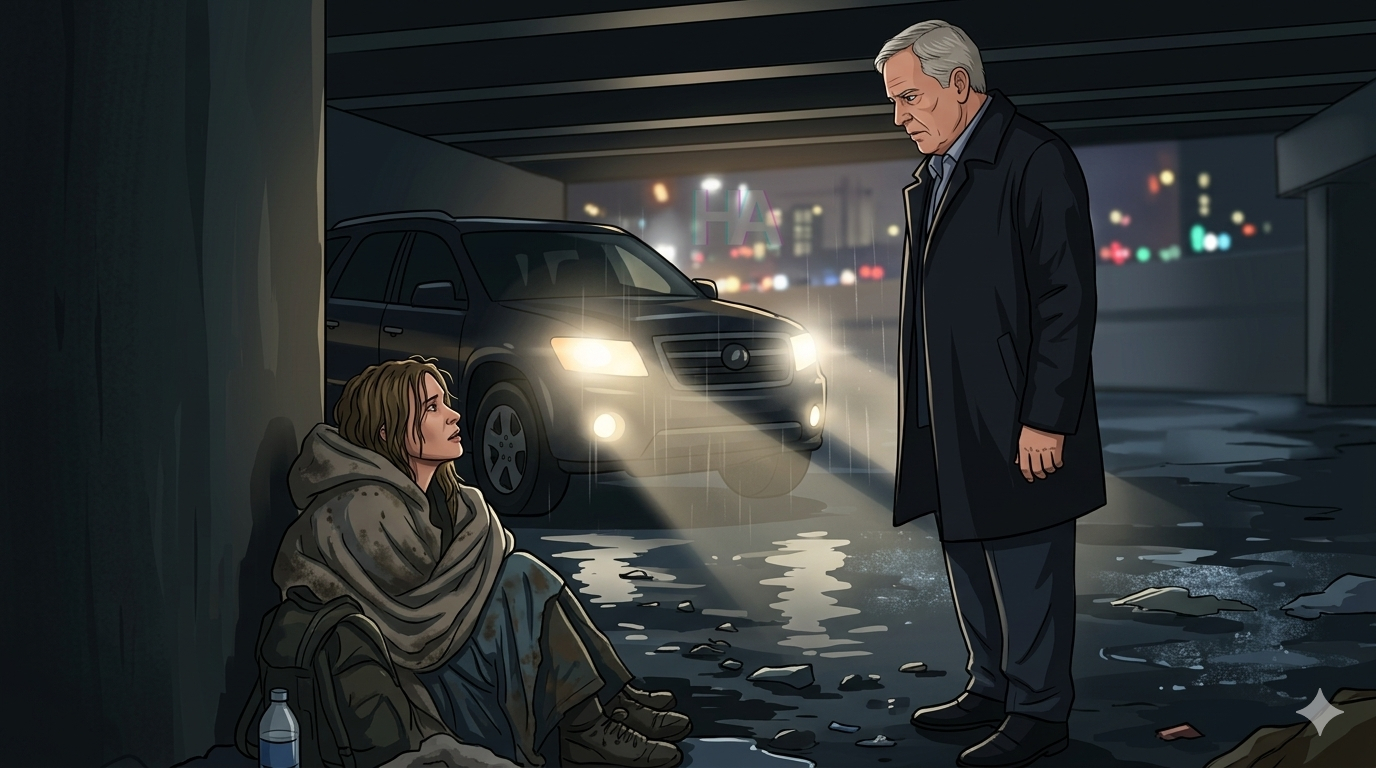
The first thing you notice is that Alejandro Valdés still smells like money.
Not the vulgar kind. Not the loud, cologne-soaked scent of men who need the world to know they own it. His scent is clean wool, leather gloves, tobacco that never touches his clothes, and the cold metallic whisper of expensive cars left idling in February air. It hits you while you stand beneath the bridge with your blanket wrapped around your shoulders, your shoes damp through the soles, your fingers cracked from the cold, and suddenly the last two years collapse inward until they feel like a bad dream that learned how to breathe.
You had once known that smell in marble foyers and candlelit dining rooms.
Now you know it while standing ankle-deep in mud.
Alejandro stares at you as if grief has come back wearing your face. For a long moment he says nothing, and in that silence you become aware of everything ugly about yourself. The dirt ground into your coat. The unwashed hair stuck to your cheeks. The raw shame of being seen by someone who once introduced you as family. You expect pity, and you hate yourself for dreading it more than cruelty.
But what appears in his eyes is not pity.
It is horror.
Not horror at you. Horror at what was done to you.
“You need to get in the car,” he says again, more quietly this time, as if the words are made of glass and might break between you. “Please.”
You almost laugh at that. Please. As though the rich ever have to beg. As though men like Alejandro Valdés know what it means to stand in front of ruin and ask instead of command. But there is something in his face, something splintered and sleepless, that keeps you from turning away.
So instead of mocking him, you ask the only thing that matters.
“Why now?”
The question lands hard. You can see it in the way his mouth tightens, in the way he looks past you toward the filthy water below the bridge, as though the river has already heard too much. His driver stays at the top of the stairs, respectful enough not to come closer, but near enough that you know none of this is accidental. Alejandro didn’t stumble across you. He hunted for you.
And somehow, against all logic, he found you.
“Because I was lied to,” he says. “Because I believed my son. Because I have spent two years living in a house built on a lie so rotten I can smell it in the walls.”
You say nothing. You don’t trust your voice.
He steps closer, lowering his tone. “And because yesterday, I learned that if I wait any longer, more people are going to die.”
The cold seems to deepen around you.
It is the kind of line that belongs in one of those glossy dramas you used to watch late at night with Camila, back when Camila was still your best friend and not the woman who climbed into your life like a smile carrying poison. But Alejandro says it with no theatrical flourish, no hunger for effect. Just a stripped, exhausted certainty that makes your stomach knot.
You swallow hard. “What are you talking about?”
He studies your face for a second, as if deciding how much truth your current life can bear. Then he says, “Get in the car. I’ll tell you everything. But not under a bridge.”
It should be easy to refuse him.
You have spent two years learning not to trust polished shoes and quiet voices. You have learned that elegant people destroy lives without ever raising their tone. You have learned that when the wealthy speak softly, it is often because they expect the world to bend closer. Alejandro is a Valdés. Rodrigo is a Valdés. The blood in their veins is the same, even if one drinks whiskey in crystal and the other drinks it from cut-glass cruelty.
But Alejandro had once been kind to you.
Not performatively kind. Not the kind of kindness that exists only when witnesses are around. He had remembered the way you took your coffee. Had asked about your mother’s treatments when she was sick. Had danced with you at your wedding when your own father was too overwhelmed to stop crying. Men like him do not survive in that world by being innocent, but that doesn’t mean they are incapable of remorse.
And right now, remorse is standing in front of you wearing a cashmere coat and asking for your help.
So you nod once.
The inside of the SUV feels obscene.
Heat spills over your skin so suddenly it stings. The leather seats are buttery soft, the cabin scented faintly with cedar and something citrus-bright, and a wool blanket appears in the driver’s hands before you can say a word. Alejandro tells him to drive, then reaches into the mini fridge, pulls out a bottle of water, and hands it to you as though you are a guest rather than a woman rescued from beneath a bridge.
You don’t drink it at first. You just hold it.
The condensation gathers against your palm, cold and real.
“I owe you an explanation,” he says.
“You owe me more than that.”
He accepts the blow without flinching. “You’re right.”
The city rolls by outside in streaks of neon and shadow. You recognize the route too late. Not toward his family mansion in Lomas. Not toward any hotel you know. The SUV glides south, away from the polished districts, deeper into a section of the city where warehouses squat behind locked gates and the sidewalks empty faster after midnight.
Alejandro notices the shift in your body.
“I’m not taking you to the house,” he says. “Rodrigo is there.”
The sound of his name slices clean through you. Even now. Even after hunger, cold, and months when your reflection looked so hollow you stopped glancing into windows. Pain doesn’t always fade. Sometimes it simply changes clothing and waits.
You stare at the city lights instead of him. “I thought you said things had changed.”
“They have.” His voice hardens. “He just doesn’t know I know.”
That gets your attention. You turn back to him and see something new in his face. Not just guilt. Calculation. A man rearranging the furniture of his soul because the house he thought he lived in has turned out to be full of hidden rooms.
“Then tell me,” you say. “All of it.”
He folds his gloved hands together, then slowly removes one glove, exposing the wedding band he still wears though his wife has been dead six years. He rubs his thumb across it once, absently, then begins.
The story starts, he says, six months after your divorce.
At first it was only numbers. Small inconsistencies. Transfers between subsidiary companies that shouldn’t have existed, shell entities buried under layers of legal names so bland they almost vanished inside the paperwork. Alejandro noticed them because he still notices everything. Men don’t build empires in real estate without learning to read numbers the way priests read confession.
Rodrigo explained it away.
Temporary holding structures. Tax exposure management. New development vehicles created for offshore investors who preferred discretion. It was the kind of language wealthy sons inherit before they inherit their fathers’ offices. Alejandro didn’t like it, but he signed off on the explanations because he was tired, because grief had made him careless, because fathers are sometimes fools precisely where they think themselves strongest.
Then a woman died in Puebla.
You blink. “What?”
Alejandro’s jaw flexes. “An architect. Young. Brilliant. She worked on several municipal housing bids tied to one of Rodrigo’s companies. She allegedly died in a car accident on a mountain road. But there were rumors. Missing hard drives. Missing permits. A partner who vanished three days later.”
The car grows very quiet.
“And that has something to do with me?” you ask.
He looks at you steadily. “Everything.”
He tells you that two weeks ago, an old accountant named Ernesto Báez came to see him in secret. Not at the office, not at the house, but in the sacristy of a small church in San Ángel where Ernesto knew cameras wouldn’t follow and security would not recognize him under a cap. The man had worked for Valdés Urban Holdings for twenty-seven years. He had seen enough to know what ordinary corruption looked like, and enough to know when something darker had moved into the books.
Ernesto was terrified.
He told Alejandro that Rodrigo had spent the last two years carving pieces out of the company like meat from a living animal. Public housing funds were being siphoned through shell firms. Unsafe materials were being used in low-income developments while premium invoices were filed. Buildings meant for working families were being erected with foundations that would not last a decade. Two inspectors had been bribed. One had disappeared.
“And Camila?” you ask, because her name is a bruise you still press when you want proof you can feel something.
Alejandro’s eyes turn to stone. “Camila helped create the companies.”
For a second, you can only hear the low hum of the tires.
It makes a horrible kind of sense. Camila had always been clever in the sleek, smiling way that never got its hands dirty in public. In college she could talk professors into deadline extensions, talk men into paying for dinners, talk women into telling her secrets they would later regret sharing. When she slipped into your life, she did it with warmth. When she slipped into your marriage, she did it with timing.
And when she replaced you, she did it wearing white at a courthouse ceremony three months after the divorce papers dried.
You close your eyes. “So why am I here?”
“Because Ernesto also told me something else,” Alejandro says. “Something Rodrigo and Camila were stupid enough to say in front of the wrong person.”
The city outside fades into industrial dark. Chain-link fences. Loading docks. Pools of sodium-orange light. You tighten the blanket around you without realizing it.
Alejandro continues. “They weren’t satisfied with pushing you out. They wanted certainty.”
Your voice comes out flat. “I know. They took the apartment. Froze the joint accounts. Rodrigo made sure I couldn’t get references in the industry. Camila told people I had become unstable.”
“That was only the beginning.”
He lets the silence stretch just long enough to become unbearable.
“Your accident,” he says at last. “The one on the highway leaving Cuernavaca. It wasn’t random.”
Every nerve in your body seems to wake at once.
You had spent two years not thinking about that night.
You had to. Because if you replayed it too often, you would stop functioning. The rain. The truck swerving. The violent spin of headlights across wet asphalt. The guardrail giving way. The world flipping, tearing, filling with shattered glass and river water. You survived because the car had lodged against the embankment instead of sinking. You survived because a farmer and his son heard metal screaming and dragged you out through a broken window. You survived with cracked ribs, a split scalp, and no purse, no phone, no papers, and by the time you woke in a provincial clinic, Rodrigo had already buried the truth.
He told everyone you had fled.
Later, when no one heard from you and the clinic records vanished after a mysterious break-in, the story changed. You had died abroad. Tragic. Complicated. Unverifiable.
You had no money to fight it. No strength. No proof. By the time you made it back to Mexico City, your name had been peeled off your old life like paint.
You stare at Alejandro. “Are you saying Rodrigo caused it?”
“I’m saying a private security contractor who now works for one of his shell firms was paid in cash two days before the crash.” Alejandro’s voice is steady, but the fury under it is volcanic. “I’m saying your route was known. I’m saying the truck was stolen and burned within forty-eight hours. I’m saying this was never divorce, Sofía. It was elimination.”
Your hands begin to shake.
You press them between your knees, but it does nothing. A sound rises in your throat, not quite a sob, not quite a laugh. Just something raw enough to remind you you are still human. For months after the accident you blamed yourself for everything. For trusting Rodrigo. For missing the clues. For thinking Camila’s distance was stress instead of betrayal. For losing your career, your home, your friends, your name.
Now the grief mutates.
Now it has teeth.
The SUV turns through an iron gate into a narrow courtyard behind what looks like an abandoned textile warehouse. Security lights snap on one by one, illuminating brick walls, steel doors, and two men you do not recognize waiting near the entrance. Neither is dressed like a bodyguard. One wears glasses and a navy coat. The other is a woman in her forties with severe bangs and a legal brief tucked under her arm like a weapon.
Alejandro notices you tense.
“They’re with me,” he says. “Lucía Mena. Criminal attorney. Tomás Gálvez. Former federal investigator.”
Former. The word is always dangerous.
Inside, the warehouse has been converted into something between a war room and a bunker. A long table sits beneath hanging lamps. Computer monitors glow along one wall. Filing boxes are stacked three high, each labeled with dates and company codes. Someone has been building a case in here, brick by brick, while the rest of the city went to dinner and slept.
And somehow, you’ve just been dragged into the center of it.
Lucía approaches first. Her gaze flicks over you with brisk intelligence, taking in the cracked lips, the soaked cuffs, the instinctive readiness to bolt. There is no pity in her either. You appreciate her immediately.
“So you’re alive,” she says.
“That seems to be the theme tonight.”
A faint smile tugs at one corner of her mouth. “Good. I prefer live witnesses.”
Tomás, taller and quieter, offers coffee instead of conversation. You take it because your hands need something to do. The mug is hot enough to sting, and the first sip nearly undoes you. Not because it’s extraordinary. Because it isn’t. Just coffee. Ordinary, bitter, real. A taste from a life where mornings still belonged to people.
Alejandro waits until you’ve sat before he speaks again.
“We have three problems,” he says. “One, Rodrigo controls enough of the board to move money and bury records within hours if he suspects exposure. Two, Camila manages the personal side of the deception. Contacts, social shields, charity events, press relationships. She launders image better than accountants launder funds. Three, there is one file we cannot access.”
Tomás slides a photograph across the table.
It shows a slim gray building in Polanco, discreet to the point of invisibility, tucked between a private clinic and an art advisory firm. No signage except a brass plaque bearing a company name you don’t recognize.
“Monte Claro Holdings,” he says. “One of the shells. The top floor has a secure archive room with restricted biometric access. According to Ernesto, that’s where the original ledgers and pay logs are stored. Enough to prove fraud, bribery, and potentially conspiracy to commit attempted murder.”
You look from the photo to him. “And let me guess. You want me to walk in there.”
Alejandro meets your eyes. “Camila doesn’t know I found you. Rodrigo believes you’re gone. We can put you near them without triggering alarms no known adversary would trip.”
For a second, the absurdity nearly overwhelms you.
You haven’t had a stable roof in months. Your bank balance is a ghost. You own one coat, a blanket, and a trauma no clinic ever properly stitched. And now these people want you to infiltrate the machine that devoured your life because your disappearance makes you the perfect weapon.
“You really are all insane,” you murmur.
Lucía leans forward. “We’re not asking you because it’s fair. We’re asking because it may be the only chance to stop them before they move everything offshore.”
Alejandro’s face softens, but only slightly. “And because you deserve the truth.”
There it is. The most dangerous bait in the world.
Not money. Not shelter. Truth.
You place the mug down carefully. “What exactly would I have to do?”
The plan is brutal in its elegance.
Camila, it turns out, is chairing a charity gala in seventy-two hours at the Museo Casa de la Bola, one of those polished society events where old money pretends to care about public virtue while new money buys legitimacy by the table. Monte Claro is sponsoring one of the silent auction wings. Several staffers, stylists, and last-minute event vendors will move in and out of its administrative suite that week carrying wardrobe racks, floral mockups, catering revisions, media packets.
Tomás has already created false credentials for a temporary events consultant named Elena Cruz.
You will be Elena.
Your job will be to gain access to the Monte Claro building during a pre-gala coordination meeting, identify the biometric archive room, and install a relay device the size of a lipstick tube beneath the scanner casing. Tomás says the relay will clone the next authorized thumbprint and unlock the door for a five-minute window later that night. He and Lucía will retrieve the files. No heroics. No detours. No improvisation.
“Why not just have one of your people do it?” you ask.
Lucía answers first. “Because Camila interviews everyone herself when she’s nervous. She likes to look into people’s faces and decide whether they belong. You, of all people, know what kind of woman she is.”
You do.
Camila never trusted résumés. She trusted chemistry. Instinct. Weakness. She liked to test where other people cracked. Back when you were friends, you used to think that made her perceptive. Later you realized it made her predatory.
“And if she recognizes me?”
Alejandro’s gaze is grim. “Then we pull you out.”
You nearly smile. “That’s not what happens when predators recognize prey.”
No one argues.
The next two days feel unreal, as though your body has been borrowed by a woman you used to be.
They take you to a private apartment above the warehouse, minimalist and anonymous, where a doctor treats the infection on your ankle and a hair stylist cuts away the worst damage without asking questions. New clothes arrive. A dark wool coat. Black trousers. Neutral heels low enough to run in. A cream blouse that makes you look polished without memorable beauty. Lucía insists on practicality. Tomás insists on exit routes. Alejandro mostly watches you like a man observing someone rebuild from ash and hating that he ever helped set the fire.
At night, sleep comes in ragged bursts.
You keep waking to fragments. Rodrigo smiling as he helped you zip your dress before a fundraiser. Camila laughing across your kitchen island while secretly reading your husband’s texts under the table. The rain-slick scream of the guardrail. Your own name spoken like a rumor. Underneath all of it, a worse memory lingers. The last thing Rodrigo said before your accident.
Drive safe.
When the morning of the meeting comes, Lucía teaches you how to lie with your breathing.
“People think deception is in the words,” she says while fastening a discreet earpiece beneath your hair. “It isn’t. It’s in the body. If your pulse panics, your face betrays you. So when Camila looks at you, don’t try to hide. Redirect. Give her a different puzzle to solve.”
“What puzzle?”
Lucía steps back and studies you. “The puzzle of whether she’s still the smartest woman in the room.”
That, strangely, helps.
By noon you are standing in the Monte Claro lobby with a tablet in one hand and a portfolio tube in the other, wearing a badge that names you Elena Cruz, Event Logistics Consultant. The building is as discreet as the photo promised. Cream stone. Private elevators. Quiet enough to hear the click of expensive shoes across the floor. Money here does not announce itself. It expects recognition.
Camila is waiting on the seventh floor.
You know it before you see her because the room changes temperature when she enters. Some people radiate warmth. Camila radiates attention. She moves through the conference suite in a pale ivory sheath dress and caramel heels, her dark hair pinned into the kind of effortless twist that takes ninety minutes to look unplanned. She is still beautiful. Not in a way that hurts you anymore. In a way that disgusts you, because beauty like hers has been used as cover for so much rot.
She glances at you once, then again.
Your blood turns to ice.
For half a second you think it’s over. That she has recognized the angle of your jaw, the shadow of your eyes, something marrow-deep no haircut or contour can disguise. But then her gaze drops to your portfolio and the floral schematics tucked under your arm, and what flickers across her face is not recognition.
It is impatience.
“You’re late,” she says.
“I’m three minutes early,” you reply, checking the tablet.
That startles her just enough to rebalance the room. Camila is used to women accommodating her. She likes pliancy in staff. A crisp correction makes you legible in a different way. Not prey. Personnel.
Her mouth hardens. “Then you can use those three minutes to tell me why the museum sent peonies after I specifically asked for ranunculus.”
Because once, years ago, she told you peonies look like overfunded funerals.
But Elena Cruz wouldn’t know that. So you let your face register faint professional annoyance and say, “Because the ranunculus order collapsed after the grower lost refrigeration, and I assumed you’d prefer a luxury substitution to dead flowers.”
Camila stares at you.
Then, to your immense relief, she smiles.
Not kindly. Never kindly. But with the predatory interest of a cat discovering the mouse has teeth. “Fine,” she says. “Come with me.”
The meeting unfolds in fragments of controlled chaos.
A catering executive drones about seating revisions. A sponsor argues over logo placement. Two junior assistants hover by a wall monitor, terrified. Through it all, Camila moves like a queen inspecting architecture she believes reflects her. You shadow her, hand her revised lists, field questions, and keep one eye on the hallway beyond the conference room where Tomás says the archive suite sits behind frosted glass at the far end…………………………………..