Chapter 1: Table Fourteen
The bridal suite at the St. Regis Hotel was a suffocatingly opulent cage of white orchids, spilled champagne, and the frantic, manicured energy of high-society expectations. I stood in the center of the room, twenty-eight years old, staring at my reflection in a floor-to-ceiling gilded mirror. My wedding dress, a custom silk and lace masterpiece that had taken six months to create, felt less like a celebration and more like a beautifully tailored straitjacket.
My fiancé, Garrett, was a man whose entire existence was predicated on the meticulous curation of “optics.” He was thirty years old, handsome, and the founder of the Hope Foundation—a non-profit that looked magnificent on glossy brochures but functionally served as a networking vehicle for the city’s elite.
His mother, Constance, was the architect of his ambition. She was a woman composed entirely of sharp angles, expensive fillers, and a terrifying, desperate need to be perceived as old money. To Constance, I was an acceptable, if slightly disappointing, acquisition. I was educated, attractive, and possessed immaculate credit, but my bloodline was fatally flawed.
My parents, Thomas and Maria, were not old money. They were not new money. They were a plumber and a public school cafeteria worker. They were the hardest working, most deeply loving people I had ever known, and their hands bore the permanent callouses of a life spent building my future.
The heavy, mahogany door of the bridal suite cracked open. My maid of honor, Sarah, slipped in, her face pale and her eyes darting nervously.
“Fawn,” Sarah whispered, closing the door and leaning against it. “I just walked through the ballroom to check the place cards. You need to see the seating chart. Now.”
I frowned, lifting the heavy skirt of my gown. “We finalized the chart on Tuesday, Sarah. Garrett’s parents and the major foundation donors are at Table One. My parents and my aunts are at Table Two, right next to the dance floor.”
Sarah shook her head, her voice tight with suppressed anger. “Not anymore.”
I pushed past her, stepping out of the suite and marching down the long, carpeted hallway toward the grand ballroom. The doors were propped open, the room a stunning, chaotic swirl of florists and caterers making final adjustments before the two hundred guests were allowed inside.
I bypassed the massive, crystal-draped head table and the sprawling, prime real estate of Table One, where the names Henderson and Porter—two of the city’s most ruthless venture capitalists—were elegantly embossed on thick cardstock.
I scanned the room for Table Two. My parents’ names were not there.
I kept walking. Past the fountain, past the bandstand, past the towering ice sculpture.
In the very back corner of the massive ballroom, shoved aggressively near the swinging double doors that led to the industrial kitchen, was Table Fourteen. It wasn’t one of the large, sturdy, round banquet tables. It was a flimsy, rectangular folding table, hurriedly draped with a slightly wrinkled tablecloth to hide its cheap legs.
It was positioned less than three feet away from a large, gray, industrial trash bin.
And resting on top of the cheap table, written on simple, unembossed paper, were the names: Thomas and Maria Evans.
A cold, heavy, and violently sharp knot of pure outrage formed in the pit of my stomach. I didn’t cry. I didn’t scream at the wedding planner. I spun on my heel, the heavy silk of my dress snapping like a whip, and marched directly toward the groomsmen’s suite.
I didn’t knock. I shoved the heavy oak door open with such force it hit the wall with a loud crack.
Garrett was standing in front of a mirror, adjusting his silver cufflinks. His three groomsmen froze, holding glasses of scotch.
“Out,” I demanded, my voice a low, lethal growl directed at the groomsmen. They didn’t argue. They scrambled past me, leaving Garrett and me alone.
“Fawn, what are you doing?” Garrett sighed, turning around with an exasperated, patronizing smile. “It’s bad luck to see the groom before the ceremony. We’ve talked about this.”
“Why are my parents sitting at a folding table next to a trash can, Garrett?” I asked, my voice trembling with a rage so profound it physically ached.
Garrett didn’t even have the decency to look ashamed. He rolled his eyes, turning back to the mirror to adjust his tie.
“Fawn, not now,” he sighed, waving his hand dismissively. “My mother rearranged the chart this morning. We had to move some things around. Mr. Henderson and his entire board of directors RSVP’d at the last minute. I am closing a massive, multi-million dollar development deal with them tonight. It is the most important night of my career. I need them at the front.”
“You put my parents by the garbage,” I repeated, my voice rising, the sheer, staggering disrespect suffocating me. “My father, a plumber, drained twelve thousand dollars from his pension—his life savings, Garrett!—to pay for the elite catering you and your mother demanded for this room. And you shoved him in the corner?”
Garrett turned to face me, his expression hardening into cold, arrogant annoyance.
“Fawn, look at them,” he said, his voice dropping into a cruel, rationalizing whisper. “Your father insisted on wearing a boxy, shiny suit from 1995. Your mother is wearing a dress that looks like she bought it for a church social. The Hendersons are billionaires. They are expecting elegance. They are expecting pedigree. It’s about the optics, Fawn. We cannot have your parents front and center looking like they just got off a shift. We have an image to maintain.”
I stared at the man I had promised to love. The handsome, charming facade melted away, revealing a weak, pathetic, status-obsessed coward.
Before I could respond, the adjoining door to the suite clicked open. Constance stepped in, wearing a severe, emerald-green gown, holding a glass of champagne. She looked at me, entirely unbothered by my obvious fury.
“Oh, Fawn, stop being so dramatic,” Constance sneered, her upper lip curling in undisguised disgust. “Garrett is right. They look poor. And frankly, your father smells like a basement. We cannot have him ruining the ambiance for the investors. They will be perfectly fine in the back. Now, go fix your makeup. You look flushed.”
As Garrett murmured his cowardly, enabling agreement, nodding along with his mother to hide my hardworking parents in the dark, they were entirely unaware that the spark in my chest had just ignited into a roaring, unquenchable inferno. The tears of hurt in my eyes instantly dried up, replaced by a freezing, razor-sharp clarity.
The weeping, accommodating bride died in that room. And the executioner was born.
Chapter 2: The Grey Rock
The spark in my chest didn’t just burn; it calcified into solid, unbreakable ice.
I didn’t scream at Constance. I didn’t throw my engagement ring at Garrett and run sobbing down the hallway in a cliché, theatrical display of brokenhearted hysterics. I utilized the “grey rock” method instantly. My face went completely, terrifyingly blank. I became as uninteresting, unreactive, and emotionally detached as a stone.
“I see,” I said softly, my voice completely devoid of any inflection.
Garrett let out a loud, relieved sigh, his posture relaxing immediately. He believed my silence was submission. He believed I had accepted my place, and my parents’ place, in his hierarchy of optics.
“Thank you, Fawn,” Garrett said, stepping forward to kiss my cheek. I turned my head just enough so his lips brushed the air. “I knew you’d understand. This deal is going to change our lives. Now, go get ready. The grand entrance is in twenty minutes.”
Constance offered a smug, victorious smirk, taking a sip of her champagne. “Good girl,” she murmured patronizingly.
I turned my back on them and walked out of the suite.
I didn’t go back to the bridal room. I didn’t fix my makeup. I stood in the long, shadowed hallway leading to the grand ballroom, listening as the two hundred high-society guests began to file in.
I could hear the clinking of expensive crystal, the low, arrogant murmur of networking, and the soft jazz playing over the massive sound system. I peeked through the cracked double doors.
The ballroom was a sea of tuxedos, diamonds, and suffocating pretension.
At Table One, sitting dead center under the largest chandelier, were the Hendersons and the Porters—the billionaire investors Garrett was so desperately trying to impress. Constance was already hovering around them, glowing with fake superiority, laughing a little too loudly at their jokes.
My eyes scanned the room, bypassing the floral arrangements and the ice sculptures, until they landed on the dark, crowded corner near the kitchen doors.
Table Fourteen.
My father, Thomas, was sitting in his slightly oversized, outdated suit. His tie was crooked. His hands, rough and permanently stained from decades of hard labor, rested on the cheap tablecloth. My mother, Maria, sat beside him in her simple, modest dress.
They weren’t angry. They were smiling gently, looking around the massive, intimidating room with wide-eyed awe, completely unaware of the horrific, degrading insult that had placed them next to the trash bin. They were just happy to be there, happy to see their daughter get married, completely oblivious to the fact that they were being treated like dirty secrets.
My heart physically ached, a sharp, violent pain of profound, protective love.
The Master of Ceremonies, a booming, professional voice, echoed through the massive speakers.
“Ladies and gentlemen, if I could direct your attention to the main doors! Please take your seats and put your hands together for the grand entrance of the happy couple, Garrett and Fawn!”
The crowd began to applaud politely, turning in their chairs. The upbeat, celebratory entrance music swelled.
Garrett wasn’t beside me. He was likely still in the hallway, waiting for his cue to walk out and link my arm.
I didn’t wait for my groom.
I reached down, grabbed handfuls of the heavy, expensive silk skirt of my gown, and hiked it up to my knees. I pushed the double doors open violently, marching directly into the grand ballroom alone.
The applause faltered slightly as I strode past the tables. I didn’t look at the confused faces of the guests. I didn’t look at Constance, whose smug smile was rapidly melting into a frown of panicked confusion.
I walked straight up the steps of the main stage, my face a mask of terrifying perfection, and marched directly up to the MC.
I didn’t ask. I snatched the microphone roughly from his hand.
A loud, piercing whine of feedback screeched through the massive speakers, causing several guests to wince and cover their ears. The upbeat entrance music was abruptly, awkwardly cut by the sound technician.
The room of two hundred high-society guests fell into a jagged, suffocating, absolute silence.
At Table One, Constance had frozen, her champagne glass suspended halfway to her mouth.
Near the main doors, Garrett had finally stepped into the ballroom. He stopped dead in his tracks. The color violently drained from his face, leaving his skin the pallor of wet ash. His eyes were wide with pure, unadulterated panic as he realized I was not following the script.
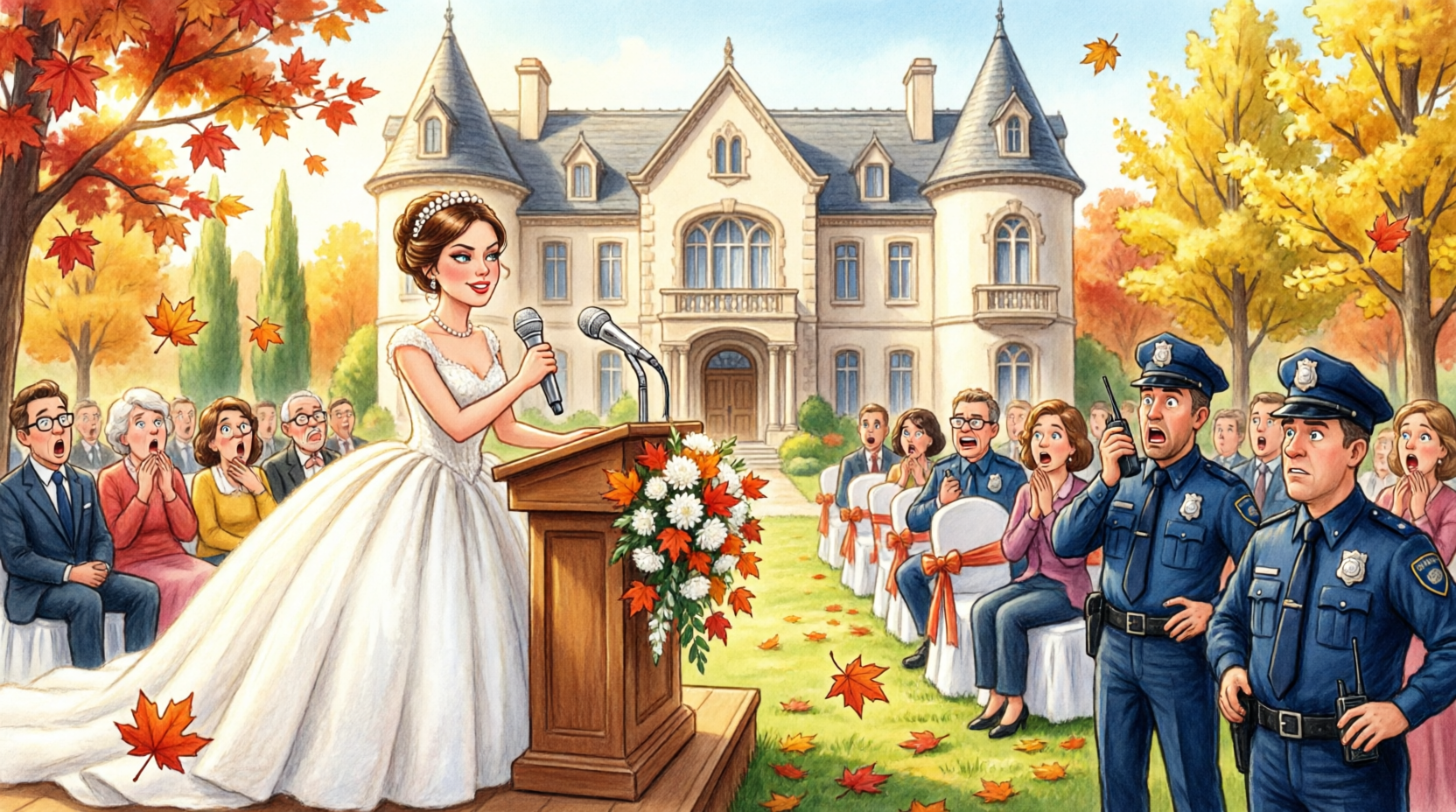
I stood center stage, bathed in the bright spotlight. I took a deep, steadying breath, looking directly into the horrified, panicked eyes of my future mother-in-law.
And I smiled. A massive, radiant, terrifying smile that didn’t reach my dead eyes.
I reached into the tight, structured bodice of my wedding dress. I pulled out a folded, crumpled piece of paper I had taken from my purse in the bridal suite—the official, itemized catering invoice.
I smoothed the paper out on the podium, ready to serve the elite guests a course of absolute, unvarnished truth that they would never, ever be able to digest.
Chapter 3: The Twelve-Thousand-Dollar Plumber
I tapped the microphone. The dull thud echoed like a heartbeat in the cavernous, silent ballroom.
“Thank you all for coming,” my voice rang out, crystal clear and terrifyingly steady.
The guests shifted uncomfortably in their seats. This was not the standard, blushing-bride welcome speech. The tension in the air was thick, heavy, and electric.
“Constance and Garrett worked so incredibly hard on the seating chart for tonight,” I continued, my voice dripping with deceptive sweetness, drawing the crowd in. “They spent weeks agonizing over the placement, ensuring that the ‘right’ people were seated at Table One. People with status. People with incredible wealth.”
I gestured gracefully toward the front of the room. Mr. Henderson, a ruthless venture capitalist, and Mr. Porter, a real estate mogul, smiled uncertainly, exchanging confused glances with their wives. Constance was staring at me, her face beginning to flush a blotchy, furious red.
“But before we begin the service,” I said, my tone hardening, the sweetness evaporating instantly into cold, absolute steel. “I want to draw your attention away from the chandeliers and the centerpieces. I want you to look at the very back of the room. Look at Table Fourteen. The flimsy folding table shoved next to the industrial kitchen doors and the trash can.”
I pointed a shaking, furious finger toward the back of the room.
Two hundred pairs of wealthy, elite eyes turned simultaneously to follow my hand.
The spotlight operator, confused but following my direction, swung the massive, bright beam of light across the room. The blinding white circle illuminated the dark corner, perfectly framing my father, Thomas, and my mother, Maria. My father squinted against the harsh light, his crooked tie and outdated suit suddenly the focal point of the entire gala. He smiled nervously, giving a small, confused wave.
“That is my father, Thomas,” I announced, my voice booming over the speakers, vibrating with a protective rage that demanded absolute silence. “Garrett and Constance decided he wasn’t elegant enough for the head table. Thirty minutes ago, they told me he had ‘grease under his fingernails’ and that he ‘smelled like a basement.’ They shoved him by the garbage because he didn’t fit their aesthetic. He was bad for their optics.”
A collective, horrified gasp rippled through the ballroom. Several women at the elite tables covered their mouths in shock. The sheer, unabashed cruelty of the statement, aired publicly in a room built on polite, fake smiles, was catastrophic.
Constance leaped from her chair, her face contorted with malice and panic. She frantically waved her arms at the sound technician in the corner, screaming silently for him to cut the microphone. The technician, wide-eyed and paralyzed by the drama, didn’t move a muscle.
“But I want everyone sitting in this room, everyone preparing to enjoy the imported caviar and the dry-aged filet mignon tonight, to know a very important fact,” I continued, raising the crumpled, folded piece of paper high in the air for all to see.
I locked eyes with Mr. Henderson and Mr. Porter at Table One.
“Those greasy hands,” I said, my voice cracking slightly with emotion before turning back to iron, “drained a twelve-thousand-dollar pension to pay for every single bite of food on your plates tonight.”
The silence in the room was absolute. It was the silence of two hundred wealthy people realizing they were the actual charities of the evening.
“My father is a plumber,” I stated proudly, fiercely. “He broke his back for forty years to save that money. He gave it to us because Garrett claimed the Hope Foundation’s funds were tied up in escrow. But that was a lie.”
I looked directly at Garrett, who was currently sprinting down the center aisle toward the stage, his face a mask of absolute, unadulterated terror.
“Garrett’s foundation isn’t tied up in escrow,” I revealed, dropping the nuclear bomb. “It is entirely, completely broke. He is broke. Constance is broke. And you are all eating on a plumber’s dime.”
The ballroom erupted.
The polite, high-society facade completely shattered. Wealthy guests began whispering furiously to each other, their comfort instantly turning to sheer, humiliated disgust. They looked at their expensive plates of food with revulsion, realizing the staggering, pathetic deceit of their hosts.
Constance collapsed back into her chair, burying her face in her hands, weeping hysterically as the elite social standing she worshipped burned to ash in real-time.
But I wasn’t finished. I watched Garrett scramble up the wooden steps of the stage, his tuxedo jacket flapping, panic sweating through his expensive shirt, completely unaware that I was about to drop a second, far more catastrophic secret that would destroy his life forever.
Chapter 4: The Annihilation
Garrett scrambled onto the stage, his dress shoes slipping on the polished wood. He looked like a frantic, terrified animal trapped in the headlights. He lunged toward me, his hands outstretched, desperate to wrestle the microphone from my grip.
“Fawn, stop! Give me the mic! You’re ruining everything!” Garrett hissed, his voice a pathetic, high-pitched whine that barely carried over the rising, chaotic murmur of the ballroom. He tried to grab my arm, attempting physical intimidation disguised as panic.
I didn’t cower. I stepped back smoothly, maintaining my grip on the microphone, my eyes blazing with a cold, untouchable fury.
“Don’t touch me,” I commanded, my voice booming over the massive speakers, amplifying his cowardice for the entire room to hear.
Garrett froze, his hands hovering in the air. He realized that any aggressive move he made was currently being broadcast to two hundred of the most powerful people in the city.
“I’m not ruining anything, Garrett,” I declared, my voice echoing off the high, chandelier-draped ceilings. “I’m saving myself.”
I turned my back on him. I walked to the very edge of the stage, looking directly down at Table One.
“Mr. Henderson. Mr. Porter,” I called out clearly, addressing the two billionaire investors by name.
Both men, who had been whispering furiously to their wives, stopped and looked up at me. Their faces were grim, their expressions tight with professional outrage. They were men who despised being lied to, and they had just been publicly informed that they were the victims of a pathetic, social-climbing con.
“I know Garrett has been aggressively courting you for a massive, multi-million dollar commercial development deal,” I stated, exposing the true reason for the lavish, expensive wedding charade. “He promised you that the Hope Foundation had the collateral to back the initial construction loans. He showed you the spreadsheets.”
Garrett let out a strangled, horrified gasp behind me. “Fawn, no! Shut up!”
“Do not sign that development deal,” I warned the investors, my voice ringing with absolute, undeniable authority. “The spreadsheets he showed you are entirely fraudulent. He inflated the foundation’s assets by three hundred percent. Garrett is effectively bankrupt. He is drowning in private debt.”
The entire ballroom gasped. This was no longer just a messy domestic dispute about seating arrangements. This was the live, public exposure of massive, catastrophic corporate fraud.
“His plan,” I continued, delivering the final, fatal, irreversible blow, “was to secretly forge my signature on the collateral loans the exact second we signed the marriage license tomorrow morning. He was going to use my immaculate credit score and my savings to secure the money he needed to con you.”
Mr. Henderson, a man whose net worth was measured in the billions, didn’t yell. He didn’t ask Garrett for an explanation. The cold, hard truth of my words resonated perfectly with the desperate, pathetic display of the groom currently sweating on the stage.
Mr. Henderson simply picked up his linen napkin, wiped his mouth with slow, deliberate disgust, and threw the napkin onto his untouched plate of expensive food. He stood up. His wife stood up immediately beside him.
Mr. Porter and his entire board of directors followed suit.
Garrett watched in absolute, paralyzing horror as the two most powerful men in the room turned their backs on him and began walking toward the exit.
“Mr. Henderson! Wait! Please, she’s lying! She’s hysterical!” Garrett screamed from the stage, his voice cracking into a wretched, pathetic sob as his entire future, his wealth, and his reputation walked out the door.
Neither investor even glanced back.
I turned to face Garrett. The arrogant, status-obsessed man who had told me my father wasn’t good enough to sit at his table was gone. In his place was a broken, weeping, publicly humiliated fraud.
I raised my left hand. With my right hand, I slowly, deliberately slid the two-carat diamond engagement ring off my finger.
I didn’t hand it to him. I held it out over the wooden stage and let it drop.
It hit the floor with a hollow, pathetic, insignificant clink.
“The wedding is cancelled,” I declared into the microphone, my voice carrying a profound, absolute finality.
I looked past the stunned crowd, my eyes searching the back of the room until I found Table Fourteen. My father was standing up, his eyes wide, his hands resting on the back of my mother’s chair. He didn’t look angry; he looked fiercely, incredibly proud.
“Dad,” I called out, a genuine, radiant smile finally breaking across my face. “Grab the centerpieces. Tell the caterers to box up our twelve thousand dollars’ worth of food. We’re going home.”
As I lowered the microphone and turned to descend the stage stairs, the crowd of stunned, wealthy guests automatically parted, creating a wide path for me. They didn’t look at me with pity. They looked at me with sheer, unadulterated awe. I walked through the sea of tuxedos and diamonds like royalty.
Behind me on the stage, Garrett fell to his knees on the hard wooden floor. He buried his face in his hands, weeping loudly, hysterically, as the catastrophic realization hit him that he hadn’t just lost a bride; he had just broadcast his financial, social, and professional suicide to the entire city.
Chapter 5: Tupperware and Truth
Six hours later, the universe had aggressively, flawlessly balanced the scales.
The contrast between the smoldering, catastrophic ruins of Garrett’s fake empire and the soaring, peaceful reality of my own life was absolute.
In the cavernous, rapidly emptying ballroom of the St. Regis Hotel, the atmosphere was a nightmare of consequences. The elite guests had fled en masse immediately after my speech, refusing to be associated with a public fraud scandal.
Constance, her emerald dress wrinkled and stained with spilled wine, was currently shrieking hysterically at the venue manager. The manager, flanked by two burly security guards, was calmly but firmly demanding immediate payment for the massive open bar tab and the remaining venue rental fees—costs Constance and Garrett had planned to cover with the cash gifts they had expected from the wealthy attendees. Gifts that had walked out the door with the guests.
Garrett wasn’t helping his mother. He was sitting alone in the dark corner of the ballroom.
He was sitting at Table Fourteen, right next to the industrial trash bin.
His head was buried in his arms, resting on the cheap, flimsy folding table. His phone, lying next to his head, was buzzing relentlessly, a ceaseless, vibrating symphony of destruction. It was flooded with text messages from minor investors, foundation board members, and social acquaintances, all rapidly, permanently severing ties and demanding immediate financial audits. He was drowning in a hell entirely of his own making.
Miles away, the atmosphere was entirely, wonderfully different.
I was sitting in the small, cozy, linoleum-floored kitchen of my parents’ modest, working-class home. The house smelled faintly of old wood, lemon pledge, and real, unconditional love.
I was no longer wearing the heavy, suffocating custom silk wedding gown. It was currently shoved unceremoniously into a black plastic garbage bag in the corner of the room, waiting to be donated or burned. I was wearing comfortable gray sweatpants and an oversized, faded college t-shirt.
I was laughing uncontrollably.
Sitting across the small kitchen table from me were my parents, Thomas and Maria. The table was covered in high-end, elite catering. But it wasn’t plated on fine china. We were eating slices of dry-aged filet mignon, truffled potatoes, and $500 Wagyu steak directly out of clear plastic Tupperware containers.
My father had actually done it. After my speech, while Garrett was weeping on stage, my dad had calmly walked into the industrial kitchen, presented the head chef with the paid invoice, and demanded they box up the food he had rightfully purchased. The kitchen staff, who had heard the entire speech over the ballroom monitors, had happily obliged, packing every single piece of unserved meat and expensive appetizer into heavy-duty containers.
“I can’t believe you actually took the centerpieces, Dad,” I gasped, wiping a tear of mirth from my eye, pointing to the massive, ridiculous arrangements of white orchids currently dominating the kitchen counters.
My father chuckled, a deep, rumbling, joyful sound. He picked up a piece of Wagyu steak with his fingers and popped it into his mouth.
“I paid for the flowers, Fawn,” he smiled, his eyes crinkling at the corners. “Your mother loves orchids. And I wasn’t about to leave a twelve-thousand-dollar meal for a man who put me next to a garbage can.”
My mother laughed, reaching across the table to squeeze my hand. “It is very good steak, honey.”
The laughter died down, replaced by a comfortable, profound silence.
My father reached across the table. He took both of my hands in his. His hands were rough. They were calloused. The faint, dark stains of grease and pipe sealant were permanently embedded in the creases of his skin, a testament to forty years of grueling, honest, exhausting labor to put food on our table and send me to college.
I didn’t see poverty in his hands. I saw the absolute, terrifyingly beautiful strength of a king who had sacrificed his body to build my future.
“I’m so proud of you, Fawn,” my father said softly, his eyes shining with bright tears. But they weren’t tears of sorrow or humiliation. They were tears of profound, overwhelming relief. “I’m so sorry you had to go through that. But I have never been more proud to be your father than I was tonight, watching you stand up there and fight for us.”
“I would burn the world down for you, Dad,” I whispered, squeezing his rough hands tightly, a fierce, radiant smile illuminating my face.
There was no tension in the small kitchen. There was no anxiety about optics, no fear of judgment, and no suffocating pretension. There was only the immense, empowering, beautiful weightlessness of absolute safety.
I let go of my father’s hands, picked up my cheap glass of domestic beer, and clinked it loudly against his bottle. I took a long, refreshing drink, completely, blissfully unbothered by the fact that my phone, resting on the counter, was buzzing with a dozen frantic, begging, pathetic voicemails from Garrett.
I didn’t answer them. I didn’t listen to them. I methodically, permanently deleted every single one without hearing a single second of his pathetic apologies, erasing his existence from my reality forever.
Chapter 6: The True Gold
One year later.
It was a bright, brilliantly warm Saturday afternoon in early September. The city streets were bustling with weekend foot traffic, the air crisp and full of life.
I was standing in the open doorway of my newly opened, incredibly successful boutique marketing firm. The space was bright, modern, and entirely my own. After the catastrophic wedding, I had refused to return the engagement ring—selling the two-carat diamond to partially refund my father’s pension and using the rest of my own savings to finally launch the business I had been putting off while managing Garrett’s fragile ego.
I was twenty-nine years old, thriving, deeply respected by my clients, and entirely unbothered.
I held a cup of coffee, watching the people walk by.
Earlier that week, a friend had forwarded me a brief, two-paragraph article from the back pages of the local business journal. It was a sterile, factual update on the spectacular implosion of the “Hope Foundation.”
Following the public exposure at the wedding, the foundation had been heavily audited by the state. The widespread financial fraud, the inflated assets, and the misappropriated funds were all laid bare. The foundation had officially filed for bankruptcy and was permanently dissolved.
Garrett, facing massive civil lawsuits from defrauded minor investors and the crippling debt of the unpaid venue bills, had narrowly avoided federal prison by pleading guilty to lesser fraud charges. He was now working a grueling, mid-level sales job at a suburban call center, his wages heavily garnished to pay restitution. He was entirely stripped of the elite, high-society status his mother had so desperately, pathetically craved. Constance, drowning in her own debt, had been forced to sell her house and move to a different state, ostracized from her country club friends.
I read the article and felt absolutely nothing. No anger. No pity. No vindictive joy. They were simply ghosts haunting a life I no longer lived.
A familiar, loud, rumbling sound broke through my thoughts.
I looked down the street. Pulling up to the curb, parking slightly crookedly in front of my boutique, was a battered, reliable, white plumbing van.
My father, Thomas, stepped out of the driver’s side. He was wearing his heavy canvas work pants and a faded blue button-down shirt with his name stitched over the pocket. He had just finished a Saturday emergency call. He looked tired, but as soon as his eyes found me standing in the doorway of my business, his face broke into a massive, radiant, joyful smile.
He walked toward me, his hands still bearing the faint, permanent stains of hard, honest work.
I didn’t hesitate. I didn’t care for a single second if the grease or dust from his work shirt ruined my pristine, expensive silk blouse.
I ran forward, throwing my arms around his neck, hugging him tightly. He smelled of pipe sealant, old coffee, and absolute safety.
“Hey, kiddo,” my dad chuckled, hugging me back fiercely. “Place looks great. You busy?”
“Never too busy for you, Dad,” I smiled, pulling back. “Come inside. I bought those pastries you like from the bakery down the street.”
As my father walked into my beautiful, successful boutique, I paused in the doorway. I looked at my reflection in the large, clean plate-glass window.
I was wearing a sharp, tailored blazer. My eyes were clear, bright, and completely fearless.
I thought back to the woman in the gilded mirror of the St. Regis bridal suite. I had once thought the heavy, expensive white silk of that wedding dress was my armor against the world. I had thought marrying into status would protect me.
I smiled softly at my reflection.
As I turned to follow my father inside, the man whose calloused, greasy hands had built the foundation of my entire life, I knew with absolute, unshakeable certainty the greatest lesson I had ever learned.
True gold isn’t found on the embossed rims of fancy menus, or in the offshore bank accounts of the elite, or in the desperate, pathetic approval of people who judge you by your zip code.
True gold is found in the unyielding, unbreakable, calloused loyalty of the people who would sacrifice absolutely everything they have, just to see you shine.