My name is Hannah Reeves. My daughter is Emma. Six months before that night, my husband, Captain Daniel Reeves, died on the other side of the world in a place whose name I still cannot say without tasting metal at the back of my throat. Since then, every ordinary thing had become split down the middle, half before and half after. Before, I had been one of those women who assumed there would always be a next Christmas, a next parent-teacher conference, a next summer, a next argument over who forgot to switch the laundry, a next chance to roll my eyes at my husband’s jokes and then laugh anyway. After, time had become stranger than grief itself. It dragged and lurched. It made simple mornings feel impossible and impossible moments feel strangely manageable, as if the worst thing having already happened left the world free to pile on absurdities because, really, what more could it do.
I had not wanted to bring Emma to the father-daughter dance.
That is the first truth.
The second truth is that she had wanted to go with the kind of quiet, stubborn hope that made saying no feel like its own form of cruelty.
The flyer had come home folded into the front pocket of her backpack three weeks earlier, bright pink paper with silver stars around the edges and the words Enchanted Evening: Oakridge Elementary Father-Daughter Dance written in curling script. I found it while sorting library notices and spelling lists at the kitchen table. Emma was in the living room coloring at the time, her legs tucked under her, her hair falling forward over one shoulder. I looked at the paper, and then I looked at her, and even before she noticed my face she seemed to know what I was holding.
She went very still.
“That’s the dance,” she said.
I tried to keep my voice neutral. “I see that.”
There was a long pause. Then, without looking up from her coloring book, she asked, “Do you think I still get to go?”
Children ask terrible questions in very small voices.
I set the flyer down and crossed the room to sit beside her on the rug. For a moment I watched her color the edge of a castle tower in purple so dark it was almost black. She had always pressed hard with crayons. Daniel used to joke that she colored like she was trying to leave evidence for archeologists.
“Do you want to go?” I asked carefully.
She nodded.
“With who?” I asked before I could stop myself, because I was not as prepared as I should have been to hear the answer.
Emma finally looked at me. Her eyes were her father’s eyes, a deep soft brown that always seemed to hold more thought than a child should have to carry. “Maybe Daddy can come,” she said. “Just for a little while.”
I had spent the previous six months learning that grief in adults is mostly private while grief in children wanders around the house asking impossible questions. They ask in the cereal aisle. They ask in the bath. They ask in the middle of brushing their teeth. They ask while tying shoes. They ask because they do not yet know that some questions are not meant to be answered; they are meant to be survived.
That morning, a week before the dance, she asked again over a bowl of cereal she barely touched. “Do you think Heaven lets people visit if it’s something important?” she said, circling her spoon through the milk. “Not forever. Just for a little while. If they really, really need to.”
I stood at the sink rinsing a mug, the water running harder than necessary. “I think,” I said after a moment, “that your daddy loves you enough to never really leave you.”
That was the sort of sentence people say when they have run out of honest ones.
Emma accepted it because she had learned, in the way grieving children do, that adults sometimes answer sideways when the truth is too sharp.
We bought the dress three days later.
It took three stores, one near-tearful meltdown in a dressing room because the first one had “too many sparkles in a mean way,” and a granola bar eaten in the parking lot of the second store while I pretended not to be fighting panic in the front seat. By the time we found the lavender dress with layers of soft tulle and a bodice that shimmered just enough under light, she had grown quiet with the fragile caution of someone who wants something badly and is trying not to show it in case it disappears. When she stepped out of the dressing room in that dress and turned once, slow as a question, I had to look down under the pretense of fixing the hem because my eyes had filled so fast it embarrassed me.
“Does it look like a real princess dress?” she asked.
“Yes,” I said.
“Even without…” She stopped.
“Even without what?”
“A dad holding my hand,” she whispered.
I sank down so we were eye level. “Especially then,” I said, though my voice almost gave out on the last word.
At home, after she fell asleep, I sat on our bed holding the dress over my lap while the lamp cast a pool of yellow light across the room. Daniel’s side of the closet was still too full. I had not touched most of it. His service uniforms were covered and zipped. His old jeans still hung exactly as he had left them. His shaving cream was still in the bathroom cabinet because every time I reached for it to throw it away, I ended up crying on the tile floor instead. I held Emma’s dress and stared at the closet and thought, I cannot take our daughter to a father-daughter dance by myself. Then I thought, but I also cannot be the reason she stops believing that love might show up where it is needed.
Daniel would have known what to do.
That was the cruel private joke of losing him. The problems that came after his death were often the very ones he would have solved best. He had a steadiness that made chaos feel temporary. When the washing machine overflowed, when the dog got skunked, when Emma spiked a fever at midnight, when I spun myself into a storm over bills or school or all the thousand tiny emergencies of modern life, Daniel always moved first and panicked second, if at all. It wasn’t that he was unemotional. Quite the opposite. He felt everything deeply. But he understood the difference between fear and action, and he had that rare ability to make both of them coexist without letting one drown the other.
The year before he died, Emma had performed in a school pageant dressed as a sunflower. She forgot her single line halfway through and just stood there on the stage, tiny and frozen under the auditorium lights. I had felt my heart lurch into my throat. Daniel, sitting beside me, just cupped his hands around his mouth and said in a stage whisper that somehow carried to the back row, “You’ve got this, Sunflower!” Half the audience laughed. Emma’s face lit up. She remembered the line. On the drive home he told her getting scared on stage just meant she cared enough to be brave.
That was Daniel. He made courage sound ordinary.
Six months after his funeral, I was trying to become fluent in a language he had once spoken for both of us.
The night of the dance, I dressed Emma in the lavender tulle while she stood on the rug in our bedroom and turned this way and that under my instructions. I curled the ends of her hair with more determination than skill, then pinned back one side with a small silver clip shaped like a star. She insisted on lip gloss because “all the other girls will probably have shiny lips,” so I let her wear the faint pink one from the grocery store checkout display that tasted like vanilla and looked harmless. When I finished, she studied herself in the mirror for a very long time.
“Do I look old enough?” she asked.
“For what?”
She pressed her lips together. “For him to recognize me if he comes.”
I knelt behind her and rested my chin lightly on her shoulder so we were looking at the same reflection. “Your father would recognize you anywhere,” I said.
This time, my voice did not crack. Perhaps because it had become the only certainty I had left.
The drive to Oakridge Elementary took twelve minutes. It felt like forty. Emma sat in the back seat with both hands folded over the skirt of her dress, careful not to wrinkle it. Every time we stopped at a light, I glanced in the mirror to check her face. She was composed in the way children sometimes are when they have decided something matters too much to risk dissolving before it happens. The gym lights were visible from the parking lot, glowing through high rectangular windows. We could hear music even before I turned off the car.
“Do you want to go in?” I asked.
She nodded immediately, which somehow hurt more than hesitation would have.
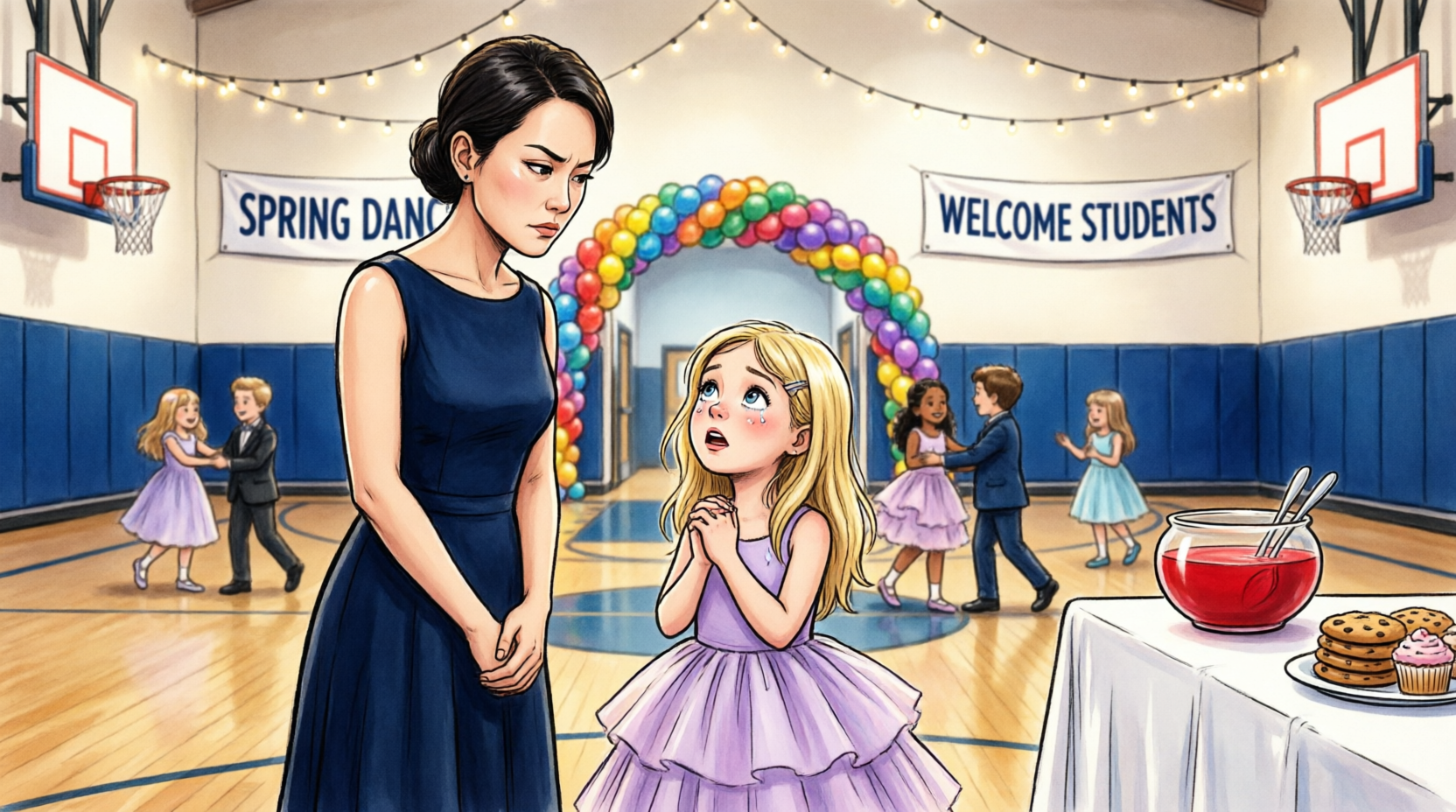
The gym had been transformed as much as a school gym can be. Crepe paper streamers hung from basketball hoops. Balloon bouquets floated from weighted ribbons tied to folding tables draped in white plastic cloths. Someone had strung fairy lights around the bleachers, and on the far side of the room a DJ booth with a rented speaker system blinked in soft blue. The floors had been polished so recently that the smell of wax still mixed with the scent of powdered punch and popcorn. Little girls in satin and tulle darted through the room like bright fish. Men in suits, polos, uniforms, and one unfortunate bolo tie moved more carefully, looking either proud or mildly bewildered depending on temperament.
And there, near the refreshment tables, was Melissa Harding.
If I had believed in omens, I would have taken one look at her and turned around.
Melissa had been PTA president for two years, which in practice meant she behaved as if she were governor of all things involving bake sales, classroom volunteers, holiday drives, and any event with a sign-up genius sheet. She was one of those women who weaponized efficiency. Her emails arrived in bullet points. Her smile rarely moved above the mouth. She wore matching sets and carried clipboards like legal warrants. Before Daniel died, I had tolerated her the way most people tolerated her: politely, from a careful distance. After Daniel died, I had noticed the quality in her I had somehow missed before—the kind of charity that likes audiences, the kind of sympathy that sounds suspiciously like management.
At the funeral reception she had clasped both my hands and said, “If there is anything at all the school community can do, we are here for you,” then later sent an email asking if Emma would still be able to participate in the class auction basket because “consistency helps children.” Two months later, she cornered me in the hallway after pickup to ask whether I had submitted Daniel’s military information to the front office because “it affects our records.” There was always something in her tone that made grief feel like paperwork.
Still, when she saw us at the dance, she made the correct face. Small smile. Sympathetic eyes. Head tilted just enough.
“Hannah,” she said. “You made it.”
The same words Emilys and Melissas of the world always use when they mean I wasn’t sure you’d have the nerve.
Emma pressed a little closer to my side.
Melissa looked down at her. “Emma, you look very pretty.”
Emma whispered, “Thank you.”
Melissa’s gaze flicked around the room, taking in the fathers and daughters and then returning to us with the quick calculation of someone already thinking in terms of optics. “Well,” she said brightly, “I’m glad you both could come.”
Both.
I should have left then. The warning was there in plain language, like a thin crack at the bottom of a glass you still drink from because you don’t want to be dramatic.
Instead, I led Emma farther into the room.
At first she stayed beside me. We stood near the bleachers and watched fathers lift daughters into spinning circles. One man in a Navy dress uniform danced so badly his daughter laughed so hard she had to cling to his shoulders to stay upright. Another bent low to let his little girl stand on his shoes while she conducted the song with one finger like a queen. Everywhere I looked, men were trying—awkwardly, beautifully, imperfectly. There is something almost unbearable about joy when the specific shape of your own loss is standing in the middle of it.
Emma’s hand in mine felt damp.
“Do you want punch?” I asked.
She shook her head.
“Do you want to dance with me?”
She hesitated. “Maybe later.”
Then, after another song, she let go of my hand.
“I’m going to stand over there,” she said, pointing toward the far corner near the stacked blue gym mats. “Just in case he comes in and can’t find me.”
I looked where she was pointing. From there she would have a clear view of the main doors.
My first instinct was no. No, because hope was about to hurt her again. No, because I wanted to pull her against me and carry her straight back to the car. No, because I was not strong enough to watch this and remain human.
But she was seven, not stupid. She knew the difference between a fantasy and a possibility. She was not waiting because she believed literally, not entirely. She was waiting because grief had taught her to look at doors.
So I crouched down, smoothed a hand over her hair, and said, “I’ll be right here.”
She nodded and walked away, the lavender layers of her dress whispering around her knees.
She stood in the corner with her hands folded over the front of her skirt and scanned the room. Every time the doors opened, her whole body changed. Her shoulders straightened. Her chin lifted. Something fragile and luminous moved through her face. Then another father would walk in, laughing into his phone, or holding a corsage box, or carrying a daughter who’d fallen asleep early, and Emma’s body would soften again, not dramatically, just a little, as if disappointment had become something she knew how to do quietly.
I stood near the wall and watched my child break in slow motion.
Time became strange. Ten minutes. Fifteen. Twenty. The DJ switched from a pop song to a country ballad and back again. People refilled cups. Mothers took photos near the balloon arch. A volunteer carried out more cookies on a tray. Somewhere in the room a little girl cried because another child stepped on her toes. Normal life kept happening around the center of my private disaster, which is one of the least discussed cruelties of grief: the world does not dim around your pain. It keeps laughing at the wrong volume.
I had just decided enough was enough. I was going to go get Emma, tell her we had given the evening a fair chance, and take her for ice cream or drive around with music on low until she fell asleep in the back seat. I was already moving when I saw Melissa Harding peel away from the refreshment table and head directly toward Emma with the kind of deliberate purpose that makes every maternal instinct go cold at once.
I started walking faster.
The crowd was thicker than it had any right to be, full of broad shoulders, swishing dresses, and people who kept stepping sideways without looking. By the time I got within earshot, Melissa was already standing in front of my daughter with one hand around a plastic cup and the other bracing the clipboard against her side.
“Oh, sweetheart,” she said, in that bright false-soft voice women like her reserve for public correction, “you look a little… out of place standing here all by yourself.”
Emma looked up at her. Even from where I was, I could see the small tension gather around her mouth. “I’m waiting,” she said. “My dad might come.”
Melissa gave a short little laugh. Not cruel in the openly theatrical way of a movie villain. Worse. Socially plausible. The kind of laugh that can always be defended later as misunderstanding.
“Oh, honey,” she said, tilting her head. “This is a father-daughter dance. It’s not really meant for… situations like yours.”
A hush passed through the nearest circle of adults. Not silence. Just the subtle dimming of attention people do when they recognize cruelty and decide, instantly, whether they have the courage to interrupt it.
No one moved.
Emma’s fingers tightened in the skirt of her dress. “But I have a dad,” she said, so softly I almost didn’t hear her. “He’s just not here.”
Melissa exhaled sharply. “Well, yes, but that’s exactly why maybe this isn’t the best place for you tonight.”
I was closer now. Close enough to see Emma’s lip begin to tremble. Close enough to see Melissa glance briefly over her shoulder, aware of the audience and using it like stage light.
“It’s just that we worked very hard to make tonight special,” Melissa continued. “And when someone stands alone like this, it changes the mood. You understand, right? It makes people… sad.”
My vision narrowed.
“But maybe he can still come,” Emma whispered. “Maybe just a little.”
Melissa’s expression pinched with impatience. “Sweetheart, sometimes clinging to things that aren’t possible only makes everyone uncomfortable. There’s no need to stay somewhere you don’t belong.”
That was the exact moment something inside me snapped.
Not cracked. Not bent. Snapped.
I pushed past a man holding a juice box, barely noticing when orange liquid splashed across my wrist. I heard myself say, “Melissa,” but it came out lower and harsher than I intended, more warning than word. Another step and I would have been beside them. Another step and I might have said something I’d been saving for women like her my entire life. Another step and perhaps all the careful, widow-appropriate composure people had admired in me for six months would have finally caught fire in a middle school gym.
Then the doors slammed open.
Not gently. Not accidentally. They hit the wall with a force that cracked through the music, and the DJ cut the track off mid-chorus in a panicked fumble that made the whole gym go still.
The sound that followed wasn’t loud exactly. It was measured. Heavy. Synchronized.
Footsteps.
Anyone can walk. This was different. Every step landed with the unmistakable rhythm of people moving in formation, even indoors, even on waxed school flooring. Heads turned. Conversations died. Somewhere a plastic cup dropped and rolled under a table.
In the doorway stood four Marines in dress blue uniforms so immaculate they seemed almost unreal under the gym lights. At the front was a taller man in full dress uniform adorned with ribbons and medals, his posture straight enough to make the room around him seem to tilt. The insignia on his shoulders caught the light in a way that made half the parents nearest the doors instinctively move aside before their minds even caught up. Four silver stars. The kind of rank most civilians only ever see in photographs or at televised ceremonies. His face was deeply lined, not with age alone but with command, and beneath that there was something grave and tender at once.
He took in the room in a single sweep. Then his gaze found Emma.
Everything about him changed.
Not softened, exactly. Focused.
The Marines behind him followed as he began walking. Not rushed. Not theatrical. Purposeful. The polished heels of their shoes clicked against the floor in perfect rhythm as they crossed the gym. The crowd split without being asked. Fathers stepped back. Children went silent. One of the volunteers near the punch table pressed a hand to her chest. Melissa turned toward the sound just as the general stopped a few feet in front of Emma.
Then, in one smooth motion, he saluted.
The Marines behind him did the same.
The room went utterly silent.
Emma stared up at him, her face drained of all expression except astonishment. Her fingers loosened from her dress. Her mouth parted slightly.
The general lowered his hand and said, in a voice that seemed to fill the whole room without rising above gentleness, “Emma Reeves?”
She blinked. “Yes.”
“I’m General Thomas Hale.”
She looked at him as if names had become strange objects. “You know my name?”
“I do,” he said. “And I knew your father.”
There are moments when the atmosphere in a room changes so completely it feels like weather. I felt it then, an invisible pressure drop, as if every adult present suddenly understood that whatever story they thought they were watching had just become something far larger than a school function.
The general glanced once toward me, just enough for me to know he knew exactly who I was, then returned his full attention to Emma.
“Your father talked about you all the time,” he said. “He used to show us your drawings. There was one of a dragon in rain boots that made its way through three separate offices because he wouldn’t stop carrying it around.”
Emma’s brows pulled together. “The green one?”
“The very one,” he said solemnly. “He told us the dragon was brave because rain boots are not regulation battle gear and it wore them anyway.”
A small, confused sound escaped her. It might have been a laugh trying to remember itself.
The general continued, “He also told us that if there was ever a dance or a recital or any big night he missed, and if somehow the universe gave us a chance, then one of us had better step in.”
My hand flew to my mouth.
Daniel had said things like that. Always half-joking, always as if death or distance were merely logistical inconveniences that could be outsmarted by loyalty and planning.
The Marines remained motionless behind General Hale, but I could see something change in their faces, tiny shifts around the eyes, as if they too were no longer in a school gym but somewhere else entirely, carrying the memory of a man I loved through their own bodies.
Melissa made a small sound then, some uncertain intake of breath that suggested she wanted to reclaim the room by speaking. General Hale did not even glance at her.
Instead he lowered himself to one knee so he and Emma were eye level.
“I heard what was said to you,” he said quietly. “And I need you to understand something very clearly. You are not out of place. Not here. Not tonight. Not anywhere.”
Emma’s lower lip trembled. She looked at him with a seriousness that seemed too old for her face. “You really knew my dad?”
“I did.”
“Was he…” She stopped and swallowed. “Did he miss me?”
The general’s jaw tightened just once before he answered. “Every day,” he said. “And he was proud of you every day too.”
Tears rose to her eyes so fast I felt my own vision blur in sympathy.
General Hale stood again, slowly. Only then did he turn toward Melissa Harding.
I have spent much of my adult life watching power move around rooms. At school meetings. At military functions. At funerals. At hospitals. Usually power is loud or petty or self-advertising. What I saw then was something else entirely. The general did not loom. He did not raise his voice. He simply faced Melissa with the full composure of a man who had spent decades making decisions under pressure and no longer needed volume to be obeyed.
“You were speaking about belonging,” he said.
Melissa clutched her cup harder. “General, I was only trying to—”
“No,” he said calmly. “You weren’t.”
The word was not loud. It didn’t need to be.
He took one step closer, not threatening, just enough to make it clear that evasion was no longer an option.
“That child’s father served this country in uniform,” he said. “He gave his life in service to people he would never meet, in communities he would never see, so that rooms like this could stay bright and safe and full of children who still believe in music and paper stars.” He paused. “And you told his daughter she didn’t belong.”
The entire gym seemed to hold its breath.
Melissa’s face flushed scarlet, then pale. “I didn’t mean—”
“To manage the atmosphere?” he supplied. “To preserve the mood?”
She said nothing.
He let the silence lengthen just enough to become unbearable.
Then he looked beyond her, out over the room, and his voice carried farther. “Community is not measured by how comfortable we are with celebration. It is measured by what we do when grief walks into the room in party shoes and tries to stand quietly in the corner.”
No one moved.
One of the fathers lowered his eyes. A woman near the raffle table began to cry silently into a cocktail napkin. The DJ stood frozen over his laptop, as if afraid any sound he produced might break something sacred.
General Hale turned back to Emma and extended his hand.
“Your father can’t be here in the way we all wish he could,” he said. “But you are not alone tonight.”
Behind him, the Marines stepped forward in a line so smooth it barely looked like movement. Not surrounding. Not crowding. Forming, instead, a kind of human honor guard at the edge of the dance floor.
The general glanced toward the DJ. “Music, please.”
The DJ jumped like he’d been shocked and then fumbled frantically through a playlist before a slow instrumental version of “What a Wonderful World” drifted through the speakers, tinny at first, then fuller once he corrected the volume.
General Hale looked back at Emma. “May I have this dance?”
For one heartbeat she didn’t move.
Then she placed her hand in his.
He led her to the center of the floor with the careful dignity of a man escorting something far more fragile than a little girl in a lavender dress. She stepped onto the tops of his polished shoes instinctively, just as the other girls had done with their fathers all evening, and laid one small hand against the dark blue of his coat. He bowed his head slightly toward her. The room seemed to tilt around them.
Then the Marines behind them began clapping softly in time with the music.
One by one, other fathers joined in. Then mothers. The sound built, not loud enough to overwhelm, but steady enough to become a pulse. I stood at the edge of the floor with my hand still over my mouth and watched my daughter smile for the first time that night.
It wasn’t a tiny smile. It was startled, radiant, helpless as sunrise.
Halfway through the song, another Marine stepped forward from the line and approached a little girl at the edge of the room whose father, I suddenly realized, was deployed because she wore a yellow ribbon bracelet I had seen around school. He bent, asked her something, and when she nodded, led her onto the floor too. Then another fatherless girl joined. Then another. Within minutes the center of the gym had become something none of us had expected: not a rescue of only my daughter, but an expansion of the room to include every child who had come there carrying absence.
A man in a fire department dress uniform took the hand of a girl whose mother whispered that her father had died the year before. One of the teachers stepped in with a niece. A grandfather rose from the bleachers, slower than the rest, and asked his granddaughter if she’d like another turn. What had been an event defined by one category—father and daughter—became, under the pressure of real tenderness, something wider and truer: a room where no child stood alone if an adult had any decency left.
Melissa slipped away at some point. I didn’t see her leave. I doubt anyone cared enough to track it.
I could not stop watching Emma.
Her head tipped back when the general said something that made her laugh. He moved carefully, letting her guide the tiny awkward circles because children do not so much dance as announce joy with their feet. Every now and then she looked up at him with that searching expression grieving children wear when they are listening for echoes, and each time he answered with the kind of attention that says I know exactly whose daughter you are and I am going to treat that fact like an honor.
The song ended. The clapping continued. Then another slow song started. Emma did not leave the floor. The general leaned down and said something to her; she nodded gravely. Then he led her toward me.
When they reached the edge of the floor, Emma came straight into my arms so hard I had to take two steps back to steady us both. She smelled like vanilla lip gloss, clean hair, and the faint starch of her dress.
“Mommy,” she whispered into my neck, breathless and crying and laughing all at once, “he knew about the dragon boots.”
I pressed my face into her hair and closed my eyes. “I know, baby.”
When I looked up, General Hale was standing there with his cap tucked beneath one arm. Up close, I could see that his face was more tired than commanding. There was no self-importance in him. Only a profound kind of gentleness sharpened by discipline.
“Mrs. Reeves,” he said.
I almost said you knew him, too, as if that were the only fact that mattered, but all that came out was, “Thank you.”
He inclined his head. “Your husband was one of the finest officers I ever served with.”
The sentence nearly knocked the breath out of me.
Most of the condolences in the months after Daniel died had blurred together into a soft, useless fabric of phrases: he made the ultimate sacrifice, he was a hero, he loved his family. All true. All somehow insufficient. But one of the finest officers I ever served with—that was specific. It belonged to a real man, not a memorial poster.
“He talked about Emma constantly,” the general continued. “And about you. He once missed an event because he was on a communication detail with me in Germany. He complained about it so thoroughly for two straight days that by the end of the trip the entire team knew the color of the dress she’d worn and what flavor cake had been served.”
Despite everything, I laughed. Daniel would absolutely have done that. He had never believed in keeping home and duty separate; he carried us into every room he entered, confident the world should want to hear about us.
“How…” I began, then stopped because the whole evening still felt impossible. “How are you here?”
General Hale glanced briefly toward one of the Marines, a broad-shouldered man with a scar along his jaw who stood respectfully back. “Sergeant Moreno reached out to a family liaison after hearing from Emma’s teacher that there was a father-daughter dance and some concern about whether she’d attend. By chance, I was at the base ninety minutes away for an inspection. When he told me the date, I knew Daniel had mentioned it once. It seemed unwise to ignore that.”
I looked at the sergeant, who gave me the smallest nod, almost embarrassed by being noticed.
Emma tugged on my sleeve. “Can he stay for cake?”
The general looked so taken aback by the question that for the first time his command presence cracked into something almost boyish. “I can stay for one piece,” he said solemnly. “If invited.”
“You’re invited,” she said at once.
So he stayed.
The rest of the night moved in a haze of soft astonishment. The Marines did not dominate the room; they diffused it. The hard edges around other people’s discomfort began to dissolve. Fathers who had stood awkwardly near the bleachers loosened. Mothers came over to introduce themselves properly, as if embarrassed by their earlier silence. A teacher whose husband was deployed asked if one of the Marines would dance with her daughter. He did. The DJ, perhaps relieved to discover he was not actually presiding over the collapse of civilization, started choosing better songs. Someone refilled Emma’s cup twice. An older janitor named Mr. Jenkins, who had known Daniel from school pickup years earlier, came over with a napkin-wrapped brownie and slipped it into Emma’s hand like contraband.
I watched my daughter dance with a four-star general, eat cake beside Marines in dress blues, and laugh with a fullness I had not heard since before the funeral. The sound of it was almost painful at first. Like hearing birdsong after months underground.
At one point, while Emma sat between two Marines asking whether medals were heavy and whether tanks counted as cars, General Hale stood beside me near the bleachers.
“I’m sorry we’re meeting under these circumstances,” he said quietly.
“So am I,” I admitted.
He folded his hands behind his back and looked across the room at Emma. “Daniel was unusual,” he said. “In command environments you meet a lot of talented men. Competent men. Ambitious men. Your husband was competent, yes, but what set him apart was his orientation toward other people. Even at his busiest, he seemed fundamentally unavailable to cynicism.”
The description was so exact it hurt.
“That sounds like him.”
“He made a point of showing us her drawings,” the general said, almost smiling. “Once, during a planning review, he passed around a crayon portrait labeled Daddy Fighting Bad Guys But Also Smiling. I still remember that because he said, with perfect seriousness, that the smile was operationally significant.”
I laughed, then covered my mouth because the sound came out dangerously close to a sob.
“He could be impossible,” the general added. “He once told a colonel that if the briefing ran ten more minutes, he’d miss FaceTiming his daughter and become insubordinate out of principle.”
“That also sounds like him.”
General Hale was quiet for a moment. Then he said, “He saved lives on the day he died.”
I looked at him sharply. The official account I had been given was clean and abstract, full of phrases like hostile engagement and tactical response and casualty evacuation. Necessary language. Dehumanizing language. I knew the broad shape, but not the texture. Most people, seeing widowhood in my face, assumed I did not want more details. The truth was I wanted only the details that belonged to Daniel as a man, not as a line in a report.
The general did not make me ask.
“He exposed himself to draw fire away from a damaged vehicle,” he said. “There were younger Marines pinned. He knew exactly what he was doing. He moved before anyone gave the order.” The general’s voice remained level, but the memory was alive inside it. “Men are alive because he refused to hesitate.”
I gripped the edge of the bleachers until the metal dug into my palm. “Did he suffer?”
The question came out small. I hated how small.
General Hale answered without flinching. “No.”
I do not know if he told me the whole truth. I do know he told me the kindest truth he could carry honestly. That matters.
“Thank you,” I whispered.
He inclined his head once, and for the first time all evening I let myself believe the room was holding more than spectacle. It was holding witness.
The dance ended later than scheduled because no one seemed willing to be the first person to restore ordinary time. Eventually the music softened, the lights brightened, and volunteers started gathering centerpieces and stacking cups. Children wilted in stages, heels kicked off, hair slipping loose, sugar and emotion combining into exhaustion. Emma, who had refused to sit down for the final hour, suddenly leaned against my side with the boneless heaviness of a child on the edge of sleep.
General Hale and the Marines walked us to the parking lot.
Outside, the air was cold enough to shock after the overheated gym. The stars above the school were faint, half-drowned by the parking lot lights. Emma had one hand in mine and the other wrapped around a napkin with two untouched cookies she insisted on saving “for later or maybe for angels if they eat sugar.” The Marines halted near my car with the same unconscious precision they had carried all evening, then relaxed slightly when the general turned to Emma.
He reached into the inner pocket of his coat and drew out a small coin.
It was heavier than it looked, gold-toned in the parking lot light, stamped with insignia on both sides.
“This is a challenge coin,” he said, placing it in her palm. “Your father had one from our unit. I thought you should have this.”
Emma stared down at it with reverence. “For me?”
“For you,” he said. “And because sometimes a person needs something in her pocket that reminds her who she belongs to.”
She closed her fingers around it. “If someone says I don’t belong again, I can show them this?”
The general’s mouth softened. “You can. Or you can just remember this night and know you never had to prove it in the first place.”
She nodded solemnly, accepting the responsibility of memory as if it were a real object.
Then, to my absolute astonishment, she threw her arms around his waist.
For one tiny startled second, General Thomas Hale, four-star officer, seemed unsure what to do with a small girl’s full-speed gratitude. Then he put one hand lightly on her back and closed his eyes.
When she let go, Sergeant Moreno stepped forward and saluted her again, less formal this time, almost playful. One by one, the others did too. Emma returned the salute with crooked seriousness, which made every grown man standing there look suddenly close to smiling and crying at once.
As we drove home, she fell asleep in the back seat before we reached the first stoplight, her cheek pressed to the side of the car seat, the challenge coin clutched tight in her hand. I kept glancing at her in the rearview mirror, afraid the whole night might somehow evaporate if I stopped looking.
When I carried her inside, she stirred just enough to murmur, “Daddy sent friends,” and then slipped back under.
I stood in her doorway long after tucking her in, the hallway light laying a pale strip across her blanket, and listened to her breathe. The coin was still in her fist. I kissed her forehead, whispered goodnight to the room at large because there was no one else to say it to, and went into my bedroom where Daniel’s closet still waited in its half-preserved silence.
For the first time in months, I pulled out one of his uniform jackets and sat with it across my lap.
I didn’t cry immediately.
I ran my fingers over the fabric, the buttons, the places where his body had shaped the seams. I thought about him telling stories in some operations office about Emma’s dragon in rain boots. I thought about him being irritated on principle over a missed FaceTime. I thought about him saying, somewhere in his vast impossible confidence, that if he ever couldn’t be at a dance somebody had better step in.
And they had.
Not because magic was real. Not because grief had been outsmarted. Not because absence could be filled. It couldn’t. Daniel was still dead. My bed was still too large. Emma would still wake up someday and remember with fresh pain that the man who called her Peanut and put jellybeans in his uniform pockets for emergencies was never going to stand at the kitchen counter again.
But something had shifted.
Grief had made room, just for one night, for a different weight.
The next morning Emma woke up before me for the first time in weeks. I found her at the kitchen table in pajamas, drawing with the challenge coin beside her like a paperweight. She had drawn a little girl in a purple dress standing between four very tall stick figures in blue uniforms. Above them was a man with wings I suspected were mostly symbolic and hair that looked suspiciously like Daniel’s.
“Who’s that?” I asked, pointing to the tall figure in the sky.
She looked up as if the answer were obvious. “Daddy watching to make sure they did it right.”
I sat down across from her and laughed softly. “And did they?”
She nodded with total certainty. “Yes. But he still has to come next time.”
It was the kind of answer only children and the deeply faithful can give.
School on Monday was an entirely different place.
Not because buildings change over weekends. Because stories do. Apparently by Saturday morning, photographs of General Hale dancing with Emma had traveled through group texts, veteran family networks, and every parent phone chain in Oakridge. Someone had sent a clip to the local news. The school principal called me before eight to ask if Emma would be all right coming in and whether we needed “support.” I almost said no out of reflex because support is often the word institutions use before returning to business as usual. But then he added, in a voice that sounded genuinely humbled, “Mrs. Reeves, we failed your daughter Friday night. I need you to know we understand that.”
That was different.
When Emma and I arrived at school, Mrs. Alvarez, her second-grade teacher, met us at the front entrance. She was a small woman with silver-threaded dark hair and the kind of deeply practical kindness that always made me think of the women who survive wars and still remember your child’s allergy. She knelt immediately to Emma’s level.
“You looked very beautiful at the dance,” she said. “And very brave.”
Emma held up the coin. “This is from a general.”
Mrs. Alvarez, without missing a beat, touched two fingers to her heart and said, “Then I think that coin has excellent taste in owners.”
Emma smiled and went inside carrying the coin in both hands.
I stayed in the hallway with Mrs. Alvarez. “You knew?” I asked quietly.
She nodded. “I contacted someone at the family readiness office after Emma told me she hoped her daddy might still come. I only meant to ask whether anyone from his old unit might send a note or maybe a small token for the dance. I never imagined…” She shook her head, eyes shining. “I never imagined General Hale himself would come.”
“Thank you,” I said.
She squeezed my hand. “No one should have let that child stand alone.”
The school board moved faster than I expected once the story escaped their control. Melissa Harding sent me an email by noon. Subject line: Clarification and Regret. The body was exactly what such emails always are—careful, bloodless, full of phrases like unintended harm and emotionally charged atmosphere. There was no direct acknowledgment of the sentence she had used or the contempt underneath it. She apologized for my daughter’s feelings. She apologized for the misunderstanding created by “the moment.” She did not apologize for what she had believed.
I did not answer.
By Wednesday, the PTA announced Melissa had stepped down “to focus on personal matters.” No one asked my opinion. No one needed it. I had no appetite for vengeance by then, only distance. The dance had exposed something larger than one woman’s malice. It had exposed the whole room’s willingness to let cruelty masquerade as order until someone with enough stars on his shoulders made silence impossible. That knowledge stayed with me in more complicated ways than Melissa’s departure ever could.
General Hale wrote two weeks later.
The envelope bore official military markings so formal I almost left it unopened on the counter for an hour out of sheer intimidation. Inside was a handwritten letter on cream stationery and a photograph. In the photo, Daniel stood in desert camouflage between two other Marines, one arm thrown around Sergeant Moreno’s shoulders, grinning into the sun with a ridiculous amount of dust on his boots and one sleeve rolled higher than regulations allowed. He looked alive in the infuriating, casual way old photographs do—not monumental, not tragic, just Daniel, halfway through saying something funny.
The letter was brief.
Mrs. Reeves, it began, your husband once told me that when people speak of service, they often speak too abstractly, as if duty belongs to flags more than to kitchens, school pickups, homework tables, and the hands that braid hair before dances. He believed the true measure of service was whether the people you loved felt protected in your absence. He did not fail in that. I enclose a photograph I thought Emma might want someday, and one for you if you choose. Respectfully, Thomas Hale.
I sat at the kitchen table with the letter in my hand and cried for a very long time.
Not because it made the loss newly real. Because it made Daniel newly particular. And particular is the thing grief hungers for most. Not hero, not sacrifice, not fallen. The rolled sleeve. The joke. The dragon drawing in the office. The man.
I gave the photograph to Emma in a frame shaped like a star.
She put it on her bedside table and moved it twice before deciding the angle had to be “just right so Daddy can see the window.”
For a while after the dance, she carried the challenge coin everywhere. In her backpack. In the cup holder on the drive to school. In the pocket of her coat. Once I found it under her pillow and asked why it was there. She shrugged and said, “Maybe I sleep better when it knows where I am.”
So did I, if I’m honest.
Spring came slowly that year, as if even the weather wasn’t sure how to reenter a world that had shifted so much. Emma lost two teeth and developed an obsession with cartwheels. I learned how to sign the endless forms for military survivor benefits without crying in public. The grass returned. People began speaking to me less as a spectacle and more as a person again, which was a relief so enormous it almost felt insulting. Grief turns you into a category for strangers. I was grateful every time someone forgot to treat me that way.
General Hale remained unexpectedly present, but only in the exact proportions kindness requires. He did not intrude. He sent one short birthday card to Emma with a pressed flower tucked inside and the message, Your father told me you prefer purple to pink and dragons to unicorns. Please continue being correct. Sergeant Moreno came by once in summer on his way through town and brought Emma a patch from Daniel’s old unit and a story about how her father once spent an hour trying to fix a coffee maker in a tent because “good morale begins with functional caffeine.” Emma laughed so hard at that she hiccuped. I wrote thank-you notes that felt inadequate and mailed them anyway.
At school, something had changed as well, though less dramatically. Mrs. Alvarez organized a spring event and called it Family Night instead of anything more specific. No one made a speech about inclusion. No one needed to. Sometimes institutions learn only after public humiliation, but now and then learning still counts. When the flyer came home, Emma ran it to me and said, “See? They fixed it.”
I looked down at the paper and then at her face—so earnest, so willing to believe correction mattered—and I said, “Yes. They did.”
We went.
This time she did cartwheels in the grass behind the school while I sat in a lawn chair eating a hotdog and talking to another mother whose wife was deployed overseas. That mother wore no pity on her face, only fatigue and humor. We traded stories about late-night tears and school projects and the surreal bureaucracy of raising children while carrying absence around like a second spine. Emma ran up twice to show me she could now do a handstand for almost three seconds. When she grew tired, she leaned against my leg without embarrassment.
Healing, I discovered, does not arrive as a grand conclusion. It arrives in these tiny returns to ordinary life, each one less haunted than the last.
Still, the father-daughter dance remained a landmark in our house, referenced in small unexpected ways. When Emma got nervous before a music performance, she slipped the challenge coin into the pocket of her cardigan. When a boy in her class told her girls couldn’t like bugs and outer space both, she informed him that a general once told her she never had to prove where she belonged, and he had been silent for the rest of recess. On hard nights, when she missed Daniel with the wild animal ache children carry so openly, she would sometimes ask me to retell the story of the doors opening. Not the sad part. The steps. The salute. The dance. She wanted it exactly right each time.
“Did the doors really bang that loud?” she’d ask.
“They did.”
“And everyone really stopped?”
“They really did.”
“And he knew about the green dragon boots?”
“He absolutely did.”
Each retelling sanded down the sharpest edges of the original hurt and made room for something else to grow in its place. Not replacement. Nothing replaces the missing. But an overlay. A memory wrapped around another memory until the part that once burned began to hold.
One year after the dance, Oakridge Elementary invited Emma to help open the new spring social. It was not a father-daughter event anymore. It was simply called The Oakridge Family Celebration, which sounded bland enough to be bureaucratic but honest enough not to wound. The principal asked if Emma would cut the ribbon because, in his words, “some children teach communities how to do better.” I thought the phrasing was a little theatrical, but Emma loved the idea of giant scissors.
On the afternoon of the event, she wore a pale blue dress and the challenge coin on a ribbon tucked inside her bodice because by then she had decided it was “formal courage.” While I helped pin her hair, she looked at me in the mirror and asked, “Do you think Daddy knows they changed it?”
I paused, comb in hand.
“Yes,” I said. “I think he knows.”
She seemed satisfied by that.
The celebration itself was simpler than the dance had been. Tables on the playground. Music from a rented speaker. Parents, grandparents, siblings, foster parents, neighbors, two uncles, one nanny who had clearly earned sainthood, and every configuration of love that real life produces no matter how many forms try to reduce it. When Emma cut the ribbon, the applause startled birds out of the oak tree by the fence. She looked around, startled and pleased, and for one instant I saw Daniel in her so clearly it nearly folded me in half.
Afterward, while children ran sticky and shrieking between tables, I noticed a black sedan parked near the curb. General Hale stepped out, not in full dress uniform this time but in a dark suit with a Marine pin on the lapel. He hadn’t told us he was coming. He stood back at first, hands in his pockets, as if giving the moment room to belong to Emma and the school. Then she saw him and tore across the grass with both arms flung wide.
“General Hale!”
Every adult nearby turned, first in surprise and then in recognition. He bent to catch her easily. When he looked up at me over her shoulder, the smile on his face was smaller than people expect from powerful men and somehow all the more trustworthy for it.
“I was nearby,” he said later, which I suspected was only technically true.
Emma dragged him to the lemonade table and introduced him to every child within range as if he were a beloved but slightly formal uncle. I stood there watching and thought about how strange healing is. How it can braid grief and gratitude together so tightly you stop trying to separate them.
That night, after Emma fell asleep, I sat alone on the back steps of our little house with a cup of tea gone cool in my hands and listened to spring insects begin their work in the yard. The sky above the trees was a deep exhausted blue. In the quiet, I thought of the first months after Daniel died, when I believed grief would either destroy us or calcify us into smaller, meaner versions of ourselves. I had not understood then that grief can also enlarge. Not by mercy of its own, but through the people who decide, deliberately, not to leave you alone inside it.
Melissa Harding had mocked my daughter because Emma’s grief disrupted the clean shape of a theme. General Hale had crossed an entire world to remind her, and all of us, that belonging is not granted by those who manage the decorations. It is revealed in the moment someone vulnerable is standing in the corner looking at the door, and the rest of the room has to decide whether to let her stand there alone.
I wish I could say everyone learned the right lesson immediately and forever. That would make for a better ending and a less human one. The truth is people still fail each other every day in small, tidy ways. People stay silent. People choose comfort. People confuse order with goodness and appearances with care. But I also know this now: sometimes all it takes is one person willing to walk straight through the middle of that silence and refuse its terms. One person willing to say, in whatever uniform or ordinary clothes they happen to wear, not this child, not tonight.
There are still evenings when Emma asks if Heaven allows visits.
There are still mornings when I reach across the bed before I remember.
There are still forms to fill out, anniversaries to survive, songs to turn off halfway through because they belong too specifically to what we lost.
But when those nights come, and they do, Emma takes out the challenge coin and rolls it between her palms. Sometimes she puts it on the table beside her homework. Sometimes she tucks it under her pillow. Sometimes she asks me to tell the story again.
And every time, the part that matters most is not the insult, though that is where it began. It is the sound of the doors opening. The measured footsteps. The salute. The voice saying her name like it had always deserved ceremony. The hand extended. The dance.
Because grief doesn’t disappear.
It changes shape.
And on the worst night we thought we could survive, it made room for something else entirely.
Not forgetting.
Not replacement.
Belonging.