What was strange about that day wasn’t the silence.
It was the whisper.
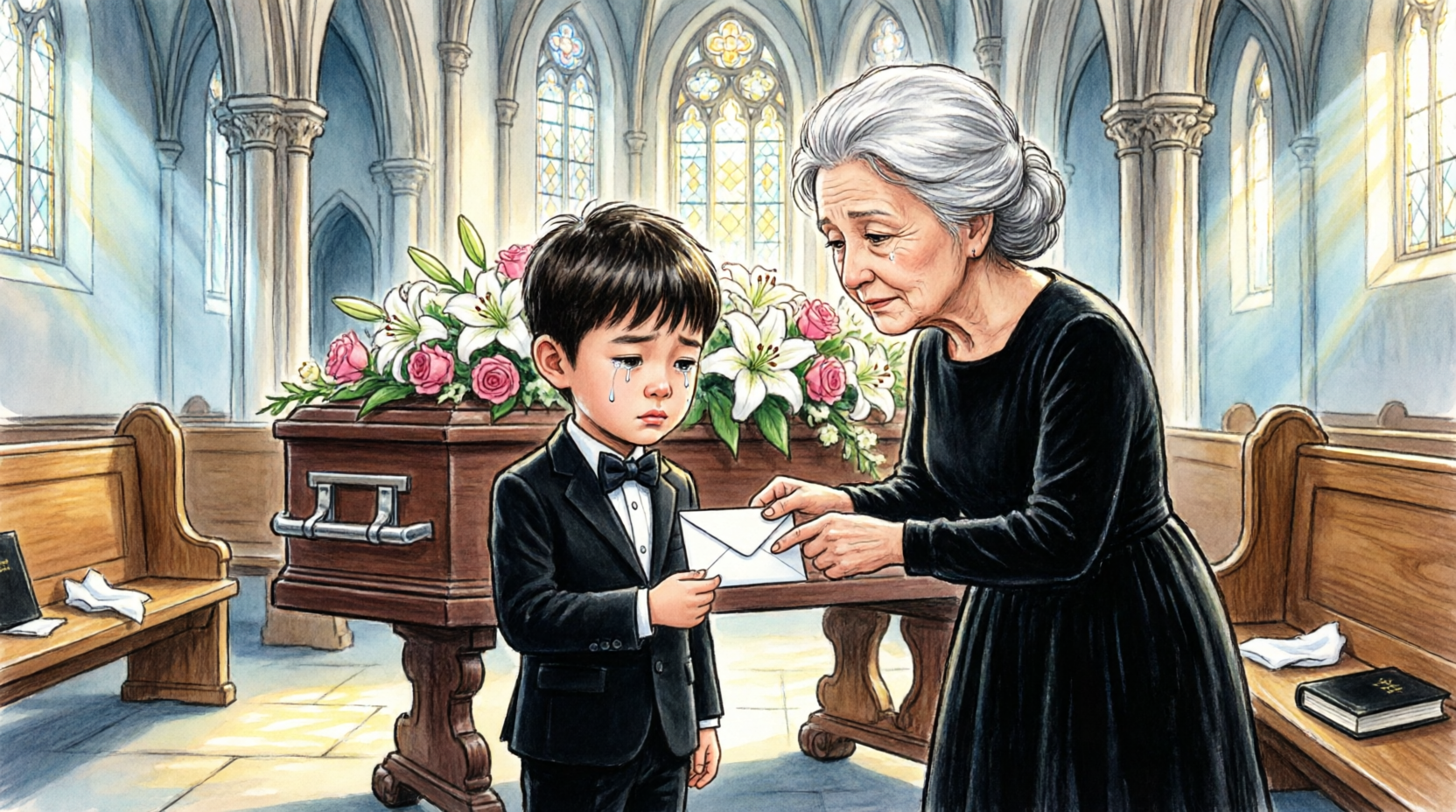
I stood beside the casket of my husband, Robert Hayes, trying to breathe through a grief so heavy it hollowed out my chest, when my eleven-year-old grandson, Ethan, approached me quietly. He didn’t meet my eyes. He just pressed a folded piece of paper into my hand and murmured so softly it almost disappeared beneath the scent of lilies and polished wood:
“Grandpa told me to give you this… if he didn’t wake up.”
A chill ran through me.
I slipped the note into my purse before anyone could notice, but curiosity won within seconds. My fingers trembled as I unfolded it, shielding it beneath the brim of my black coat.
The first line stole the air from my lungs:
Grandma, don’t trust my dad.
For a moment, I thought grief was playing tricks on me.
My son—Michael. My own child.
I looked up just as he approached, his expression perfectly composed. He had always known how to wear emotions like tailored suits—putting them on or taking them off depending on the occasion.
“Mom,” he said gently, resting a hand on my arm, “you should sit down. You’ve been standing too long.”
I nodded—not because he asked, but because my knees were giving out. Forty-two years with Robert couldn’t be buried in a single morning without something inside breaking. He guided me to the front pew, and I sat slowly, the note burning inside my purse like a live ember.
Don’t trust my dad.
The service continued, but I barely heard a word. The pastor spoke about Robert’s generosity, about the construction company he built from an old pickup truck and two borrowed workers, about his love for family.
But my attention had shifted.
Michael checked his watch too often.
My daughter, Lily, sitting beside me, wasn’t crying. Her eyes were dry, her jaw tight. Her husband, Brian, kept glancing toward the back of the room as if waiting for something. And Michael’s wife, Rebecca, exchanged quick, uneasy looks with them—nothing like grief. More like calculations disguised as sorrow.
I tried to convince myself it was just the pain distorting my thoughts.
But then I remembered something else.
Two nights before he died, Robert had tried to tell me something in the kitchen. It was nearly midnight. He held a cup of coffee, his eyes more tired than usual.
“Margaret,” he said, “if anything ever happens to me, promise me you won’t sign anything without showing it to David Klein.”
“Sign what?” I asked, forcing a nervous laugh. “Don’t talk like that.”
He opened his mouth to explain—
—but Michael walked in, and the moment died right there.
At the time, I dismissed it.
At the funeral, with the note hidden in my purse, I realized Robert hadn’t been speaking lightly.
After the burial, as the cold October wind cut through us at the cemetery, Michael stayed close to me like a shadow.
“Mom, you should come stay with us tonight,” he insisted. “You shouldn’t be alone.”
Lily quickly added, “Yes, Mom. We already set up the guest room.”
That made me pause.
“You already set it up?”
She blinked. “Well… just in case.”
I said nothing. I simply tightened my grip on my purse.
There was another line in Robert’s note:
Don’t go with them. Call David Klein.
David—my husband’s attorney. His closest friend for decades. I hadn’t spoken to him privately in a long time. Michael had gradually taken over the business, the meetings, the contracts—everything Robert and David once handled together.
At the reception, I found a moment alone. I borrowed a neighbor’s phone and called his office.
When I heard David’s voice, my throat tightened.
“It’s Margaret,” I said. “Robert left me a message. He told me to call you.”
There was a long silence on the other end.
“So he managed to do it,” David finally said.
My heart pounded.
“Do what?”
“Prepare a backup,” he replied calmly. “Margaret, listen to me carefully. Robert came to see me three days before he died. He was worried—far more than he let on.”
I glanced across the room. Michael was scanning the crowd, looking for me.
“Worried about what?”
“Documents,” David said. “And the possibility that someone might pressure you to sign them after he was gone.”
The ground felt unsteady beneath me.
“Michael?”
“I won’t name names over the phone,” he said. “But don’t sign anything. Not today. And don’t go home with him. I need to see you tonight.”
We met at a quiet diner on the edge of town. David was already waiting, his expression heavier than I had ever seen.
He didn’t waste time.
“Your husband didn’t leave everything to Michael,” he said.
I stared at him.
“What?”
“Four years ago, Robert transferred majority ownership of Hayes Construction into a family trust,” he explained. “You’re the primary beneficiary.”
“I signed something…” I whispered. “He said it was for tax purposes.”
“It was,” David said. “But it was also protection.”
Then he showed me the document Michael wanted me to sign.
It looked temporary.
It wasn’t.
“It would give him full control of the company,” David said. “And make it nearly impossible to reverse.”
“Why would he do that?”
David hesitated.
“Because Michael and Brian have been negotiating to sell the company to an investment group.”
He pulled out a black USB drive.
“Robert started gathering evidence when things didn’t add up.”
We watched the footage.
Michael searching through Robert’s desk.
Lily going through files late at night.
Audio recordings of arguments.
“Just sign it, Dad,” Michael’s voice said sharply.
Robert’s reply made my chest tighten:
“I won’t sell the lives of my workers just to make your bank account bigger.”
Then came the worst part.
A pharmacy receipt.
Robert’s heart medication dosage had been doubled days before he collapsed.
“Who picked it up?” I asked, already knowing.
David slid the paper toward me.
Brian.
They might not have planned to kill him.
But they had weakened him.
Confused him.
Made him vulnerable.
That night, I didn’t sleep.
The next morning, Michael arrived at exactly ten.
Alone.
Calm.
Too calm.
“Morning, Mom,” he said. “I brought the paperwork.”
I let him in.
We sat in the living room where Robert and I had lived our entire life together.
“Explain it to me,” I said.
He blinked.
“What?”
“Explain what these documents do.”
He tried.
But it sounded rehearsed.
Halfway through, I placed David’s documents in front of him.
“And this?” I asked.
I watched the color drain from his face.
“Where did you get that?”
“Doesn’t matter. Who is Horizon Capital?”
His jaw tightened.
“A potential investor.”
“One partially owned by Brian,” I said calmly. “And shell companies linked to you.”
His expression hardened.
“You’ve been talking to someone.”
“Yes,” I said. “The truth.”
The mask cracked.
“The business needs to move forward,” he snapped. “Dad was getting sentimental.”
“No,” I said quietly. “He was protecting people.”
Silence filled the room.
Then I placed the trust documents in front of him.
“Read.”
He did.
Confusion.
Then disbelief.
Then anger.
“This isn’t real.”
“It is,” I said. “And your father made sure of it.”
He looked at me like a stranger.
“You don’t know what you’ve started.”
I stood.
“No. You started it the day you turned your father’s death into a transaction.”
He left, slamming the door.
But this time, the sound didn’t bring fear.
It brought clarity.
Within days, David and a financial investigator presented everything to authorities. Accounts were frozen. Emails surfaced. Plans exposed.
Lily broke first.
Rebecca followed—handing over evidence she had hidden.
“I couldn’t let Ethan grow up thinking this was normal,” she told me.
I hugged her—not because everything was forgiven, but because silence had already done enough damage.
Michael and Brian were charged.
The case made headlines.
But the company survived.
Because Robert had planned for that, too.
Months later, I stood at his grave with Ethan.
“Did Grandpa know I’d give you the note?” he asked.
I smiled softly.
“He chose you because you were the bravest.”
He looked down.
“I was scared.”
I took his hand.
“Being brave doesn’t mean you’re not scared. It means you do what’s right anyway.”
The company moved forward—with integrity.
We protected the workers.
We built something better.
And in the house that once held betrayal, something unexpected returned:
Peace.
Not the naive kind.
But the kind that comes from facing the truth—and standing anyway.
Because sometimes, the deepest betrayals come from those closest to us.
And sometimes, salvation comes from where you least expect it—
From a man who refused to die without protecting his wife…
And a boy brave enough to carry the truth.