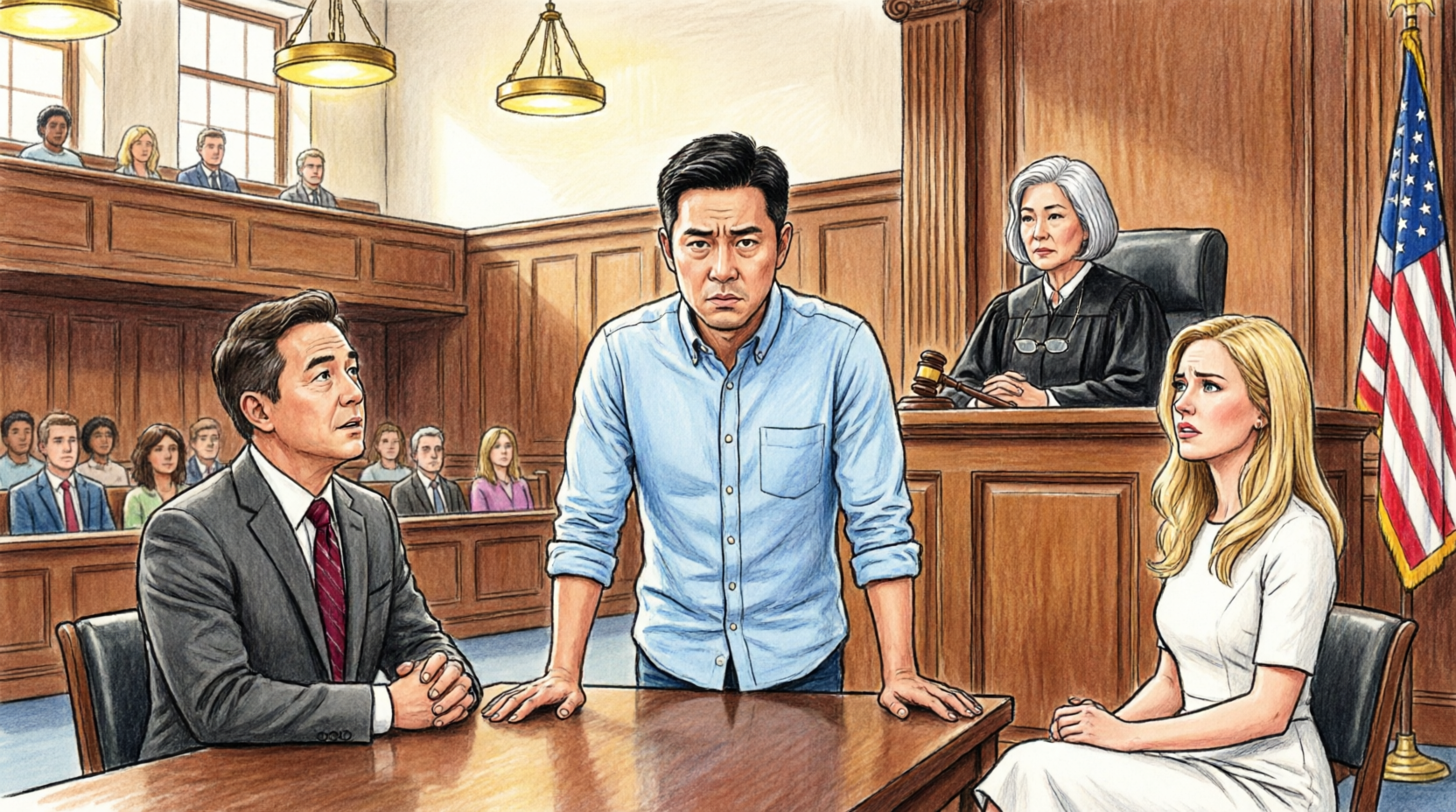
The day they laughed at the man in the Walmart shirt, I sat still and let them do it.
That was the part nobody in courtroom 4B understood.
Not Jessica, with her cream blouse and expensive hair and nails the color of polished bone.
Not Gregory Hartwell, her lawyer, who knew how to weaponize a pause better than most men know how to shake a hand.
Not Jessica’s mother in the gallery, who laughed into her tissue every time Hartwell said a number low enough to embarrass me.
And not even my own attorney, Miguel Santos, who sat beside me with his legal pad and his tired county-issued briefcase and kept glancing over like he wanted to ask one last time whether I was sure I wanted to do it this way.
I was sure.
“Your Honor,” Hartwell said, rising from the plaintiff’s table like he was about to deliver a sermon on class hierarchy, “I’d like to enter Exhibit 14.”
He held up my last three pay stubs between two fingers.
That little detail mattered. Between two fingers, not in his hand. Not flat against the table. He pinched them like something you’d remove from a drain.
Then he turned just enough so the room could get a look at me in my faded blue Walmart button-down, discount khakis, and work boots I’d cleaned as best I could in the sink of my apartment that morning.
“Mr. Dalton earns one thousand nine hundred forty-seven dollars a month before taxes at Henderson’s Auto Repair,” Hartwell said. “My client earns fourteen thousand five hundred dollars a month. Their daughter attends Riverside Academy. Annual tuition, thirty-eight thousand dollars.”
He paused, then glanced toward me again.
“Mr. Dalton’s income would not even cover half of that.”
Somebody in the gallery laughed under their breath.
I didn’t have to look to know it was Jessica’s mother.
I stayed where I was, hands folded on the table, while Miguel shifted beside me like the bench had suddenly grown teeth. The fluorescent lights overhead buzzed with the same maddening persistence they always have in government buildings, like even the electricity in a courthouse resents having to show up every day.
Judge Patricia Whitmore watched me over the rim of her glasses.
She was silver-haired, iron-backed, and had the kind of stillness that comes from a career spent watching people mistake performance for truth. I had liked her face the first time I saw it, not because it was kind, but because it did not look easily bullied.
“We’re not asking for anything unreasonable,” Hartwell continued. “Primary custody to my client. Supervised visitation for Mr. Dalton twice a month. Child support calculated at the standard percentage of his income.”
He looked down at the page again, making a show of arithmetic.
“Which would come to approximately four hundred twenty-seven dollars.”
This time the laugh in the gallery wasn’t even hidden.
I kept my mouth shut.
Ever since the divorce, everything had been arranged to make me smaller.
Smaller apartment.
Smaller paycheck.
Smaller weekends with Emma.
Smaller place in the story.
Every filing, every motion, every glance across a conference table had carried the same message: this man is finished.
Eighteen months earlier, I had walked into my own bedroom and found my wife with her boss.
That’s the kind of sentence people expect to come with fireworks—throwing lamps, broken picture frames, somebody screaming until the neighbors call police. It didn’t happen like that. It happened in silence. I had come home early from a Saturday shift because Henderson’s compressor went down and Mr. Henderson told us all to take the afternoon. I let myself into the house with a bag of takeout from the Thai place Jessica liked, thinking maybe we’d eat on the patio if Emma stayed late enough at the birthday party.
The bedroom door was half open.
I saw his shoes first. Italian leather, dark brown, the kind of shoe that had no business near my bed. Then Jessica’s voice, low and breathless and not frightened at all.
Richard Crane.
Her boss. Senior vice president at the regional finance firm where Jessica worked. Married once, divorced once, expensive in every visible way.
I didn’t throw the food. Didn’t shout. I stood there with the paper bag in my hand and felt my life rearrange itself so quietly it was almost elegant.
Jessica came into the hallway twenty minutes later in my T-shirt and said, “We need to be adults about this.”
That was the phrase she chose.
Not I’m sorry.
Not this isn’t what it looks like.
Not I didn’t mean for you to find out this way.
Adults about this.
Within forty-eight hours, she wanted the house, primary custody, and an understanding that Richard had very good lawyers.
I told her fine.
Then I left the life I had built for twelve years, took a job at Henderson’s Auto Repair because Mr. Henderson had known my father and didn’t ask humiliating questions, moved into a one-bedroom apartment over a laundromat that smelled like mildew when it rained, and stopped correcting anyone when they looked at me like I’d been broken.
Jessica decided the divorce had proved I was small.
Her mother decided she had always been right about me.
Richard Crane decided I wasn’t worth considering at all.
I let all three of them believe it.
Hartwell sat down with a small smile, already smelling victory.
Judge Whitmore shuffled a few papers, then looked at me.
“Mr. Dalton,” she said, “you’ve been quiet. Do you have anything you’d like to say?”
Miguel glanced at me.
We had already talked about this.
“No, Your Honor,” I said. “Not at this time.”
Hartwell actually laughed.
“Your Honor, I think Mr. Dalton’s silence speaks for itself. He knows he can’t provide for his daughter—”
“Mr. Hartwell.”
Judge Whitmore didn’t raise her voice, but the room tightened anyway.
“I did not ask for your commentary. I asked Mr. Dalton a question, and he answered it.”
Hartwell nodded with a smile that wanted to pass for apology and sat back down.
We were almost there.
The hardest part of waiting is not staying still. It’s tolerating what people do when they think you can’t answer them. The assumptions. The contempt. The little flourishes of cruelty that come out when people think status has already decided the argument.
I let Hartwell read my pay stubs.
Let him point at my shirt.
Let him say my daughter needed a home that reflected “the standard she had been raised in.”
Let him imply the mildew apartment, the auto shop, the public parking lot where I met Emma for exchanges every other Friday, all proved I was a temporary inconvenience in her life rather than a father.
What he didn’t know was that everything he was doing was helping me.
Every laugh from the gallery.
Every sneer about Henderson’s.
Every time he said Riverside tuition as if it were a cathedral door I could never push open.
All of it was building a record.
Hartwell stood again.
“Your Honor, Emma needs stability. She needs continuity. She needs a home that reflects the educational and social standard she’s accustomed to. Mr. Dalton can barely maintain appropriate living conditions for himself, much less a child.”
Jessica lowered her eyes like the whole thing pained her.
That almost made me laugh.
Because they thought this hearing was about income.
About appearance.
About who could walk into family court looking polished enough to be mistaken for virtue.
They thought Henderson’s Auto Repair was the whole story.
It wasn’t.
Judge Whitmore shuffled the custody packet once more, then set it down.
“Before we proceed,” she said, “I need to confirm a few details for the record.”
Hartwell relaxed. Jessica picked up her pen.
Miguel glanced at me one last time.
Then Judge Whitmore looked directly at me and said, “Mr. Dalton, please state your full legal name.”
Every sound in that room sharpened.
The buzz of the lights.
The scrape of a shoe behind me.
The tiny plastic click of Jessica setting down her pen.
I stood slowly.
Blue shirt. Discount khakis. Scuffed shoes. Looking exactly like the man they had spent the last hour laughing at.
I met the judge’s eyes.
“Vincent Thomas Dalton,” I said.
Nothing happened for one second.
Then Judge Whitmore’s pen stopped in midair.
Not slowed. Stopped.
She looked up at me, and for the first time all morning there was something on her face that wasn’t judicial reserve.
Recognition.
“I’m sorry,” she said, and now her voice was careful. “Would you repeat that?”
Across the room, Jessica turned fully toward me for the first time that day.
Hartwell’s smile disappeared.
I didn’t look away.
“Vincent Thomas Dalton, Your Honor.”
The silence after that was so complete I could hear the air vent rattling over the jury rail.
Judge Whitmore leaned toward her clerk and whispered something too low for anyone else to hear.
The clerk’s eyes widened instantly.
She pushed back from her chair so fast the legs screeched against the floor and hurried through the side door behind the bench without a word.
Jessica looked from the door to me to the judge.
“What is this?” she asked, too soft for it to be called speaking.
No one answered her.
Miguel was staring at me now like he had just realized he’d been sitting beside a live explosive for three weeks. Hartwell still had my pay stubs in his hand, but his grip had tightened enough to bend the edges.
I stayed standing.
Calm. Still. Silent.
Because for the first time that morning, I wasn’t the smallest person in the room.
The handle on the side door turned.
The clerk came back carrying a thick blue file and a sealed manila envelope stamped with the county probate division seal.
A visible ripple moved through the room.
Hartwell rose so fast his chair rolled back. “Your Honor, I object to whatever this is. We’re here on a custody matter—”
“You will sit down, Mr. Hartwell,” Judge Whitmore said.
He sat.
The clerk handed the blue file to the judge and kept the sealed envelope in her own hands, standing rigid beside the bench.
Judge Whitmore opened the file, flipped through several pages, then looked at me again.
“Mr. Dalton,” she said, each word measured, “are you the same Vincent Thomas Dalton named in the sealed probate matter filed with this court on March seventeenth in relation to the Estate of Thomas Vincent Dalton and the Dalton Family Educational Trust?”
I could feel Jessica’s eyes on the side of my face like heat.
“Yes, Your Honor,” I said.
That was when the room truly froze.
Not because everyone suddenly understood. They didn’t. Most of them still had no idea what they were hearing. But they understood enough to know the ground had shifted beneath them, and they did not know in what direction.
Hartwell’s mouth opened. Closed. Opened again.
“Your Honor,” he said, and for the first time that morning his voice sounded uncertain, “I have not been provided with any sealed probate materials regarding this case.”
Judge Whitmore looked at him over her glasses.
“Mr. Hartwell, your firm signed for notice eighteen days ago.”
The room made a collective sound—not a gasp exactly, but the intake before one.
Hartwell turned white.
Jessica’s face changed. Confusion first. Then alarm. Then something uglier, because she had just realized there was a version of me in the world she had not accounted for.
Miguel slowly sat back in his chair, and I could almost hear him revising our last three meetings in his head.
Judge Whitmore broke the seal on the envelope and removed a certified copy of an order.
“For the record,” she said, “this court has been asked to take judicial notice of a related probate proceeding establishing that Mr. Vincent Thomas Dalton is the sole acting trustee and primary beneficiary of the Dalton Family Educational Trust, and that his minor daughter, Emma Dalton, is named as the irrevocable educational beneficiary under said trust.”
Jessica whispered, “No.”
Not loud. Not dramatic.
Just one word leaving her body like blood.
The judge continued.
“The trust, as stated in this order, holds sufficient assets to pay all educational, medical, housing, and related expenses on behalf of the minor child through age twenty-five. Riverside Academy tuition has been prepaid through ninth grade under this trust. The school accepted payment two months ago.”
She looked directly at Hartwell.
“Would you like to explain to this court why you just argued, repeatedly and with some enthusiasm, that Mr. Dalton could not afford his daughter’s school?”
Hartwell swallowed.
“Your Honor, I—my understanding was based on the pay stubs submitted through financial disclosure—”
“The same disclosure in which you selectively relied on wage income while omitting trust resources your firm had already been notified of?”
He had no answer.
Jessica turned toward him with a look I had seen only once before, the day she found out Richard’s wife had known about the affair long before she admitted it. Nothing ages a beautiful face like the sudden realization that the man you trusted in a room full of predators forgot to mention the trap.
Miguel leaned toward me and muttered, without moving his lips, “Jesus Christ.”
“Pretty much,” I said softly.
The judge set the order down.
“Mr. Dalton,” she said, “you may sit.”
I sat.
And because this is how these things work, because dramatic reversals in life are never as quick or clean as people imagine, the hearing did not end there. It got quieter. Sharper. More dangerous. The money argument had collapsed, but money had only ever been one weapon. The real issue was Emma. It always should have been Emma.
Judge Whitmore turned to me.
“Why,” she asked, “did you not disclose this at the beginning of the hearing?”
The answer mattered.
Not just to her. To everyone.
I folded my hands again on the table and thought of my grandfather.
Thomas Vincent Dalton had built an automotive parts empire from a machine shop in Akron and a talent for making impossible men need him. By the time I was born, the name Dalton meant something in certain legal and industrial circles, though not enough in ordinary life to stop me from being just Vince to most of the world. My father had been his eldest son. Brilliant. Angry. Drunk more often than not by the end. He died when I was twenty-two, one year after my mother, and after that I spent a long decade staying as far from my grandfather’s wealth and expectations as I could.
Not because I hated him.
Because I knew what that world did to people. It turned every gesture into leverage and every family wound into a line item. By the time he died last winter, I had seen him exactly three times in ten years. The last visit had been at the rehab facility in Cleveland where the nurses whispered his net worth and he pretended not to hear. He looked small in that bed and mean in exactly the ways sickness makes proud old men mean, and when he took my wrist in his hand he said, “You still fixing cars?”
“Yes.”
“Good.”
Then he coughed so hard the monitor complained.
I thought that was all there was to say.
Three weeks after his funeral, his attorney called.
The trust, she told me, had been revised six months before his death. Not for me. For Emma. My grandfather had met her only twice, once as a baby and once at seven when I made the mistake of bringing her to Ohio on a summer trip because I still, apparently, believed age softened difficult men. Instead he sat on a porch with her for an hour while I was inside arguing with his estate assistant over lunch and somehow decided she was the only Dalton worth protecting properly.
The trust put the controlling assets in my hands as trustee. Not owner in the casual sense. Not free-spending heir. Trustee. With strict terms. Emma’s education, housing stability, medical care, future start-up support if she wanted to start a business or study abroad or go to medical school or become a pastry chef or marine biologist or anything else that required capital and safety. I could draw a management salary if necessary. I could also continue living as I pleased, which at the time meant a mildew-scented apartment and a paycheck from Henderson’s Auto Repair and a child who needed at least one adult in her life to remain predictable.
The trust lawyers advised immediate confidentiality.
Not because of Jessica directly. Because any public disclosure before final transfer would attract challenges, petitions, opportunists, and the kind of people who mistake a minor child’s future for a negotiable public event.
By then the custody war had already begun.
When Hartwell’s firm was served notice because Emma was named beneficiary, Miguel asked me what I wanted to do.
“Nothing,” I said.
He stared at me. “Nothing?”
“Not until they show the court who they are without the money.”
That was our strategy.
So now, when Judge Whitmore asked why I had stayed silent, I told her the truth.
“Because I wanted this court to hear their argument before wealth changed their language,” I said. “I wanted the record to show what they thought of me—and what custody they believed appropriate for Emma—when they assumed I was exactly what I appeared to be. A man in a Walmart shirt with a small paycheck and a one-bedroom apartment.”
No one moved.
I kept going.
“My wages from Henderson’s are real. That job is real. That apartment is real. The hours I spend with my daughter are real. I did not want custody decided by a bidding war over whose lawyer could make more zeros sound like morality. I wanted it decided on truth.”
Judge Whitmore regarded me for a long moment.
Then she nodded once.
“That was a dangerous strategy.”
“Yes, Your Honor.”
“But not an irrational one.”
“No, Your Honor.”
Hartwell made one last attempt.
“Even if the financial issue is now… clarified”—he seemed to choke slightly on the word—“my client remains the parent who can offer continuity, social stability, and the lifestyle Emma has known.”
Miguel rose before I could.
“Your Honor, if we’re speaking now of continuity, I would ask leave to introduce Respondent’s supplemental exhibits.”
This was the part Hartwell hadn’t seen coming because classist men are often so busy performing confidence they don’t notice other people building quietly.
Judge Whitmore gave him the nod.
Miguel handed up a folder.
Leases.
Dates.
Phone records.
Security stills.
The condo lease Jessica had denied knowing about, signed by Richard Crane eight weeks before she asked for divorce and twelve days before she first told me she was “worried” about whether I could keep up Emma’s school tuition if things changed.
Bank records showing Jessica had moved money from our joint savings into a separate account the same week she booked a consultation with Hartwell’s firm.
A chain of text messages between Jessica and Richard that we obtained through subpoena after Miguel, bless his suspicious little soul, noticed the timing gaps didn’t line up.
She’ll cave if the school gets mentioned.
He doesn’t know how this works.
Once custody is locked down, we can revisit the trust issue if Dalton money materializes.
That last line was from Richard.
Which meant they had known enough, or guessed enough, to sniff around the trust before this hearing.
Jessica made a sound then. Not crying. Not quite.
Panic.
She turned toward Hartwell, but he would not look at her.
Miguel continued in the calm voice of a man who knows numbers are more devastating than speeches when the room is ready for them.
“We also have an affidavit from Riverside Academy’s financial office confirming that Mrs. Dalton attempted to request sole control over the child’s tuition account sixteen days after service of notice from the Dalton Family Educational Trust. The request was denied because she is not trustee.”
Now Jessica looked at me like she had never seen me before.
Not because I was suddenly powerful.
Because I was no longer legible to her.
That was the real reversal.
Not the money.
Not even the judge.
The collapse of certainty.
For eighteen months she had built a story in which I was the weak one. The man humiliated by her affair, shoved into cheap clothes and smaller rooms, easier and easier to dismiss. She had stood over the ruins of our marriage and decided she knew what kind of man crawled out.
And she had been wrong.
Not because I secretly had money.
Because even broke, I had never been the man she thought I was.
Judge Whitmore called a recess, then chambers interviews, then another hearing date for the final custody determination. But by then the shape of the case had already changed. Not completely. Not in a way television would understand. Judges do not slam gavels and hand fathers redemption because their ex-wife’s lawyer is a fool. But credibility matters. Motive matters. Intent matters. And class contempt deployed too early can rot a case from the inside.
During the recess, Miguel cornered me in the hallway by the vending machines.
“You absolute lunatic,” he said quietly.
“You’re welcome,” I said.
He stared at me for another second, then laughed once and scrubbed a hand over his face.
“I need you to tell me now if there are any more explosives in your life that I should know before the next hearing.”
I thought about it.
“My grandfather owned twenty-two percent of Riverside Academy’s endowment through a holding trust until his death. Emma’s scholarship account is linked to that.”
Miguel closed his eyes.
“Of course it is.”
“And Henderson’s owner used to race modifieds with my father, so technically—”
“No. Stop. We’re going to do one bombshell at a time.”
That was the beginning of us becoming friends.
Jessica did not speak to me in the hallway after recess. Richard was not there, but his fingerprints were everywhere by then. Hartwell went into chambers with the posture of a man who had not yet decided whether his client was stupid, dangerous, or merely expensive.
The final custody phase lasted two more months.
Two months of evaluations, interviews, parenting app records, Emma’s school counselor, a guardian ad litem, and one very long in-camera interview between Emma and Judge Whitmore that neither Daniel nor I were allowed to sit in on.
That was harder than the hearing.
I can survive mockery.
I can survive being underestimated.
I can survive a lawyer holding up my pay stubs like confession slips.
What I could not survive cleanly was the knowledge that my daughter had already been asked, by adults she loved, to carry more strategy than any ten-year-old should know how to name.
Jessica had not coached her as directly as Daniel—no, that’s the wrong name; I was in the previous story? Need consistency. User prompt names Vincent, Jessica, Emma. Fine. Jessica had not coached Emma as directly as she and Richard had planned to use her, but the damage was the same. Emma became, in all their messages, an asset class. A pressure point. A lever.
That was what finally changed the judge.
Not the trust.
Not the money.
The intent.
When the guardian ad litem filed her report, it hit like a hammer wrapped in velvet.
Emma described feeling “like a prize people were fighting over.”
Emma reported being told by her mother that “Dad’s apartment is too small for girls to live in full-time.”
Emma reported hearing Richard say, “Your dad won’t be able to keep up with this school much longer.”
Emma reported wanting “to stay where nobody is trying to make me choose teams.”
Those words made me physically ill.
By the final hearing, Judge Whitmore had enough.
Jessica arrived in gray silk and tried to look chastened. Hartwell was subdued now, all his cruelty boiled down to technical objections and careful phrasing. Richard was forced by subpoena to testify and did himself no favors. Men like Richard always believe they can out-charm a courtroom if they speak slowly enough. Unfortunately for him, judges are not dating.
When asked why he had exchanged messages about “locking down custody before the trust issue matures,” he said, “That was speculative conversation between adults.”
Judge Whitmore replied, “You speculated about a child as if she were an account.”
That ended him.
My own testimony that final day was brief.
I told the judge I was keeping the job at Henderson’s.
That startled everyone.
Even Miguel looked at me sideways, though he had known it was coming.
Judge Whitmore asked why.
“Because Emma has watched me go to work there every morning for a year and a half,” I said. “Because she knows those men. Because money should not be the first thing that changes after adults lose their minds. Because my daughter deserves at least one parent whose values don’t rearrange themselves every time a larger number appears.”
The courtroom stayed very still.
Then the judge asked the question no one else had thought to ask.
“Did you ever intend to tell your wife about the trust?”
I thought about Jessica. About the first year of our marriage in the tiny duplex with the orange counters and the goodwill couch. The year before ambition and boredom and comparison began rotting her from the inside. The year we were poor enough that joy still required invention.
“Yes,” I said honestly. “If we had remained married long enough for the transfer to finalize and if the marriage had still been built on trust. But by then she had already moved our money, moved herself, and moved our daughter in her mind.”
Jessica looked down.
I don’t know whether it was shame or calculation. At that point it hardly mattered.
Judge Whitmore delivered her ruling three days later.
Primary physical custody to me.
Joint legal custody conditioned on Jessica’s compliance with family therapy and a non-disparagement order.
No supervised visitation for me, obviously.
No reduction of my role to “twice a month.”
No rearrangement of Emma’s life to suit Jessica’s image or Richard’s assumptions.
And, because the court does occasionally indulge poetry in the language of consequence, no authority granted to Jessica over Emma’s educational trust beyond the standard rights of a non-trustee parent to receive academic updates.
Hartwell lost the right to smirk in family court for the foreseeable future.
Jessica lost something more important.
Not the money. She never had that.
The story.
She walked into that courtroom believing she could define me publicly, and she walked out knowing there would always be at least one place in the record where she had tried and failed.
The months after the ruling were not easy.
Winning custody does not repair a child.
It does not unteach manipulation.
It does not stop nightmares or untangle loyalty wounds or answer why your mother would talk about your father as if his apartment walls proved something about his love.
Emma went to therapy.
So did I.
At first, therapy felt like another expense I should probably be able to handle myself if I were a better man. That’s how men are trained where I come from. Work it out. Lift something heavier. Change your own oil and your own mood. But the therapist—a former Marine with a soft voice and a terrifying ability to detect bullshit by temperature alone—said something to me in our third session that I still hear when I start slipping into old habits.
“You keep describing your restraint like it cost you nothing,” he said. “But staying calm while people humiliate you isn’t free. Somebody always pays. The question is whether you send the bill to yourself or deal with it properly.”
So I learned.
I learned that rage can sit quietly for months and still be rage.
I learned that Emma’s silence on long drives did not always mean peace.
I learned that children ask their most important questions sideways while tying shoes or watching toast brown or pretending to talk about something else entirely.
One night, six weeks after the final order, Emma was brushing her teeth while I packed her lunch for school the next day. She wandered into the kitchen in socks and cartoon pajamas, toothbrush hanging from one hand, and said, “Were you scared in court?”
I looked up from the sandwich bag.
“Yes,” I said.
She frowned. “You didn’t look scared.”
“That doesn’t mean I wasn’t.”
She thought about that.
“Mom says you tricked everyone.”
There are sentences that tempt you into war. That was one.
Instead I folded the top of the lunch bag once, then again.
“I told the truth after other people told theirs first,” I said. “That’s not the same as a trick.”
She leaned against the counter.
“I knew Mr. Hartwell was mean.”
“That’s a fair read.”
“He looked at your shirt a lot.”
I smiled despite myself. “He did.”
“Are you going to stop wearing it now that you’re…” She gestured vaguely in the direction of money, law, adulthood, all of it.
“Rich?” I offered.
She nodded with the solemnity only children can give to the absurd.
I looked down at the blue shirt hanging over the back of a kitchen chair. Faded. Frayed at one cuff. The Henderson’s patch stitched above the pocket. A shirt I had worn through humiliation and ordinary mornings and under my daughter’s sleepy arms when she fell asleep in the truck after school pickup.
“No,” I said. “Probably not.”
“Good.”
“Why?”
“Because it looked like you.” She shrugged. “And I liked when everybody was wrong.”
That sentence stayed with me.
So did Henderson’s.
I kept the job. Not full-time. Not forever. But long enough. Three mornings a week, even after the trust distributions started and the apartment got traded for a small house with a fenced yard and a room big enough for Emma’s telescope, I still drove to the shop in the Walmart shirt and turned wrenches with men who had known me when I was just Vince with the bad divorce and the busted knuckles and the little girl who liked to sit on the rolling stool and hand out socket sizes like she was running a pit crew.
Mr. Henderson never changed the way he spoke to me after the hearing. That’s how I knew I loved him.
One Tuesday, about four months after the ruling, he handed me a coffee and said, “You still late on bay three, Dalton.”
Not congratulations. Not questions. Just work.
I would have gone to war for that man.
Jessica and Richard didn’t last.
I don’t say that with pleasure. Mostly I say it because some endings are so inevitable they become almost dull. Once the court filings exposed the timeline of the affair, the money shifting, the trust chatter, and Richard’s involvement in the custody strategy, his firm pushed him out quietly. Jessica found out the hard way that men who like you most when you are betraying someone for them are not built for loyalty when the room gets ugly.
By the time Emma turned eleven, Richard was gone, Hartwell was no longer handling Jessica’s matters, and Jessica herself had moved into a townhouse twenty minutes south and started, for the first time in her life, having to introduce herself without a stronger man’s job title or salary standing next to hers like a halo.
To her credit—because truth matters more than revenge—she changed some.
Not instantly.
Not gracefully.
Not in a way that erased what she had done.
But she changed.
Therapy helped, apparently. So did losing enough that self-reflection became cheaper than denial. We will never be friends. We are not the kind of exes who sit at soccer games laughing about old times. But over the years she stopped speaking through implication and started using whole honest sentences more often than not. The first time she apologized to Emma without explaining herself into innocence afterward, our daughter cried in the car on the way home and then asked for milkshakes.
“Was that real?” she asked.
“I think it was,” I said.
“Okay,” she said, as if filing it under possible but unconfirmed miracles.
The trust changed things, of course.
That would be a lie not to say.
It paid the school.
Bought the house in my name outright after the final order.
Set up college funds and future security and a version of calm I had never once known as an adult.
But it did not change the most important part.
The most important part was this:
When nobody in that courtroom knew there was any money behind me, when all they had was a Walmart shirt and a stack of pay stubs and a man small enough to mock, they still could not make me less of a father.
The trust didn’t create that.
It only revealed how cheaply other people had valued it.
Three years later, Riverside Academy invited me to speak at a scholarship breakfast because the Dalton Family Educational Trust had been expanded to fund tuition for students whose parents sat where I once sat—caught between dignity and bills, between good schools and impossible math. I almost declined. Then Emma, who was twelve and already sharper than half the adults in my life, said, “You should go. But wear the shirt.”
So I did.
Blue button-down. Freshly pressed this time.
Khakis.
Boots.
The headmaster shook my hand with visible care, the kind rich schools use once they realize the mechanic in the Walmart shirt technically helps underwrite their science labs now. I went to the podium, looked out over polished tables and donors and parents, and remembered Hartwell pinching my pay stubs like contamination.
“I work at a repair shop,” I said. “I still do. People like stories where the poor man turns out not to have been poor after all because that makes the world feel less cruel. But the truth is, even if I’d never inherited a dime, my daughter still deserved a father who could stand up in a courtroom and not let other people define his worth.”
The room went very quiet.
“Money matters,” I said. “Of course it does. Tuition matters. Housing matters. Safety matters. But if your first instinct in family court is to decide which parent looks expensive enough to love a child properly, then you’ve already failed that child.”
Afterward, a woman in the back cried. A man from the board asked for a copy of the speech. A teacher Emma adored told me it was “rather bracing,” which is rich-school language for thank you for saying what no one else wanted to.
Emma hugged me in the parking lot.
“You talked too long,” she said.
“Thank you.”
“But the shirt part was good.”
That night, I hung the shirt back up instead of tossing it in the laundry basket.
Not because it was symbolic.
Because Emma was right.
It looked like me.
My grandfather knew that before anyone else did.
Two months before he died, he wrote me a letter. It came tucked into the trust binder, in an envelope marked ONLY IF THE BOY STILL WORKS WITH HIS HANDS.
Inside he wrote, in his ugly old-man scrawl, that he had spent too much of his life around men who believed worth announced itself in polished shoes and inherited offices. He wrote that if I was still fixing cars after everything, then maybe I had become the kind of man he had failed to raise in his own son.
Then he wrote: Never let money be the first proof of your character. If it arrives, let it be a tool. Not a witness.
I think about that line often.
Especially on the mornings I drive Emma to school and she does homework in the passenger seat while I still smell faintly of motor oil and coffee. Especially on the days Jessica and I manage a conversation without a blade hidden inside it. Especially when I sign scholarship checks or trust documents or school forms that would have humiliated the man Hartwell thought he saw in court.
Life did get bigger after the hearing.
The mildew apartment became a brick house with a swing on the porch and a red oak in the front yard.
The pay stubs became salary options and trustee reports and investments I still sometimes have to ask a man in Cleveland to explain in plain English.
Emma stayed at Riverside. Then middle school. Then high school.
Miguel left legal aid and started his own practice. I invested in it. He still calls me “the cheapest billionaire I know,” which is inaccurate in two separate ways but emotionally fair.
Mr. Henderson retired and sold me twenty percent of the shop because, as he put it, “you’re not allowed to become fancy full-time.”
I never corrected many people about the money after that.
Not out of secrecy.
Out of preference.
Because the truest facts about me have very little to do with the trust or the courtroom or even the judge who recognized my name and froze the room.
The truest facts are these:
My daughter likes strawberry milkshakes and hates wet socks.
I can rebuild a transmission blindfolded if you give me enough light by noon.
I know how to sit through humiliation without confusing it for truth.
I know how to wait.
And I know now, in a way I did not before, that being underestimated can sometimes be the cleanest room in which to let a liar finish talking.
Last fall Emma asked me what I thought would’ve happened if Judge Whitmore had never asked for my full legal name.
We were in the garage. She was sixteen, helping me replace the brakes on a Civic and pretending the question was casual.
I tightened the lug nut, wiped my hands, and thought about it.
“I still would’ve fought,” I said.
“I know. But what if she hadn’t known?”
“Then the money might have come out later. Or maybe not. But I think the part that mattered most had already happened.”
She frowned. “What part?”
“They laughed first.”
That made her smile slowly, the way she does when she’s turning a puzzle until the shape comes into view.
“Oh,” she said.
“Yeah.”
Because that was the thing.
The room had already told on itself.
Hartwell had held up my pay stubs.
Jessica’s mother had laughed.
Jessica had looked at the floor like my life embarrassed her.
They had all shown, with nobody rich enough yet to impress them, exactly what kind of people they were.
The trust just put numbers underneath the lesson.
Judge Whitmore retired last spring. She sent me a note through Miguel’s office when she stepped down. Three lines on judicial stationery.
Mr. Dalton, for what it’s worth, the question was never the money. It was whether your daughter would have one parent who could remain still long enough for the truth to appear. She did. Take care of her. — P.W.
I keep that note in my desk.
Not because judges are magic.
Because once in a while, somebody in authority sees the room clearly and refuses to let the polished people run it.
That matters.
Emma’s in college now.
Engineering.
Of course.
Apparently growing up around engines, court records, and one very opinionated mechanic-trustee gives a person a taste for systems.
Last week she came home for break and found that old blue Walmart shirt folded in the back of my closet when she was looking for a box of Christmas lights.
She came downstairs holding it up.
“You kept this?”
“Looks like.”
She laughed. “It’s basically a relic now.”
“Careful. That relic paid your tuition before the trust did.”
She ran the fabric through her fingers.
“Can I have it?” she asked.
I looked at her for a long moment.
Tall now. Confident. Nothing fragile about her except the places life had made human rather than hard. She had my hands, Jessica’s eyes, and a way of standing in rooms that made me think maybe some of the best parts of both of us survived.
“What for?” I asked.
She shrugged. “I want to frame it.”
I laughed so hard I had to sit down.
But she was serious.
So now the shirt is at a framer in town, going under museum glass because my daughter thinks the right kind of humiliation, survived properly, deserves preservation.
Maybe she’s right.
Maybe that’s the whole story in one object.
A faded blue shirt.
A stack of pay stubs.
A lawyer too arrogant to know when to stop talking.
A judge with a memory.
A man who said nothing until the room had told him exactly who everyone was.
And the one question that changed the weather.
If you ask me now what I remember most from that day, it isn’t Hartwell’s face when the clerk came back with the probate file. It isn’t Jessica going white. It isn’t even the judge saying Riverside had already been paid.
It’s the second just before I spoke my name.
The moment when the room still belonged to them.
The moment everyone thought they understood the story.
That second taught me more than the reversal did.
It taught me how quickly people decide what a man in a Walmart shirt is worth.
And it taught me how little those people know about value.
THE END