
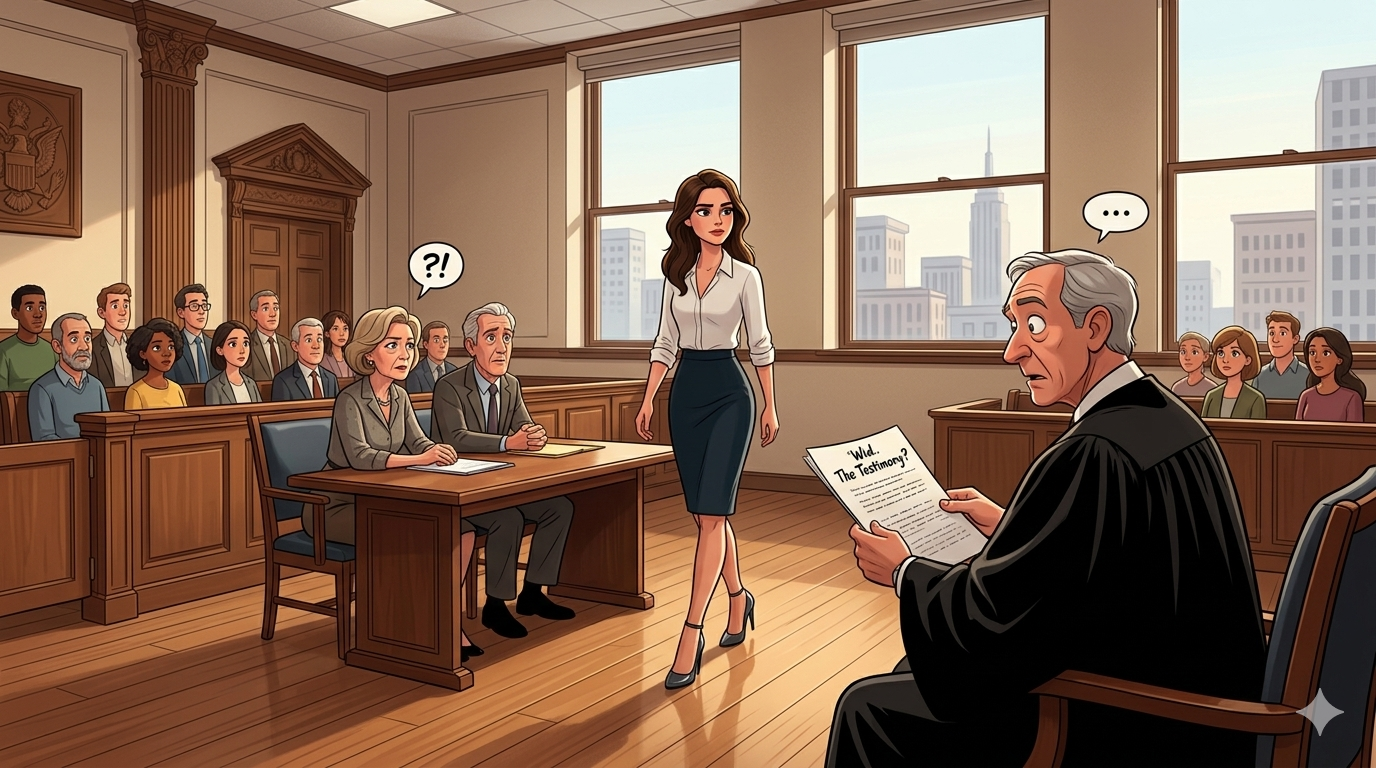
The courtroom stayed silent. Even Palmer didn’t interrupt. There was nothing to object to when truth arrives without decoration.
Thomas asked the question that mattered most. “Did you ever discuss the will with Judge Parker?”
“No,” I said. “He never told me his plans.”
“Did you manipulate him?” Thomas asked, voice firm now.
I looked at the judge. Then I looked at my parents.
“No,” I said. “I didn’t manipulate him. I loved him. There’s a difference.”
Thomas sat down.
Palmer rose for cross-examination like a man stepping into a ring.
He started soft. “Ms. Morrison,” he said, “you testified you saw your parents rarely. Couldn’t you have reached out more? Tried harder?”
“I was a child for most of that time,” I said calmly. “Children don’t arrange visits. Parents do.”
Palmer paced. “But as an adult—”
“As an adult,” I cut in gently, “I realized they weren’t interested. They called only when they needed something. I stopped chasing people who didn’t want to be caught.”
Palmer’s eyes narrowed. “Isn’t it possible you isolated your grandfather from his daughter? Made yourself indispensable so he’d leave you his money?”
I didn’t blink. “I didn’t need to isolate him. They isolated themselves.”
Palmer tried to provoke me with words like ambitious, calculated, dependent on Grandpa’s influence for my career.
I let him swing.
Then I answered in facts.
“My grandfather mentored me because he wanted to,” I said. “Because he was proud of me. That’s family. That’s not manipulation.”
Palmer’s voice sharpened. “Isn’t it true you benefited financially from your relationship with him?”
“In what way?” I asked calmly.
“He paid for your education. Your living expenses.”
“Yes,” I said. “Because I was his granddaughter and he wanted to. Just like he gave my mother over eight hundred thousand dollars over twenty years.”
Palmer stiffened. “Objection—”
“Answer the question,” Judge Brennan said, tone firm, eyes on Palmer.
I leaned forward slightly, keeping my voice controlled. “The difference is I was present,” I said. “I didn’t just take his money. I gave him my time, my love, my company.”
Palmer’s lips thinned. He tried one last angle.
“Ms. Morrison,” he said, “isn’t it convenient that you were his caregiver in his final years? That you were there constantly?”
I held his gaze. “I visited because I loved him and he was alone,” I said. “If I cared about the will, I would have asked about it. I never did.”
Palmer’s jaw tightened. “No further questions.”
I stepped down, heart pounding—not from fear, but from release.
Thomas stood and presented the last exhibits: photos from my childhood—Grandpa at soccer games, Grandma at recitals, my graduations. A timeline of presence.
Then financial records—payments to Diane, requests for more, broken promises to visit. A timeline of taking.
Judge Brennan recessed to review evidence and hear closing arguments the next morning.
When we returned, Palmer made his final plea about bloodlines and grief and vulnerable old men. Thomas answered with calm facts, pointing again to pattern: absence and presence, taking and giving.
Then Judge Brennan returned to the bench with a thick folder in his hands.
“My role is not to judge the quality of family relationships,” he said, voice steady. “My role is to determine whether Judge Parker’s will should stand.”
He looked at my parents.
“The plaintiffs argue incompetence and undue influence. The evidence does not support either claim.”
He listed it plainly: medical records, witnesses, the drafting attorney’s testimony.
Then he said the sentence I felt in my bones.
“What the evidence does show is a pattern. A pattern of absence by the plaintiffs and presence by the defendant. A pattern of financial taking by the plaintiffs and kept commitments by the defendant.”
He paused. “Judge Parker didn’t need to be manipulated into seeing that pattern. He lived it.”
My mother’s breath hitched. My father’s face darkened.
“The will stands as written,” Judge Brennan said. “The petition is denied.”
A sob burst from my mother’s throat. My father swore under his breath.
Judge Brennan wasn’t finished.
“Furthermore,” he said, voice firm, “I am awarding attorney’s fees to the defendant. The plaintiffs brought this case without merit, causing unnecessary expense and emotional distress.”
Palmer shot up, protesting, but Judge Brennan’s gavel cracked down.
“My ruling stands,” the judge said.
Adjourned.
It was over.
As people gathered their papers and the courtroom started to breathe again, my mother approached me, mascara streaking now, tears real or at least more convincing.
“Haley,” she whispered, reaching for my arm. “Please. Can we talk?”
I stepped back, calm.
“There’s nothing to talk about, Diane,” I said.
Her face crumpled. “I’m your mother.”
“You’re the woman who gave birth to me,” I replied. “My mother was Helen Parker. My father was William Parker. They earned those titles by showing up.”
Her hand trembled, hovering in the air like she wanted to grab a past that didn’t belong to her.
“Please,” she begged. “I made mistakes.”
“You had every chance,” I said, voice firm. “Every birthday, every Christmas, every Sunday for thirty-two years. You chose not to show up. Don’t contact me again.”
Scott barked from behind her, angry and impatient. “Diane, come on.”
I turned away without looking back.
And for the first time in my life, I felt completely free.
Not because I won money.
Because I won the truth.
Part 7
I visited Grandpa’s grave the same day the verdict came down.
I didn’t do it for drama. I did it because I needed the quiet, the kind the courtroom never gives you. The cemetery sat on a gentle hill outside town, old trees and trimmed grass, my grandparents’ headstones side by side like they still belonged together.
Tulips bloomed near the base—red and yellow, stubborn as memory. I’d planted them after the funeral, hands in the soil the way Grandma taught me.
I sat beside their stones and let the wind move through the leaves overhead.
“We won,” I said softly. “They tried to take it. They tried to rewrite everything. But the truth stayed put.”
No answer, of course. But the quiet felt full anyway, like it always did when I was with them.
Six months passed, and life settled into a rhythm that felt almost foreign.
Work. Gym. Dinner with friends sometimes. Quiet nights with books and the kind of peace that comes when you stop waiting for someone to become better.
I didn’t touch the inheritance much. Most of it stayed invested, growing quietly. I kept prosecuting because the work mattered. My grandfather didn’t raise me to become rich. He raised me to become useful.
Then one Saturday morning, my doorbell rang.
A woman stood on my porch, about sixty, hair gray, expression cautious. I recognized her only after a second—Patricia Caldwell, my grandparents’ neighbor for decades. The woman who’d found Grandma after the stroke.
“Haley,” she said gently, “I wasn’t sure if I should come. But after what happened in court… I think you deserve this.”
She handed me a large envelope.
Inside were letters. Dozens of them. All in my grandfather’s handwriting, all addressed to my mother.
Unsent.
Patricia stepped inside while I stared at the first letter, hands shaking.
“I helped your grandfather sort papers after he passed,” she explained softly. “These were in a drawer marked unsent. He asked me to help organize his study. I couldn’t bring myself to throw them away. After the trial, I thought… you should know.”
I opened the first letter.
Dear Diane, it began. I’m writing this because I can’t say it to your face without anger creeping in. Haley had her dance recital today. She kept looking at the audience, searching for you. I watched her face fall when she realized you weren’t there.
My throat tightened. I flipped through more.
Each one documented another missed moment. Another attempt to reach my mother with truth instead of money. Some letters were furious. Some were heartbreakingly gentle.
One, dated two years before Grandpa died, hit hardest.
I’ve given you hundreds of thousands of dollars. I told myself it was helping you stabilize, but I’m starting to realize I’m enabling your refusal to grow up. I will continue the monthly payments because you are my daughter and I cannot completely cut you off. But I am done with the extra money. I am done rescuing Scott. I am done pretending this is help when it’s really prolonging dependence.
Then, in the same letter, the sentence that broke me open:
The greatest gift you ever gave me wasn’t money. It was Haley. You gave her to me, and she saved me after your mother died.
I set the letters down, tears falling quietly.
Patricia handed me a tissue. “He loved you so much,” she said. “And he never stopped hoping Diane would change. Even when he knew she wouldn’t.”
“Why didn’t he send them?” I whispered.
Patricia’s eyes softened. “I think he needed to write them,” she said. “But he knew sending them wouldn’t fix anything. He didn’t want to give her more power over him.”
After Patricia left, I spent hours reading every letter. Not because I needed more proof. Because I needed to feel him again—his mind, his heart, the way he wrestled with loving someone who kept disappointing him.
That night I called Thomas.
“I got letters,” I said, voice rough. “Grandpa wrote to Diane but never sent them.”
Thomas was quiet for a moment. “That sounds like him,” he said softly. “Methodical even with grief.”
“Should I show them to her?” I asked, surprised by my own question.
Thomas didn’t hesitate. “No,” he said. “She already knows, deep down. Showing her won’t change her. It’ll only pull you back into managing her guilt. That’s not your job.”
He was right.
So I kept the letters for myself and filed them away with the other pieces of Grandpa’s life—photos, his watch, the original will letter he left me.
A month later, I ran into Judge Brennan at a legal conference. He shook my hand warmly.
“How are you holding up?” he asked.
“I’m good,” I said, and realized it was true. “Really good.”
He nodded. “Your grandfather would have been proud of how you handled yourself.”
“He would’ve told me to keep my tone calmer,” I said, a small smile tugging at my mouth.
Judge Brennan’s eyes softened. “He would’ve told you you did the hard right,” he said. “And that’s what mattered to him.”
That night, I drafted my own will.
I was thirty-two, not dying, not sick, but the trial had taught me that clarity is a gift you leave behind. I made my choices intentional: education charities, legal aid programs, child advocacy funds.
Nothing for Diane or Scott.
Not out of spite.
Out of principle.
They’d already taken enough.
As my life moved forward, I realized something else: winning the case didn’t just protect my inheritance.
It protected my history.
It made the record official.
And once the record is official, you stop needing anyone else to validate what you already know.
You stop begging for a family that never wanted to be one.
You build your own life, and you do it without looking back.
Part 8
Two years after the trial, I got a call from the governor’s office.
At first I thought it was a prank. Then I heard the governor’s chief counsel speak my name with careful seriousness, and my stomach flipped.
“We’d like to nominate you for a judgeship,” she said.
I was thirty-three. Young, by judicial standards. Not unheard of, but rare enough that people would talk.
I thought about Grandpa’s voice. Evidence over emotion. The hard right over the easy wrong.
“I accept,” I said.
The appointment process was intense—background checks, ethics reviews, hearings where strangers asked questions like they owned my life. One panelist brought up the lawsuit.
“Ms. Morrison,” he said, “you were involved in contentious litigation with your parents. Some question whether that demonstrates a lack of family values.”
I looked him straight in the eye.
“Family values means valuing the people who show up,” I said. “My grandparents showed up. My biological parents didn’t. The lawsuit wasn’t about money. It was about honoring a man’s clear wishes and refusing to let greed rewrite thirty-two years of reality.”
The room went quiet.
I got confirmed.
Judge Haley Morrison.
On my first day, I wore my grandfather’s old robe. It was too big, draping off my shoulders like history. I didn’t care. It felt like walking into the courtroom with him beside me.
My first case was a custody dispute—two parents screaming through attorneys while their five-year-old sat in the hallway with a stuffed animal and a social worker.
As I listened, I saw myself. A child caught between adult pride and adult selfishness.
When it was time to rule, I looked at both parents and spoke plainly.
“Children remember who shows up,” I said. “They remember who makes them feel safe. They remember absence. If you want your child to remember love, then act like it.”
I ordered joint custody with mandatory counseling and a child advocate. The parents looked shocked, like they’d expected court to validate their drama. Instead, they got a reminder that their child wasn’t a trophy.
Word spread about the new judge who didn’t tolerate manipulation.
My docket filled.
Family cases. Estate disputes. Elder abuse. Situations where people tried to dress selfishness up as entitlement.
In a strange way, I felt like Grandpa’s final gift wasn’t just the money.
It was the lens.
Five years into the job, I got an unknown number calling my personal phone.
I answered against my better judgment.
Scott’s voice came through, rougher than I remembered. “Haley. It’s your father.”
“What do you want?” I asked.
“It’s Diane,” he said. “She’s sick. Heart problems. She’s asking for you.”
I felt something cold and quiet settle in my chest.
“How sick?” I asked, not because I cared about Diane’s feelings, but because I cared about facts.
“Months,” Scott said. “Maybe a year.”
“I’m sorry,” I said calmly. “But I won’t be visiting.”
“She’s your mother,” Scott snapped.
“No,” I replied. “She’s the woman who gave birth to me. She chose not to be my mother.”
Scott exhaled, angry. “You really are cold.”
“I’m honest,” I said. “There’s a difference.”
I hung up and blocked the number.
Six months later, Scott emailed me: Diane died.
No details. No apology. Just a blunt announcement, like he was checking off a task.
I read it once and deleted it.
I didn’t attend the funeral. I didn’t send flowers. I didn’t call Scott.
Some people at work who knew the story asked if I was okay.
“I’m fine,” I said, and meant it. “You don’t grieve a mother you never had.”
People judged that, of course. Some called it heartless. Others understood. I stopped caring.
Grief is real, but guilt isn’t always grief. Sometimes guilt is just the discomfort of consequences arriving.
Years passed. My rulings gained a reputation. I wrote opinions that emphasized consistency over biology, action over titles. I recused myself from one estate dispute that mirrored my own case too closely, but before stepping away, I told both attorneys in chambers:
“Pattern matters,” I said. “Show the court who was present. Courts should stop rewarding absence.”
Ten years after Grandpa died, I was nominated for the state Supreme Court.
The seat he once held.
At my confirmation hearing, a senator tried to corner me with the same old logic.
“Justice-nominee Morrison,” he said, “your mother died estranged from you. You didn’t attend her funeral. Some say that shows a lack of compassion.”
I looked at him calmly.
“Compassion is not the same as surrender,” I said. “My mother had decades to build a relationship with me. She chose not to. Her death is sad in the universal way any death is sad. But I didn’t lose a mother. I lost a stranger.”
The senator opened his mouth, then closed it.
I was confirmed.
Justice Haley Morrison.
On the Supreme Court, I wrote an opinion in a parental rights case that became widely cited. The parents argued they deserved endless chances despite years of neglect.
I wrote: Parental rights are earned through consistent action, not claimed through biology. A child’s welfare supersedes a parent’s desire to be forgiven.
Critics accused me of being influenced by my past.
They were right, in the only way that mattered.
I was influenced by truth.
And I used that influence to protect people who didn’t have power—children, elders, the abandoned.
Because my grandparents taught me something my parents never did.
Love isn’t a title.
It’s a practice.
Part 9
Twenty years after Grandpa died, the state renamed the Supreme Court building after him.
The William Parker Justice Center.
They asked me to speak at the dedication ceremony, and when I stood at the podium, looking up at his portrait hanging in the main hall, my throat tightened the way it always did when his absence became too real.
“Justice William Parker was many things,” I began. “A brilliant legal mind. A champion of justice. A mentor to countless attorneys and judges.”
I paused, letting the crowd settle.
“But to me,” I said, “he was simply Grandpa. The man who saved me when no one else would.”
I told them about Sunday dinners. About chess games. About Grandma’s cookies and the garden. About the way Grandpa listened like my small life mattered.
“He could have said no,” I said. “He was in his fifties when I came to him. Planning for retirement. Looking forward to easier years. Instead, he took in a baby. Then a toddler. Then a teenager. He never complained. He just showed up every single day.”
The crowd was quiet. People who had known my grandfather as an institution were hearing him as a person.
“People sometimes ask if I’m bitter about being abandoned,” I said. “I’m not. Because being left with Helen and William Parker was the greatest gift I ever received.”
After the ceremony, the building felt too bright, too loud. I stayed behind when the crowd scattered. I stood in front of his portrait until my eyes burned.
“We did it,” I whispered. “Everything you hoped for.”
That night, I opened the box of his things again, the one I’d kept through every move and every new office. The unsent letters. The will letter. The photos. The old chess piece Grandpa once handed me like a prize.
I reread the will letter, the line that never stopped feeling like a hand on my shoulder:
You earned this through showing up.
Years later, I finally retired from the bench.
Sixty years old, decades of decisions, thousands of lives touched by rulings that tried to make justice look more like reality and less like myth. At my retirement reception, a young attorney approached me with trembling hands.
“Justice Morrison,” she said, voice thick, “I was raised by my grandmother. My parents were addicts. When they died, relatives tried to claim my grandmother manipulated them into leaving her everything. Your opinions—your framework about pattern and presence—saved us. The judge cited you. We won.”
My chest tightened. I hugged her, surprising myself with how fiercely I held on.
“That’s what it was all for,” I said quietly.
On my last day in chambers, I packed slowly. I took the framed photo off my desk: me, Grandpa, Grandma, all of us covered in frosting at my eighth birthday, laughing like the world couldn’t touch us.
It was the purest evidence I ever had.
Not bank statements. Not calendars. Not court transcripts.
Just proof of love in motion.