
Renee noticed first, because Renee noticed anything that might affect her security. She had a mind for the useful. It made her good at real estate and, I suspect, at self-preservation.
One evening, passing the upstairs hallway, I heard her voice from the bedroom.
“She’s been going out more. I saw a folder on the table before she took it to her room. It looked like legal paperwork.”
Daniel’s response came slower. “Maybe she’s sorting out old estate stuff from Dad.”
“Two years later?”
A pause.
“I’ll ask her.”
He did.
The next morning, while I stirred sugar into my coffee, he sat down across from me at the island and said casually, “Mom, everything okay? You’ve had a few appointments lately. Nothing medical, I hope.”
He meant it to sound caring.
It did sound caring.
That was the problem.
Because underneath it, I heard the watchfulness.
Not concern for my well-being exactly. Concern for unknowns.
“I’m fine,” I said. “Just some administrative things. The older you get, the more papers there are.”
He nodded, but later that afternoon I found the lockbox in my room shifted half an inch from where I had left it.
Not much.
But enough.
Enough to tell me someone had tried to open it.
I looked at that little box on the dresser for a very long time.
Then I drove across town, made certified copies of everything inside, and had them delivered to Pat’s office for secure storage.
From that day on, whatever happened under Daniel’s roof, they would not catch me unprepared.
The house on Whitmore Lane arrived in my life the way some things do when you are finally ready to see them.
I had asked Judy, the real estate agent Pat recommended, for something modest but solid. Not flashy. Not too large. Good light. A real yard. Privacy. Trees if possible. Something with age, I said, and she smiled because she understood exactly the type of woman who would say that.
When she first sent the Whitmore Lane listing, I stared at the photographs longer than was probably wise.
Four bedrooms, which I did not need but liked on principle because it offended me that other people assumed old women required only corners and compromises.
An east-facing sunroom.
A front porch with a swing.
A yard large enough for tomatoes and lavender and marigolds.
Oak trees that looked as though they had been there before any developer ever drew lines through the neighborhood.
It was not trendy. It was not white-walled and shiplapped and staged to photograph well online. It looked like a house that expected to be lived in by people with books and tea and opinions and a habit of staying.
I fell a little in love with it.
The offer went in cash through the trust.
Clean.
Fast.
No financing contingencies.
No drama.
Judy called me from her car. “Margaret, they accepted. We’re in escrow.”
I stood outside a pharmacy holding a bag of vitamins and hearing those words as though they had been spoken to someone braver than me.
Mine, I thought.
The word almost made me dizzy.
And then, because peace never goes unchallenged for long, Renee found out.
Not from me.
Never from me.
Real estate is a gossiping profession in a sunlit disguise, and Phoenix is smaller than it pretends to be. A woman in Renee’s networking circle mentioned a cash deal on Whitmore Lane involving a trust name Renee didn’t recognize. Renee, being Renee, pulled at the thread until it connected.
She came into my room on a Saturday morning without knocking.
I was writing at the desk by the window when the door opened. She closed it behind her and stood in the center of the room, perfectly composed except for the eyes.
“You bought a house,” she said.
No preamble. I respected that, at least.
“I’ve been looking for one,” I replied.
“A four-bedroom house on Whitmore Lane. Cash. Through a trust called Eleanor Properties.” Her voice sharpened at the edges. “Where did the money come from, Margaret?”
“I have resources,” I said.
“We discussed your resources after Harold died.”
No, I thought, you discussed what you assumed my limits were.
“You had enough to live modestly,” she continued. “Not enough to buy that kind of property outright in this market.”
I took off my reading glasses and laid them on the desk. “Do you usually feel entitled to an accounting of other people’s finances?”
She did not like that.
Her face cooled immediately. “Daniel and I have supported you for two years. We took you in when you had nowhere to go. I think we deserve some transparency.”
There it was.
Took you in.
As though I had arrived feral at their back door and not with boxes of my own linens, a pension, savings, grief, and an almost embarrassing willingness to make myself useful in exchange for belonging.
“You have been generous,” I said, because politeness was still my sharpest weapon. “And I appreciate the roof. I’ll be out of your home before the end of the month.”
She didn’t move.
“If you’ve come into a significant amount of money,” she said, “Daniel is your only son. He is your heir. There are estate implications here. Tax implications. Exposure. Risk. At your age, you should not be making decisions without family involved.”
“At my age,” I said, “I have finally learned that ‘family involved’ and ‘family informed’ are not the same thing.”
That got her.
The mask slipped just a fraction.
“You’re making a mistake,” she said.
“Perhaps,” I said. “But it will be my mistake.”
Daniel came to my room that evening with regret arranged carefully across his face.
“Mom, Renee is upset.”
“I noticed.”
He sat on the edge of the bed, hands clasped loosely, and did not quite meet my eyes. “Is something going on financially that we should know about? I just… I don’t want you to get taken advantage of.”
It was almost convincing.
But I had heard him at dinner. I had heard him ask when I planned to move out with the tone of a man discussing a household maintenance issue. Concern delivered after discovery sounds different from concern offered before injury.
“You don’t need to worry about me,” I said. “I’m going to be fine.”
He waited for more.
I gave him nothing.
Three days later, Dorothy came.
That was when the loneliness broke.
Dorothy Caldwell had been my friend since 1987, when our daughters had been in second grade together in Tucson and we were both still women who believed middle age was some distant weather system. She was a widow too now. Sharp-eyed, practical, and unromantic in the exact ways I trust most.
When I told her everything over the phone the week before, she had not gasped or sermonized or told me family was family. She had said, “I’m coming up for the move,” in a tone that made argument insulting.
She arrived Friday afternoon with a suitcase, a cast-iron skillet, and a certainty I borrowed shamelessly.
We walked through Whitmore Lane together before closing, and she stopped in the sunroom and said, “This house feels like it has been waiting for you.”
I laughed. “That sounds sentimental, Dor.”
“It is,” she said. “That doesn’t make it wrong.”
On moving day, she was there when the movers carried in the boxes from storage and set Harold’s armchair by the west window exactly where I wanted it. She was there when I opened the kitchen cabinets and saw my own plates inside them. She was there when I stood in the backyard with my keys in my hand and cried for the first time since the dinner with the rolls.
Not because I was sad.
Because relief, when it finally arrives, sometimes goes straight through the same door as grief.
I texted Daniel that morning:
I’ve moved out today. The room is clean and cleared. Thank you for the time I was there.
He did not respond for six hours.
Then:
Are you okay?
I stood in the middle of my own kitchen and smiled.
Yes, I typed. Very much so.
If the story ended there, it would have been enough for me.
But people rarely give up that easily when they think there is money involved.
The following Sunday, Daniel invited me to lunch.
Not alone. A family lunch. His in-laws would be there. Renee’s sister. The children. It was pitched as reconciliation, but I had lived too long not to hear structure in invitations.
Pat Holloway helped me prepare.
Not for combat. For clarity.
I brought a folder.
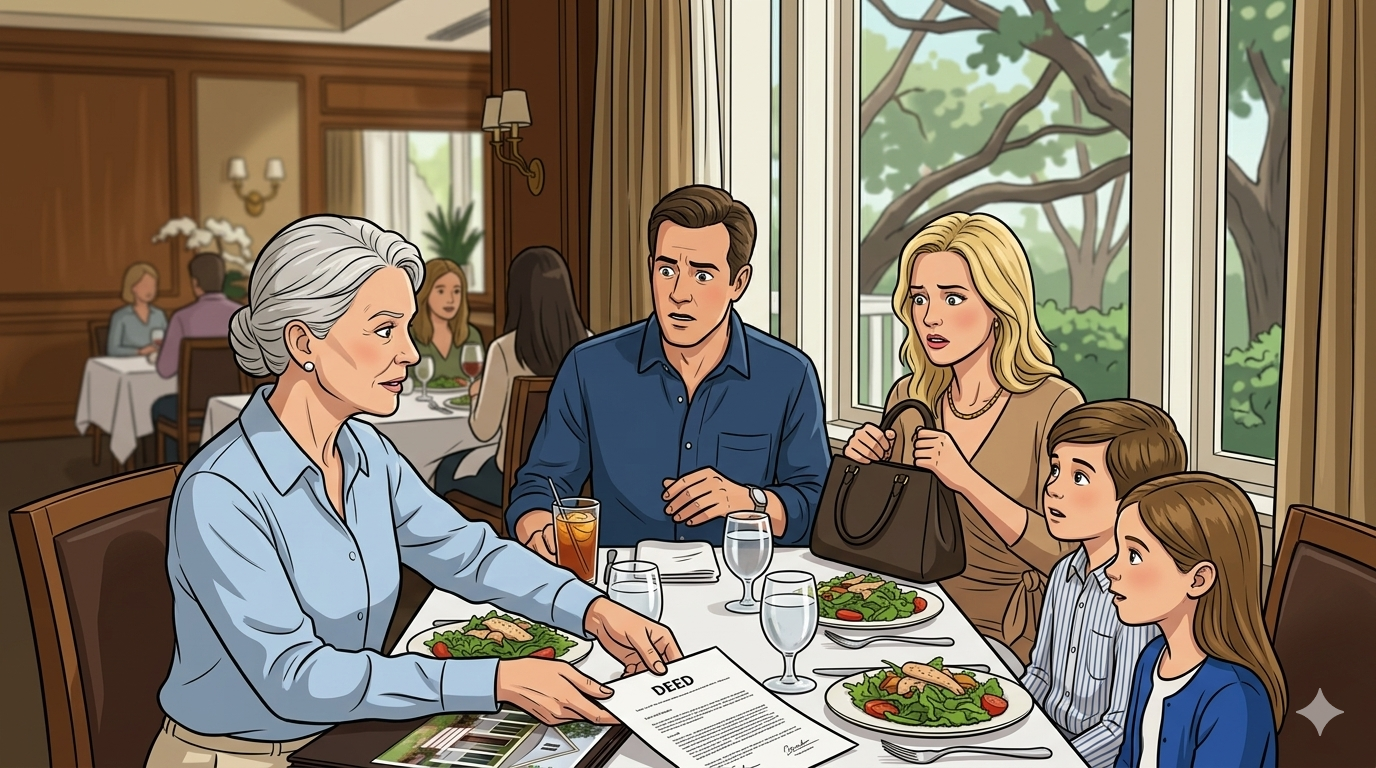
And when Renee, forty minutes into a perfectly staged lunch, finally stood up to address the table with a glass in one hand and concern in her voice and announced that “the family” needed to discuss the fact that I had made significant financial decisions without consulting Daniel and that she believed I had come into a large sum of money and was being manipulated—
I opened the folder.
“I appreciate the concern,” I said.
Then I told them.
Not every detail. Not the exact account balances or the trust architecture or the names of my advisers.
Just the truth.
I had won the lottery.
I had claimed it legally and privately.
I had retained counsel.
I had purchased a house.
I was no longer dependent on anyone at that table.
And the reason no one had been informed was because I had overheard myself described as a financial burden before any of them knew I might become an asset worth courting.
You could have heard a teaspoon hit carpet.
Renee’s face went still in that dangerous way people’s faces do when the lie they were counting on has been outpaced by facts.
Daniel looked like someone had struck him without standing up.
“I’m not a woman who needs protecting,” I said to both of them. “I was a woman who needed dignity. There is a difference.”
I left before dessert.
That lunch changed everything.
Not because of the money.
Because I finally said the quiet part in front of witnesses.
After that, the legal questions faded quickly. Pat informed me that Renee had indeed spoken to two attorneys about possible challenges—competency, undue influence, estate concerns. Both had told her, in more sophisticated language, to sit down and stop embarrassing herself.
The money was mine.
The house was mine.
The decisions were mine.
I was competent, represented, and not remotely susceptible to whatever narrative she hoped to impose.
Daniel and Renee separated in the fall.
I did not celebrate that.
I also did not blame myself for it.
A marriage in which one person sees an elderly parent as an encumbrance until a trust document appears was already carrying too much rot to survive forever.
Daniel and I rebuilt slowly.
There is no grander word for it than that.
Not healed.
Not restored.
Rebuilt.
We met for coffee. Then lunch. Then occasional dinners where the subject of money was treated like weather—real, present, not the center of the room. He apologized more than once. I believe he meant it. I also believe remorse does not reverse time. Both things can be true.
Caroline visited that summer and walked through Whitmore Lane with tears in her eyes. “Mom,” she said, standing in the sunroom while morning light poured across the floorboards, “this is the first place I’ve seen you look settled since Dad died.”
That mattered more than almost anything else.
Caleb and Sophie came by in July and treated the house as children always treat honest spaces—with immediate practical curiosity. Sophie asked whether she could help me plant tomatoes. Caleb found Harold’s bridge-design books and vanished into them for two hours. By the second visit, they were asking if they could come over on Saturdays. By August, Saturday had become ours.
I put a chalkboard in the kitchen.
I bought licorice for Caleb and watercolor paper for Sophie.
I planted lavender by the walkway because Dorothy insisted the house wanted it.
Frank, my widowed neighbor, taught me how to adjust the drip irrigation schedule for late summer and brought me heirloom seedlings I had no business attempting but did anyway. We drank tea on the porch sometimes and talked about our spouses without lowering our voices as if missing them were embarrassing.
I wrote my will with care.
Forty percent to Caroline.
Twenty percent to Daniel.
The rest to a scholarship foundation in Harold’s name for first-generation engineering students and widows returning to school late in life, because Harold would have loved the practicality of that and I loved the poetry.
Renee was not mentioned.
There was nothing vindictive in that.
Only specificity.
By the second spring in Whitmore Lane, I no longer thought of Daniel’s house as the place I had left.
I thought of it as the place where I finally understood what I could no longer tolerate.
That is a different thing.
People imagine that sudden money solves loneliness.
It doesn’t.
Money solves money. It solves roofs and locks and legal expertise and the ability to leave a room without wondering where you’ll sleep next. Those are not small things. They are enormous things. They are freedom, often. But they are not love.
Love still has to be measured by behavior.
Who notices when you disappear.
Who speaks to you as if your interior life matters.
Who asks the second question instead of settling for the convenient answer.
Who sees your age and does not immediately translate it into leverage.
I learned all of that more clearly after the money than before it.
And I am grateful for that too.
If you ask me now what changed my life, I will tell you the answer you probably expect first.
Yes, winning fifty-two million dollars after taxes changed my life.
It bought me a house with oak trees and a porch swing.
It bought me lawyers and advisers and privacy.
It bought me the right never again to sit at someone else’s table pretending not to hear the subtext in the room.
But that was not the true beginning.
The true beginning was much smaller.
It was a basket of dinner rolls in my hands.
My son’s tired voice across a Tuesday dinner table.
My own hand setting the basket down instead of gripping it tighter.
My own body standing up.
My own feet carrying me out of the room.
The money was the door.
Walking away was the key.