
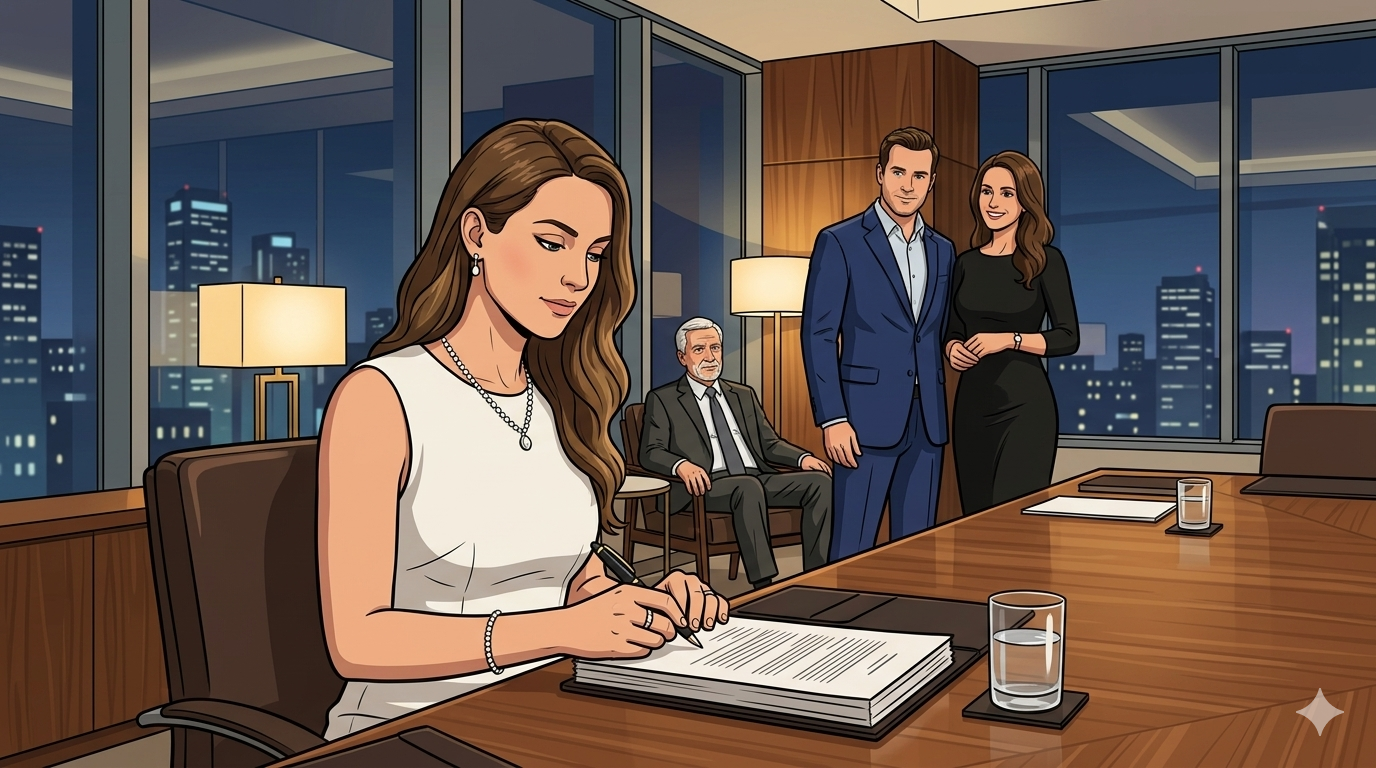
The black card skidded across the mahogany conference table and stopped just short of my hand like it had been trained to recognize humiliation on sight.
No one reached for it. No one breathed too loudly. The only sound in the room was the soft, expensive hum of the air conditioner and the wet hiss of rain against the thirty-eighth-floor windows. Mexico City had dissolved into a gray blur behind the glass, all towers and traffic and lives moving forward as if nothing important was happening above them. But inside that room, every eye was fixed on me, waiting for the same thing.
They were waiting to see if I would cry.
Diego leaned back in his leather chair with his hands folded over his stomach and smiled the way men smile when they believe they’ve choreographed the final scene perfectly.
“Take it, Isabella,” he said. “That should cover a tiny rental for a month or two. Maybe somewhere with bars on the windows. Consider it severance for wasting two years of my life.”
Camila laughed from the window ledge without even pretending not to. She had one stiletto dangling from her toes, her phone loose in her hand, her mouth curved into the kind of smirk women wear when they mistake a man’s temporary attention for permanent status.
“I think she’s in shock,” Camila said, glancing at me the way people inspect damage after a fender bender. “Poor thing. She probably thought crying quietly and cooking pot roast would save her.”
I looked down at the black card. American Express Centurion. Heavy. Arrogant. A small rectangle of metal Diego liked to place on restaurant tables with a little too much force, as if everyone in the room should stand up and salute his spending limit.
I didn’t touch it.
Across from me, Diego’s attorney shifted uncomfortably in his suit. Robles was sweating at the temples despite the cold room, his fingers moving restlessly against the edge of a legal pad. Beside him, his junior associate kept her head down and her expression neutral, which was smart. Smart people know how to survive rooms like that by becoming furniture until the blood dries. At the far end of the conference table, near the dark credenza beneath an abstract painting, a man in a charcoal suit sat quietly with a leather portfolio on his lap.
No one had asked who he was.
That was Diego’s first fatal mistake of the afternoon.
He had always assumed he understood the room he was standing in. He thought wealth was loud, obvious, desperate to be recognized. He thought if a person was truly important, the room would announce it for them—through introductions, through body language, through the subtle rearranging of air that follows people who are used to being obeyed. If no one announced a person, Diego simply edited them out. He mistook silence for irrelevance.
He had been making that mistake since the day he met me.
He tapped the stack of divorce papers with one manicured finger. “Sign, Isabella. Let’s not turn this into a melodrama. You’ve always hated scenes.”
I almost laughed.
He was right about one thing. I did hate scenes. I hated loud rooms, public cruelty, emotional theater, all the gaudy ways people use humiliation to make themselves feel larger. I had spent most of my life learning how to move quietly through rooms so I could see people clearly before they ever thought to look at me. But quietness and helplessness are not the same thing. Diego had never understood that distinction, and now it was about to cost him everything.
I picked up the pen.
Camila let out a satisfied little sigh, like a woman settling into a spa chair. Diego’s grin widened. Robles slid the final page half an inch closer with the eagerness of a man who thought the worst part of the day was over.
He believed he was watching my surrender.
That was the funniest part.
Because this wasn’t the moment I lost anything. This was the moment the invoice arrived.
Two years earlier, Diego believed he had discovered me.
That was how he liked to tell it. He told the story so often he had almost convinced himself it was romantic. He met me at La Estrella Café in Polanco on a wet Thursday afternoon, when the city smelled like traffic, coffee, and rain on stone. I was working the morning shift, wearing a dark green apron over black clothes, my hair pinned back, my name tag reading Isabella Ruiz. He had come in with two men from some logistics startup and spent most of the meeting speaking too loudly into the space around him, as if the walls needed to understand his valuation.
When his clients left, he stayed.
“At this point,” he said, smiling up at me as I cleared their cups, “I should probably just start paying rent for the table.”
“You could also just leave,” I told him.
He laughed as if I’d flirted. I hadn’t.
That should have been enough information.
At twenty-nine, Diego Ramirez was all momentum and presentation. He was good-looking in the polished, aggressively maintained way of men who believe the mirror is part of the market. Expensive haircut, expensive watch, expensive casualness. His company, NovaLink, was just beginning to rise then—some logistics and data optimization firm that made investors feel modern. He talked in polished bursts about scaling, market capture, vertical integration, efficiency. He spoke the language of ambition with the feverish confidence of someone who loved not success itself but being seen in proximity to it.
Normally, I had no patience for men like that.
But there were things about Diego that slipped past my first line of defense. He was funny when he forgot to perform. He had a boyish energy that made his arrogance seem temporarily forgivable. He asked about my classes with what sounded like actual interest. He remembered details. He sent flowers to the café on a day I’d mentioned having an exam and wrote good luck, don’t roll your eyes, I mean it on the card.
He was exhausting, yes.
He was also, sometimes, charming.
The truth is, men like Diego often appear most attractive to women who have spent their lives around truly powerful men. Next to old, disciplined wealth, Diego’s swagger looked almost harmless. Flashy, ambitious, a little vain, but not dangerous. My father certainly recognized the danger before I did.
When I first mentioned Diego over breakfast one Sunday, my father didn’t look up right away. He was reading a financial report on one of his tablets, glasses low on his nose, coffee untouched. The morning light on the terrace made the silver in his hair look almost white.
“The founder?” he asked.
“Yes.”
“The one who introduced himself to you by mentioning he’d just closed a six-million-dollar round?”
I laughed. “You make him sound worse than he is.”
My father looked up then. “A man who introduces himself with his net worth is either insecure or dangerous.”
“Or excited.”
“Often all three.”
Alejandro Mendoza had built enough of the city to be allowed that kind of cynicism.
He never courted publicity, which only made the mythology around him thicker. Real estate, logistics, private equity, infrastructure, hospitality—there were districts in Mexico City that functioned because companies under his holding structures quietly kept them functioning. The Mendoza name moved beneath the visible economy like a deep current. You didn’t see it unless you knew exactly where to look. My father preferred it that way. He hated interviews, despised awards dinners, and once told me that anyone who needed strangers to know they were rich probably wasn’t rich enough.
I was his only child.
Almost no one outside our inner circle knew that.
After my mother died in a car accident when I was eleven, my father withdrew me from the visible version of our life with a ferocity that some people misunderstood and I later came to admire. The tabloids had circled like flies around grief, turning photographs of mangled metal into entertainment, speculating on inheritance, custody, lovers, trauma. My father saw what the public does to pain and made a decision. We vanished.
Schools under different names. Apartments registered through trusts. Private security so discreet it looked like coincidence. A quiet life inside an enormous one. By eighteen, I could move through most of the city unrecognized if I wore simple clothes and used my mother’s surname. At first it was protection. Later it became preference. I liked knowing how people treated me when they believed I had nothing but a waitressing job, night classes, and a rented apartment.
It was educational in the purest sense.
Some men ignored me.
Some men patronized me.
Some flirted with the thrill of “saving” a girl they imagined lacked options.
A rare few treated me like a full person.
My father never told me to stop living that way. He only warned me about the conclusions men draw when a woman appears unguarded.
“If someone thinks you are easy to diminish,” he told me once, “he will eventually show you who he is.”
Diego took longer than some.
At first, he seemed to enjoy my ordinariness. Or what he believed was ordinariness. He told friends I was “refreshing.” He said he liked that I wasn’t one of those women who cared about status. He praised my restraint, my simplicity, my lack of social performance. At the time, I mistook that for admiration.
It wasn’t admiration.
It was comfort.
A man like Diego loved being important relative to someone. He loved the way my apparent modesty amplified his own shine. Standing next to me, he got to feel generous, sophisticated, worldly. I made his success feel larger because he believed I had no success of my own.
By the time I understood that, I was already in love enough to bargain with reality.
We married after fourteen months.
Quietly.
Civil ceremony, then dinner. No major announcement, no society pages, no strategic guest list. Diego liked telling people we were “keeping it real.” In truth, he loved the story of himself marrying beneath his tax bracket. It made him look romantic and evolved. He never asked too many questions about my family because I gave him just enough truth to keep his imagination busy and his suspicion asleep. My mother had died. My father and I were not close in the way he considered normal. I had no appetite for discussing wealth or status. All true, in their way.
He filled the gaps with fantasy.
The first six months of marriage were easy enough to fool me.
He was affectionate, attentive, almost boyishly proud to be a husband. He brought me pastries from meetings, sent me photos from business trips, touched the small of my back in crowded rooms like he needed reassurance I was there. He called me grounding. He told people I reminded him what mattered. He said things like you’re the best thing I’ve ever done in a voice that made me feel chosen, not acquired.
Then NovaLink grew.
With growth came investors.
With investors came visibility.
With visibility came the kind of scrutiny that turns insecure men feral.
Diego became increasingly conscious of how things looked. Not how they felt. How they looked. He corrected what I wore to dinners I hadn’t wanted to attend. He once bought me a dress without asking because, as he put it, “we’re in different rooms now.” He laughed when I asked a genuine question at a strategy dinner about labor conditions in one of his supply-chain models.
“You don’t ask that kind of thing in front of funding,” he told me in the car later.
“Why not?”
“Because it makes me look naive.”
That was when I started understanding that Diego didn’t experience marriage as a union. He experienced it as branding. I was not his partner in the deepest sense. I was part of the aesthetic package around his ascent. When I enhanced that package, he was warm. When I complicated it, he became irritated.
The cruelty began in small doses.
He corrected my pronunciation of names I already knew.
He told stories about me at parties that subtly positioned me as provincial.
He explained rooms to me as if I were a visiting student, not a woman who had spent her childhood watching men twice his age acquire and ruin cities over lunch.
He began using phrases like your world and my world, as though he had personally invented influence.
Then came Camila.
She started as an executive assistant. Efficient. Immaculate. The kind of woman who wore ambition in silhouettes and scents. She hovered near Diego with a tablet and a smile sharpened into deference. At first I barely registered her. Then I saw the looks. The jokes half-finished before I entered the room. The messages answered a little too quickly. The intimacy of repetition.
I asked him once, very calmly, if there was something between them.
He laughed.
“You’re jealous of my assistant?”
“I’m asking a question.”
“And I’m answering it. No.”
Later, when I found her lipstick in the glove compartment of his car, he said I was becoming paranoid. When I noticed they had begun traveling to the same conferences and returning from them with the same private ease, he told me I was insecure. When I pointed out that he had grown colder to me in exact proportion to how close she got to him, he accused me of trying to sabotage the most important year of his career.
Gaslighting is too elegant a word for what men like Diego do. It sounds strategic. Often it’s simpler than that. They just keep denying obvious things until your own trust in your perceptions becomes more fragile than their lies.
I might have stayed longer than I should have.
I might have spent another year trying to perform the wife version of patience until he left me cleanly and publicly anyway.
What changed everything was a pitch deck.
He had left his laptop open on the kitchen island while showering before a trip to Monterrey. I only glanced because I thought he’d left a calendar open and I needed to know when he’d be back. Instead, I saw a presentation title in bold across a dark slide:
CEO Image Realignment.
Beneath it were bullet points.
Refine founder narrative.
Increase luxury-facing market appeal.
Divorce before public offering.
Frame prior marriage as youthful mismatch.
Reposition with partner more aligned to brand sophistication.
I didn’t need to read any further.
When I confronted him, he didn’t look guilty. He looked annoyed.
“You weren’t supposed to see that yet,” he said, toweling his hair.
That was the moment I stopped grieving the marriage and started documenting the man.
I contacted my attorney first.
Then my father.
When I told Alejandro what I’d found, there was a long silence on the line. Then he asked only one question.
“Would you like me in the room when it ends?”
I didn’t answer immediately because some stubborn part of me still wanted to prove I could do it myself. That I could handle my own husband, my own humiliation, my own decisions without folding back into the protection of my father’s world.
Then I imagined Diego in full performance mode, framing me as unstable, emotional, small.
“Yes,” I said.
So my father came.
Not as himself at first.
Not announced.
Not introduced.
Just a quiet man in a charcoal suit in the corner of a room where Diego believed he was about to stage-manage my reduction.
And now, with the divorce papers signed, Diego was still talking.
He was enjoying himself too much to sense the trap closing.
“You really should see this as a mercy,” he said, flipping through the signed pages. “I know you probably imagined you’d stay attached to me forever. Nice apartment, nice dinners, nice last name. But you never belonged in my world, Isabella. You don’t know how to dress for investor weekends. You ask the wrong questions in front of the right people. You still think loyalty matters more than timing.”
Camila smiled down at her phone and muttered, “God, that’s true.”
Diego continued, warming to his own cruelty. “And honestly? Between us, you were always better suited to something smaller. Something quieter. You’re a good background person.”
There it was. The sentence that completed the painting.
I folded my hands in my lap and felt the oddest calm.
No anger.
No pleading.
No heartbreak.
Just the certainty that this man had reached the end of the rope and still believed he was climbing.
“Are you done?” I asked.
He blinked, amused. “Actually, I was thinking maybe I’d say one last thing for closure.”
Camila laughed. “Closure is healthy.”
Diego leaned forward. “For what it’s worth, Isabella, I hope you do something sensible now. Maybe find a smaller life that fits you. Maybe marry a dentist in Puebla. Maybe teach children. I don’t know. But this”—he gestured around the room, to the skyline, to the table, to the life he believed he commanded—“was never you.”
I stood.
He frowned. “Where are you going?”
I slid the black card back across the table with one finger. It scraped softly and stopped in front of him.
“I don’t need that,” I said.
Camila rolled her eyes. “Don’t be dramatic. You’ll need something.”
I turned toward her. “Keep the card. You may need it more than I will.”
She laughed once, but the sound died quickly because something in my face had finally broken the spell of her certainty.
Diego shook his head. “Is this the part where you try to regain your dignity with a line?”
“No,” I said. “This is the part where you meet my father.”
Silence.
Real silence this time.
Diego stared at me as though language itself had failed.
Then the man in the corner stood.
Attorney Robles went white so fast it was almost medical.
The junior associate actually inhaled sharply.
Camila’s smile vanished.
And my father walked to the table with the unhurried calm of a man who had nothing to prove and everything to protect.
He set his portfolio down in front of Diego.
“Good afternoon,” he said.
Robles half rose. “Señor Mendoza, I—”
My father lifted one finger.
Robles sat back down.
Diego looked from me to my father to the attorney whose complexion had turned the color of old paper. You could see recognition arrive in stages. First confusion. Then memory. Then panic. The Mendoza name was not one you forgot if you moved money in Mexico City. Diego had spent the last year pitching fund structures to entities ultimately connected to Mendoza Holdings without ever realizing it. He had been begging at the edge of my father’s empire while insulting my taste in wine.
“What is this?” Diego asked.
My father opened the portfolio.
“This,” he said, “is the moment you realize the room never belonged to you.”
He laid out documents one by one.
Commercial lease ownership for the building.
Financing structures connected to NovaLink’s bridge facility.
Covenant details on Diego’s penthouse.
A liquidity support map showing the boutique investment bank handling NovaLink’s IPO depended on Mendoza-backed capital.
A board notice, time-stamped seventeen minutes earlier, calling an emergency governance review.
Diego grabbed the nearest page.
I watched the blood leave his face.
No shouting.
No threats.
No dramatic accusations.
Just paper.
That’s the thing about real power. It rarely needs volume. Volume is for people trying to make uncertainty look muscular. True power is quiet because it does not require belief to operate.
“They can’t do this,” Diego said.
My father looked at him the way a surgeon might look at a patient insisting on negotiating gravity.
“They can review exposure,” he said. “They can assess reputational risk. They can decide whether a founder who treats his spouse like disposable packaging is a stable public-facing asset.”
Camila slid off the window ledge, suddenly less decorative.
Robles found his voice. “Señor Mendoza, surely there is no need to make this adversarial. This is a personal matter.”
My father’s gaze shifted to him, cool and direct. “No. A personal matter was when my daughter discovered her husband intended to discard her as a narrative inconvenience. This became a business matter when he performed that intention in a board-facing environment while under structures my firms support.”
Diego looked at me. “Your daughter?”
“Yes,” my father said. “My daughter.”
The room swayed in the most beautiful way.
Not physically.
Socially.
Hierarchically.
Suddenly everyone had to re-see the last two years in reverse. The “ordinary” wife. The quiet background person. The woman Diego thought had no family, no influence, no options. All of it snapped apart at once, revealing not the helpless girl of his imagination but a woman who had let him write his own indictment in full sentences.
“No,” Diego said. “No, that’s impossible. She said she had no one.”
“I said very little,” I replied. “You filled in the rest.”
He stared at me as if betrayal had somehow occurred in the opposite direction.
That almost made me pity him.
Almost.
My father opened another folder.
Inside was a printout of messages between Diego and Camila—messages my legal team had obtained through discovery once Diego filed. He had assumed that because I was being quiet, I was unprepared. The messages made his private contempt impossible to package as misunderstanding.
Need divorce finalized before roadshow.
She has no leverage.
After the dead-weight charity case is gone, we can present the upgraded version.
She still thinks loyalty matters. It’s almost cute.
Camila looked at the pages, then at Diego, then away.
He reached for his phone. Sixteen missed calls. Nineteen unread messages. One from his CFO: Why is Mendoza involved? Call me NOW. One from the lead underwriter: We have a serious problem. Another from a board member: Are these allegations and materials authentic?
He went pale enough that even Camila stepped back instinctively.
My father rested both hands lightly on the table.
“You offered my daughter a black card and a used Nissan as severance. That was unwise.”
The sentence landed harder than any shouted threat ever could have.
Diego tried one final move. The legal one. The technical one. Men like him always believe the paperwork that protects them in ordinary disasters will also protect them from moral collapse.
“She signed a prenuptial agreement,” he said.
“She did.”
“The divorce is complete.”
“It is.”
“Then legally, this is over.”
My father’s faint smile made even Robles look sick.
“The marriage is over,” he said. “Your difficulties are just beginning.”
Then he turned to me.
“Are you ready?”
It was such a gentle question.
Not triumphant.
Not loaded.
Just a father asking whether his daughter had finished being diminished for one afternoon.
I looked at Diego. Really looked at him. Not the man I married, because that man had largely been projection and hunger. I looked at the man in the room now. Arrogant, frightened, scrambling, finally understanding that his cruelty had not landed on empty ground but on protected territory he was too vain to recognize.
“Yes,” I said.
We walked out.
Behind us, chaos began in the only language Diego had ever truly respected.
Phones.
Lawyers.
Numbers.
Risk.
The conference room door closed on the sound of his voice breaking.
In the elevator down, neither my father nor I spoke at first. Rain blurred the city beyond the glass. In the reflection, I looked strange to myself. Small and composed and untouched, though I knew the truth was messier. Pain does not vanish just because you win the room.
At the lobby, my father asked, “How do you feel?”
I thought about it honestly.
“Tired,” I said. Then, after a second, “Less stupid.”
He looked at me with an expression so soft it almost undid me.
“You were never stupid,” he said. “You were optimistic. There is a cost to that. But it is not stupidity.”
I nodded, though part of me still wanted to grieve the woman who had mistaken Diego’s attention for depth. There is always a little mourning involved when illusion dies. Even when the illusion was embarrassing. Even when its death saves you.
Outside, the driver opened the car door.
As we pulled away, I looked up at the tower. Thirty-eight floors above the street, Diego was discovering the difference between influence and ownership. Between attention and authority. Between being rich enough to dominate a dinner and being foolish enough to insult the only person in the room whose silence had been protecting him.
The unraveling began almost immediately.
By evening, NovaLink’s board had placed him on temporary leave pending “leadership conduct review.” By the next morning, the investment bank handling the IPO delayed the roadshow indefinitely. Two institutional investors requested emergency calls. One fund publicly cited “governance concerns.” Another privately asked whether Diego’s continued visibility posed unacceptable reputational volatility. That phrase delighted my father for reasons he refused to explain.
Camila disappeared by Friday.
She posted a statement through a friend saying she had “never intended to become entangled in a private legal matter” and was “taking time to refocus on her own professional goals.” Translation: the building was on fire and she had found the nearest exit with good lighting.
Diego called me thirteen times the first day. Twenty-two times the second. Then the letters started.
Some were angry.
Some apologetic.
Some confused.
All self-serving.
He wanted a meeting.
He wanted context.
He wanted to explain.
He wanted to know why I had hidden my identity if I truly loved him.
That last one made me laugh out loud in my father’s library.
Because there it was again. His final defense. That if only I had informed him of my value in a language he respected—family, money, influence, pedigree—then he might have treated me well. As if decency toward an apparently ordinary woman was too much to ask of him, but decency toward the daughter of Alejandro Mendoza would have been obvious.
He had told on himself so completely that no answer from me was necessary.
Still, he kept trying.
He sent flowers.
I refused them.
He sent a handwritten letter.
I shredded it.
He had Robles reach out to my attorney proposing a private dinner “for closure.”
My attorney replied with one sentence: Ms. Mendoza does not require further contact to understand what happened.
That was when Diego finally understood there would be no side door back into my life.
The city, meanwhile, entertained itself.
In Mexico City, gossip travels with extraordinary speed when money, humiliation, and hierarchy intersect. The story mutated in all directions. Some versions said Diego had unknowingly married a billionaire heiress. Some said my father had bought the tower that week just to corner him. Some said Camila had fainted. Some said I had sliced the black card in half and thrown it back in his face. That one I almost wished were true.
The reality was quieter and far more devastating. I had done almost nothing. I had sat in a chair, signed the papers, and let Diego become fully himself in front of the wrong witness.
That was enough.
My father asked me, a week later over dinner, whether I wanted him to keep pressing. There were a dozen pressure points still available. Contracts to challenge. Debt to accelerate. Associations to sour.
“No,” I said. “I want out. Not revenge as a hobby.”
He nodded approvingly. “Good.”
“Do you still think I was foolish to marry him?”
“I think,” he said, cutting into his sea bass, “that some lessons cannot be outsourced.”
That was as close to I told you so as he would ever come, which is why I have always loved him.
The legal end of it happened cleanly. The prenup stood. I asked for nothing public, nothing dramatic, nothing that would keep me tied to Diego through years of performative litigation. What he lost in the market was more than I could have gotten through court anyway. And unlike spousal support, it carried the specific sting of being self-inflicted.
I moved out of the apartment we had shared and into a smaller place temporarily, mostly to remember what silence felt like when it wasn’t weaponized. Then I began rebuilding.
That is the least glamorous phase of any collapse. Not the confrontation. Not the headlines. The rebuilding.
I slept.
I ate.
I sat in rooms alone and let the humiliation metabolize without rushing to turn it into a speech about resilience.
I rejoined the foundation work I had neglected during the marriage.
I started planning the arts and scholarship initiative my mother had dreamed of funding years before her death.
I stopped dressing for men like Diego.
I stopped entering rooms prepared to explain myself.
The strangest part was how quickly the city forgot his side of the story once he ceased being useful.
That is another thing arrogant men misunderstand. They think the world loves them. Usually the world just enjoys momentum. Once it stops, admiration evaporates and all that remains is the shape of their conduct.
Three months later, NovaLink named a new interim CEO. Older. Boring. Competent. Precisely the kind of man investors trust when they no longer have the appetite for charm. Diego’s penthouse went on the market soon after. Not by choice.
Camila resurfaced with a hotel-chain executive, then vanished again into some other orbit.
And me? I started laughing more. Not loudly. Not as performance. Just unexpectedly, in the kitchen, in traffic, over coffee with women who actually knew me. The kind of laughter that returns only when your body no longer mistakes home for a negotiation.
A year later, I ran into Diego by accident in a hotel lobby near Chapultepec.
He looked expensive in the way men do when they are spending money they no longer control. Good suit. Tired face. Less ease around the mouth. He saw me and paused, then approached as if drawn by old muscle memory.
“Isabella.”
“Diego.”
“You look well.”
“I am.”
He nodded, hands half in his pockets, searching my face for something. Regret, maybe. Softness. The old reflex to make his discomfort more manageable.
“I’ve wanted to talk to you,” he said.
“There’s nothing left to say.”
He exhaled. “I was awful to you.”
“Yes.”
He winced at the simplicity of it. “I didn’t understand what I had.”
There it was again. The ownership language. Had. As though the problem had been his failure to value an asset correctly.
“That was never the problem,” I said.
He frowned. “Then what was?”
I held his gaze.
“The problem was that you believed my value depended on your ability to recognize it.”
For once, he had no answer.
I left him standing there with his expensive silence and took the elevator up to a meeting about a community arts campus that would fund programs for girls from neighborhoods men like Diego only entered through security-tinted glass.
Years later, people still tell versions of that divorce story.
They say the billionaire stood up in the corner and destroyed my husband.
They say Camila’s face went white.
They say the board fired him before he could leave the building.
They say I never flinched.
Some of that is true.
But the version I carry is simpler.
The divorce papers were still warm from the printer.
The black card skidded across the table.
My husband mistook my quiet for emptiness.
And then the one man in the room who had loved me long before I learned how to protect myself stood up and reminded everyone, including me, that being underestimated is only dangerous when you start believing it too.
Diego thought he was ending a marriage with a forgettable woman.
What he was actually doing was insulting the daughter of a man whose influence ran through his financing, his building, his lenders, his board confidence, and the future he thought he had built alone. But even that is not the most important truth.
The most important truth is this:
He had a chance to love me when he thought I had nothing to offer but myself.
That was the test.
And he failed it before the money ever entered the room.
THE END!!!