
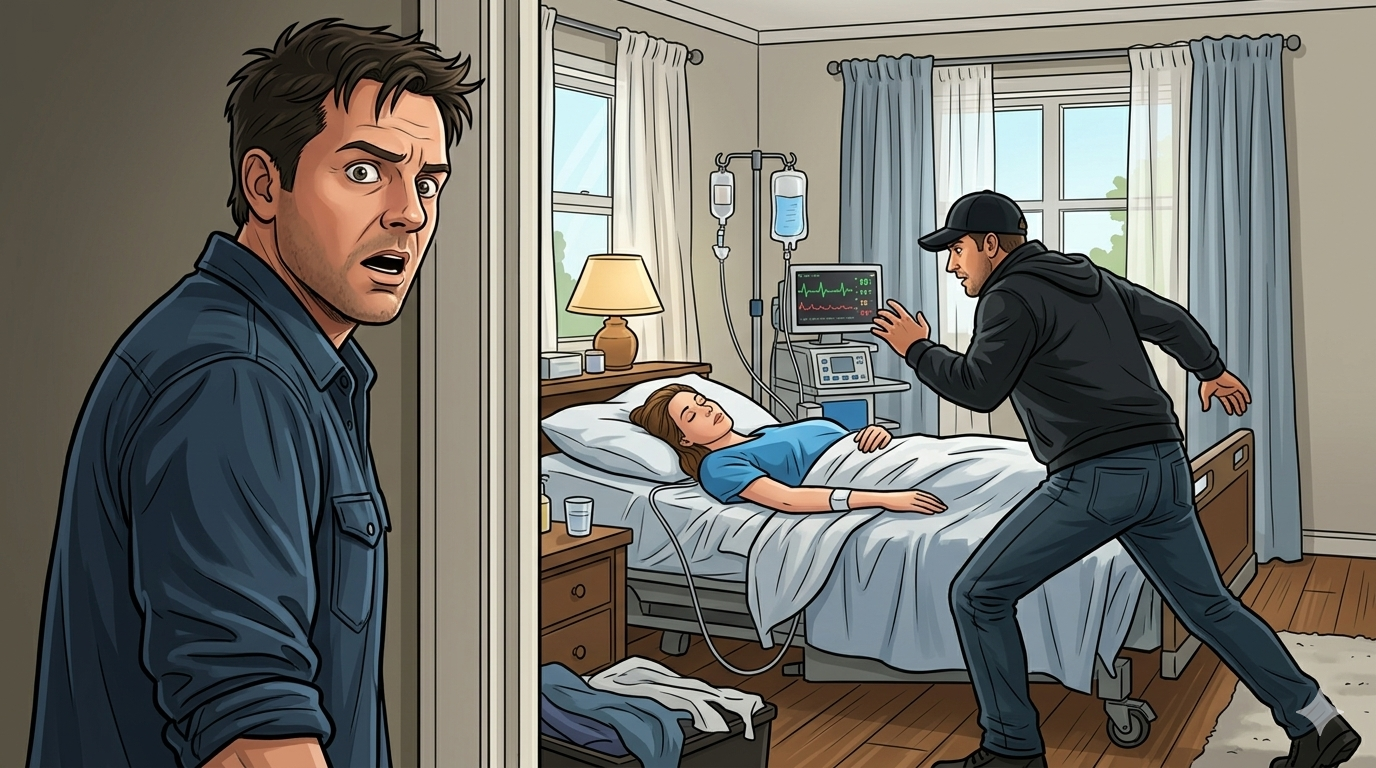
Part 7
The first thing I learned about living alone is how loud a refrigerator can be when there’s no other noise to compete with it.
My new apartment sits above a bait shop near the marina. The floorboards always smell faintly of saltwater and old wood, and if I crack the window, I get the raw, metallic tang of low tide mixed with diesel from the fishing boats. It’s not pretty. It’s honest. I needed honest.
Most mornings I walked to the end of the pier with coffee that tasted like burnt pennies and watched gulls bully each other over scraps. I tried to practice being a person again—one without alarms set for medication schedules, without a hallway that felt like a prison corridor.
Some nights were almost normal. I’d eat cereal for dinner and leave the bowl in the sink because no one was here to be disappointed in me. I’d fall asleep on the couch with the TV murmuring, and for a few precious minutes, my body forgot it had ever lived on adrenaline.
Then the world remembered for me.
It happened on a Wednesday, the kind of late winter day where the sky looks like wet cement and everything smells like thawing mud. I came home to find a thick envelope shoved under my door, the paper stiff and official.
SUBPOENA, stamped in angry black letters.
I stood there in the narrow hallway outside my apartment, the stale smell of someone else’s cooking drifting from downstairs—fried onions, maybe—and felt my hands go cold.
Inside was a court order: I was required to testify in a financial crimes case involving North Harbor Group. My name was printed in the top paragraph like it belonged there.
I read it twice, then a third time, because denial is a reflex.
Under “relevant parties,” there it was: Matthew Rourke.
And beneath that, a phrase that made my stomach drop.
Potential accessory to fraudulent transfer.
For a second, the old urge to run kicked in. Not run like jogging. Run like disappear. Drive until the ocean turned into desert, change my name, sleep in cheap motels that smelled like bleach.
Then I pictured Bree’s eyes—the first time they focused on me after six years—and the way my sister had cried when the cuffs clicked on her wrists. I didn’t have the luxury of disappearing. People had already tried to write my story for me.
I called Detective Harper and left a message that came out sharper than I meant.
“It’s Matt. I got subpoenaed. Call me back.”
She called ten minutes later. “You got it too,” she said, which told me I wasn’t the only one being dragged back in.
“Too?” I asked.
“Federal task force,” she said. “They’re widening the net. North Harbor isn’t just a local mess anymore. Matt… your name is in the ledger.”
My mouth went dry. “How?”
“The transfers,” she said. “Some are authorized under your name. Some are routed through an account opened with your information.”
I stared at the wall above my sink where a crack ran like a tiny lightning bolt. “That’s impossible.”
Harper’s voice softened, just a notch. “It’s not impossible if someone had access to your documents. Your signature. Your routines.”
My vision blurred with sudden anger. Bree’s whisper: I used your name.
“I didn’t sign anything,” I said, but even as I spoke, I heard how weak it sounded in a system that runs on paper, not truth.
“I know,” Harper said. “But knowing and proving aren’t the same thing.”
I sat down hard on the edge of my couch. The cushion sighed under me. Outside, gulls screamed like they were laughing.
“What do I do?” I asked, hating how small my voice sounded.
“You cooperate,” Harper said. “And you don’t talk to anyone else involved. Not Bree. Not Alyssa. Not—”
“I’m not talking to them,” I cut in, heat in my chest. “I’m not—” I stopped, because my throat tightened around the rest of the sentence: I’m not forgiving them.
Harper paused. “Good. Because there’s something else.”
I waited, my pulse ticking in my ears.
“The ledger you handed over,” she said carefully, “it’s missing pages.”
I sat up. “What?”
“Sections were torn out,” Harper continued. “Cleanly. Like someone knew exactly what they wanted removed.”
A cold wave rolled through me. “When?”
“We don’t know,” she admitted. “Could’ve been before you found it. Could’ve been after. We logged it, sealed it, but federal evidence moves through hands. Too many hands.”
For the first time since the arrests, I felt that same old paranoia snap back into place like a collar.
“I need to see it,” I said.
“You can’t,” Harper replied. “Not without the task force. And Matt… there’s another thing missing.”
I waited, bracing.
“Your home security footage from that final night,” she said. “The files are corrupted. The chunk where Alyssa first pulled the gun? Gone.”
My skin prickled. “That’s not possible. I backed them up.”
“Someone accessed your laptop,” Harper said. “Or your cloud. Or both.”
I stared at my coffee mug on the table, the dried ring it left like a bruise. “You’re saying someone is still cleaning up.”
“Yes,” Harper said. “And you need to assume they know where you live now.”
The words sank into me slowly, like a hook catching.
After I hung up, I checked my locks twice. Then I checked my windows. Then I sat at my tiny kitchen table with the subpoena in front of me and tried to breathe like a normal person.
At 2:17 a.m., my phone buzzed.
Unknown number: Don’t testify.
My chest tightened.
Another buzz.
Unknown number: You already gave the cops one book. Don’t make us look for the second.
My fingers went numb around the phone. Second book? I didn’t have a second—
I stood so fast my chair scraped. I crossed the apartment and yanked my door open.
The hallway was empty, lit by a flickering bulb that made everything look sickly. But on the floor, right outside my threshold, lay a small padded mailer.
No postage. No return address.
My name written in block letters.
I picked it up with shaking hands and carried it inside like it was radioactive. The mailer smelled faintly of cologne—sharp, expensive, out of place in my salty little life. I tore it open.
Inside was a single Polaroid photo.
It was me, crouched in my old side yard, looking into Bree’s bedroom window.
The timestamp in the corner read a date from months ago—my first night watching.
On the back, in neat handwriting, were four words:
Bring the book tonight.
My throat tightened as a sick realization crept in—if someone had photographed me that night, what else had they seen, and what “book” did they think I still had?
Part 8
I didn’t sleep. I sat in a chair with the Polaroid on the table like it could confess if I stared at it long enough.
The photo wasn’t taken from the street. The angle was too close, too low. Whoever took it had been in the side yard with me—or behind me—breathing the same cold air, watching my hands shake, watching my life split open.
That meant one thing I didn’t want to say out loud: this started before Kellan ever showed his face.
By eight a.m., I was at the police station, the lobby smelling like burnt coffee and wet wool. Detective Harper met me near the front desk, eyes tired, hair pulled back tight like she hadn’t had a real night of sleep in weeks.
“You got messages?” she asked.
I handed her my phone.
She scrolled, her jaw tightening. “Yeah,” she muttered. “This is them.”
“Them?” I echoed.
Before she could answer, a woman stepped out of an office down the hall. She wore a plain dark blazer, no badge visible, but her posture had that calm authority that made the air around her feel organized.
“Matthew Rourke?” she asked.
Harper nodded toward her. “This is Agent Chen. FBI financial crimes task force.”
Agent Chen shook my hand. Her grip was firm, dry, professional. Her eyes stayed on mine like she was filing me into a category.
“Mr. Rourke,” she said, “thank you for coming in quickly.”
“I didn’t have much choice,” I replied, and my voice sounded harsher than I meant.
Chen didn’t flinch. “No,” she agreed. “You don’t.”
She led us into a small conference room that smelled like cheap air freshener and old paper. A stack of files sat on the table. A laptop. A clear evidence bag with something inside I didn’t recognize at first.
Chen tapped the bag. “This was recovered from Alyssa Rourke’s apartment during the search,” she said.
Inside was a slim black notebook—same size as Bree’s ledger, but different cover. No plastic wrap. No label.
My stomach dropped. “That’s not mine.”
“We know,” Chen said. “But it’s related. It contains partial records of transfers—some overlapping with Bree’s ledger, some not.”
I swallowed. “So there are two ledgers.”
“Minimum,” Chen corrected gently. “In operations like this, there are always copies. Always backups.”
Harper leaned forward. “Tell him about the missing pages.”
Chen opened one of the folders and slid a photocopy toward me. It was a scan of Bree’s ledger, pages numbered in Bree’s handwriting.
The numbering jumped: 41… 42… then 49.
Seven pages missing.
I stared at the gap until my eyes hurt. “Those pages—what was on them?”
Chen’s expression stayed neutral. “We don’t know. But based on surrounding entries, those pages likely covered the period right before Bree’s accident. That window matters.”
My skin prickled. “You think the accident was connected.”
Chen didn’t say yes. She didn’t say no. She just said, “Patterns don’t usually start after a major event. They start before.”
Harper’s gaze flicked to me, almost apologetic.
Chen slid another paper across the table—an account application form. My name. My social security number. My address from the old house.
And my signature at the bottom.
It looked like mine. The curve of the M. The little tail on the R.
I felt bile rise.
“That’s not—” I started.
“I know,” Chen said. “But you need to understand what you’re facing. This document was used to open an account that moved significant funds. The defense will argue you were involved.”
“And I wasn’t,” I snapped, heat flaring. “I was wiping my wife’s mouth while my sister was drugging her.”
Chen’s eyes stayed steady. “Then help us prove that.”
I forced myself to breathe. Goal: clear my name. Conflict: the paper says otherwise.
“What do you need?” I asked, the words coming out like swallowing nails.
Chen nodded once, approving. “We need whatever they’re asking you to bring.”
“The ‘book,’” Harper murmured, glancing at the Polaroid I’d handed over.
“But I don’t have another book,” I said, frustration rising. “Unless—” My mind flashed to Bree’s work folder in my safe. The pages with Alyssa’s name circled. The initials K.M.
Chen leaned in slightly. “Bree had more than one set of records. Work records. Personal notes. A whistleblower packet. Anything that could bring down multiple people. If she hid something else, you’re the most likely person she hid it near.”
I shook my head slowly. “I sold the house.”
Harper’s brows knit. “When did you close?”
“A few weeks ago,” I said. “But the new owners haven’t moved in yet. Renovations.”
Chen’s gaze sharpened. “Then the property may still hold evidence. And someone else may be trying to retrieve it before we do.”
My chest tightened as the threat clicked into place. Those messages weren’t just intimidation. They were instructions. A test. They thought I had something. They were trying to pull it out of hiding by scaring me into handing it over.
Chen pushed a card toward me. “Call me if anything else happens. And Mr. Rourke—don’t go back there alone.”
I almost laughed, sharp and humorless. “Seems like I’m not allowed to do anything alone anymore.”
Harper walked me out. The hallway smelled like disinfectant and wet boots. At the front door, she stopped me with a hand on my arm.
“Matt,” she said quietly, “if this turns out to be bigger than Kellan—if there are more people… promise me you won’t try to play hero.”
I looked at her hand, then up at her face. “I’m not a hero,” I said. “I’m just tired of being someone’s tool.”
Back at my apartment, the bait shop downstairs was open. A bell jingled every time someone came in, and the scent of cut bait drifted up through the floorboards like a warning.
I checked my mailbox out of habit, even though the Polaroid hadn’t been mailed.
Inside was a small brass key taped to a plain white envelope.
No stamp. No address.
Just four words, printed from a label maker:
UNIT 12. DON’T WAIT.
My throat tightened as my hand closed around the cold metal.
If they wanted me at Unit 12, did that mean the “book” was already there—and if so, what would I find first: the truth that clears me, or a trap that buries me?
Part 9
The storage facility sat on the edge of town, tucked behind a discount furniture store and a self-serve car wash that always smelled like lemon soap and damp concrete. The sign out front flickered, one letter buzzing like it was about to give up.
HARBORLOCK STORAGE.
I parked two rows away and sat in my car with both hands on the wheel, breathing through my nose like I could calm my body by sheer force. The brass key lay on the passenger seat, catching weak sunlight.
Agent Chen had told me not to go alone. Harper had told me not to play hero.
But the envelope had shown up at my doorstep without a stamp, without an address. Whoever was moving pieces knew where I lived. If I waited, they wouldn’t.
Goal: find what they want before they take it. Conflict: walking into their hands.
I texted Harper anyway. Just two words: Going now.
No response.
My phone showed one bar of service.
“Perfect,” I muttered, and stepped out into air that smelled like wet pavement and cheap pine cleaner. The wind was sharp, cutting through my jacket. Somewhere nearby, a car wash sprayer hissed like a snake.
Inside the storage office, fluorescent lights buzzed overhead. A small space heater whirred in the corner. A man behind the counter chewed gum and watched a tiny TV mounted near the ceiling, where some talk show host was yelling about celebrity divorces.
He barely glanced at me. “Need a unit?”
“I already have one,” I lied, holding up the key like it belonged to me.
He nodded toward the back without care. “Gate code’s on the sign. Units are numbered.”
No ID check. No paperwork. Just the lazy indifference of a place that relies on people not caring enough to break rules.
I walked through the gate, past rows of metal doors that looked like shut mouths. The smell back here was oil and dust and cold steel.
Unit 12 was near the end of a row, slightly tucked away from the main lane. That felt intentional.
My heartbeat thudded in my ears as I approached. I checked over my shoulder twice. No one. Just wind rattling a loose chain-link fence.
The lock on Unit 12 was newer than the others—shiny, unweathered. I slid the brass key into it.
It turned smoothly.
I paused with my hand on the latch, my breath fogging in front of me. My skin prickled with the sense that I was stepping onto a stage where the audience was hidden.
Then I pulled.
The roll-up door screeched as it lifted, metal protesting. Cold air rushed out from inside, carrying the stale scent of cardboard and old fabric.
The unit was half-full.
There were boxes stacked neatly, labeled in thick black marker: OFFICE, TAX, MEDICAL, PHOTOS.
My name was on some of them.
My stomach tightened.
I stepped inside slowly, my shoes crunching on grit. The concrete floor was cold enough to seep through the soles.
On top of the nearest stack sat a slim black notebook wrapped in plastic—too familiar.
I reached for it, fingers shaking.
Before I touched it, I noticed something else: a small digital recorder placed beside the notebook, like a gift.
My throat went dry.
I picked up the recorder. The plastic felt cold and slightly sticky, like someone’s hand had been sweating when they set it down.
I pressed play.
At first, there was only static and a faint hum. Then a voice came through, low and close to the mic.
Bree.
Not the broken whisper I’d heard in the hospital. This was clearer—still strained, but unmistakably her voice. Like she’d recorded it in the brief window when she could speak more, before whatever sedation or damage stole it again.
“Matt,” the recording said, and my chest tightened at how she said my name—like it hurt.
“If you’re hearing this, it means you found Unit 12. It means they’re pushing you. It means I’m probably not there to explain it.”
My mouth went dry. I glanced around the unit, suddenly hyperaware of every shadow.
Bree continued, voice shaking. “There are two books. The one you gave them was never the whole story. I hid the rest because… because I didn’t trust anyone. Not you. Not Alyssa. Not the cops. Not myself.”
Anger flared in me even as my throat tightened.
“I used your name,” Bree admitted, and the words hit like a bruise pressed too hard. “I told myself it was temporary. I told myself I’d fix it before you ever noticed. Then I got scared. Then I got greedy. Then I got in too deep.”
My fingers clenched around the recorder until my knuckles ached.
“There’s evidence in that unit,” Bree said. “Real evidence. Names. Dates. The kind that burns everything down. But Matt… listen to me. If you open the wrong box first, you’ll think I’m the villain. And maybe I am. But I’m not the only one.”
My breath caught. Red herring or truth? My eyes darted to the boxes labeled TAX, OFFICE.
Bree’s voice softened, almost pleading. “Start with PHOTOS. Please. It’ll make the rest make sense.”
Then the recording clicked off.
Silence rushed in, thick and heavy. The storage unit felt suddenly smaller, like the metal walls were inching closer.
I stared at the PHOTOS box, my heart hammering.
Photos could mean anything. Bree and I smiling on vacations. Bree at her desk. Alyssa at family holidays.
Or photos like the Polaroid—proof someone had been watching. Proof of the accident being staged. Proof of who else was involved.
I reached for the PHOTOS box and peeled back the tape with trembling hands. The cardboard gave off a dusty, papery smell.
Inside were envelopes. Some labeled in Bree’s neat handwriting.
One envelope was marked:
ACCIDENT NIGHT.
My stomach dropped.
I slid the photos out. The first image showed our car at the intersection where Bree was hit—headlights glaring, smoke curling into the fog. But the angle was wrong. This wasn’t from a bystander.
This was from above, like from a building… or a camera mounted high.
The second photo showed Bree on a stretcher, her face pale, her hair matted to her forehead.
And in the background, half-hidden near the ambulance door, was someone I recognized instantly.
Mrs. Powell.
Not in her nurse uniform—she wore a dark coat, her peppermint-tea hair tied back, her face turned toward the camera like she’d sensed it.
My lungs stopped working.
Mrs. Powell had been there the night Bree was hit.
My hands shook so hard the photos rattled.
A sound scraped outside the unit—metal on metal.
The roll-up door shuddered.
I spun toward it, heart slamming, and watched in horror as the door began to slide downward from the outside, closing me in.
Through the narrowing gap, I saw a pair of boots planted on the pavement.
And a familiar, calm voice drifted in, almost amused.
“Found what you needed, Matthew?”
The door dropped another foot, and my blood went cold—because if Kellan was here, how long had he been waiting, and what was he going to do now that I’d seen Mrs. Powell in those photos?
Part 10
The roll-up door didn’t slam. It slid down with slow, deliberate pressure, metal teeth chewing the light away an inch at a time. The boots outside stayed planted like they were part of the pavement.
“Found what you needed, Matthew?” the voice said again, calm as a weather report.
My throat locked up. The storage unit smelled like cardboard and old fabric and that sharp, expensive cologne from the mailer. I could taste adrenaline like copper on my tongue.
I shoved the photos back into the envelope with clumsy hands and stuffed the recorder into my pocket. Goal: keep the door open long enough to get out. Conflict: whoever was outside had weight and leverage and zero intention of letting me leave.
I lunged toward the gap and jammed my shoulder under the door, the metal cold and gritty against my jacket. It bit into my collarbone. I pushed up hard—hard enough that my breath came out in a grunt.
The door rose maybe three inches.
Outside, I heard a soft laugh.
“Careful,” the voice said. “You’ll bruise yourself. And then you’ll say we did it.”
“We?” I hissed, teeth clenched. “Show your face.”
The boots shifted. The door pressed down again, heavier now. I shoved back, my legs shaking, my hands sliding on metal.
“Don’t make a scene,” the voice said, closer. “I hate scenes.”
I tried to wedge my foot under the gap and felt the edge scrape my shoe. Gravel ground under my heel.
“Is this your plan?” I spat. “Trap me in a storage unit? You’re pathetic.”
The voice didn’t change. “I’m efficient.”
Something clicked outside—like a lock turning. The door shuddered and dropped another inch.
Panic hit fast and hot. I stared around the unit, brain searching for options like a frantic animal. There was no back door. No window. Just boxes and metal walls.
My phone sat in my pocket like dead weight. One bar earlier; now it might as well be a brick.
“You want the book,” I said, forcing my voice steady. “Fine. I’ll hand it out. Back up.”
Silence. Then, amused: “You don’t have it.”
My stomach dropped. “I do.”
“No,” the voice said, with the confidence of someone looking at a scoreboard. “You have what Bree wanted you to find. Not what we need.”
Bree. Hearing her name in that tone—casual, possessive—made my skin crawl.
“You’re Kellan,” I said, even though part of me screamed not to confirm anything.
A soft exhale, like a smile. “That’s one of them.”
My shoulders burned from holding the door. My arms shook. I could feel my strength bleeding out in tiny tremors.
“Tell me why my nurse is in those photos,” I blurted, because my mind couldn’t let go of it. “Tell me why Mrs. Powell was at the accident.”
The pause that followed was small but real—like I’d stepped on a nerve.
Then the voice recovered. “Ah. You opened the PHOTOS box. Good boy.”
Rage surged. “Answer me.”
“Would it help you,” Kellan murmured, “if I told you Mrs. Powell isn’t who you think she is?”
My breath hitched. “She’s—”
“Peppermint tea and motherly scolding,” Kellan continued, almost fond. “A perfect costume. Bree always had an eye for casting.”
Bree always had an eye for casting.
The words sank in like a hook.
“You’re lying,” I said, but it came out thin.
“I’m practical,” Kellan corrected. “Mrs. Powell was there that night because she was supposed to be. Everyone was supposed to be where they were.”
The door pressed lower, grinding on my shoe. Pain shot through my toes.
“You’re going to testify,” Kellan went on, voice smooth, “and they’re going to eat you alive. Accessory. Co-conspirator. Loving husband who ‘handled’ the money while his poor wife slept.”
My mouth went dry. “I didn’t.”
“I know,” Kellan said, almost gently. “That’s the beauty of it. You don’t even have to be guilty to be useful.”
Emotion flipped inside me—fear turning into something sharper, colder. Not just panic. Clarity. They weren’t trying to kill me. Not yet. They were trying to steer me.
“What do you want?” I asked.
“A choice,” Kellan said. “You can walk out of here and keep breathing, or you can keep tugging at threads until you hang yourself.”
My arms were starting to fail. The door inched down.
“Walk out,” I rasped. “How?”
There was a faint shuffle outside, then the door lifted—just a little—as if someone had eased their weight off it.
“Hands where I can see them,” Kellan said. “Step out slow.”
I didn’t trust it. But my shoulder screamed, my foot throbbed, and the gap was my only oxygen.
I slid forward, palms open, ducking under the door as it hovered halfway. Cold air hit my face like a slap.
And there, just beyond the threshold, were not one pair of boots.
Two.
One pair was heavy men’s boots—mud on the soles, a scuffed toe.
The other pair was smaller, cleaner, with a worn heel and a faint dusting of salt like someone had walked off a coastal sidewalk.
My eyes snapped up.
I caught only fragments because my brain refused to assemble the picture: a dark SUV idling a few lanes down, headlights off; a figure in a coat standing close to the door; a flash of pale latex at the wrist.
Then the figure leaned slightly into the strip of light spilling out of Unit 12.
A woman.
Older.
Hair tied back.
And even before my eyes fully registered her face, my nose did.
Peppermint.
Not the gentle peppermint of tea. The sharper peppermint of menthol—like something meant to wake you up or clear you out.
My stomach dropped through the floor.
“Mrs. Powell?” I breathed.
Her expression didn’t soften. It didn’t harden either. It was just… resigned. Like someone caught mid-task, not mid-crime.
“Matthew,” she said quietly, using my name the way she always did, like a reprimand.
The man beside her—hood up, face half-shadowed—spoke in that same calm voice.
“See?” he said. “Everyone’s where they’re supposed to be.”
Mrs. Powell’s eyes flicked to the envelope of photos clenched in my fist.
Then she did something that turned my blood to ice: she reached into her coat pocket and lifted a key ring.
On it hung a familiar brass key.
And a second one—my old house key, the one I’d thought only Alyssa had.
My hands started to shake.
If Mrs. Powell had my key, how long had she been inside my life, and how many nights had she stood over Bree’s bed while I slept in that chair thinking I was the only one?
Part 11
I didn’t scream. I didn’t lunge. I just stood there in the cold storage lane, breathing like my lungs were trying to escape my body.
Mrs. Powell held the key ring up for a second longer, then lowered it slowly, like she understood the violence in stillness.
The hooded man beside her shifted his weight, the cologne from the mailer hitting me again—sharp and expensive. He kept his face angled away from the overhead security light, like he’d practiced being unidentifiable.
Goal: get out alive and get the evidence into the right hands. Conflict: the right hands might not exist.
“You’ve got two seconds,” I said, voice shaking, “to tell me what the hell this is.”
Mrs. Powell’s mouth tightened. “This isn’t a conversation to have here.”
“You’ve been in my house,” I spat. “You’ve been touching my wife. You’ve been—”
“Protecting her,” Mrs. Powell cut in, and the sharpness in her voice felt like a slap. “From people like him.”
The hooded man chuckled softly.
“Don’t,” I warned, but it was useless. My control was thin as paper.
Mrs. Powell’s gaze stayed on me, steady. “Matthew, you need to listen to me.”
“I listened for six years,” I said. “I listened to pumps and monitors and your little peppermint-tea advice. I listened while my sister drugged my wife. I listened while everyone lied.”
Her eyes flickered, and for a fraction of a second I saw something human there—regret, maybe, or exhaustion.
“I didn’t know about Alyssa,” she said quietly.
The hooded man made a small sound, like disagreement.
Mrs. Powell ignored him. “I knew Bree was in danger. I knew she had information that could get her killed.”
“And your solution was to play nurse in my house?” I demanded.
“It was the only access point,” she snapped, then immediately softened her tone like she realized she’d shown too much. “Bree went off-grid after she started digging. She asked for help. I gave it.”
My stomach turned. “Bree asked you.”
Mrs. Powell hesitated. That hesitation was loud.
“She did,” she said finally, but it sounded like half a truth.
The hooded man stepped closer, and my body tensed instinctively.
“Enough,” he said smoothly. “We’re not here for your feelings.”
Mrs. Powell’s shoulders lifted like she was bracing herself. “You shouldn’t have come, Matthew. I told Harper not to let you—”
Harper.
My pulse spiked. “You know Harper.”
Mrs. Powell’s jaw tightened. “Of course I do.”
A new cold spread through me. If she knew Harper, if Harper knew her, then what was real? What had been staged? What part of my “help” had been curated?
I glanced down the lane. No cars. No sirens. Just wind rattling chain-link and the distant hiss of the car wash.
“You lured me here,” I said to Mrs. Powell, voice low. “You sent the key.”
Mrs. Powell didn’t deny it. “I had to.”
“Why?” My hands shook around the envelope. “To take the photos? To take the book?”
“To keep you from giving it to the task force,” the hooded man said calmly, and my stomach flipped.
Mrs. Powell shot him a look—warning, furious.
So that was it. Not just intimidation. A tug-of-war over evidence.
“The FBI isn’t clean,” Mrs. Powell said quickly, as if racing the damage he’d done. “Not this case. Not this town. Someone’s been feeding them filtered truth for years.”
My mouth went dry. “Agent Chen?”
Mrs. Powell’s gaze darted—just a flicker, but enough.
The emotional turn hit like a shove: the one person who’d sounded steady in that conference room might be another hand on the puppet strings.
“Get in the SUV,” the hooded man said, voice still calm. “You bring what you found. We’ll decide what happens next.”
I didn’t move. My feet felt bolted to the ground.
Mrs. Powell’s voice softened. “Matthew, please. If you go back to the station with those photos, you’ll be dead before you hit the courthouse steps.”
“Then why not call Harper?” I demanded. “Why not do this the right way?”
Mrs. Powell’s lips pressed together. “Because the right way got Bree hit in the first place.”
The words landed like a punch.
I looked at the ACCIDENT NIGHT envelope in my hands. Bree on a stretcher. Fog. Headlights. Mrs. Powell in the background.
My throat tightened. “Were you there when she got hit?”
Mrs. Powell’s eyes didn’t leave mine. “Yes.”
“Did you—”
“No,” she cut in, sharp. “I did not put her in that road. But I knew she was being followed. I knew she was being squeezed. And I got there too late.”
The hooded man exhaled, impatient. “We’re running out of time.”
Mrs. Powell stepped closer to me, lowering her voice. I could smell peppermint and something else underneath—like antiseptic, like hospitals.
“Matthew,” she whispered, “Bree didn’t record that message for you because she trusted you. She recorded it because she needed a fail-safe. A drop point. And you’re it.”
My stomach twisted. “So she used me.”
Mrs. Powell’s expression softened, just a fraction. “Yes.”
The admission didn’t shock me so much as it confirmed the bruise I’d been pressing for months. I swallowed hard, fighting the urge to either laugh or throw up.
“What do you want from me?” I asked, voice hoarse.
Mrs. Powell reached out and gently touched the envelope in my hands, like she was grounding me. “Give me the photos and the recorder,” she said. “Not him. Me.”
The hooded man shifted, irritated.
“Then what?” I demanded.
Mrs. Powell’s eyes held mine. “Then you walk away.”
“Walk away,” I echoed bitterly. “That’s your big plan?”
“It’s survival,” she said softly. “And you can’t save Bree anymore. Not the way you think.”
The words hurt because they were true.
I stared at Mrs. Powell, trying to decide whether she was an ally, a liar, or both.
Then my phone buzzed in my pocket—one sudden vibration that felt like a heartbeat.
One bar of service had found me.
A text flashed on the screen from Harper:
DON’T MOVE. STAY WHERE YOU ARE.
My blood went cold.
Mrs. Powell’s eyes flicked to my phone, then past me, down the lane.
Her face changed—tightening, calculating.
And she whispered, barely audible, “They followed you.”
I turned my head, and in the distance I saw headlights blooming to life at the end of the storage row—more than one car, coming fast.
If Harper was coming, who else was coming with her, and why did Mrs. Powell look like she’d just realized she miscalculated?…………………………………………..