
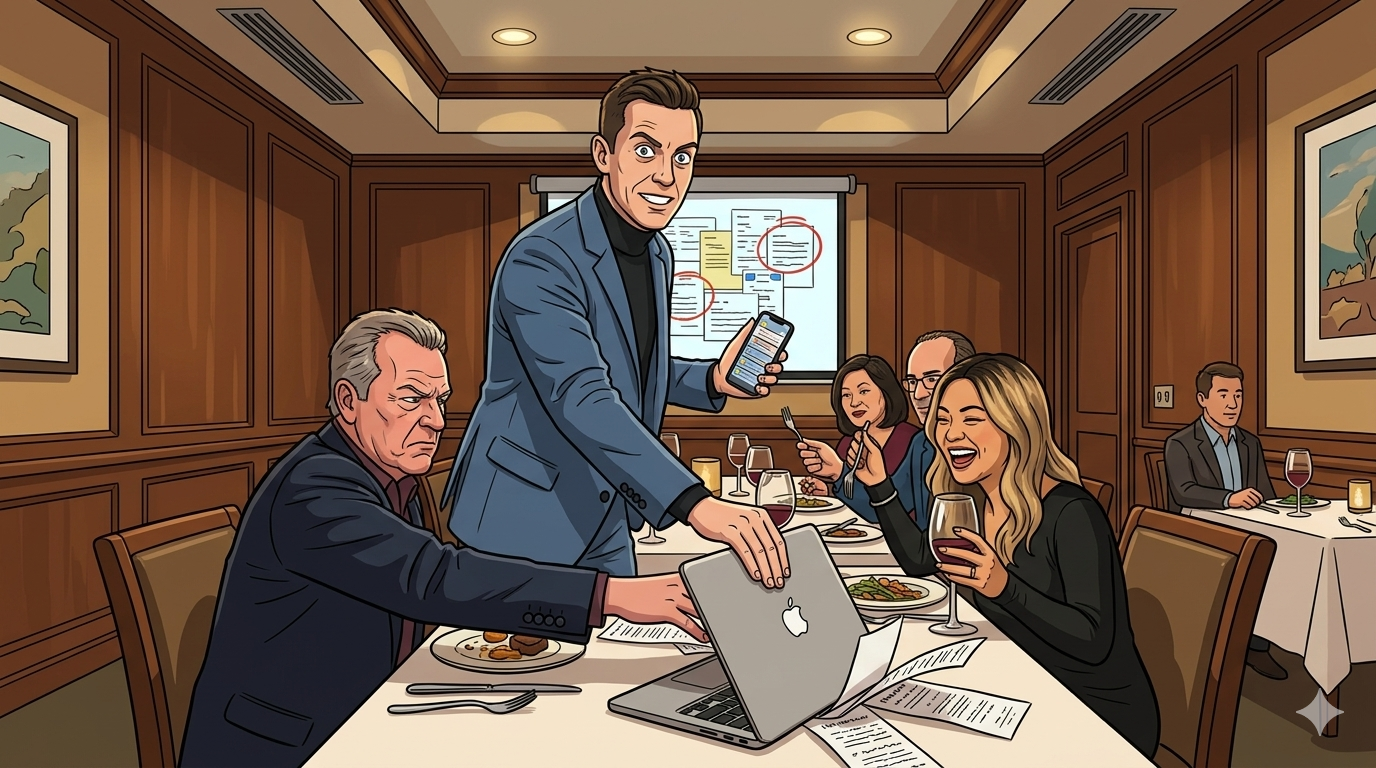
My family uninvited me from Christmas at the eight-thousand-dollar chalet I paid for as if I were some distant cousin who might show up drunk and “cause complications.” I did not argue. I did not beg. I nodded, walked out of my parents’ living room, drove home through freezing rain, opened my laptop, and canceled the reservation with one click.
The next morning my phone detonated.
My father called first, screaming so hard I had to pull the phone away from my ear. My sister followed with a stream of all-caps texts about ruined outfits, wasted vacation days, and how I had “embarrassed the family.” My mother appeared at my front door at eight in the morning carrying a casserole dish and the expression she always wore when she wanted to pretend a disaster was just a misunderstanding.
But the part that changed everything was not the yelling.
It was the call from my bank.
The woman on the line sounded calm in the way people do when they are trained not to sound alarmed for you.
“Mr. Brennan,” she said, “we flagged an attempted travel-lodging transaction tied to your account credentials this morning. The booking was submitted under the name Roger Brennan.”
My father.
Using my account.
Trying to rebook the same chalet in his own name.
That was the exact moment something final gave way inside me.
Because exclusion I understood. I had lived with it all my life. But theft has a different temperature. It is colder. Cleaner. It tells you the truth in a language even denial cannot soften.
My name is Patrick Brennan. I am twenty-eight years old, and for most of my life I played a role in my family that took me far too long to name. I was not the golden child like my younger sister Vanessa. I was not the authority like my father Roger, or the martyr like my mother Linda. I was the utility. The fix. The fallback. The son who paid for things, carried things, arranged things, and was expected to be grateful for the privilege of being useful.
The chalet had been my latest mistake.
It sat high in the mountains outside Vail, all exposed pine beams and stonework and floor-to-ceiling windows that looked out over a slope of untouched snow. The listing made it look like the set of an expensive holiday movie. There was a massive fireplace, a copper soaking tub, a long rustic dining table, and a wraparound deck with strings of warm lights that glowed against the dark.
It cost eight thousand dollars for the week.
I booked it without flinching because I made the same mistake I had made too many times before: I thought maybe one grand gesture would finally buy me a seat at my own family table.
I even texted my father the confirmation.
He did not say thank you.
He replied, “Good. That’s the least you could do.”
At the time, I swallowed it, because swallowing things had become a family skill.
That was my father’s way. He never gave credit. He gathered it. If a dinner turned out well, he had chosen the restaurant. If Vanessa found a good apartment, he had “guided” her. If my mother hosted a lovely Easter brunch, he spoke about it as if she were a junior employee who had executed his vision. Gratitude, in his world, was a resource that only moved in one direction.
Still, I wanted to believe the chalet would be different.
I pictured snow outside the glass, music low in the background, a tree by the fireplace, hot cider on the counter, and for once no one acting like I was just the guy handling logistics. I imagined something dangerously naive: warmth.
Then Vanessa started posting.
“Can’t wait for our family Christmas at the chalet Dad rented!”
I stared at her caption so long my screen dimmed. Dad rented.
Not me.
Not the one who paid the deposit. Not the one who spent an hour comparing rental terms and cancellation policies and snow access and sleeping arrangements because Vanessa had very firm opinions about “aesthetic bedrooms.” Not the one who had already bought garland and ornaments and extra stockings because some foolish part of me still wanted the place to feel magical.
When I asked her about the post later, she gave me that lazy little smile she had perfected by age twelve—the one that said she knew exactly what she was doing and also knew she would never be punished for it.
“Relax, Patrick,” she said. “Nobody cares who clicked reserve. It was Dad’s idea.”
That should have warned me.
It did not.
A week later I stopped by my parents’ house after work carrying two boxes of decorations. My mother had asked if I could pick up extra lights because “the chalet needs to look festive in photos,” and I had done it because helping was easier than hoping they would notice I was trying.
They were in the living room drinking wine when I came in. Vanessa was stretched across the couch talking about holiday outfits for pictures she had already mentally assigned to social media.
I set the boxes down and started to say I found some nice glass ornaments.
My father cut me off without even looking at them.
“You’re not invited to Christmas this year.”
There are moments when the brain tries to rescue you by pretending you misheard something obvious.
“What?”
He swirled the wine in his glass and kept his eyes on the television.
“It’s family-only Christmas,” he said. “We don’t need complications. You can do your own thing.”
Complications.
That was what I was now.
The man paying for the holiday, buying the decorations, handling the details, and still somehow too inconvenient to actually attend.
Vanessa did not defend me.
My mother did not either. She stared into her glass with that polished silence she always used when she wanted to agree with someone while still feeling like a good person.
I stood there holding a box of lights I had paid for and felt something old and humiliating rise in my throat. Not surprise. Recognition.
So I did the only thing that shocked them.
I nodded.
No fight. No pleading. No speech about fairness or gratitude or family. I just said, “Understood,” turned around, and walked out while the room stayed warm behind me.
At home I opened my laptop, pulled up the reservation, and canceled the chalet.
One click.
The refund confirmation hit my email thirty seconds later.
By 7:12 the next morning, my father was calling.
By 7:13, Vanessa was texting that she had already posted about the trip and I had ruined everything.
By 7:26, my mother was leaving me a voicemail that began with, “Let’s all calm down.”
At 8:04, she arrived at my condo with a casserole and that fake-peacemaker tone she used when panic had finally reached her.
“Your father was upset,” she said softly once I opened the door. “You know how he gets. You’re still welcome, Patrick, if you handle this quietly.”
Handle this quietly.
Meaning pay again.
Meaning restore the fantasy and pretend dignity was too expensive to ask for.
I was still looking at her when my phone rang.
The bank.
I answered, and two minutes later I was standing in my own doorway with my mother on the porch and a fraud specialist telling me my father had tried to rebook the chalet using my account credentials.
Not my card by itself.
My credentials.
There is something uniquely sickening about hearing that word when it involves someone who taught you how to ride a bike.
The woman from the bank, whose name was Elise, explained that the fraud system had flagged the transaction because the booking used saved account data associated with my online banking profile, but the reservation name did not match the account holder. That mismatch had frozen the payment before it processed.
Then she said, almost as an afterthought, “There were also several smaller verification attempts over the last seven days.”
I felt my spine go rigid.
“What kind of attempts?”
“A linked external transfer request, two small merchant validations, and a loyalty-travel profile creation. They were blocked, but they suggest someone was testing access.”
Testing access.
My mother was still standing there with lasagna in her hands when I looked up and asked, “Has Dad been using the old desktop in your study?”
Her face changed.
Just for a second. A tiny flinch. A blink too slow to be accidental.
“Why would you ask that?”
Because six months earlier, during tax season, my father had insisted I use that desktop to help him untangle what he called “some basic account mess.” I had logged into my bank to verify a transfer to the IRS. He had hovered over my shoulder the entire time. Later he asked me to write down a few details for “family emergency paperwork”—date of birth, security question answers, my full legal name. At the time, it had felt intrusive in the way he always felt intrusive. Now it felt like reconnaissance.
I stepped back from the doorway.
“You should go home, Mom.”
Her grip tightened around the casserole dish. “Patrick, don’t be dramatic.”
I almost laughed.
Dramatic.
My father had just tried to use my bank credentials to book an eight-thousand-dollar chalet in his own name, and somehow my tone was the problem.
I shut the door.
Then I spent the next two hours doing something I should have done years earlier: I treated my family like strangers.
I locked every card. Changed every password. Enabled new authentication on every financial account I had. Froze my credit with all three bureaus. Reported the attempted booking as fraud. Filed an identity theft report. Asked the bank for login history. Requested the IP addresses tied to the attempts. Downloaded six months of statements.
And when I opened my credit report, I found the part that made the chalet feel almost small.
Someone had tried to add my parents’ address back onto my credit file two weeks earlier.
There was also a rewards card application I never submitted.
And an external account link request under the name R. Brennan Household Operating.
My father was not improvising because Christmas fell apart.
He had been building a back door.
I called my friend Maya, who worked in financial compliance for a regional credit union and had the kind of brain that sharpened when other people panicked.
Halfway through my explanation, she stopped me.
“Patrick, do not warn him yet.”
“I already told my mother to leave.”
“That’s fine. But from this point on, you document everything. Texts, voicemails, screenshots, timestamps. If he admits anything, don’t interrupt him. Let him talk.”
“I can’t believe I’m doing this with my own father.”
“I can,” she said quietly. “You just didn’t want to before.”
That landed harder than anything else that day.
Because she was right.
The evidence started arriving on its own within the hour.
My father left a voicemail that said, “You had no right to cancel something for this family, and I did what I had to do to fix your mess.”
Vanessa texted, “He only used your card because you sabotaged the reservation. Stop acting like a victim and just authorize it.”
My mother sent, “Please don’t make this into a legal thing. He was trying to save Christmas.”
I took screenshots of every word.
By noon, my father had switched from rage to righteousness.
“You owe this family,” one text read.
Another said, “After everything we spent on you growing up, you want to cry over one booking?”
That was his favorite revision of history. Parenting, in his version, was an investment portfolio, and children who reached adulthood still in debt to him had simply understood the arrangement correctly.
At three that afternoon, he called again. This time I answered.
“What do you want?” I asked.
“I want you to stop this nonsense and fix the chalet.”
“You tried to use my bank account.”
He exhaled sharply, like I was being difficult over a parking spot. “It’s family. Don’t be ridiculous.”
“You used my credentials.”
“I used what was available after you canceled a holiday you paid for in the first place.”
“Under your own name.”
Silence.
Then, “Because I wasn’t going to let you hold Christmas hostage.”
The clarity of it nearly took my breath away. He was not denying it. He was justifying it.
I kept my voice flat. “Fine. Then let’s handle it quietly.”
He jumped on that phrase so fast I knew he thought he had won.
“Good. Tomorrow. Ten a.m.”
“Not at your house,” I said. “At the bank.”
There was a pause.
“Why the bank?”
“Because if we’re straightening out account access, we may as well do it properly.”
He grunted his approval. My father loved any sentence that sounded procedural. It made him feel like the serious adult in the room.
The next morning, I arrived fifteen minutes early.
The branch manager, a woman named Celeste, had already reserved a private office. Beside her sat a fraud investigator from the bank’s regional team and a uniformed security officer who was there, she told me gently, “just in case emotions run high.”
I handed them a folder thick with printed screenshots, timestamps, credit alerts, and voice-message transcripts.
At 10:03, my family walked in.
My father in his charcoal coat, jaw set, already irritated by inconvenience. My mother carrying a leather purse with both hands like she was attending a funeral. Vanessa in cream boots and a fitted wool coat, looking as though she had still somehow expected this meeting to end with a restored luxury holiday.
My father did not sit at first.
He looked at me, then at the office, then at the investigator.
“What is this?”
Celeste smiled the tight professional smile of someone who had seen wealthy men confuse confidence with immunity.
“This is a formal review of reported unauthorized account activity, Mr. Brennan.”
The air changed.
Not dramatically. Just enough. A tiny pressure shift.
My father sat down.
The investigator spoke first. He was young, calm, and had the exact tone I imagine surgeons use right before telling someone that pretending will not improve the scan.
“Mr. Brennan,” he said, “we have an attempted lodging transaction submitted using Patrick Brennan’s banking credentials, with the reservation placed under your name. We also have linked transfer requests and account-access attempts from devices associated with your household internet service.”
My father let out a short disbelieving laugh.
“This is absurd. We’re family.”
The investigator nodded once. “That is not a legal authorization category.”
Vanessa shifted in her chair.
My mother whispered, “Roger…”
He ignored her.
“I was trying to fix a family trip that he canceled out of spite.”
Celeste folded her hands. “Using someone else’s account without permission is not considered fixing.”
“I’m his father.”
I will probably remember that moment for the rest of my life, not because of what he said, but because of the expression on his face when he said it. He genuinely thought it should settle the matter. That fatherhood was a permanent override code.
The investigator slid a page across the desk.
“This is a log of access attempts from the last nine days. This page shows the external transfer link request. This page shows the address modification attempt connected to Patrick’s credit file. This page shows the lodging submission under your name.”
My father did not touch the papers.
Vanessa looked at them and went pale.
My mother started crying silently, which had been her specialty for years: tears without intervention.
Then Celeste turned to me. “Patrick, for the record, did you authorize any of these actions?”
“No.”
She nodded and made a note.
My father leaned forward. “This is insane. He paid for the chalet. It was for the family. I used the information to restore what he ruined.”
The investigator’s eyes lifted.
“So you’re confirming that you knowingly used his information?”
The silence after that was almost merciful.
Vanessa understood before he did.
“Dad,” she whispered.
But he was already too far in, too sure of himself, too accustomed to rooms bending around him.
“I’m confirming,” he snapped, “that my son does not get to play power games with this family and then cry fraud when I correct the problem.”
The investigator closed the folder.
“Thank you,” he said.
There it was. The stupid, fatal dignity of a man narrating his own mistake.
My father finally realized something had shifted. He looked at me then, really looked at me, and I watched the first flicker of uncertainty move across his face.
“What did you do?”
I held his gaze.
“What I should have done the first time you treated my bank account like family property.”
He stood up so fast the chair legs scraped hard against the floor.
“You ungrateful little—”
The security officer moved.
Not aggressively. Just enough. A step. A presence.
My father stopped.
Celeste’s voice stayed level. “Mr. Brennan, the bank is closing all active credential paths connected to Patrick’s compromised profile. The attempted transactions are being referred for further review. Patrick has also filed an identity theft report. You should not contact him about his accounts again.”
My mother made a sound then—not quite a sob, not quite a plea.
“Patrick, please. It’s Christmas.”
I looked at her and felt almost nothing.
That was the strangest part. Not hatred. Not triumph. Just the stillness that comes after a long illness finally receives the correct diagnosis.
“No,” I said. “It was theft.”
Vanessa started crying for real then, mascara gathering at the corners of her eyes.
“I already posted everything,” she said, as if social embarrassment were somehow the center of the tragedy. “People know we were supposed to go.”
I nearly laughed.
Even now, her crisis was still the audience.
When the meeting ended, my father stormed out first. My mother followed him in tears. Vanessa lingered half a second as if she expected me to soften now that the adults had left the room.
Instead I turned back to Celeste and asked what the next steps were.
That afternoon I went home, changed every remaining password I owned, boxed up the last few decorations I had bought for the chalet, and put them in the hall closet.
My phone kept buzzing.
Voicemails. Pleas. Threats. Rewrites.
My father calling me vindictive.
My mother saying families should not destroy each other over money.
Vanessa insisting Dad had only “borrowed” what I should have spent anyway.
I saved them all.
Then, for the first time in years, I blocked every one of them.
The days that followed were ugly in the administrative way family betrayals often are. Forms. Affidavits. Statements. One patient detective from the financial crimes unit who asked careful questions and never once acted surprised. A credit bureau dispute. A new checking account. A replacement debit card. A separate report for the address tampering.
But beneath the paperwork was something cleaner than revenge.
Relief.
Because once you stop trying to win a seat at a table that was never yours, you realize how much of your life you spent standing.
Three days before Christmas, a mutual cousin texted me quietly to say the family holiday had collapsed completely. No chalet, obviously. No rebooking. No elegant backup plan. My father had tried to pretend I was “having a mental episode” and had forced the cancellation for attention, but that version apparently weakened when he also needed everyone not to ask why a bank investigator had called the house.
Vanessa deleted her posts.
My mother stopped delivering casseroles.
My father, I was told, had become obsessed with who else in the family “knew my side.”
For once, I did not care.
On Christmas Eve, Maya invited me to her place.
It was not a chalet. It was a slightly overstuffed bungalow with crooked garland over the doorway, two loud dogs, a tiny dining room, and a table full of people who passed mashed potatoes without scoring moral debts into the air above them. Someone burned the first batch of rolls. Someone else brought the wrong wine. A kid spilled sparkling cider on the tablecloth and nobody acted like the evening had been ruined.
At one point Maya’s mother handed me a plate and said, “Sit, sweetheart. You’re family tonight.”
It hit me so hard I had to look away.
Not because the sentence was dramatic.
Because it was easy.
Because there was no transaction attached to it.
Later, driving home through fresh snow, I thought about the chalet. About the windows and fireplace and view I had once believed could purchase belonging. About how I had imagined that if the setting looked expensive enough, maybe the people inside it would finally behave like the family I kept waiting for.
But places do not change people.
Money only gives them a larger room in which to reveal themselves.
When I got home, my apartment was quiet. A little too quiet, maybe. But honest. My tree stood in the corner with cheap white lights and the ornaments I had nearly given away to decorate someone else’s holiday. I made tea, sat by the window, and watched the snow thicken over the parking lot.
My phone stayed dark.
For the first time in my life, Christmas cost me less than trying to be wanted.
And that turned out to be the best gift I had ever given myself.
THE END!!!