
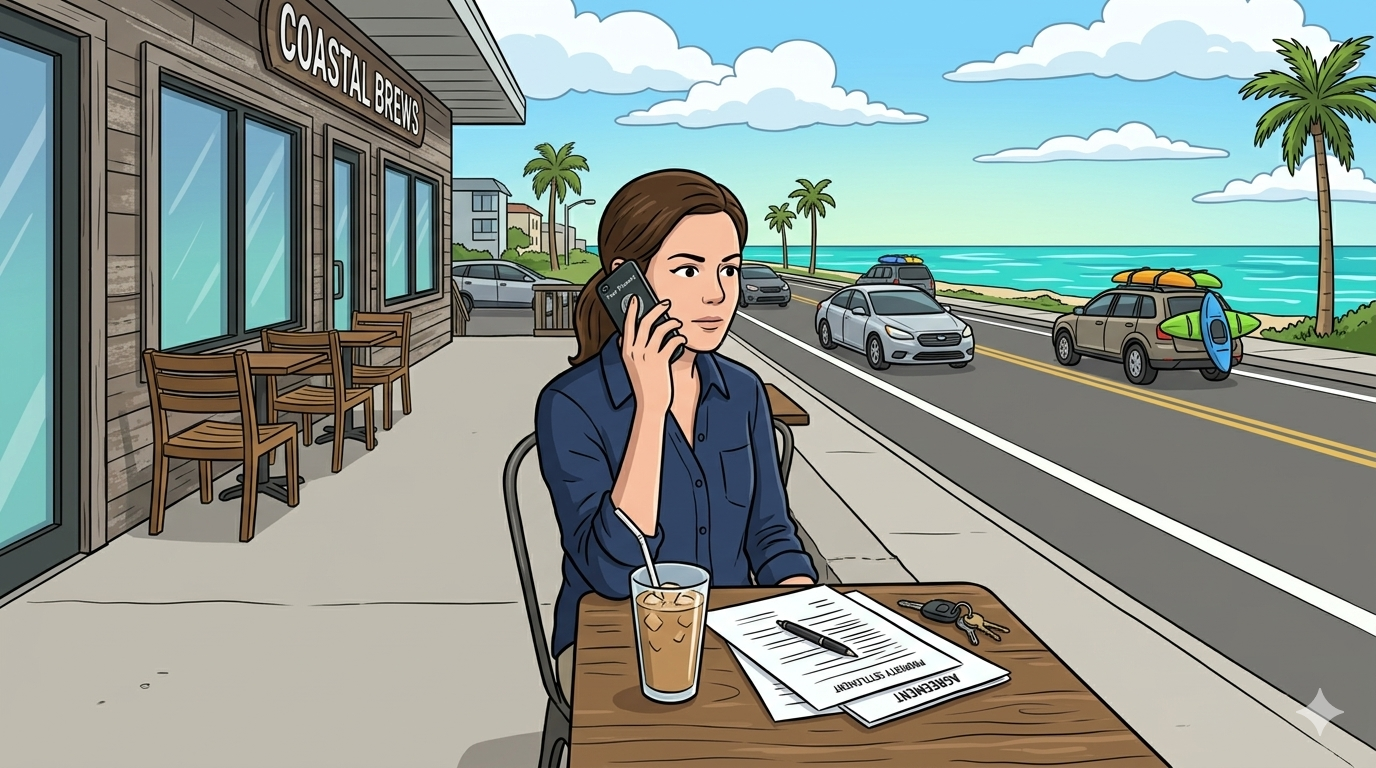
The line stayed silent so long I wondered if he had hung up. Then he said, “You’ve become very hard.”
There are worse things a woman can become. “No,” I replied. “I’ve become visible.”
Kevin’s arrest cracked open more than the theft case. Once law enforcement pulled at one thread, other threads came with it. Melissa was the one who called me with the fuller story because by then she had decided, quite reasonably, that truth mattered more than family performance.
“Jennifer went through his office after the arrest,” she said. “She found account printouts, vendor statements, credit cards she didn’t know about. Claire, he’s been embezzling from his job.”
Kevin worked for the city parks department in procurement, a role bland enough to make corruption seem unlikely until one remembers that petty men often hide best inside boring titles. According to Melissa, he had been skimming through falsified vendor reimbursements and padded maintenance invoices for at least two years. Small amounts at first. Then bigger. Gambling losses, debt, some terrible side investment scheme involving a cousin’s “sure thing” landscaping equipment import plan. By the time auditors started piecing it together, the total was staggering.
“He told Jennifer they were fine,” Melissa said. “Turns out they were drowning.”
“And she didn’t know?”
“No. Or if she suspected, she refused to look. Which, honestly, has kind of been her whole marriage.”
That line stayed with me for days because it named something bigger than Jennifer and Kevin. Refusing to look. That had been the central operating principle of our whole family. Refusing to look at Kevin’s arrogance because confronting him would be unpleasant. Refusing to look at Jennifer’s dependency because she was the golden daughter and golden daughters must be preserved from consequences. Refusing to look at how often I was used because I was the one most likely to survive the using. My beach house had not started this collapse. It had merely become the place where refusing to look finally failed.
The pressure from my family intensified anyway.
My mother left voice mails invoking everything from loyalty to Christian forgiveness to my late grandmother’s horror at seeing “the family torn apart in public.” The irony of that last one might have been funny if I weren’t so exhausted. My father sent texts suggesting compromise, mediation, private settlement, anything that would let them restore the appearance of unity without the labor of accountability. Jennifer did not contact me for five days. When she finally did, it was not to apologize again or to attack. It was simply a text that read: He lied to me about all of it.
I stared at the message for a long time before responding: I know.
She did not answer.
Meanwhile, my own life persisted in the rude ordinary ways life always does even when your family detonates. Hatchlings still needed tagging. Grant deadlines still loomed. The aquarium still needed a speaker for a donor event. My colleagues noticed the strain but, blessedly, most did not pry beyond a gentle, “You okay?” I discovered how many people in my professional orbit had similarly complicated families. Once one person admits estrangement or boundary-setting aloud, others start offering their own stories like quiet contraband. I listened to a coworker describe not speaking to her father for nine years after he stole from her savings account in college. I heard about a mentor’s brother being cut off after repeatedly endangering her children. The more people spoke, the more I realized how thoroughly we are conditioned to treat family harm as less real than other harm simply because the names are shared.
A week after the arrest, I got a call from Detective Barnes asking whether I would consider resolving the necklace case through a plea arrangement contingent on restitution, guilty acknowledgment, and cooperation in the broader fraud investigation. Kevin’s embezzlement exposure, he explained, now dwarfed the theft charge, and the prosecutor’s office wanted to streamline where possible. If I insisted, they would pursue both at full weight. If I agreed, the theft would still remain part of the official pattern and Kevin would still carry the conviction.
I did not answer immediately. I drove instead to the beach house and walked barefoot through every room as if reacquainting myself with a body after injury. The carpet had been cleaned. The damaged lamp replaced. The deck rail repaired. Still, the place held an echo for a while, the sort left not by sound but by violation. I went upstairs, opened the jewelry box, and touched the necklace where it lay restored in its slot. Then I thought about what I actually wanted.
Not revenge. Not really. Revenge is hot and immediate and usually less satisfying than advertised. What I wanted was record. Truth on paper. Consequence with a date and a signature. I wanted Kevin’s theft to cease existing as a family dispute and exist instead where it belonged: as an official fact about a man’s character.
So I called Barnes back and said yes to the plea arrangement on the necklace charge, provided full restitution for the property damage and a written admission tied to the case file. He said that was reasonable. Gregory agreed.
The hardest conversation came not with Kevin, who by then had exhausted my interest as a subject, but with Jennifer.
She arrived at my Charleston apartment one Sunday afternoon without warning. I almost didn’t buzz her in. When I did, she came upstairs carrying none of her usual armor. No righteous indignation. No polished defensiveness. Just exhaustion and a paper bag from a bakery we used to love when we were younger.
“I brought lemon bars,” she said.
It was such a sister thing to do, such a stupid, small, history-soaked gesture, that for a second I hated her all over again. Then I stepped aside and let her in.
She sat at my kitchen table, put the bag between us, and began crying before I even poured coffee. Not theatrically. Not to manipulate. The kind of crying that seems to leak out once the body realizes it cannot hold any more.
“I’m sorry,” she said. “For all of it.”
I waited.
“I kept thinking if I could just keep Kevin calm, keep everyone comfortable, keep the family from blowing up, then that meant I was being a good wife and a good daughter and a good sister. But all I was really doing was asking you to absorb what nobody else wanted to deal with.” She wiped her face angrily. “And when he told you to leave, I saw it. I saw how wrong it was. And I still froze because part of me thought if I challenged him in front of his family, I’d have to deal with the fallout. So I chose the easier cruelty.”
There are apologies so precise they open a wound rather than close it, because they prove the person knew enough to do better all along. Hers was one of those.
I sat down across from her. “Why?”
She laughed bitterly. “Because I built my whole life around being needed by difficult people. Kevin needed me. Mom needed me to stay the pleasing daughter. Dad needed me not to make him pick sides. And you…” Her face crumpled. “You always seemed like you’d survive me no matter what.”
I had no answer to that because it was true. Or at least, it was what everyone had decided was true. The dependable child becomes the one adults outsource their moral laziness to. She’ll be okay. She doesn’t need much. She understands.
“I did need you,” I said finally. “I needed one person in that house to say, ‘This is Claire’s home. We’re leaving.’”
Fresh tears rolled down her face. “I know.”
We sat with that for a long time. Then she told me about Kevin’s finances. The debts she had never known the scale of. The second credit cards. The forged signatures. The way their bank account never made sense, and how every time she asked, he had a loud enough answer to make further questions seem ungrateful. She told me she had found paperwork suggesting he had tried to refinance their house without telling her. She told me he still insisted he had intended to buy the necklace back before I ever knew it was missing, which was such a cartoonishly insulting lie even she could not repeat it without recoiling.
“Are you leaving him?” I asked.
She looked down at the table. “I think I already did. I just haven’t finished the paperwork.”
We did not repair everything that day. That would have been fiction. Too much had been exposed. But something changed. Not trust. Not yet. Something more cautious and perhaps more durable: honesty without immediate self-protection. When she left, she asked if she could call me sometimes. I told her yes, with conditions. No more treating me like emergency infrastructure. No more borrowing money. No more assuming my time, my home, or my help existed by family default. If we were going to have a relationship, it would be one built from mutual respect or nothing.
She nodded. “I’ll take whatever version you can offer.”
A month later, Kevin pled out on the theft and then, under far heavier pressure, on the embezzlement.
The local paper ran a small story about a municipal procurement employee charged in a fraud scheme involving falsified invoices. His mug shot appeared online. People in town whispered. Former friends became scarce. His family, predictably, first rallied and then fractured. Patricia insisted the whole thing had been exaggerated by vindictive women. One brother stopped speaking to Jennifer because divorce, in his view, made her disloyal. Melissa texted me after the hearing: He still thinks he’s the victim. Which told me everything and nothing. Men like Kevin often do.
My parents, meanwhile, discovered that the mythology of the lake house would no longer keep anyone obedient because they were forced to sell it themselves. Financial strains I had only vaguely sensed for years turned out to be far worse than advertised. Debts. Poor investments. Lifestyle maintenance funded by optimism and my occasional willingness to help. Once I stopped serving as the family’s quiet emergency reserve, the whole structure showed its rot.
My mother tried once to revive the old guilt with a line about how “families share burdens.” I answered, “Families don’t assign them to the same person and call it love.” She did not bring it up again.
Winter came. Then spring. The legal dust settled into official outcomes. Kevin was sentenced to prison time on the broader fraud case. Jennifer moved with the children into a modest apartment and, to my genuine admiration, got herself through a medical coding certification program while managing school pickups and an unraveling divorce. We spoke more regularly, not often, but enough. We did not revisit the beach house every call. Some wounds need scar tissue before they can be touched safely.
Melissa became, unexpectedly, a real friend. Not just a surviving connection from Kevin’s side of the family, but someone I actively chose. She came down to the beach one weekend with two women from her graduate program and we spent forty-eight glorious hours doing exactly what no one in my family had ever done in that house: enjoying it without claiming it. We cooked too much fish, drank wine on the deck, played absurd card games, and had the kind of conversation that makes you realize how starved you have been for adult company unhooked from obligation. At some point on the second night, Melissa raised her glass and said, “To clear titles and terrible men finally meeting paperwork.” I laughed so hard I nearly dropped mine.
The beach house itself changed for me after what happened, but not in the way I feared. For a while I worried it would forever carry the stain of violation, that every time I unlocked the door I would hear Kevin’s voice or see Jennifer looking away. Instead, because I refused to abandon it to the memory, it became something stronger. Not just a sanctuary. A boundary made physical. A place where I had, at last, chosen myself without apology.
I installed a better security system. I put cameras by the doors. I created a digital guest log and a rule so simple it now seems absurd I ever needed it: no one enters without my explicit invitation. Not implied. Not inherited. Not assumed through family title. Invited.
There were aftershocks, of course. Family holidays became negotiations. Some relatives sided with Jennifer only after Kevin’s convictions made doing so socially safe. Others maintained a foggy both-sides-it posture because clear moral positions make weak people itchy. I skipped Thanksgiving one year and spent it at the beach with colleagues, eating smoked mullet dip and pecan pie while a storm rolled offshore. It was one of the best Thanksgivings I’ve ever had.
Then, six months after Kevin’s sentencing, my father had a heart attack.
When Jennifer called, I was standing on the deck at the beach house watching a pair of royal terns dive just beyond the shore break. Her voice was ragged.
“Dad’s at Charleston Memorial. It was bad, but he made it through surgery. He’s asking for you.”
I should tell you that estrangement is never as clean as people who haven’t lived it imagine. Even when you are right, even when distance is healthy, even when every boundary is justified, one phone call can still turn your whole interior landscape soft and dangerous. I drove to the hospital alone with the radio off and the ocean still in my skin.
Jennifer met me in the cardiac waiting area wearing yesterday’s clothes and no makeup. She looked, somehow, both older and more like the girl I had grown up with. We hugged awkwardly because neither of us knew what else to do.
“He keeps asking whether you’re coming,” she said.
“Does Mom know you called me?”
She glanced toward the ICU doors. “Yes. She didn’t want to. I did it anyway.”
That, more than anything, told me how much Jennifer had changed.
My mother came out of the room as I approached. She stopped short when she saw me and for a second I saw all her usual reactions line up—defensiveness, pride, management, hurt—and then dissolve under simple relief.
“You came,” she said.
“Yes.”
Something like apology moved across her face, but she didn’t say it yet. Maybe because the hallway was too public. Maybe because she still didn’t know how to speak to me outside the old hierarchy. She stepped aside.
My father looked small in the hospital bed, the hard edges of his personality blunted by tubes, monitors, and the frightening humility of serious illness. He turned his head when I entered and his eyes filled.
“Claire,” he said. “I’m sorry.”
I sat in the chair by the bed because the alternative was standing over him like a judge, and I did not want that memory.
“For what?” I asked, not because I needed the list, but because I needed him to make one.
“For letting your mother steer everything because it was easier. For rewarding Jennifer’s dependence and your competence in ways that punished you both. For making you feel like the easiest person to disappoint because you’d survive it. For the lake house threats. For the beach house. For not calling Kevin what he was years earlier.” He swallowed hard. “For choosing peace over truth until there wasn’t any peace left.”
I looked at the man who had taught me to bait a hook, to parallel park, to keep receipts in labeled envelopes, and thought about how ordinary some kinds of failure are. My father was not a monster. He was, in some ways, worse in the intimate logic of family: he was a decent man who kept yielding to smaller cowardices until they shaped a life.
“I don’t know what to do with that apology yet,” I said.
“That’s fair.”
“But I’m here.”
He closed his eyes briefly, and when he opened them there was a softness in his face I had not seen in years. “Thank you.”
My mother apologized later in the hallway, not elegantly, not in a single noble confession, but in halting pieces. She spoke of jealousy she had never admitted out loud—not of my career exactly, but of my independence. Of how easy it had been to praise Jennifer for needing us while quietly resenting that I did not. Of how she had mistaken self-sufficiency for invulnerability. She did not ask forgiveness that day. Perhaps she understood enough by then to know forgiveness is not owed on demand. She only said, “I see now that I let my comfort matter more than your dignity.” And because the sentence was true, I nodded.
What followed was not a miraculous family healing. I distrust stories that pretend catastrophe automatically produces wisdom. People change unevenly, if at all. But some things did improve. My parents began therapy, partly at Jennifer’s insistence, partly because heart attacks have a way of clarifying that denial is not a retirement plan. Jennifer kept the divorce moving and stopped defending Kevin to anyone. My father, once he recovered, started calling me not only when he needed something but sometimes just to ask about the turtles, the nesting season, the tide conditions. The first time he remembered the name of a species I had mentioned months earlier, I nearly cried.
And me? I changed in ways harder to summarize neatly. I said no more often and with less explanation. I stopped overfunctioning at family gatherings. I let my mother sit in the awkwardness of planning without assuming I would fill the gaps. I refused twice when Jennifer, reflexively, started to ask if I could watch the kids so she could run errands, then remembered and corrected herself. The relationship we rebuilt was slower, more careful, and, because of that, perhaps more real.
Two years after Kevin told me to get the hell out of my own house, I hosted a weekend at the beach house for people who had become my chosen circle. Melissa came. So did my research partner Lena, a coastal engineer named Nia I met at a restoration conference, and my friend Daniel from the aquarium who once drove three hours to rescue a stranded dolphin and still claimed he hated road trips. On Saturday evening we cooked red snapper on the grill, ate outside under string lights, and talked for hours while the tide came in silver under the moon. At one point Daniel leaned back in his chair, looked around, and said, “This place feels like your nervous system if it had central air.” I laughed so hard I choked on my wine.
Later, after everyone had gone to bed, I stood alone at the rail and listened to the ocean.
I thought about that first afternoon. About Kevin’s contempt. About Jennifer’s silence. About the version of me who drove away from the house with her hands shaking and still had no idea that the next few weeks would tear open every family lie she had been trained to preserve. If you had told me then what would happen—police reports, stolen pearls, felony charges, divorce, therapy, debt, heart attacks, awkward apologies, slow rebuilding—I might have thought the price too high.
But standing there in the salt wind, with my house quiet behind me and no one in it who did not value my peace, I understood something I wish women were taught earlier and with less apology: the price of never drawing the line is usually higher. It just gets charged in smaller, more socially acceptable installments—resentment, exhaustion, invisibility, the erosion of self so gradual you call it maturity while it happens.
When people heard the story later, the version that circulated among relatives and neighbors and eventually even some coworkers, they focused on the utilities. That part made for good drama. She shut off the power. She had the sheriff remove them. She got him arrested. Those are the bright hard edges people can understand. But those weren’t the true pivot. The real turning point happened in a simpler moment, quieter and much older than the gas station parking lot or the sheriff’s notice.
It happened when Kevin pointed at me in my own house and expected me to accept his version of reality because everyone always had before.
And for the first time in my life, I didn’t.
That was the moment everything changed. Not when the police came. Not when the necklace was recovered. Not even when the family mythology finally cracked under the weight of its own lies. The change began the second I understood that leaving that house would not be surrender if I left in order to reclaim it properly. That walking away from the immediate argument could be the most decisive act of ownership I had ever performed. That nice is not the same as good. That peace purchased with self-erasure is just another form of loss.
Kevin regretted saying those words, I’m sure. He regretted the consequences, if not the entitlement that produced them. Jennifer regretted not speaking sooner. My parents regretted underestimating what it costs to keep one daughter quiet so another can stay comfortable. But the person whose regret mattered least in the end was Kevin, because what happened after his insult was never really about teaching him a lesson. It was about me finally learning one.
I was not a spare room in other people’s lives. I was not family infrastructure. I was not the accommodating sister, the reliable daughter, the soft target with the extra money and the easier temperament. I was the owner of that house. The keeper of my grandmother’s pearls. The woman who had built a life painstakingly enough to know exactly what it cost. And once I acted from that knowledge, the entire arrangement of who got to use me and how began to fall apart.
Good.
Some structures deserve collapse.
The last time Kevin and I spoke was in a courtroom hallway.
He was being led from one hearing room to another, thinner than before, hair badly cut, rage now diluted by something meaner and weaker—self-pity. He saw me, stopped, and gave the kind of half-smirk men like him use when they want to signal they still believe themselves significant in your story.
“You happy now?” he asked.
The deputy beside him tensed, but I only looked at Kevin and thought how astonishing it was that even now he imagined my actions had been organized around his feelings.
“No,” I said. “Just finished.”
He stared, not understanding. I didn’t explain.
Because that was true, too. By then I was finished—not with my family, not entirely, not with grief, not with the complicated repair that comes after a system breaks, but with him. Finished arranging my energy around a man whose greatest talent was mistaking others’ generosity for weakness. Finished relitigating the obvious. Finished needing anything from him that the court could not already record more cleanly than he ever would.
And finished, too, with the version of myself who would have called what happened at the beach house a misunderstanding rather than the revelation it truly was.
If you ask me now whether I would do it all the same way again—the utilities, the report, the charges, the line I finally drew—the answer is yes. Not because it was painless. It wasn’t. Not because it made me righteous. It didn’t. There were nights I still woke shaky with the knowledge that my family had looked at me and found my boundaries negotiable. There are losses no act of self-respect fully erases. But yes, I would do it again, because everything good that followed required the collapse first.
My beach house is still mine. That feels like an oddly radical sentence some days.
I spend many weekends there. Sometimes alone. Sometimes with people I choose. The windows stay open when I want them open. The rug remains clean unless I am the one who tracks sand over it. The kitchen smells like whatever I cooked, not whatever someone else assumed I would tolerate. In the upstairs bedroom, the pearls sit in their blue velvet box, and every so often I take them out and wear them with a faded T-shirt and bare feet while making coffee, because Grandma was right: pretty things should not wait in boxes for special occasions. Sometimes survival is occasion enough.
Jennifer came one summer afternoon with the children after asking properly a month in advance. She brought groceries. The kids ran on the beach while we sat on the porch and talked not about Kevin, not about the past, but about school forms and recipes and her new boss who wore orthopedic sneakers with every outfit. It was not the relationship we once had. That one is gone. But what replaced it had more honesty in three hours than our old version sometimes managed in a year. When she left, she hugged me awkwardly, then more firmly, and said, “Thank you for letting us come.” Such a simple sentence. Such a revolutionary one in a family where entitlement once substituted for gratitude. I hugged her back and said, “You’re welcome.” And I meant it.
My parents visited too, once, after asking. My father brought a folding chair he insisted was superior to all beach chairs made after 1998. My mother complimented the tile in the upstairs bathroom and then, after a pause, admitted she had never properly appreciated how much work I had done on the house. It wasn’t absolution. But I’ve learned not to despise small true things just because they arrive late.
Sometimes people still try to make the story into a cautionary tale about family fractures. They say it quietly, as if I’m meant to feel chastened by my own history. Such a shame, they’ll murmur. All that over a weekend. Over a necklace. Over pride.
They are wrong, of course.
It was never over a weekend. Or a necklace. Or pride.
It was over the accumulated debt of years in which everyone around me treated my generosity as communal property. It was over what happens when one woman finally refuses to be the easiest place for everyone else to deposit their selfishness. It was over truth. And once truth enters a room, especially a family room, there is no graceful way to pretend not to see it.
That first afternoon, when Kevin sneered and told me to get the hell out, he thought he was humiliating me.
What he was really doing was handing me the clearest possible invitation to stop playing the role they had written for me.
I accepted.
And everything that followed—every slammed door, every ugly phone call, every legal document, every revealed lie, every painful reckoning—was the sound of that old script finally burning.
THE END!!!