
ere other people’s emergencies always mattered more than your own life.
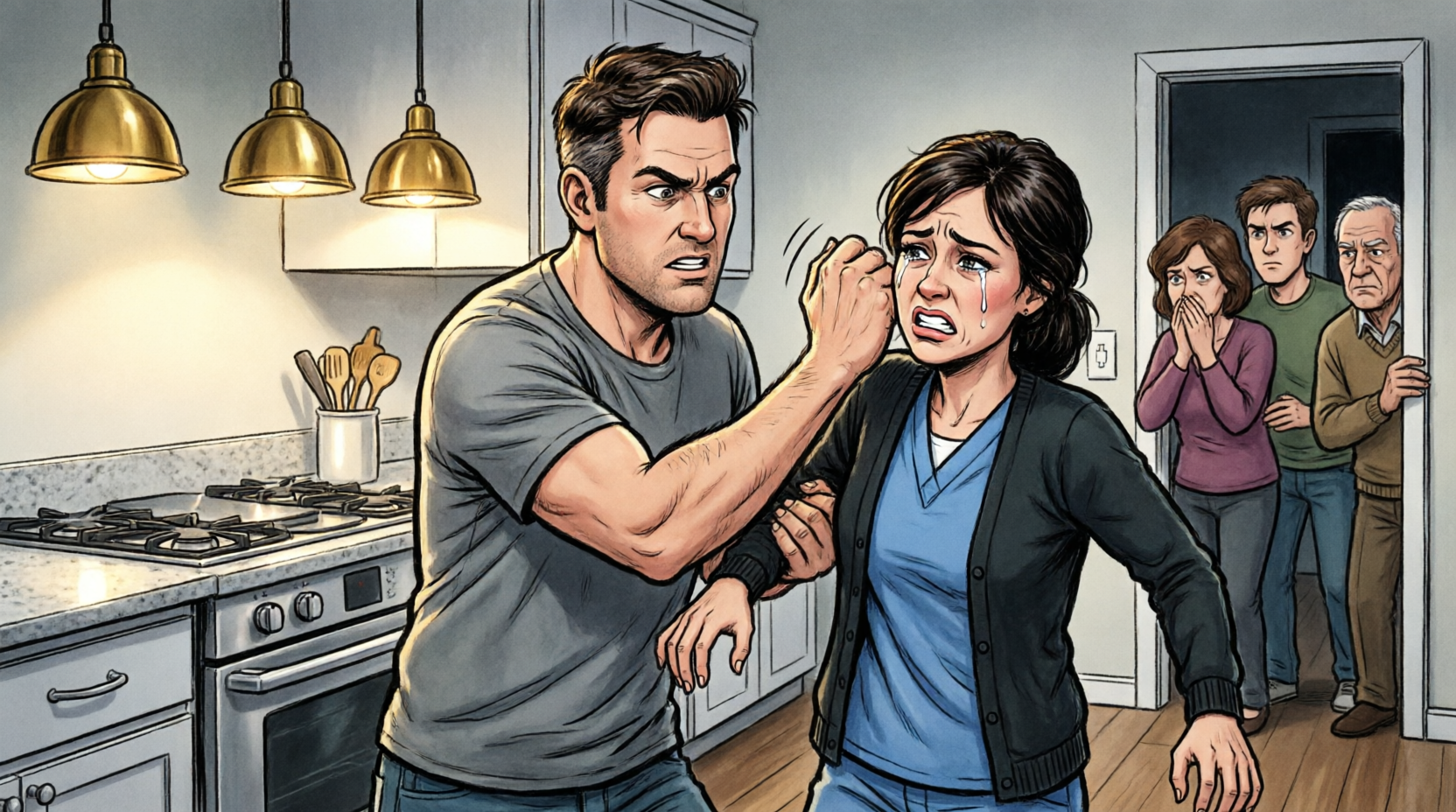
Before you can even pull your keys from your bag, the apartment door flies open.
Your husband is already standing there.
Ethan Morrow, thirty-seven, handsome in the way polished men can remain handsome long after kindness leaves their faces, fills the doorway with pure accusation. His jaw is tight. His eyes are hot with the kind of anger that has long since stopped being spontaneous and become ritual. He doesn’t ask why you’re late. He doesn’t look at your exhausted face and wonder what happened. He doesn’t see a wife. He sees a target that has made him wait.
“Do you know what time it is, you useless bitch?”
The slap lands before the sentence fully settles.
Your head jerks sideways so hard the hallway blurs. A white burst of sound explodes in your left ear. Your bag slips from your hand and crashes to the floor, scattering your wallet, your lip balm, your phone, the little packet of crackers you never had time to eat on break. The metallic taste in your mouth arrives a second later, sharp and familiar. He grabs your upper arm hard enough to bruise and drags you across the threshold.
“My mother, my brother, and Ashley will be here in twenty minutes,” he snarls. “Get in the kitchen and cook. And fix your face. I am not being embarrassed because you can’t act like a woman.”
You don’t cry.
That would have been months ago, maybe even years ago, before you learned that tears around Ethan are like gasoline near a stove. They don’t soften him. They feed him. So you nod once, because nodding is faster than speaking, and go to the kitchen while your heart hammers so hard it feels like it’s trying to get out of your ribs.
In the hallway mirror, you catch a glimpse of yourself.
Split lip. Cheek beginning to swell. Hair half-fallen from the clip you shoved it into at the hospital around five that afternoon when the ER got slammed. Tired blue eyes set in a face you barely recognize some nights. You look like a woman who has been surviving so long she forgot survival wasn’t supposed to be a permanent address.
In the kitchen, you open the refrigerator.
Eggs. Potatoes. Bell peppers. A marinated pork loin you prepped the night before because Ethan’s mother once complained that your dinners were “fine, but not memorable.” Lettuce. Tomatoes. Sour cream. Butter. Everything ready, because even when you work twelve-hour shifts, you still somehow prepare in advance for the moods and appetites of people who treat your effort like a minimum requirement for being allowed to exist.
Your hands shake as you peel the potatoes.
Not just from fear. Fear is there, yes, cold and old and well-practiced. But underneath it, deeper and steadier, is something else. Something like a door closing. Something like the last thin strand of a rope finally snapping under weight it should never have been asked to carry.
Six months earlier, you would have obeyed on autopilot.
You would have moved through the motions of dinner and hosting the way nurses sometimes move through emergency protocols even while their minds are fraying. Set the table. Smile carefully. Hide the bruise under concealer. Ignore the way Ethan’s mother, Diane, always found elegant ways to call you lacking. Ignore the brother, Ryan, who laughed at cruel things because he had learned from the family that a woman in pain was often just a punchline with eyelashes. Ignore Ashley, Ethan’s sister, who had the polished moral emptiness of someone who mistakes loyalty to blood for virtue.
But tonight is not the same.
In the lining of your purse, the one still spilled in the hallway, there is a small flash drive wrapped in a pharmacy receipt. In the junk drawer beneath the dish towels, hidden under a bag of lentils, there is a brown file folder. In your coat pocket there is a folded copy of a police incident intake form you planned to submit tomorrow morning. Planned.
Until he slapped you tonight.
Until he dragged you across the floor because his family was coming and your pain might ruin the table setting.
Now tomorrow feels late.
You cook in silence.
The knife moves through peppers in thin precise strips. Oil hisses in the skillet. Eggs crack cleanly against the bowl edge. The potatoes soften. The pork sears and fills the kitchen with the kind of warm savory smell that would feel like comfort in another life. In the living room, Ethan opens a beer and turns the television up louder than necessary, the volume one of his favorite props. Noise means normal. Normal means no one asks questions.
At 10:48, the doorbell rings.
Diane arrives first in a tailored camel coat and too much perfume, carrying herself like the queen of a tiny and unpleasant country. Ryan follows with a six-pack and a grin already halfway to mockery. Ashley comes in behind them wearing a cream blouse, expensive boots, and the kind of smile women reserve for situations where they expect to enjoy another woman’s discomfort like dessert.
“Clara!” Diane calls toward the kitchen as if she owns your name. “We were starting to think you’d forgotten what time family dinner was.”
You wipe your hands, lift the serving tray, and step out with your lip half-covered by makeup that couldn’t quite hide the swelling.
All three of them see it.
You know they see it. You can watch recognition arrive in each face and then, almost instantly, be translated into choice. Not concern. Not alarm. Choice. The decision to let the bruise remain unnamed so the evening can stay on schedule.
That is the moment you understand Ethan did not learn this cruelty alone.
He learned it in chorus.
“The food’s almost ready,” you say.
Your voice is calm enough to make Ethan look up from the head of the table.
For a second, something uncertain flickers across his face. Maybe he hears it too. The difference in your tone. The absence of apology in it. You set the tray down, smooth the napkin at your wrist, and smile for the first time all night.
“And after dinner,” you add, “I’m serving something I’ve been preparing for a long time.”
Ashley laughs lightly. “Well, now I’m curious.”
Ryan drops into his chair. “As long as it’s not one of Clara’s healthy experiments.”
Diane gives him a soft chiding glance and says, “Don’t be rude,” but her smile says the opposite. Ethan studies you another second, then looks away. Maybe he thinks you’re finally trying harder. Maybe he thinks the slap corrected your mood. Maybe he is too arrogant to imagine that a woman who has tolerated this much can also develop timing.
You go back into the kitchen and reach for the brown folder.
The cardboard is smooth and warm from the room.
Inside are seven months of your life, translated into paper and sound. Audio transcripts. Date logs. Photographs of bruises. Bank statements. Screenshots. A written statement from your coworker Marissa, who saw Ethan grab you outside the hospital parking garage two weeks ago and asked if you were safe, and stayed wonderfully quiet when you said, Not yet. The emergency copy of the apartment lease in your name alone because you signed it before marriage and never added him, one of the few practical decisions younger you made without understanding how badly you would someday need it.
And on top, clipped neatly together, are three pages you added only yesterday.
Copies of private messages between Ethan and his mother.
Page one: Diane telling him you were getting “too independent” and that a wife who earns her own paycheck starts believing she deserves a voice.
Page two: Ethan replying, Don’t worry. I know how to handle her.
Page three: Diane’s answer.
Better. Break her now before kids make her harder to move.
You stand there with the folder in your hands while the family laughs in the other room and forks tap against glasses and television noise spills under the domestic scene like mold beneath wallpaper.
Then you take a breath and carry the truth to the table.
Part 2
You don’t bring dessert.
You bring the folder and your phone.
The pork is arranged perfectly on the platter. The potatoes are golden. The salad is cold and crisp. Everything looks so orderly that when you set the folder down beside the serving bowl, it takes the room a second to register that something doesn’t belong.
Diane notices first.
Her brows draw together. “What is that?”
You take your seat for the first time that night, not in the kitchen, not hovering beside the table, not standing ready to refill drinks before anyone can ask. You sit at the empty place Ethan always treats like a favor instead of a right and fold your hands on top of the brown cardboard.
“You’re right,” you say to Diane. “I have been preparing something.”
Ethan’s knife stops against the plate.
Ryan laughs under his breath. “What is this, some kind of speech?”
“No,” you say. “A record.”
Ashley glances at Ethan, then back to you. “Clara, you’re acting strange.”
That almost makes you smile.
Of course. The woman who gets slapped, dragged, insulted, and ordered into labor is not strange. The woman who sits down with a file folder is.
Ethan leans back in his chair with the dangerous stillness you know too well. “Go put that away.”
You look at him and, for the first time in years, do not look away first.
“No.”
The silence that follows is small but absolute. Even the television in the other room seems to lose force around it.
Diane sets down her fork very carefully. “Now is not the time to be dramatic.”
“No,” you say. “Actually, this is exactly the time.”
You take out your phone, unlock it, and tap the first audio file.
Ethan moves half an inch before he catches himself. But it’s enough. Enough for you to see the recognition, the panic, the instant calculation behind his eyes. He knows that look too late can be fatal. The speaker crackles.
Then Diane’s voice fills the dining room.
“If she starts talking about money again, tell her she’s unstable. Women like that hate being called emotional because they know it’s true.”
No one breathes.
The recording is clear. It was taken three weeks earlier from your parked car outside Diane’s townhouse after Ethan stepped out to “help his mother with groceries” and forgot your phone was still connected to the Bluetooth audio system in his truck. You sat in the passenger seat listening to them talk because at first you thought it was just another complaint about you being tired or unavailable. Then the content changed, and with it, your whole understanding of the marriage.
Ryan’s head turns slowly toward his mother.
Ashley goes pale.
Diane recovers first, because women like her have survived on recovery all their lives. “That could mean anything.”
You press play again.
Ethan’s voice this time.
“She knows the apartment is in her name. I checked. But once she’s on leave again and everybody sees how she acts, we can push the rest.”
Ashley actually gasps.
Ethan slams his palm onto the table so hard the glasses jump. “Turn that off.”
You don’t.
You let the third recording play.
Diane again, cool and certain as rain in winter. “A woman with no family nearby, working hospital hours and barely sleeping? It won’t be hard. You just need one doctor willing to say she’s under strain. Once she breaks in public, the story writes itself.”
The room goes dead.
Not one of them can pretend now. The words are too plain. Too cold. Too practiced. Not a couple having a rough patch. Not some ordinary marriage strain inflated by a tired wife. Strategy. Containment. Erosion.
You hit pause.
The sound disappears so abruptly that the refrigerator hum from the kitchen seems loud as machinery.
Diane’s face has gone tight and pale in a way that strips twenty years of social grace from it. “You were spying.”
That is what she chooses.
Not denial.
Not remorse.
Not how dare you say I wanted to institutionalize you.
Just the little offense of someone having the audacity to hear.
Ethan rises from his chair.
“You stupid bitch,” he says, voice low now, almost shaking. “Do you have any idea what you’re doing?”
“Yes,” you say. “Ending it before you do.”
Ashley pushes her plate away as if the food has turned toxic. Ryan stares at Ethan with genuine confusion, like a man who joined the family cruelty because it felt like sport and just realized the rules were much darker than he signed up for.
“Is that real?” he asks.
Ethan doesn’t answer him.
That is answer enough.
You open the folder.
Page by page, slowly, you lay the contents out on the table between the serving dishes and the half-empty wineglasses. Photos first. Your bruised wrist from December. The mark on your shoulder in January. The cracked lamp from February when he threw it at the wall six inches from your head and told you later it was your fault for pushing him. A copy of the ER report from March, when you told a doctor you’d slipped on wet stairs because you still hated yourself enough to protect him. Then screenshots. Messages to his mother. Two transfers from your joint household account into his private savings labeled emergency buffer. A quote request from a family law attorney asking about spousal property rights if a wife were deemed medically unstable during separation.
Ashley presses a hand over her mouth.
Ryan says, “Jesus Christ,” so quietly it is almost a prayer.
Ethan’s whole face has changed now. The handsome mask is gone. In its place is the man who always lived beneath it, the one only you knew in full. Eyes flat with rage. Mouth thin with contempt. Body coiled not with shame, but thwarted control.
“You went through my phone.”
“No,” you say. “I survived you.”
That lands in the center of the table like another serving dish nobody ordered.
Diane’s voice sharpens. “This is all out of context.”
You turn to her. “Then give me one context where telling your son to break his wife before children makes him harder to move sounds loving.”
She says nothing.
You press once more on the phone.
This time it’s your own voice, recorded two months earlier without your knowledge by the nanny camera you bought after Ethan started accusing you of forgetting things he never actually told you. You had hidden it inside the kitchen clock because by then your aunt in Baltimore, the retired family lawyer you finally confessed to, said a sentence that sat in your bones and refused to leave.
If you think you’re losing your mind around one person, start collecting proof before you start doubting yourself.
The audio plays.
Your voice, shaky and small: “Please don’t raise your hand at me.”
Ethan’s reply, terrifying in its calm: “Then stop making me regret marrying you.”
Ashley closes her eyes.
Ryan stands up so abruptly his chair scrapes backward across the hardwood. “I’m out.”
He means the room. Maybe the house. Maybe the family. Hard to tell. But before he can take two steps, Diane snaps at him with the reflex of old power. “Sit down.”
He looks at her, really looks at her, and something in his face hardens.
“No.”
That is the first time anyone in this family has publicly refused her in your presence.
It feels almost historic.
He walks out.
The front door slams hard enough to rattle the framed wedding photo in the hallway.
Ashley is crying now, quietly and furiously, mascara starting to blur at the corners of eyes that have likely seen too much for years and chosen not to read it because the alternative would demand action. “I thought you two just fought,” she whispers.
You meet her gaze. “He hit me tonight because I was late from the hospital.”
That sentence, more than the recordings, seems to finish something inside her.
She pushes back her chair. Not dramatically. Just enough to stand. “Mom,” she says, voice breaking, “what the hell is wrong with you?”
Diane turns on her daughter with pure venom. “Don’t be naive. Married people say ugly things in stress.”
“No,” Ashley says. “Not like that.”
Then she looks at you.
“I’m sorry,” she says, and you can tell she means it in the weak, useless, but still real way of people who finally discover the truth after years of benefiting from not knowing it.
You nod once.
Ethan takes a step toward you.
“Give me the folder.”
You stand too.
“No.”
He takes another step.
The fear that lives in your body rises instantly, old and efficient. It knows his size, his speed, the shape of rooms where no one intervenes fast enough. But layered over it now is something new. Something stronger than courage, because courage still imagines choice. This is decision. Cold and finished.
You lift your phone.
“Touch me again,” you say, “and the police get every file tonight instead of tomorrow.”
That stops him.
For one beautiful second, the whole room is ruled not by his anger or his mother’s manipulation, but by consequence.
Part 3
He thought he had more time.
That is what you realize as you watch his face.
Not that he thought you were weak forever. Men like Ethan are smarter than that. They always know resistance exists in theory. They just bank on timing. They assume the woman will break later, after enough financial entanglement, enough isolation, enough self-doubt, enough exhaustion. He thought he still had time to make you look unstable before you learned how stable your evidence had become.
Now dinner is on the table, his sister is crying, his brother is gone, his mother looks half-poisoned by exposure, and you are standing there with one hand around your phone and the other on the folder like a witness at your own resurrection.
“Clara,” he says, switching tactics so fast it would impress you if it weren’t monstrous. “You’re tired. You’ve been under too much pressure. We can talk privately.”
The language nearly makes Ashley laugh through her tears.
Privately.
That word again. The favorite word of people who build their power in hidden rooms and then complain about spectacle when the walls finally come down.
“No,” you say. “That’s over.”
He exhales sharply through his nose. “What do you want?”
The question should feel victorious. Instead it lands heavy.
Because for two years, everything in this marriage has been arranged around what he wanted. Obedience. Quiet. Money. Clean shirts. Excuses. Bodies that cooked and bent and absorbed. Now he is finally asking you what you want, and the answer isn’t romance or repair or closure. It’s far more expensive than that.
“I want you out of my apartment.”
Diane actually recoils. “Your apartment?”
You almost laugh. You had forgotten how many lies he must have told them.
“Yes,” you say. “Mine. It was mine before marriage. It is still mine. I never added him to the deed.”
Diane turns toward Ethan so fast her chair nearly tips. “You told us you were handling that.”
“There’s more,” you say.
You remove one final paper from the folder and place it on the table. Your leasehold title history. Your aunt made you order a fresh certified copy three days ago, right after telling you that paper is what keeps people from rewriting your reality in rooms where emotion gets expensive.
Ethan glances at it, then away. He already knows what it says. Diane reads just enough to understand the catastrophe.
“You lied to us,” she whispers to him.
There is something almost fascinating about that moment. Her outrage is not that he lied to you. Not that he hit you. Not that he and his mother planned to destroy your name. Her outrage is that he misled her about the quality of the asset. Suddenly you can see all of them clearly, the whole family machine stripped of upholstery. Nobody at this table knows how to love without calculating.
Ashley backs away from it all, one step at a time.
“I can’t do this,” she says.
No one stops her.
The front door closes again, softer this time. Now it’s just you, Ethan, Diane, and the food getting cold. The apartment smells like roasted pork and fried peppers and fear.
Diane recovers first, because she always does.
She straightens slowly, folding her napkin with hands that are still elegant despite everything. “All right,” she says. “Then let’s be practical.”
That sentence almost makes you choke on disbelief.
Practical.
As if the evening has not already crossed every human line worth naming.
“You are overtired,” she continues, turning her full courtroom-mother gaze on you. “You work too much. You have let this hospital job make you unstable, suspicious, dramatic. My son may have handled things badly, but if you do this publicly, you will ruin your own life. No good comes from making private family tensions into legal matters.”
You stare at her.
It still shocks you, the audacity. The ease with which some people step directly over evil and begin negotiating its optics. She would have made a magnificent defense attorney for the guilty if she had ever chosen a profession that rewarded her actual talents.
“What happens next is not a negotiation,” you say.
Ethan’s face darkens. “You think the police are going to care because a husband yelled and a few private conversations sounded bad?”
The room goes very still.
There it is. The real voice. Not the careful, strategic one. The ugly confidence beneath it. The belief that harm only counts if someone else’s threshold gets crossed, and even then perhaps not. You realize with almost physical force that if you don’t end this now, he will keep going until he has argued reality itself into something cheaper.
You press the screen again.
This time, the audio is from tonight.
Your hidden phone in the hallway caught everything after you dropped your bag.
His voice: “Get in the kitchen and cook. And wash your face. I’m not being embarrassed because of you.”
Then the sound of the slap.
Then your startled breath.
Then him dragging you across the floor.
Diane flinches.
Actually flinches.
You had wondered if anything still could.
“That,” you say, “is what the police will care about.”
Ethan lunges for the phone.
You step back fast enough that his fingers catch only air, but the movement is enough. Enough to turn intention into threat. Enough to end any remaining question about whether tonight qualifies as danger. Your training from the hospital takes over, absurdly calm in crisis the way your personal life never allowed you to be.
You pivot.
Grab the ceramic water pitcher from the sideboard.
And when he comes toward you again, you throw the entire contents straight at his chest and face.
The shock of cold stops him dead.
He curses and stumbles backward. The phone stays in your hand. The folder stays under your arm. Diane screams not from concern for you, but because her son’s shirt is soaked like that is the true offense of the night.
You use the second.
You run to the bedroom.
Not because you are afraid to leave the apartment. Because the backup phone is there, already charging in the nightstand, already loaded with the case file and your aunt’s instructions in a note titled IF TONIGHT GOES BADLY. You slam the bedroom door, lock it, and call 911 before Ethan reaches the wood and starts pounding.
The dispatcher hears what your marriage never did.
Urgency. Pattern. Danger.
He is yelling through the door now, that familiar rhythm of threats and persuasion and blame blurring together into something ugly and male and increasingly desperate. Diane’s voice overlaps his, shriller, calling you hysterical, telling you not to do this, saying you’ll regret what happens next. You sit on the edge of the bed with both phones beside you and your hand pressed to your split lip while the dispatcher keeps you talking in a low steady voice until the sirens arrive.
That twenty-minute wait changes your life.
Not because of the police. Because of what happens inside you while you listen to them rage outside the locked door. Somewhere between minute six and minute twelve, maybe right when Ethan shifts from threats to pleading, something old and poisonous leaves your body.
It sounds glamorous to call it fear.
It isn’t.
It’s permission. The lifelong permission you gave other people to define when enough was enough.
By the time the officers knock and announce themselves, you know with absolute certainty that you are done asking your own life for one more week of patience.
Part 4
The police do not save you.
That is one of the hardest truths you learn that night.
They do not sweep in, see your bruised face, hear the pounding from the living room, and instantly identify a villain with cinematic clarity. Real life is more bureaucratic, more hesitant, more dependent on what can be recorded, documented, phrased. But bureaucracy is still better than being alone with a man who thinks your fear belongs to him.
You open the bedroom door only after the officers are inside and Ethan is on the far side of the living room, soaking wet, furious, and trying his hardest to look reasonable.
He switches masks so fast it is almost elegant.
“Officers,” he says, voice controlled, one hand spread in a gesture of exhausted innocence, “my wife is under a lot of stress. We had an argument. She got emotional.”
One officer glances at your lip.
The other looks at the smashed remains of your purse still scattered near the front door, the cold untouched food on the dining table, Diane standing beside the couch with the expression of a woman deeply offended that state mechanisms have entered her evening.
“Ma’am,” the first officer says to you, “can you tell us what happened?”
And because of the folder, because of the recordings, because of the photos, because your aunt taught you long before tonight that truth should be organized when it must survive powerful denials, you can.
You tell them the time you got home.
The slap.
The order to cook.
The audio recordings.
The prior incidents.
The threats.
The files.
You speak clearly, not because you are calm but because nursing taught you how to talk while adrenaline is still hitting. Your hands shake anyway. That is fine. Truth is allowed to shake.
When you hand them the phone and let them hear tonight’s recording, the room changes.
Not magically. But enough.
The officer with the gentler face listens to the slap, the dragging, Ethan’s voice. He says nothing for several seconds after it ends. Then he asks whether you want to pursue a domestic violence report and emergency removal order.
“Yes,” you say.
Ethan laughs once in disbelief. “You cannot be serious.”
The officer turns to him. “Sir, stop talking.”
That is the first time anyone has told him that in your presence.
Diane steps in instantly. “This is ridiculous. Married couples fight.”
The officer does not even look at her. “Ma’am, I said stop talking.”
You will remember that line for years.
Not because it is noble. Because it is ordinary. And ordinary boundaries sound revolutionary after a marriage like yours.
The rest of the night moves in hard fragments.
Ethan being asked for ID.
Diane sputtering that she is leaving but this is not over.
The emergency protective paperwork begun right there at your dining table, next to the salad and the serving spoon and the untouched bread. An ambulance offer you decline because your injuries don’t require the ER and you have spent enough nights in emergency departments to know when your own body can wait until morning. Ethan finally escorted out with a warning so sharp he goes silent for the first time all night.
Before he crosses the threshold, he turns back.
That is when he tries the last weapon.
“You think this makes you strong?” he says. “Nobody’s going to want a woman who does this.”
You look at him, really look at him, with his wet shirt clinging to his chest, his mother’s lies still hanging in the room, his whole face rearranged by rage and exposure.
And you realize something marvelous.
You no longer care what a man like this thinks strength should cost.
“No,” you say. “This makes me free.”
Then he is gone.
The apartment is wrecked in tiny ways.
Not movie-wrecked. Not lamps smashed and furniture overturned. Just the kind of damage intimate violence prefers because it hides inside plausible mess. A chair knocked crooked. Your purse contents on the floor. Water on the hardwood. Dinner cold and collapsing on the table. Your body still vibrating with aftermath.
The officers leave after giving you instructions for the temporary order, next-step reporting, victim services, and emergency contacts. One of them, the gentler one, pauses at the door and says, “You did the right thing.”
You nod, but the words don’t land yet.
Right now, you are too tired to absorb praise.
When the door closes, silence fills the apartment in layers.
No television.
No male breathing in the living room.
No mother-in-law correction humming like poison through the air.
Just silence.
You stand in the kitchen looking at the dinner.
The tortilla is drying at the edges. The peppers have gone glossy and limp. The pork still smells rich and savory, absurdly perfect for a meal that almost became the last act of your old life. You stare at it for a long time.
Then, with hands that still shake, you scrape every plate into the trash.
Not because the food did anything wrong. Because that dinner was made under command. Under fear. Under pain. You do not want another bite of anything that entered the world through that version of you.
At 1:12 a.m., your aunt in Baltimore calls.
You answer on the first ring.
She does not begin with Are you okay, because she is a woman who understands that okay is often a dishonest question right after survival. Instead she says, “Is he out?”
“Yes.”
“Good. Lock the chain.”
You do.
Then you sit on the kitchen floor with your back against the cabinets and tell her everything while she listens in complete silence except for the occasional soft instruction. Ice your cheek. Photograph the lip again in better light. Email me copies tonight. Sleep in the guest room. Change the door code before sunrise. Keep the folder with you, not in a drawer.
When you finally stop talking, she asks, “What do you feel?”
It is such a strange question that you almost laugh.
You look around the dark kitchen, at the trash can holding the ruined dinner, at your trembling hands, at the streak of water still drying on the floor where Ethan stood dripping and furious. Then you answer as honestly as you can.
“Like my life was about to disappear,” you say. “And then didn’t.”
There is a pause.
Then your aunt says, “That feeling? Hold onto it. That’s the truth trying to stay.”
Part 5
The next morning, the sun rises on the ugliest, clearest day of your life.
Your face is worse in daylight. The bruise blooms along your cheek in darkening layers of purple and red. Your lip has stiffened into a swollen crescent that makes toothbrushes and coffee and speaking all feel slightly foreign. You photograph everything again, standing in your guest bathroom with your phone in one hand and a legal pad in the other. Time. Date. Injury progression. Every angle.
Evidence is ugly, but it is holy.
By eight-thirty, victim services has called.
By nine, your aunt has emailed a family attorney in your city with a message so direct it may as well have been written in acid. By ten-thirty, you are sitting in a quiet office above a bank downtown while a woman named Denise Fuller reviews the protective order, the lease documents, the recordings, and the property history with the cool efficient fury of someone who has made a career out of making dangerous men legally irrelevant.
“This is strong,” she says, tapping the transcript of Diane’s voice. “Ugly, but strong.”
You sit with a paper cup of tea gone cold in your hands and nod.
Denise continues. “The apartment stays yours. His occupancy rights are minimal given the pre-marital title and the emergency order. We’ll pursue full removal and supervised retrieval of his belongings only. Also, if he or his mother contacts your employer, your licensing board, your landlord, or anyone trying to paint you unstable, we move immediately.”
There it is again.
Unstable.
The favorite word of weak men and strategic mothers when women start naming what happened.
You ask, “Will they?”
Denise doesn’t soften the answer. “Almost certainly.”
She’s right.
By lunch, the first messages arrive.
Not from Ethan. The order prevents direct contact now. From Ashley.
I’m sorry. I didn’t know how bad it was.
Then, three minutes later:
Mom says you’ve had some kind of breakdown.
You stare at the screen, and for the first time that day, you feel something almost like amusement.
Of course she says that.
The machine is still running even while the gears burn.
You forward the message to Denise, who replies with one line.
Good. Let them document themselves.
That becomes the rhythm of the next week.
Not collapse. Documentation.
Every voicemail from Diane through third parties. Every social media post vague enough to imply but not state. Every cousin texting that “family should stay private.” Every attempt Ethan makes through mutual friends to suggest you are exhausted, overworked, emotional, and blowing things out of proportion.
The strange thing is, by then the words no longer enter you the same way.
They don’t vanish.
But they land against structure.
Paper. Orders. Recordings. Photographs. Witnesses. The thing men like Ethan never fully understand is that fear multiplies in secrecy and shrinks in organized light.
At the hospital, you tell your supervisor the truth.
Not all of it. Not the whole brutal architecture. Just the pieces she needs. There is an emergency order. My husband was removed from the home. He may attempt contact or misrepresentation. I have counsel. I’m safe enough to work, but I need this noted.
Your supervisor, Linda, stares at your bruised face for one long second.
Then she says, “You should have told me sooner.”
You almost cry right there in the break room because she says it like concern, not accusation.
Instead, you nod once.
“I know.”
Word spreads quietly among the nurses the way real care often does. No gossip. Just adjustments. People covering a shift swap without making you beg. Someone leaves concealer in your locker with no note. Someone else brings soup. Marissa, the coworker who saw Ethan grab your arm in the parking garage weeks ago and wrote the statement, hugs you once in the med room and says, “I’m glad you finally got out before he convinced you it wasn’t that bad.”
That sentence follows you home.
Not that bad.
You had been living inside those words for so long you forgot how many blows they can hold.
Part 6
Ethan violates the order on day nine.
Not physically. Predictably.
He sends flowers to the hospital with a note that says:
I still love you. Let’s not let one bad night destroy us.
The roses are white.
That detail infuriates you most. White roses are apology flowers for people who want elegance without guilt. You photograph the card, photograph the delivery slip, forward everything to Denise, and let security wheel the arrangement straight back out the loading dock.
Then Diane calls your aunt.
That is a mistake so profound it almost feels like a gift.
Your aunt, retired and dangerous, records the call legally in her state and sends you the audio with a single text.
Listen.
You do.
Diane sounds wounded, dignified, and very nearly pious. She talks about heartbreak. Stress. Misunderstanding. How you always had “a dramatic streak.” Then, when your aunt says nothing encouraging, Diane makes the move you both expected eventually.
“Clara has always been fragile,” she says. “I’m afraid the hospital work has pushed her past reason.”
Your aunt responds in the flattest voice you have ever heard on a human being.
“No,” she says. “What pushed her past reason was your son’s hand.”
Then Diane makes the second mistake.
She says, “This could still be managed if Clara stopped letting outsiders fill her head.”
Outsiders.
You laugh when you hear it. A hard ugly laugh that startles even you.
Because there it is in one neat poisonous word. The whole thesis. Any witness who threatens abuse becomes an outsider. Any law that limits it becomes interference. Any woman who protects herself must have been influenced by someone unnatural, because the natural order, in their minds, was your quiet suffering.
Your aunt sends the recording straight to Denise.
By the end of the day, a harassment addendum is filed.
By the end of the week, the judge extends the order.
Ethan loses the apartment. Not in some grand dramatic way, but through the patient grind of legal process. Supervised pickup. Limited windows. No access without written permission. He comes once for his clothes and toiletries while you sit in Denise’s office downtown instead of being there to watch. Later, the building manager tells you he looked less angry than stunned. As if, right until the key handoff, he still believed some invisible male gravity would pull the place back toward him.
It doesn’t.
A month later, you are granted full possession, continued protection, and formal separation proceedings begin.
The final blow, strangely, does not come from court.
It comes from Ashley.
She asks to meet you.
You say yes because by then curiosity has replaced fear when it comes to that family. She chooses a little bakery near the river, arrives without makeup, and looks like someone who has slept poorly for years but only recently learned why.
“I left my husband,” she says within five minutes of sitting down.
You blink. “What?”
She stares into her coffee. “After that night, I kept thinking about all the things I saw growing up. Things I called normal. Things Mom explained away. Things Ethan joked about. Then I went home and realized my husband uses my silence the same way.” Her mouth twists. “Not as bad. Not yet. But I could suddenly hear the future.”
You say nothing.
Ashley’s eyes fill. “I should have done something sooner for you.”
Maybe she should have.
Maybe all of them should have.
But there is no interest in you now for retroactive morality. You are too tired for fantasy. What matters is what truth does once it gets in.
“You’re doing something now,” you say.
She nods, crying a little. “Mom says you ruined the family.”
You almost smile.
“No,” you say. “I stopped being the thing holding it together.”
That lands in her the way certain sentences only can when they explain not just one event, but an entire bloodline.
The divorce is ugly in predictable ways.
Ethan wants to argue over furniture he never paid for, over wedding gifts from your friends, over a television you bought during your first year in the apartment and he only ever used to watch sports too loudly. Men like him are rarely strategic enough to accept defeat gracefully. They need one more win, however small, just to feel the universe still bends properly.
Denise handles him like a woman cleaning gum off a good shoe.
And you?
You change.
Not in the shiny social-media way people like to package female survival. No sudden glow-up montage. No rooftop photos with captions about choosing yourself. Real transformation is less photogenic than that.
You sleep with the hall light on for a while.
You flinch when keys turn in neighboring doors.
You stand in grocery stores staring too long at couples deciding between sauces because some part of your body still expects every ordinary domestic scene to hide a trap door. Trauma is embarrassingly physical. It lives in shoulders and jaw muscles and the speed with which you answer texts from women checking in.
But other things change too.
You stop apologizing when you’re tired.
You repaint the kitchen a softer white because the yellow Ethan picked always made the room feel falsely cheerful. You replace the dining table with a smaller one because you realize you never want to host people who make silence feel like labor again. You start leaving your shoes by the door without thinking about whether someone will call it lazy. One Saturday morning, almost three months after the slap, you stand in your kitchen eating toast and realize your body is not braced.
That nearly undoes you.
Freedom, it turns out, can feel terrifying when your nervous system got used to chains.
Part 7
The real ending comes on a Tuesday in early October.
Not in court. Not in some dramatic confrontation in a parking lot. In your apartment, at 7:16 p.m., with rain tapping softly against the windows and a pot of soup simmering on the stove. You are home after an ordinary shift. Ordinary. That word still feels miraculous enough to pause on.
Your phone buzzes.
It’s Ryan.
You almost don’t answer. He has sent exactly one message since that night, a stiff little apology about not knowing what his brother was capable of and needing time to process. You were not especially interested in helping him find his conscience, but today for whatever reason, you open it.
He writes:
Mom had a small stroke. She’s okay. She asked for you. I told her no. Just thought you should know.
You sit down at the kitchen table with the phone in your hand.
A strange hush settles over the room.
Not pity exactly. Not satisfaction. Something more complicated. The whole family that built itself around your silence is now cracking under the weight of its own architecture. Diane, the woman who coached her son to break you and call it management, has finally met the plain fact that bodies do not negotiate with arrogance.
You type only one reply.
Thank you for telling me.
Then you put the phone face down and stir the soup.
That is how you know you are truly out.
Once, news like that would have dragged you into orbit around their needs. Hospital visits. calls. emotional labor. one more round of absorbing history that was never yours to manage. Now it enters your life as information and leaves it there. Not because you are cruel. Because boundaries finally have a home in you.
A week later, the divorce finalizes.
The judge is brisk, the lawyers efficient, the language sterile. Marriage dissolved. Protective terms acknowledged. No claim to the apartment. No spousal support. Limited personal property exchange already completed. Fifteen minutes and the state unthreads what two years of manipulation had tried to knot around your throat.
Outside the courthouse, the autumn air is bright and sharp.
Denise asks if you want coffee.
You look up at the sky, then laugh softly to yourself.
“No,” you say. “I want lunch somewhere no one has ever shouted at me.”
She approves.
You choose a tiny café with chipped mugs and excellent tomato soup. The waitress calls you honey and means it. No one asks for anything except your order. No one watches your face for weakness. No one turns your exhaustion into accusation. You eat a grilled cheese sandwich at a table by the window and realize halfway through that you are actually hungry.
That feels like another ending too.
By winter, you begin volunteering one Saturday a month with a local clinic that helps women navigating domestic abuse documentation and emergency healthcare after leaving violent homes. You don’t tell many people. It’s not performance. It’s simply that once you know how much the first safe voice matters, you cannot unknow it.
One evening, after helping a woman photograph the bruises on her collarbone because her hands shook too much to frame the images herself, she looks at you and whispers, “I feel crazy.”
The sentence hits you so hard you have to look away for a second.
Then you turn back and say the truest thing you know.
“No,” you tell her. “You’re finally seeing it clearly.”
That becomes the line you carry everywhere.
Not because clarity solves everything. It doesn’t. It hurts. It costs money, sleep, fantasy, reputation, family mythology, and sometimes half your former life. But clarity is what lets fear stop writing the script.
Spring comes.
Your lip has long healed. The bruise is gone. The apartment smells like basil because you started keeping herbs on the sill just because you can. One Sunday afternoon, your aunt visits from Baltimore for the first time since the divorce finalized. She stands in your kitchen, looks around at the new paint, the smaller table, the quiet, and says, “It feels lighter.”
You hand her a glass of iced tea. “That’s because nobody here is waiting to be hit.”
She looks at you for a long moment.
Then she raises her glass slightly, not quite a toast and not quite a prayer.
“To the end of nonsense,” she says.
You laugh.
Later that evening, after she leaves, you open the hall closet to put away an extra blanket and see the old brown folder on the top shelf.
For a moment you just stand there.
The cardboard is worn now at the corners. Inside are the transcripts, the photos, the reports, the proof of every moment you once had to beg yourself not to minimize. You pull it down, sit on the floor, and leaf through it slowly. Not to relive. To witness.
The woman in those pages still feels like you, but in the distant way childhood photographs feel like you. Familiar features. Different gravity. She survived with whatever she had. She got strategic before she got free. She cooked dinner with a split lip and then put her whole marriage on trial between the pork loin and the salad bowl because something in her finally realized that fear had already taken enough.
When you get to the police incident form, you stop.
The first line of your written statement reads:
He slapped me when I came home late from the hospital and told me to cook for his family.
Such a simple sentence.
Such an ugly little doorway into a whole hidden architecture of harm.
You put the pages back, close the folder, and return it to the shelf.
Not because you need it anymore. Because you respect what it carried you through.
That summer, you get a postcard with no return address.
The handwriting is Ashley’s.
It says:
Mom still says you overreacted. Ethan says you ruined his life. I think you were the first person who ever told the truth before the rest of us were ready to hear it. I hope one day I become half that brave.
You read it twice.
Then set it in the kitchen junk drawer under takeout menus and batteries and a roll of stamps you keep meaning to replace. Not because it means nothing. Because it means exactly enough. Witness, late and imperfect, from someone who finally learned the difference between peace and silence.
And if there is one thing you know now, it is this:
Silence was never peace.
Silence was dinner on the table while your cheek swelled.
Silence was his mother seeing the bruise and asking for more potatoes.
Silence was the television turned up too loud to make cruelty sound like an ordinary household noise.
Peace is different.
Peace is a smaller table and soup on the stove and nobody monitoring the clock.
Peace is keys in your own hand.
Peace is knowing that if someone ever calls you dramatic again for protecting yourself, you will not collapse under the word.
Peace is serving the truth instead of dessert and surviving the meal.
And the thing that terrified them most that night was not the folder.
Not the recordings.
Not even the police.
It was that after years of swallowing pain in silence, you finally looked them in the eye and fed them exactly what they had been cooking for you all along.
Consequences.
THE END!!!