
My grandfather, Thomas Hail, was the quietest man I ever knew, and for most of my life people mistook that for emptiness.
They saw a man who lived alone in a weather-beaten house at the edge of a tired Ohio town and assumed there could not possibly be much behind him. They saw old jackets, cheap coffee, fixed rather than replaced tools, and a porch that tilted just enough to warn careless visitors, and they decided he had lived a small life because the evidence of largeness wasn’t displayed where they preferred to look for it. No plaques in the hallway. No framed military portrait over the mantel. No old photographs of him in uniform, young and square-jawed and smiling beside men whose names mattered to history. No stories told at dinner after someone poured a second drink and asked him to “tell that one” for the thousandth time.
My grandfather never did that.
He didn’t perform himself.
He didn’t decorate silence to make other people comfortable inside it.
He never seemed to believe he owed anyone a dramatic explanation for why he had become who he was.
That unsettled people.
Silence with no visible insecurity in it makes most people nervous. They want you to break it for them. Fill it. Soften it. Laugh at the right places. Offer little handles they can grab to move you into a category that makes sense. My grandfather didn’t do categories. He moved through the world like a man who had already learned exactly how much of himself to offer and had decided he would not increase the ration just because other people found mystery inconvenient.
His house stood at the end of a narrow street lined with chain-link fences, cracked sidewalks, and porches where people watched each other’s business while pretending not to. The town itself was the kind of place travelers crossed without remembering, one of those Ohio towns with a diner that still sold pie for less than most people spend on bottled water in airports, a church on every other corner, and a downtown that seemed to have stopped negotiating with modernity sometime in the late 1980s. In autumn the maple tree in his yard dropped red leaves all over the front walk until it looked like someone had scattered damp paper flames there. In winter the porch rails collected ice and the mailbox jammed if you opened it without lifting the little metal door first. In spring the mud along the side path could suck a shoe half-off if you weren’t paying attention. In summer the whole place smelled faintly of cut grass, old wood, and whatever pie cooling on the windowsill Mrs. Kessler from next door had decided he was too thin to refuse.
To me, it was the safest house in the world.
Not because it was cozy in the way people write about in sentimental essays. It wasn’t. The wallpaper in the hall had peeled at one seam for years. The kitchen linoleum had a faded burn mark near the stove. His recliner had one arm polished darker than the rest from decades of use, and the television clicked before it caught sound. But nothing in that house lied to me. Nothing in it pretended to be more than it was. There was a chipped mug by the sink because the handle still worked. There were stacks of newspapers tied with twine in the basement because, as Grandpa once told me, old paper was useful even if other people lacked imagination. There was a kitchen clock permanently three minutes fast because “three minutes can save you from looking foolish.” There were folded dish towels lined up by size in a drawer. There was always soup in the pantry. There was always bread in the freezer. There was always the sense, impossible to describe properly to anyone who did not know him, that if something in your world cracked, this was the one place where you could bring the broken piece and nobody would tell you it wasn’t worth fixing.
My parents hated visiting.
They called him difficult, which was the family word for anyone who refused to become easier to consume.
My mother inherited his eyes and none of his restraint. She liked things named and displayed and emotionally legible. She liked family stories with convenient morals and recognizable roles. My grandfather had no patience for performance and no talent for explaining himself to people who hadn’t earned the explanation. That infuriated her. It wasn’t loud infuriation, not the dramatic kind. My mother preferred polished resentment, the variety that came out as sighs, little tight smiles, comments disguised as concern.
“He could make an effort,” she would say after one of his long pauses at dinner.
“He could try to be warmer.”
“He could at least answer a direct question like a normal person.”
My father was worse, because he didn’t even pretend the problem was emotional. My father judged people through the blunt instruments of status and usefulness. If he couldn’t translate someone into accomplishment he recognized or influence he could leverage, he discounted them almost instinctively. To him, Grandpa was just an aging man in an old house who had never turned whatever military past he had into anything profitable or prestigious enough to impress a church luncheon or a country club table. The fact that he had no interest in doing so only confirmed my father’s opinion that there probably wasn’t much there.
My brother, Tyler, simply absorbed the family weather and called it his own. When we were younger, he liked to joke that Grandpa’s special skill was making a room uncomfortable without moving a muscle. Everyone laughed because laughter is often just cowardice in party clothes, and I laughed sometimes too, not because I agreed but because I was still young enough to think survival and loyalty were synonyms.
But even when I was little, I never found him difficult.
I found him exact.
That is still the best word I know for him. Exact.
He never promised what he didn’t mean. Never flattered. Never pretended to listen while waiting for his turn to speak. He did not ask questions for show. If he asked how school was, he wanted the answer. If he asked whether I had eaten, he cared whether I had. If I said I hated a teacher, he didn’t correct my tone first; he asked why. If I said I wanted to do something people around me thought was foolish, he didn’t rush to protect me from risk. He taught me how to test the branch before trusting it.
When I was eleven, I decided I wanted to climb the maple tree in his front yard. My mother said I’d tear my dress. My father said there was no point in girls climbing trees when there were other ways to spend an afternoon. My grandfather looked out at the tree, looked at me, and said, “Then you’d better learn where your weight belongs.”
He took me outside, stood beneath the lowest branch, and spent an hour teaching me how bark feels when it is healthy, where to place my feet, how to shift my center before committing upward, how to read the give in wood before it becomes failure.
“Don’t trust something because it looks strong,” he said, his hand hovering near my ankle but not grabbing unless I actually needed it. “Trust it because you tested it.”
That was how he taught everything.
Not with speeches. Not with lectures. With a sentence, a demonstration, and the expectation that you were capable of learning if you paid attention.
When I was twelve, I asked him if the military had ships, because at that age military meant a blur of uniforms, movies, and whatever boys in my class drew in notebook margins. He gave me that almost-smile of his, the one that barely moved his mouth but changed his whole face if you knew how to read it.
“Some branches do,” he said.
“Did yours?”
“That was a long time ago, sweetheart.”
When I was thirteen, I found an old duffel bag in the back of his closet while looking for wrapping paper Mrs. Kessler swore he had hidden somewhere. Inside was a folded green jacket, a canteen, and a packet of yellowed letters tied with string. Before I could ask, he stepped into the room, looked at the open duffel, and said only, “Put it back.”
There was no sharpness in his voice. Just finality.
I put it back.
Then he took me to the kitchen and taught me how to sharpen a knife properly on a whetstone, as if what I had almost asked was not forbidden, only not for that day.
That was his way too. He didn’t redirect by force. He redirected by replacing curiosity with another skill, another lesson, another thing sturdy enough to carry you until the next question arrived.
My mother used to complain that he had never learned how to be affectionate.
I think now that what she meant was he refused performative emotion.
He was affectionate in ways that would have been invisible to anyone waiting for the wrong proof. He cut the crust off my toast when I was sick because he knew that was the only way I’d eat it. He kept the orange Popsicles I liked in the back of the freezer year-round, even in January, because children get fevers in all seasons. He once drove twenty-five minutes in sleet because I had left my school project at his house and mentioned, over the phone, that it was due the next day. He did not make a speech when he handed it over. He said, “Don’t leave your important things where forgetful people can lose them,” and went back to the truck.
I loved him long before I understood him.
Or maybe I loved him because I never had to.
In my family, understanding was often just another word for reducing something until it fit the shape already assigned to it. My grandfather refused reduction. With him, love got to be simpler than that.
I joined the Marines at nineteen.
When people ask why, I usually tell them some version of the truth they can process. I wanted challenge. I wanted structure. I wanted to serve. All of that was real. But underneath it there was something harder to summarize. I wanted to leave the life my parents had drafted for me without my permission. I wanted to step outside the neat little civilian future everyone in my hometown expected—community college, practical degree, reasonable marriage, a life that could be introduced in three church-bulletin sentences. I wanted to find out whether the restlessness in me was direction or just rebellion.
And, although I didn’t have the language for it then, I wanted to belong to something that demanded truth under pressure. Not politeness. Not family mythology. Not appearances. Truth. Competence. Endurance. Consequences.
The first time I said the word Marines out loud in my parents’ house, my father laughed.
Not a delighted laugh. Not proud surprise. The short, dismissive sound of a man hearing an ambitious idea from the wrong mouth.
“The military,” he said, leaning back in his chair, “is what people do when they don’t have better options.”
My mother looked at me over her wineglass as if I had announced plans to elope with a biker. “Is this because you’re upset about school? Because you can talk to someone before you do something extreme.”
Tyler, who was seventeen and had been emotionally sleepwalking for years already, perked up only long enough to ask, “Do you get to shoot stuff?” When I said training was more complicated than that, he lost interest halfway through my first sentence.
I went to Grandpa’s house the next day.
He was at the kitchen table with the newspaper open and his reading glasses low on his nose. Afternoon light came through the lace curtain in little broken squares. The coffee was too strong, the way he liked it. I sat down across from him and told him I had talked to a recruiter.
He folded the paper carefully, once down the center, once again, and put it aside.
“Why Marines?” he asked.
He didn’t ask whether I was sure. He didn’t ask whether I had thought about danger, although I know now that no one understood danger better. He didn’t ask whether my parents approved, because approval had never struck him as a serious compass for a life.
He asked why.
It is still one of the most respectful questions anyone has ever asked me.
I remember wrapping my hands around the mug he pushed toward me even though I was too young to like coffee as bitter as his. I remember the dust floating in the light over his table. I remember the feeling that whatever answer I gave here would matter, not because he would judge it publicly, but because I would hear myself say it and know whether it was honest.
“Because if I’m going to do something hard,” I told him, “I want it to mean something.”
He looked at me for so long I thought maybe I had failed him, or myself, or some standard I couldn’t name. Then he nodded once.
“Good reason,” he said. “A lot of people choose hard things because they think pain is the same as purpose. It isn’t. Make sure you’re running toward something, not just away.”
I carried that sentence through boot camp.
I carried it through every hard thing after that.
My parents drove me to the bus station when I shipped out because it would have looked bad if they hadn’t. The whole ride they spoke in those careful administrative tones people use when they don’t approve but want to preserve the right to say later that they were supportive enough. My mother told me to call when I could. My father warned me not to sign anything stupid. Tyler said, “Try not to come back all brainwashed,” then grinned like it was a joke I was supposed to appreciate for its originality.
Grandpa didn’t come to the station.
At the time I thought maybe he couldn’t bear goodbyes. Maybe he didn’t believe in performative send-offs any more than he believed in performative grief. Later I understood that he probably knew exactly what leaving feels like and didn’t want the last image I carried into that bus to be him trying to package feeling for the benefit of strangers.
He was waiting when I came home on leave the first time.
Not at my parents’ house. On his porch, one hand in his pocket, the other holding the screen door open as if I had gone out for milk and not completed the first brutal transformation of my life. He looked at me in uniform for a moment, taking in the haircut, the posture, the way boot camp rearranges the body into sharper lines, and all he said was, “How are your feet?”
I laughed because no one else had asked me anything so correct.
“Terrible,” I admitted.
“Good,” he said. “Means you used them.”
That was him. No big speeches about service. No sentimental proud-grandfather routine. Just the right question.
Every time I came home after that, he asked the real things.
Sleeping enough?
Eating right?
Anybody worth trusting in your unit?
How’s your shoulder?
How’s your temper?
He never once asked if I regretted it.
My parents, by contrast, never seemed to understand I had a real career and not just an extended costume.
If I said I was deploying, my mother said, “Be careful, honey,” in the same tone she used when I drove in winter weather. If I said I had been promoted, my father asked whether that meant more paperwork or better pay. If I mentioned an award, he called it good for the résumé. My life arrived to them as weather reports from a region they didn’t care to visit. They listened just enough to later describe themselves as interested.
I stopped translating most of it for them.
Not for Grandpa.
He never asked much, but when I spoke, he listened like information mattered even when he didn’t intend to comment on it. I could tell him about an exercise that went wrong, a leader I respected, a decision I was still chewing on weeks later, and he would hear it all. Sometimes he answered with a sentence. Sometimes a question. Sometimes only a nod. But I never had the feeling I was speaking into empty space.
It is possible to build an entire sense of being loved around that feeling.
Then he got sick.
The call didn’t come from my mother.
It didn’t come from my father, or from Tyler, who always seemed to know about family emergencies in time to avoid them but not in time to help.
It came from Mrs. Kessler next door.
I was stationed two states away and halfway through a miserable stretch of routine paperwork when my phone buzzed with her name. She never called me directly unless something mattered. The moment I heard her voice, I knew.
“He collapsed in the kitchen,” she said, already sounding half-angry, half-afraid in the way only deeply decent older women can when they discover the world has failed someone they consider theirs to watch over. “Ambulance took him to County. Honey, I didn’t know who else to call.”
There are kinds of fear training does not make easier. They sharpen instead. Everything in me went still. Not calm. Still. The kind of stillness that happens right before the body chooses action over reaction because there is no luxury for both.
I put in for emergency leave within the hour.
The drive back to Ohio was a blur of gas station coffee, highway lights, and the peculiar unreality that comes when your mind reaches the destination hours before your body can follow. I called my mother from the road. She answered on the second ring sounding distracted.
“What happened?”
“He collapsed. He’s in County.”
A pause. “Well, what do the doctors say?”
“I haven’t gotten there yet.”
Another pause, lighter this time, almost annoyed with me for failing to provide a completed report. “Call me when you know something.”
My father didn’t answer when I called him. Tyler texted, Keep me posted, followed by a thumbs-up emoji after I wrote back Hospital. Serious. That tiny blue icon sitting there under the word serious is still one of the ugliest things I have ever seen.
By the time I reached County Hospital it was just after dawn. The parking lot was wet from old snow and the air had that metallic bite winter gives Ohio when it wants to remind you spring is not yet earned. Inside, the hospital smelled like bleach, stale coffee, overheated air, and the faint medicinal sweetness of too many lives passing through thin rooms. A volunteer at the front desk looked up the room number while I stood there with overnight road grime still on me and a duffel over one shoulder, feeling like if she moved too slowly the whole building might come apart.
He was on the third floor.
The corridor outside his room was quiet except for the squeak of a supply cart. When I stepped inside, I had to stop just short of the bed because the sight of him changed the dimensions of the world.
Illness had made him smaller.
That is not a subtle observation. It was visible immediately and it broke something in me at once. My grandfather had never been a big man, but he had always seemed solid, dense somehow, assembled around a center that didn’t move. In the hospital bed he looked reduced, his skin papery at the temples, his hands lying too lightly on the blanket, an oxygen line under his nose. The machine beside him blinked with indifferent competence.
Then his eyes opened.
He looked at me for one second, really looked, and the corner of his mouth lifted in that tiny familiar way.
“Guess you’re the one who didn’t forget me,” he whispered.
I got to the bed before the second word finished leaving him. I sat down, took his hand, told him I was there, told him I’d called Mom and Dad and Tyler, told him they would come as soon as they could.
Even saying it, I hated the way the lie sounded—thin, polished, eager to spare him knowledge he likely already had. But reflex is powerful. I still wanted him to believe better of them than they deserved.
He gave the slightest shake of his head.
No bitterness in it. No surprise either. Just recognition.
“They won’t,” he said.
He was right.
I stayed with him two days.
Two days of machines, dry hospital air, nurses changing shifts, and the strange elastic time of waiting rooms and bedside chairs. I called my family. My mother said hospitals made her anxious. My father said work was crazy this week and surely Grandpa was sleeping most of the time anyway. Tyler said, This week’s bad. Let me know if anything changes, as though death were a dinner reservation one could possibly reschedule around a full calendar.
No one came.
No one offered to drive up, even for an afternoon.
No one asked whether I’d slept.
One nurse did. Her name was Denise, and she had a Baltimore accent, practical hands, and eyebrows capable of expressing judgment more eloquently than most people’s mouths. She brought me crackers from the vending machine when she realized I had been there twelve hours on coffee and anger. She adjusted Grandpa’s blankets as if dignity still lived in corners tucked the right way. She called him Mr. Hail and me honey without making either sound diminishing. At two in the morning when the floor was quiet except for monitors and soft shoes, she stopped by the room, looked at the chair I was pretending was adequate rest, and said, “You can love somebody without making yourself collapse too. Go wash your face. I’ll sit five minutes.”
I did what she said because she sounded like the kind of person you’d better not argue with once she had decided what was sensible.
On the second morning snow began drifting weakly past the hospital window, little white flecks against a gray sky. Grandpa woke enough to squeeze my hand and open his eyes.
“In the drawer,” he said.
“What drawer?”
“Bedroom. Top right. Handkerchief.” Each word cost him. “Keep it.”
I leaned closer. “What is it?”
He looked at me through half-lidded eyes, and what he said then made no sense at all.
“The ring knows better than the papers.”
“The ring?” I whispered. “Grandpa, what papers?”
But he had already slipped back down into sleep.
He died that afternoon just after four.
There was no dramatic last speech. No miraculous rally. No crowd gathering for farewell. Just one breath that went out farther than the others and did not come back. The monitor changed rhythm. Denise appeared in the doorway almost instantly and moved with the solemn efficiency of someone who had learned how to protect the newly dead from becoming spectacle. She touched my shoulder before she said she was sorry.
I remember nodding as if apology were a practical item I could take receipt of later.
I called my mother from the little family alcove down the hall where fake plants tried and failed to make grief feel domestic.
“At least he’s not suffering anymore,” she said.
That was all.
No How are you.
No Were you with him.
No Did he say anything at the end.
Just that one clean sentence people use when they want to perform maturity at the expense of tenderness.
My father said, “Well. Guess we knew it was coming eventually.”
Tyler texted back a single word when I told him: Damn.
I arranged the funeral myself because no one else even bothered to ask whether arrangements existed.
County had forms. The funeral home had forms. The church had forms. There are moments when bureaucracy becomes obscene simply because it continues asking for signatures after someone you loved has stopped needing anything at all. I signed where told. I chose a casket that looked too expensive for a man who spent his life repairing rather than replacing, then chose it anyway because the cheaper one seemed insultingly thin. I found a suit in his closet that still fit. I stood in his house alone and picked out a tie while his aftershave bottle sat open on the dresser and his comb lay beside it as if he might still need both later.
The funeral was on a Thursday.
The church boiler rattled through the hymns. That detail stays with me because it seemed like the building itself couldn’t quite believe how few people had come. Mrs. Kessler sat in the front pew wearing a black hat she’d probably owned since the seventies and clutching tissues with the resolute fury of a woman who intended to out-grieve everyone present on principle. A neighbor from three houses down sat in the back with his cap in both hands. Denise from the hospital came during what I later learned was her lunch break and stood quietly along the side wall in scrubs, her badge turned backward as if she didn’t want attention for having shown more humanity than the people who shared his blood.
My parents did not come.
My brother did not come.
I stood alone beside the casket and listened to the priest speak about peace and service and the blessed hope of reunion. The words were fine. Polished. Familiar. But all I could think was how obscene it felt that the quietest, strongest man in our family was leaving the world with less attention than most people gave a broken furnace.
After the burial I went back to his house alone.
That was somehow worse than the hospital.
Hospitals at least belong to interruption. Houses belong to continuation, and when the person who gives them shape is gone, every object becomes an accusation against time. His jacket still hung on the hook by the door. The mug from that morning sat by the sink with a tea ring dried at the bottom. The newspaper on the coffee table was still folded to the sports page. In the bedroom, the blankets were thrown back halfway from where he’d risen that last day, and the slippers waited beside the bed like patient dogs.
I packed slowly because speed felt like betrayal.
Most of what filled the house looked exactly like what other people always saw: practical, ordinary, unremarkable. Old work jackets with worn cuffs. VHS tapes labeled in his square handwriting. Flashlights mended with tape. Fishing lures in a rusted tin. Neatly arranged cans of soup. Boxes of nails sorted by size. In the basement, stacks of newspapers tied with twine because old paper, apparently, might still matter one day.
In his bedroom I opened the top right drawer.
Inside, beneath folded undershirts and spare batteries, lay a white handkerchief tied into a bundle.
I knew what it was before I opened it because I had seen it on his hand almost my entire life.
The ring.
It wasn’t flashy. That matters. If it had looked expensive, my parents would have asked about it years earlier, not out of sentiment but curiosity about value. It was heavy silver, thick but plain, the edges worn smooth by decades of skin and work. On the outside there was only a faint raised circle, almost erased by time. On the inside, visible only when you turned it under the light, a compass rose had been engraved deep into the metal. One point was blackened. Beneath it were three letters I had never fully made out as a child and had never stopped wondering about.
I had asked once what the engraving meant.
He had turned the ring on his finger, looked at it for a second, and said, “It reminds me who I am.”
At twelve, I found that deeply unsatisfying. I wanted a story. A battle. A location. A secret code. Children think mysteries should be decorative to deserve the name. As an adult kneeling on his bedroom floor with the handkerchief open in my lap and the house pressing in around me with all its unfinished presence, I understood that his answer had been much bigger than the one I wanted.
It reminds me who I am.
Not where he’d been.
Not what he’d done.
Who he was.
I put it on immediately.
It was too large for my ring finger and settled perfectly on my middle finger. The weight of it felt grounding in a way I couldn’t explain, as though some part of him that refused grand speeches had decided to remain practical even in inheritance. I wore it out of the house that day and never took it off again.
Three weeks later my parents sold his house.
That sentence still makes something in me go cold.
They had legal authority as next of kin. Once the funeral was over, they moved with the efficiency of people handling a nuisance, not a life. A realtor came. The porch was swept. Strangers walked through rooms where I still expected to hear him clear his throat. Mrs. Kessler called me nearly breathless with outrage. “Honey, they’ve got people measuring the kitchen like it’s just cabinets and walls.”
I called my mother.
“It’s just a house,” she said.
I had so many answers to that sentence they jammed against each other and became useless. It wasn’t just a house. It was the porch where he waited for me after boot camp. It was the kitchen where he taught me knives and coffee and the difference between instruction and control. It was the only place in my childhood where silence never felt punitive. But some arguments are too heavy to carry into a conversation with someone determined to stay shallow. I let her talk. Then I hung up. Then I went back to base and told myself the shape of my world had not been permanently altered by how little some people can recognize what matters.
Routine helps until it doesn’t.
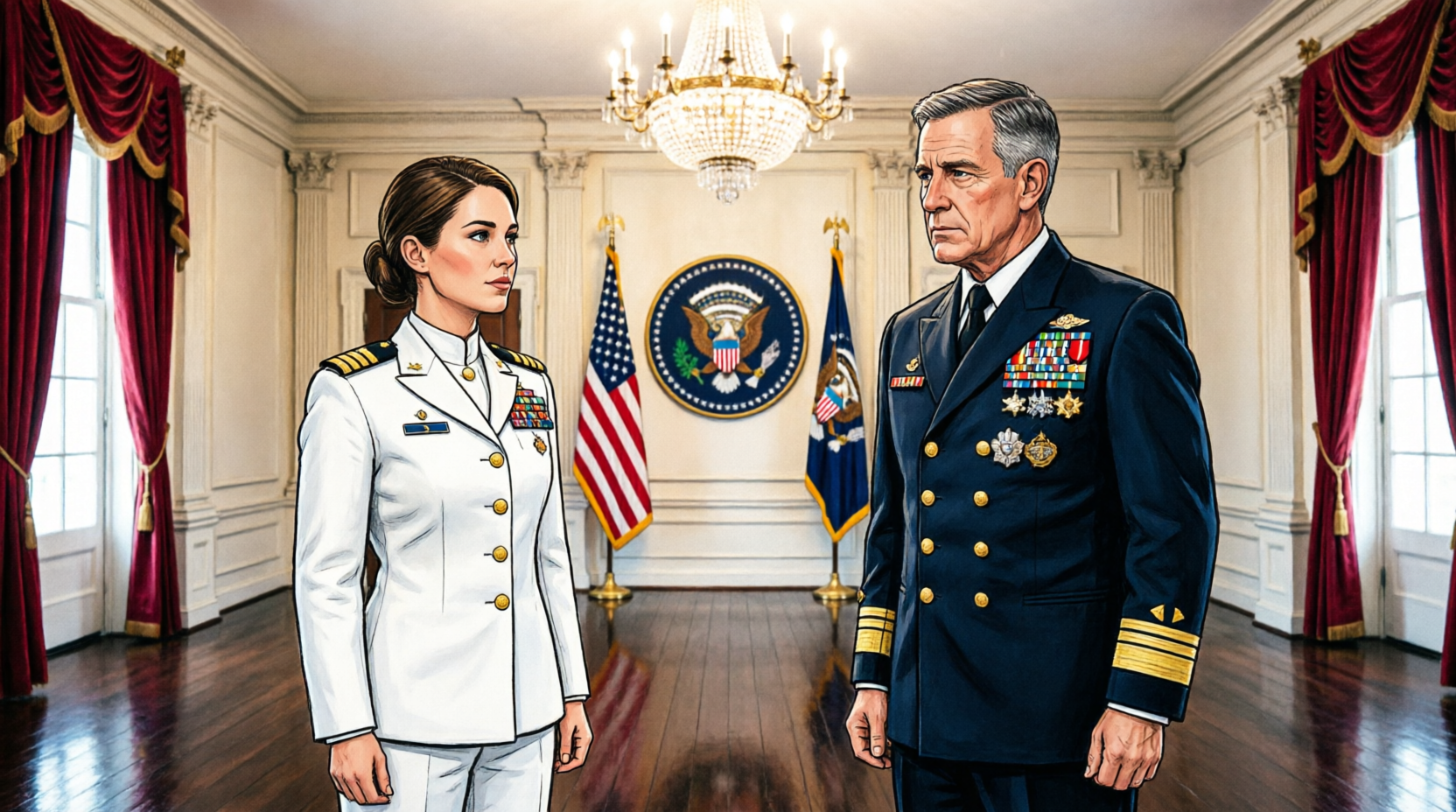
Three weeks after the funeral, I was invited to a veterans recognition ceremony. One of those formal events where patriotism is ironed flat into good lighting, polished shoes, white flowers, and speeches that are sincere and performative in equal measure. I put on my dress uniform. I lined everything up correctly. I polished my boots until the leather reflected dim pieces of me. I tucked my dog tags away, checked my hair, slipped the ring onto my finger without even thinking about it, and headed out.
The hall was full by the time I arrived.
Rows of chairs. Retired veterans in blazers with old unit patches. Senior officers in dark uniforms. Spouses in black and navy. Flags at the front lit so reverently they seemed more memory than fabric. Everything smelled faintly of floor polish, starch, perfume, and the coffee they always serve at these events whether anyone wants it or not.
I was halfway through a polite conversation about base housing repairs with a lieutenant colonel when the room changed around me.
I didn’t know it had changed at first. I just noticed the colonel’s eyes flick upward over my shoulder, then widen. Before I could turn, a voice behind me said, very quietly, “Where did you get that?”
A general stood in front of me.
Not looking at my face.
Looking at my hand.
He was a large man in the particular way some older officers are large—not soft, not merely broad, but built as if his body had been intended for use first and ceremony later. Silver hair cropped close. Weathered face. Four stars bright on his shoulders. The color had drained from him so quickly it genuinely frightened me.
He looked at the ring, then at me, then at the ring again.
“Where did you get that?” he repeated.
“It was my grandfather’s,” I said automatically.
“What was his name?”
“Thomas Hail.”
Something in his face broke open then, not dramatically, but enough to reveal the grief under all the rank. He looked around as if suddenly conscious of witnesses.
“We need to talk,” he said. “Now.”
He led me out a side door into a smaller room off the main hall, one of those bland support spaces with stacked folding chairs, a table covered in navy linen, and fluorescent lighting no amount of official seriousness can redeem. He shut the door behind us and for a second neither of us spoke.
Then he said, “Did your grandfather ever tell you why he refused the Medal of Honor?”
The world did not exactly stop. That would be cleaner. It lurched.
I actually laughed once, an ugly little sound of disbelief escaping before I could stop it. “I’m sorry—what?”
He didn’t soften the question. He only looked at me, waiting.
“My grandfather,” I said slowly, “never talked about any medal.”
He sat down hard in one of the folding chairs, as if the floor had shifted for him too. When he looked up again, his eyes were wet.
“My name is General Samuel Mercer,” he said. “And your grandfather saved my life in 1968.”
I sat because my knees had stopped negotiating.
What he told me next rearranged my entire understanding of the quietest man I had ever loved.
My grandfather had not simply been “in the military.” He had been a Marine reconnaissance operator attached to a joint special operations advisory team during Vietnam, the kind of unit that existed more fully in whispered memory than in family storytelling. The mission Mercer spoke of took place along a corridor that official paperwork had once preferred not to describe too clearly. Bad intelligence. Compromised extraction. Ambush on a fallback ridge. The radio operator killed early. The medic hit. Mercer himself wounded badly enough he could not walk. Two local scouts dead. Air support delayed. Command already preparing, even then, to simplify what had happened into something presentable.
My grandfather had gone back three times.
Once for a wounded man.
Once for Mercer.
Once again because he heard movement and realized one of the scouts might still be alive—or if not alive, then not yet brought home.
“He got hit doing it,” Mercer said. “Wouldn’t leave anyway.”
I listened without moving.
Everything in me was trying to hold two men in the same mind at once: my grandfather at the kitchen sink folding a dish towel into exact thirds, and my grandfather on a jungle ridge under fire refusing to abandon the dead because paperwork wanted them to vanish conveniently.
“The recommendation went up for the Medal of Honor,” Mercer said.
“Went up?”
“It was supported. Witness statements. Signatures. The whole thing. But the operation was classified and politically ugly. They wanted a clean citation. One that left out the border. Left out the scouts. Left out who made which decisions. They were willing to honor him if they could do it with a lie.”
I looked at the ring.
“He refused,” Mercer said.
Of course he had.
Even stunned, I felt it before the words fully settled. Not because I already knew the story. Because I knew him.
“He told them he wouldn’t stand under lights and accept a medal built on missing names,” Mercer said. “Said if the country needed a hero more than it needed the truth, it could find one elsewhere.”
Something burned at the back of my throat.
“They buried most of it,” Mercer continued. “Quiet commendation. Restricted files. Men like him don’t fit the official mythology well if they insist on naming the people power would rather erase.”
I thought of his hospital room. Of the ring knows better than the papers. Of how my parents had treated his silence as emptiness and his privacy as proof of insignificance. I thought of the house sale, of strangers measuring his kitchen, and suddenly I felt almost physically sick at how close the world had come to throwing him away twice—once in history, once in death.
“Why are you telling me now?” I asked.
Mercer’s gaze dropped to the ring again. “Because the records were declassified this summer. Because some of us have spent years trying to correct what happened. Because letters were sent to his next of kin and came back unanswered.” He hesitated. “And because I saw that ring on your hand and realized Thomas Hail has a granddaughter in dress blues who deserves the truth.”
Letters.
That word hit me like a second blow.
My parents had handled his mail more than once in the last few years, especially after his health started failing. They lived close enough to “help” whenever paperwork or inconvenience threatened to become real labor. Had they received those letters? Opened them? Ignored them? Thrown them away because they looked like more military fuss from the old man they had already reduced to a manageable story?
Mercer must have seen something in my face.
“There’s more,” he said softly. “If you want it.”
I did.
Forty-eight hours later I found myself at an archive facility outside Quantico, where fluorescent lights and security protocols guarded a history that had nearly stayed buried. An archivist in white gloves wheeled out a metal footlocker stenciled with THAIL in faded yellow paint.
“Is that how he spelled it?” I asked, because the mistake startled me.
Mercer gave a sad half-smile. “No. That’s how supply spelled anything they weren’t careful with.”
Inside was a life none of us had been invited to know.
Photographs first. Faded, grainy, edges curled. Young men in mud-streaked uniforms with faces too alert for the camera to be harmless. Folded maps marked in pencil. Letters from survivors. A field notebook wrapped in waxed cloth. Citation packets stamped and restamped through years of review. Correspondence addressed to Thomas Hail and returned or left unanswered. One handkerchief bundle, tied much like the one I had found in his bedroom drawer.
Mercer opened it.
Six silver rings lay inside.
All matched mine. Thick. Worn. Plain on the outside. Compass rose within. One blackened point.
“The team had them made after the war,” he said. “Seven total. One for each man who came back.”
I picked one up. Turned it over. On the inside, below the engraving, a name had been marked.
MERCER.
Another: DUFFY.
Another: CANO.
Another: REYES.
Another: HOLLIS.
Another: BENNETT.
And mine, worn nearly smooth by years on his hand. THAIL almost erased by touch.
“The blackened point meant north no longer guaranteed home,” Mercer said.
That line did more damage than the Medal of Honor revelation had. Maybe because it was so human. So young and sad and stubborn. Men making meaning for themselves because official language could not be trusted.
The field notebook was harder.
My grandfather’s handwriting.
Tight. Efficient. Practical. Coordinates. Gear. Weather. Short notations that looked like field work at first glance. Then, on later pages, lines that weren’t meant for command at all.
Mercer still jokes when he’s scared.
Duffy not sleeping.
Scout boy calls me old man though I’m twenty-seven.
Cannot stop hearing the radio after it goes quiet.
Do not leave them. Do not let them vanish because someone needs clean paperwork.
I sat there staring at that last line until the words blurred.
There were sworn statements too. Mercer’s among them, younger, furious, certain. A medic’s. A survivor’s. A review officer’s note identifying my grandfather’s “profound disregard for personal survival when others remained in the field.” Bureaucratic language does strange things to courage. It flattens it into a phrase and calls the result adequate.
Then there was a letter.
Unsigned. Unsheltered by official formatting. Folded into the citation packet as if my grandfather had written it and then never decided whether it belonged to command, history, or no one at all.
If you are asking me to stand under lights and take a medal for that day, then you are asking me to tell a story that leaves out men whose names deserve air. You are asking me to smile while pretending the border did not matter, the scouts did not bleed, the bad intel was weather, and command did not already decide which dead could be named safely. I will not do it. If the country needs a hero more than it needs the truth, let it find one elsewhere.
I had to stop reading after that.
Not because I was confused. Because I understood too suddenly.
All my life I had thought his silence was defensive. Or private. Or the residue of pain too old and too deep to excavate politely. In the archive room I realized something bigger: he had refused the false terms on which his story was allowed to exist. Once a person does that, once they reject the polished version hard enough, the world stops calling them principled and starts calling them difficult, stubborn, private, cold. Anything but right.
Mercer stood back while I read. He did not hover. That kindness mattered. Some discoveries require a witness who knows when to become nearly invisible.
When I finally looked up, my face must have said more than I wanted it to.
“He saved six of us,” Mercer said. “And then he spent the next forty years refusing every version of the story that made him easier to celebrate.”
“Why didn’t he tell me?” I asked.
Mercer considered that for a moment. “Maybe he wanted you to know the man, not the legend. Maybe he didn’t trust institutions not to turn it into something cheap. Or maybe”—and here his voice gentled in a way that made me think he had asked himself similar questions about the dead before—“maybe he never thought anyone in the family cared enough to hear the difficult truth.”
That hurt because it felt plausible.
I took copies of everything I could. By the time I returned to base, the ring felt different on my hand, as if context had changed its weight. That evening I sat on my bunk with the archive folder open on my lap and called my mother.
She answered sounding distracted. “What?”
No hello. No warmth. Just what, as if my existence on the line was already a problem.
“I spent today at Quantico,” I said. “With General Samuel Mercer. I know who Grandpa was.”
Silence. Then, too quickly, “What is that supposed to mean?”
“It means he was recommended for the Medal of Honor. It means he turned it down because the official citation lied. It means the Marine Corps has been trying to contact the family for months.”
In the background I heard my father ask, “Who is it?”
My mother covered the receiver badly enough that I still heard her say, “It’s her.”
Not who. Not our daughter. It’s her. The inconvenient one. The one who turns over stones.
That was when I knew.
They had received the letters.
“I didn’t know what those were,” my mother said when she came back on, and the lie landed so quickly it tripped over itself.
“Did you open them?”
“No—well, your father looked at one because it had military markings and—”
“Put him on.”
My father came to the phone with the confidence of a man who had spent his life talking over women and expected no surprises from another round.
“Listen,” he said, “before you make this into a whole thing—”
“A whole thing?”
“He didn’t like attention. You know that.”
I closed my eyes. The sheer obscenity of it. Turning my grandfather’s moral refusal into simple shyness because it was easier to live with.
“No,” I said. “He didn’t like lies.”
My father went quiet.
That stunned me. I had spent my life watching him occupy conversations by force. The moment he had no clean ground, language abandoned him.
Finally he said, “What do you want from us?”
I looked down at the open file. The maps. The statements. The unsigned letter. The names of men who had bled beside him. The man who died in a county hospital with only me there to hear his last clear sentence.
“The truth,” I said. “And for once, I don’t need you to help me get it.”
The military wanted to correct the record.
That phrase sounds straightforward until you discover how many institutions are invested in old distortions simply because they’ve been filed for long enough to feel official. There were boards. Reviews. Legal notifications. Historical analyses. Questions about next of kin. Questions about ceremony. Questions about classification and language and whether the recovered facts supported the original recommendation or only proved the original process had been morally compromised. Mercer warned me none of it would move fast.
He was right.
The first obstacle was my mother.
As his daughter, she was legal next of kin for any posthumous recognition or official amendment unless she signed authority over. For one full week I thought the whole process would die there—not because she objected on principle, but because anything complex, emotionally inconvenient, and wrapped in military bureaucracy was precisely the kind of thing she would ignore until it spoiled.
Then the local paper called.
That changed everything.
Not because she understood her father. Because she understood visibility.
A reporter wanted comment about a reopened wartime citation. Then someone from a veterans organization. Then a second paper. An old archive photograph surfaced. A historian reached out. Suddenly my father, who had spent years describing Grandpa as a strange, private old man with nothing much to say, began speaking in grave tones about how “Tom never liked discussing his service.” My mother started saying things like “It’s all so emotional” and “We had no idea how deep this went,” which was technically true and morally useless.
Mercer visited them himself.
He never told me exactly what happened in their living room, only that he had not been in a patient mood. Whatever he said, whatever four stars in a doorway did to their sense of hierarchy, the result was that my mother signed the delegation papers giving me authority to handle the records, the review process, and any official ceremony.
She called afterward.
“You got what you wanted,” she said, bitter and tired all at once.
“No,” I told her. “Grandpa did.”
The review took nine months.
Nine months of interviews, survivor statements, legal language, old maps re-examined, timelines reconstructed, and the slow grinding humiliation of an institution admitting—in pieces, never all at once—that it had once preferred a clean story over a true one. I read everything. Every statement. Every memo. Every dissent buried in margins by men who had known, even then, that Thomas Hail deserved something better than what he was being offered.
I also learned things that never would have fit on any medal citation.
That after the war he sent anonymous money to the widow of one of the scouts for years.
That one of the men he saved drank himself to death before he turned forty.
That Mercer had named his first son Thomas.
That my grandfather chose that small Ohio town not because it was home exactly, but because it was far enough from the military world to let him become ordinary on purpose.
That he once turned down an interview request from a national magazine by mailing back the envelope with one sentence written on the flap: Ask the dead if they want editing.
The more I learned, the less I felt like I was discovering a stranger.
That was the part I had not expected.
People think hidden history overturns intimacy. In my case, it deepened it. The quiet. The steadiness. The refusal to accept polished falsehoods simply because they were convenient. The way he respected difficult questions more than easy comfort. The way he had looked at me across his kitchen table and asked why Marines instead of performing fear or pride for effect. It all fit. He had never been two men—one ordinary and one secret hero. He had been the same exact man all along. The world just hadn’t been patient enough to see it without costumes.
The ceremony to correct the record was scheduled for the following spring at the National Museum of the Marine Corps.
Not the Medal of Honor. By then Mercer had been frank with me about that. History rarely repairs itself with perfect symmetry. The original recommendation had been mishandled, suppressed, and morally corrupted, but the practical outcome of the review would be a full public account of the mission, restored names for the scouts who had been erased, and a posthumous Navy Cross under the corrected citation. Some people might have called that insufficient.
I didn’t.
By then I understood medals mattered less than truth. The point was not to pin more shine onto a dead man. The point was that the official story would finally stop demanding he stand alone on a day he had refused to survive that way.
My parents came.
Of course they did.
Visibility had fully ripened by then.
My mother bought a black dress and called me twice about what was appropriate to wear to a solemn military event, as if taste could substitute for years of neglect. My father practiced lines in the mirror—I know he did, because Tyler, for once useful, told me so with a grimace over the phone. Tyler himself showed up late to the rehearsal dinner, shook Mercer’s hand too hard, and kept trying to insert himself into conversations about family legacy as if proximity could retroactively become devotion.
I watched all of it with a strange detached exhaustion.
I wasn’t angry the way I used to be. Anger requires a certain faith that people might have been otherwise if you had argued harder. By then, I knew who they were. That knowledge brings a kind of peace, though not a warm one.
The museum hall was all glass and stone and flags lifting upward in controlled stillness. Marines in dress blues lined the front. Families of other men from the mission had been found—widows, sons, daughters, a grandson older than me who walked with a cane and wore his grandfather’s campaign ribbons pinned discreetly inside his coat. The two scouts’ names, finally released, were printed in the program.
I took the folded paper into the restroom before the ceremony and cried in a stall over those names.
Not gracefully. Not silently. Just with the sudden fierce grief of realizing that my grandfather had turned down the country’s most visible form of honor because two men whose families would never be invited into that polished room had been judged inconvenient to memory.
When I came out, Mercer was waiting a little distance away, hands behind his back, pretending not to guard the corridor.
“You all right?” he asked.
“No,” I said honestly. “But the good kind.”
He nodded. “That sounds about right.”
When the ceremony began, the room settled into one of those silences that feels earned, not staged.
The commandant spoke first. Then a historian. Then Mercer.
He did not use notes.
He stood at the podium in full dress uniform and told the truth plainly, which is harder and rarer than eloquence. He named the mission. Named the ridge. Named the scouts. Named the dead. Named the failures of command that had once been politely edited into fog. Then he spoke my grandfather’s name and the room seemed to pull tighter around it.
“He was offered a version of honor that required him to accept a lie,” Mercer said. “He refused it. That refusal cost him public recognition in his lifetime. It did not cost him our respect. It did not diminish what he did. It enlarged it.”
Then he said something I had not known he intended to say.
“When Gunnery Sergeant Thomas Hail died, only one member of his family came to his bedside, arranged his funeral, preserved the one object he wore every day, and cared enough to ask what the ring meant before anyone else recognized its significance. His granddaughter stands here today not only as family, but as the reason this correction became possible.”
Every eye in the room turned toward me.
For one second I felt exposed in the oldest, most painful way.
Then something steadier replaced it.
I stood.
Not because it was comfortable. Because my grandfather had taught me, in a hundred unsentimental ways, that when truth calls your name in a room full of witnesses, you rise.
I did not look at my parents.
I could feel them somewhere behind and to the left, but they had become irrelevant to the center of the moment. The citation was read. Not the old one. Not the clean one. The real one. Fire. Extraction. Return under enemy fire. Recovery of wounded personnel and allied scouts. Refusal to abandon the fallen. Leadership. Courage. Integrity. The words filled the hall, and I thought not of glory but of his kitchen clock, always three minutes fast.
When Mercer placed the presentation case in my hands, his eyes were wet.
“He should’ve been here,” I whispered.
Mercer’s mouth tightened. “He is.”
People say things like that all the time around grief. Most of the time I let them pass because the dead are not made less absent by sentiment. But there, with the ring on my hand and the corrected truth alive in the room at last, I knew exactly what he meant. Not haunting. Not metaphor. Presence. Shape. The way some people leave behind such exact moral weight that even institutions have to bend around it eventually.
After the ceremony there were reporters, handshakes, photographs, veterans who wanted to tell me about the old man they had known only through Mercer’s stories. Strangers thanked me for my service when they meant his and maybe mine too. My mother cried into a handkerchief she almost certainly packed in advance. My father moved through the crowd with the stiff eager solemnity of a man trying to borrow reflected dignity. Tyler stood off to one side with the dazed look of someone who had wandered into a family he didn’t realize existed.
I slipped away.
Outside on the terrace the air was sharp and cold enough to wake every thought in my body. I stood alone with the ring on my hand and the Navy Cross case under my arm and let everything come at once—grief, rage, pride, relief, exhaustion, vindication, love. People talk about closure as if it arrives neat. It doesn’t. It arrives layered and contradictory and full of edges.
Footsteps approached behind me.
My father.
He stopped at a respectful distance, which was so new it hurt more than if he had barreled right up in his old way.
“I didn’t know,” he said.
I said nothing.
He looked out over the museum grounds instead of at me. “That sounds like an excuse. It isn’t meant as one. I really didn’t know.” He rubbed one hand across his mouth. “But I also never asked. And when the letters came, I thought they were more of the same military nonsense that would turn into paperwork and obligations.” His shoulders shifted under his jacket, smaller somehow than I remembered them. “I didn’t think it mattered.”
There are moments when a person says something so nakedly true that anger can’t improve it.
I turned to look at him.
For the first time in my life, I was not looking at my father the way children do, through inherited scale. I was looking at a man who had spent years dismissing what he didn’t understand because contempt was easier than curiosity. Once truth had measured him, he looked very ordinary.
“It mattered,” I said.
He nodded. “I know.”
That was all.
Not a complete apology. Not redemption. Just accuracy. Sometimes real life gives you only that much. Sometimes that has to be enough.
My mother never apologized for not coming to the hospital.
She apologized, later, for “how complicated everything became,” which told me exactly how her conscience operated. The problem, in her mind, was not the abandonment itself but the way consequences had rearranged the public narrative. I stopped waiting for more after that. Waiting for a certain kind of apology from certain kinds of people is just another way of postponing your own peace.
Tyler did better.
A few months later he drove out to see me and sat at my kitchen table drinking coffee too fast, like caffeine might help him cross emotional ground he had avoided his whole life. He was awkward, embarrassed, too loud in the silences, but for once he was honest.
“I always followed the weather in the house,” he said. “Dad dismissed Grandpa, Mom acted like he was impossible, and I just… I copied it. I thought that was what normal looked like.” He stared into his mug. “I didn’t realize I was borrowing their laziness and calling it my own opinion.”
That was the first useful sentence my brother had ever given me.
I didn’t forgive him in some dramatic cinematic way. I didn’t need to. The truth he had admitted did more than apology could have. It named the thing accurately. That matters.
The last piece of Grandpa arrived months after the ceremony in a cardboard box forwarded from Ohio.
The new owners of his house had found it shoved deep into the crawl space above the hall closet behind old blankets and insulation. Mrs. Kessler called me in a fury, horrified that someone almost threw it out, and arranged to have it sent.
Inside were odds and ends that meant nothing to anyone else: spare buttons in an aspirin tin, a church bulletin from 1984 with notes in the margin about boiler repairs, two old photographs of the maple tree after storms, a fishing license, a pocketknife with a cracked handle.
And one envelope.
My grandfather’s handwriting on the front.
For my granddaughter, if she ever asks the right question.
I sat on my apartment floor before opening it because my hands had started to shake.
Inside was one page.
Sweetheart,
If you are reading this, then either I am gone or you have finally gotten nosy enough to do me proud. There is more to my life than I ever told you, and less glory in it than some people may want to make. Men always try to polish ugly things into honor once enough time has passed. Don’t let them. I did what I could, then I came home and tried to be decent. That is the whole of it.
The ring is yours if you still want it. It was given to me by men I would have gone back for even if no one had ever written a word down. If anyone ever recognizes it, listen before you decide. But remember that you do not owe anybody my story if all they want are the shiny parts.
I was proud of you from the moment you learned to ask why before you learned to obey.
Love,
Grandpa
I laughed and cried at the same time, there on the floor with the box around me and the ring pressing into my hand.
Only Thomas Hail could leave behind a letter that opened by insulting ceremony, warned me against mythology, and then, with one line at the end, reveal he had seen me more clearly than anyone else in my family ever had.
That was the deepest revelation of all.
Not the general.
Not the archives.
Not the corrected citation.
The deepest revelation was that the man my parents treated as difficult, obscure, and emotionally withholding had understood me from the beginning. He had seen the shape of me before I had fully stepped into it myself. He had trusted my questions. He had trusted my seriousness. He had left the ring not to the daughter who shared his blood by law, but to the granddaughter who asked the right question.
I wear it still.
Sometimes people notice it. Most don’t. That feels appropriate.
The Navy Cross sits in a wooden case on a shelf in my apartment beside a photograph of my grandfather on his porch in Ohio, one hand in his pocket, one shoulder angled toward the maple tree, his expression unreadable unless you know him well enough to see the almost-smile hiding there. There is no giant patriotic shrine. He would hate that. No wall of martial glory. No sentimental captions. What I keep is smaller and truer.
The ring.
The letter.
The photograph.
The truth.
He was the quietest man I ever knew.
He was also the bravest.
He refused honor when honor required dishonesty.
He saved men who spent the rest of their lives trying to make the world understand what that meant.
He died with almost no one there.
He was not forgotten because history remembered him. He was remembered because one person loved him enough to keep asking the right question.
And once I knew exactly who he was, I stopped letting anyone make me smaller for their convenience too.
That is his final inheritance to me, more than the ring, more than the medal, more than the story finally corrected in official records. He taught me that silence is not surrender if you know who you are inside it. He taught me that refusal can be holy when the terms are false. He taught me that institutions are not the only things that rewrite history—families do it too, all the time, sanding rough edges off the truth until the version left behind flatters whoever is still alive to tell it.
I don’t permit that anymore.
Not with him.
Not with myself.
When people ask now about the ring, I decide what version they have earned. Most get the simple truth. It was my grandfather’s. He wore it every day. It mattered to him, so it matters to me. A few people, the right people, get more. They get Thomas Hail in his county hospital bed saying the ring knows better than the papers. They get the old Ohio kitchen. The archive room. The six other rings wrapped in white cloth. The sentence about north no longer guaranteeing home. Mercer’s voice in the museum hall. The names of the scouts finally spoken where they should have been spoken long before.
And sometimes, when I am alone and the evening is quiet enough to resemble his house, I think about the life he chose after the war.
That choice matters to me more as I get older.
He could have built himself into a public monument if he’d wanted. Even without the Medal of Honor, a man like that could have worn his service in ways the world rewards. He could have joined every veterans board, told his stories on stages, become the kind of local legend towns wheel out for parades and patriotic breakfasts. Instead he picked a weathered house in a town most people passed through, mended his own tools, kept old paper in the basement, and taught one stubborn little girl how to test branches before trusting them.
I think now that was not retreat.
It was discipline.
It takes a particular kind of courage to refuse the counterfeit importance the world offers and build an ordinary life on purpose anyway. To decide that decency in small rooms matters as much as bravery in catastrophic ones. To insist that a man is not only the most dramatic thing that ever happened to him.
My parents never understood that.
My mother still tells parts of the story now as if the family rediscovered him together, as if sorrow and pride had equal citizenship in our house all along. I no longer fight her version publicly. There is no need. The record exists now outside her reach. Histories, once corrected properly, are harder to bully than daughters at dining room tables.
My father is quieter than he used to be when Grandpa’s name comes up. I don’t know whether that is guilt or age or the natural result of discovering too late that a man he dismissed had more substance in one hand than all his polished certainty ever held. Maybe it doesn’t matter. Maybe not all reckonings are dramatic. Some are just long humiliations that settle into the bones.
Tyler visits more often than he used to.
He asks better questions.
That alone is a kind of miracle.
Last year he came with me to Ohio.
The house is painted now. Different family. Different curtains. The maple tree still stands. We parked across the street and sat in the car for a while without saying much. Tyler looked at the porch, then at me.
“I was awful to him,” he said.
“Yes,” I answered.
He winced, maybe because he expected comfort, maybe because truth from a sister lands differently than truth from memory.
After a minute he nodded. “I know.”
We went to the cemetery afterward. The grass was clipped close. Someone had left fresh flowers on Mrs. Kessler’s husband’s grave two rows over. Grandpa’s marker was plain, which suited him. Tyler stood there with his hands in his pockets for so long I finally walked a little distance away to give him the privacy no one had given our grandfather. When he came back to the car, his eyes were red. He didn’t explain. I didn’t ask.
That is another thing I learned from Thomas Hail: not every feeling improves with immediate translation.
There are moments when I miss him so sharply it feels like a fresh injury.
Not the public version of him.
Not the corrected historical version.
The ordinary version.
The sound of the screen door slapping shut behind me in summer.
The smell of coffee too strong for anyone sensible.
His voice saying, “Use your own knife if you don’t trust mine.”
The way he would stand at the sink after dinner, drying his hands on a towel he folded exactly before setting it down again.
The half-smile when I said something he approved of but thought praise might embarrass.
I miss the person who lived inside the legend more than the legend itself.
Maybe that is the right way to love the dead.
Not by making them larger than life until they become untouchable, but by keeping the scale true enough that you can still imagine them in a kitchen, under porch light, at the edge of a room deciding whether your question deserves an answer.
Sometimes, late, I reread his letter.
The line that always catches me is not about glory or lies or shiny parts. It is the one at the end. Proud of you from the moment you learned to ask why before you learned to obey.
There is a whole moral architecture inside that sentence.
Ask why.
Not because rebellion is glamorous.
Because obedience without understanding is how false stories survive.
It is how families erase the difficult dead.
It is how institutions turn blood into pageantry.
It is how daughters learn to shrink their own perceptions until they no longer trust what they know.
I don’t do that anymore.
At work, in uniform, in family rooms, in grief, in love—I ask why.
Why this version.
Why this silence.
Why this hierarchy.
Why this expectation.
Why this convenient forgetting.
That habit has cost me things. Ease. Approval. A few relationships built on my willingness to misunderstand myself for the comfort of others. It has also saved me from becoming the kind of person who can stand in a room full of lies and call the atmosphere peace.
I owe that to him.
When I think back now to the first time I told him I was considering the Marines, what moves me most is not the sentence he gave me, though I still carry it. It is the respect in the question itself.
Why Marines?
Not Are you sure.
Not Don’t be dramatic.
Not Girls like you don’t do that.
Why.
There are people who make your life bigger simply by assuming your reasons matter. My grandfather did that for me before I had earned it, maybe before I even fully knew what it meant. In a family full of people committed to simplification, he allowed complexity. He made room for intention. He let me be serious without mocking me for it. He let me want hard things for reasons deeper than image or escape.
That kind of respect can reroute an entire life.
So can one ring.
Not because metal is magic.
Because meaning can survive where language fails. Because a man who refused to let official papers tell the wrong story left behind an object that knew better. Because a granddaughter loved him enough to keep it when everyone else was busy clearing out the house. Because a general old enough to carry memory like scar tissue looked at that ring and recognized not only the past, but the obligation still attached to it.
The ring knows better than the papers.
He was right.
It did.
And now I do too.
THE END!!!