
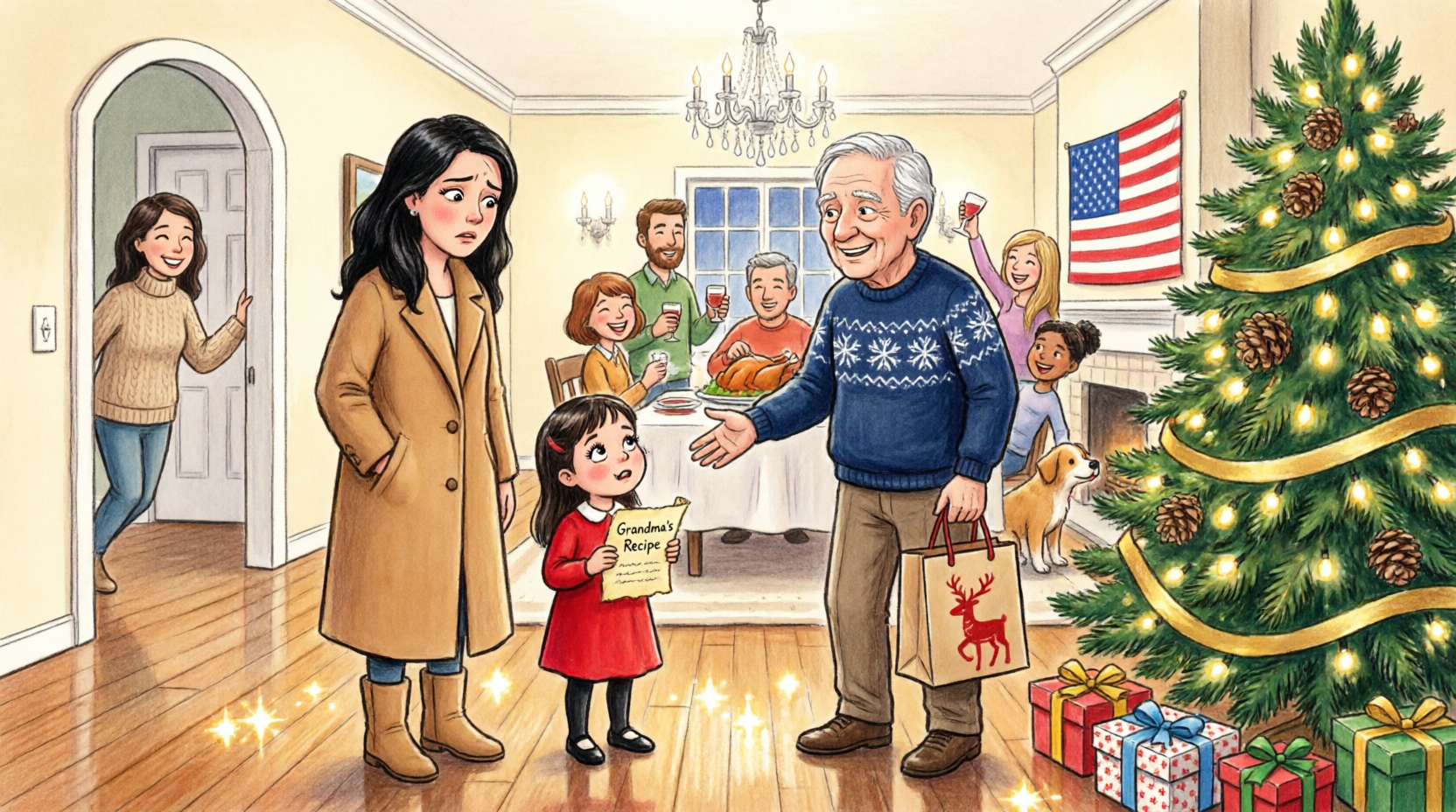
“‘My Christmas With Family,’” she said proudly. “Mrs. Anderson said we should capture real moments with our families and share them with the class. She showed us how to use the record button on the app. It’s easy. I set the tablet in the hall on that little table so it could see everybody. I wanted to show my class how we do dessert at Grandma and Grandpa’s house.”
I glanced at the screen. In the corner was a little red circle pulsing softly, and next to it the word “LIVE.” Below that, tiny profile icons and comments floated up in a steady stream. There were names of classmates, a few that looked like parents, and a viewer count that was already over one hundred.
My heart skipped a beat.
“Lily, honey,” I said carefully, “have you been recording for a while?”
She nodded.
“Since before we came in,” she said. “I wanted to show my class how we do dessert at Grandma and Grandpa’s house. I set the tablet in the hall on that little table so it could see everybody.”
I felt the blood drain from my face. So the entire time my parents had been spinning their story in the great room, telling lies about me, diminishing what had happened, they had been speaking in range of a live microphone broadcasting to a bunch of second graders and their families.
James moved behind me to see the screen better. His eyes widened. He whispered that the link could easily be shared beyond the class, that by now there might be even more people watching. Maria put a hand over her mouth.
“Oh my God,” she said softly. “They have no idea.”
For a moment, a wild, hysterical laugh bubbled up in me. I pushed it down. Instead, I reached out and gently picked up the tablet, angling it so I could see what the last comments said. Some of the kids were typing things like “Lily’s grandpa sounds mean” or “My mom says that’s not nice.” A few adult names I recognized from the school email list had posted that they were concerned and would be following up.
I swallowed hard. Real moments with your family, I thought. That teacher had no idea just how real things were about to get.
We left Lily in the den with Maria for a minute, telling her to keep working on her project and not to worry, that everything was okay. Then James and I walked back toward the great room, the tablet still streaming in my hands. I stood in the doorway this time, not hiding. My parents saw me almost immediately. My mom’s smile froze, then cracked. My dad’s face darkened.
“Cara,” my mom said tightly, as if she had tasted something bitter. “We were just explaining to everyone what happened last night. I’m sure we can work this out in private.”
I held up the tablet slightly, not enough to make a scene yet, but enough that James could see and that my parents knew I was holding something. My dad’s eyes flicked to it and back to my face.
James stepped forward before I could speak.
“No more private,” he said. “That’s the problem. Everything important in this family has been kept private, behind closed doors, where you can spin it however you want.”
Several relatives shifted uncomfortably. An older aunt started to say that this was not the time. Another uncle muttered that this was family business. I heard those words and thought about how often they had been used to cover sins.
Maria came into the room then, her face flushed, eyes glassy. She looked at my parents and something snapped in her that must have been building for years. She said that she was tired of the secrets. Tired of being told what to say when people asked about me. Tired of repeating their lines about how I had made mistakes and they were always there to help. She admitted that she had lied to protect their image because they made her feel like she owed them everything. Her voice shook as she said all of this. At one point, she started to cry, real sobs that rocked her shoulders. She said that living under my parents’ expectations was like being on a stage all the time, never allowed to drop character.
Laura, who had been sitting stiffly in a corner armchair, suddenly covered her face with her hands. I saw her shoulders start to shake. When she looked up again, her mascara was smudged, and the cheerfulness she wore like armor was gone. She said that Mom had told her for months that if she ever left her husband, everyone in their church would think she was selfish, that she had failed, that they would side with him. She admitted that she and her husband had been living apart for almost half a year, but she kept coming to these gatherings pretending everything was perfect because she was terrified of the fallout.
My mom tried to interrupt, denying, deflecting, but her voice was thinner now. My dad scolded Laura for airing personal matters in front of extended family. He said they should all sit down and talk calmly instead of attacking him in his own home.
It was chaos, voices layered on top of each other, years of resentment finally spilling out. In the middle of the noise, Lily had wandered in from the den, drawn by the raised voices. She still held her tablet, the screen pointed vaguely toward the room, the little red “LIVE” indicator still glowing. She stood there for a second, taking everything in with those big, serious eyes.
Then she walked straight up to my mom, tugged on the sleeve of her sweater, and asked, in a small, clear voice that somehow cut through all the shouting:
“Grandma, why do you hate me?”
The question hung in the air like smoke from a blown-out candle. Every adult in the room froze. My mom’s mouth opened, then closed again, her face draining of color as she stared at the small girl who had just cracked her world open in front of relatives, friends, and more than a hundred silent viewers on Lily’s school app. Lily looked up at her with those wide brown eyes that never seemed to hold anything but sincerity. She repeated it softly.
“Did I do something bad?”
My mom stumbled back a step, her hand reaching for the arm of a chair. I could see panic rising through her like ink spreading in water. My dad’s posture stiffened, his jaw locking as if bracing for impact. I stepped closer to Lily, but I didn’t touch her yet. I wanted to see what my mom would choose at this moment—truth, or the curated version of it she had spent years polishing.
She inhaled sharply.
“Lily,” she said, forcing a brittle smile, “you misunderstood. Grandma doesn’t hate you, sweetheart. Sometimes grown-ups say things that sound harsher than they really are.”
Lily blinked.
“But you called me an embarrassment last night. And Grandpa said only good kids get presents. And you didn’t give me one.”
A tremor went through the room. A few relatives exchanged glances. Someone coughed. My mom looked around desperately, searching for support, but even the most loyal aunts seemed uneasy.
My dad stepped forward, trying to regain control.
“That is enough,” he snapped. “Children mishear things. Lily is confused.”
James barked out a humorless laugh.
“Confused. Dad, are you sure you want to go with that?”
My dad turned on him.
“Not one more word, James. You’re adding fuel to something that should never have happened in the first place.”
But James walked right past him toward the television mounted above the fireplace. His shoulders were squared, and for the first time in my life I realized just how done he really was.
He picked up the remote from the mantel.
“If we’re going to talk about misunderstanding,” he said, “then everyone should hear the whole story, not just the version you two spoon-feed them.”
My mom shot forward.
“James, don’t you dare touch that television.”
He ignored her, clicked a button, and the screen lit up. The first audio file queued automatically. A familiar voice filled the room—my mom’s voice, clear and unmistakable, from what sounded like a luncheon or small gathering.
“Honestly, I don’t know why Cara keeps trying. She’s always looking for pity. She made her choices, and now she wants the whole world to pay for them.”
Gasps rippled through the room. My mom’s hands flew to her mouth.
Another clip followed, this one my dad’s voice from what sounded like a backyard barbecue.
“That kid of hers is wild. You never know how children from those situations turn out. Cara expects us to pretend everything is normal. It’s embarrassing.”
A murmur spread among the relatives. Someone whispered that they had heard something similar before but didn’t believe it.
Clip after clip rolled on. My mom calling me irresponsible. My dad telling a friend at the golf course that I used men for help. Both of them agreeing that they should distance themselves so my reputation wouldn’t stain the family name. And worst of all, a recording where they spoke about Lily—my mom’s voice, cool and dismissive:
“We don’t bring her to events. People will ask questions. It’s better this way.”
My father answered:
“Easier for everyone.”
My stomach twisted. I heard Lily inhale sharply beside me. When I turned, her little face was flushed and trembling, her hands gripping her tablet tightly. The livestream had not stopped for a single second. In the corner of Lily’s tablet, the viewer count began to jump. One hundred twenty. One hundred eighty. Two hundred fifty. I watched it climb with surreal disbelief. Two hundred eighty-seven. Then three hundred. Then higher.
The comment section streamed upward rapidly. Some kids were typing shocked faces. Parents posting things like “I am watching” and “This is not okay.”
Then another name popped up. I blinked hard. It was her teacher.
“Mrs. Anderson is watching the stream,” I whispered.
I saw her comment appear:
“Lily, sweetheart, you are very brave. Please stay safe. I am here.”
Something inside me broke and hardened at the same time. My daughter was not alone. People were seeing the truth. A whole audience was witnessing what we had lived with in silence for years.
My mom lunged toward Lily suddenly, reaching for the tablet.
“Turn that thing off right now,” she shouted. “You have no right to broadcast private matters. This is family business.”
Lily stumbled back, nearly losing her grip. I stepped between them instantly, my voice low and sharp.
“Do not touch her.”
My dad slammed his fist on the dining table.
“Turn off the livestream, Cara. Right now. You are humiliating us. You are destroying this family.”
I slowly lifted my chin and met his furious stare. I felt something steady and cold settle inside me, like steel forming at the center of my chest.
“I’m not destroying anything, Dad,” I said quietly. “You did that yourselves.”
He looked stunned, as if no one in his life had ever spoken to him that way. James stepped to my side. Maria and Laura too. Even a few cousins silently shifted closer, forming a line behind me without saying a word.
The room was different now. It felt like the walls had widened, letting air flow freely after being sealed for too long.
Lily’s voice came trembling from behind my leg.
“Grandpa, why am I not good enough?”
My dad flinched. My mom opened her mouth, but no words came out.
The livestream viewer count jumped again. Four hundred. Five hundred. Six hundred thirty-two. Comments exploded across the screen with anger, sympathy, and disbelief. Someone typed, “This is abuse.” Someone else: “Poor child. We are with you, Lily.” Another: “Reporting this to the school district.”
Then the app flashed a notification that made my breath hitch.
“Principal Hart has joined the stream.”
I felt dizzy. The principal. Watching all of this.
The great room suddenly seemed fuller than it already was. Voices began rising in confusion. Relatives asked what all these messages were. Someone asked if Lily’s tablet was connected to social media. Another person muttered that lawyers would need to be involved.
My dad pointed at me, red-faced and shaking.
“Turn off that livestream, Cara. This is enough. You’re tearing this family apart. You’re bashing your mother and me in front of strangers. You should be ashamed.”
I stepped forward until I stood directly in front of him.
“I’m not ashamed,” I said quietly. “I did nothing wrong. I protected my child. You’re the ones who said those things. Not me. Not Lily. Not James. You want to hide the truth because you can’t stand seeing the reflection of yourselves.”
His mouth opened and closed again, fury twisting his features.
The front windows suddenly glowed with white light, soft at first, then brighter, flickering. People in the room turned to look. Outside, in the driveway, headlights swung in a slow arc. Then another set. Then a large vehicle pulled up.
James stepped toward the window and parted the curtains. His expression tightened.
“Reporters,” he said quietly.
Everyone froze. I heard tires crunching on snow. Doors opening. Distant voices calling out. Cameras clicking. Someone must have shared the livestream link. Someone must have recognized the last name Whitmore. Someone must have contacted the local news. Because the press had arrived. And the world outside my parents’ home was about to know everything.
“Reporters,” James said, and the word felt heavy in the air even without his voice carrying it.
Faces turned toward the front windows, bodies shifting in little anxious movements. No one moved closer, but everyone strained to see through the curtains. Headlights washed over the snow again, then settled. I heard car doors slam, the crunch of boots on the icy driveway, and that particular hum of excited voices that always follows cameras.
In Lily’s tablet, the viewer count jumped as if responding to the noise outside. One thousand. One thousand two hundred. One thousand six hundred. The number rolled like a slot machine that wouldn’t stop.
My dad started barking orders. He told people to stay away from the windows, to ignore whatever was happening outside, to remember that this was a private gathering. His voice had that tense cheerfulness he used when he was about to lose control but wanted everyone to pretend he was still in charge.
My mom moved closer to him, one hand clutching at his sleeve. I could see fear rising in her eyes. Not fear for my daughter. Fear for the image she had curated for decades.
Her gaze flicked from Lily’s tablet to James, then to me, calculating, searching for something she could still manipulate.
Maria was standing near the arm of a sofa, both hands shakily wrapped around a mug of coffee she had not yet tasted. She looked like she was about to be sick. I went to her side and touched her arm. She flinched slightly, then let out a low, shaky breath. She murmured that I needed to know something else, that we were not done yet, not even close.
Her eyes darted toward James, then toward my parents. It was as if carrying the secret had finally become too much. She said that five years earlier, when James had gone through a major health scare, the doctors had recommended genetic testing. They had found something concerning in his blood work and wanted to know if there was any inherited risk. So they had run a panel and suggested that everyone in the immediate family get tested as well.
James had agreed. He had always been the one willing to do whatever the doctors suggested. He wanted to be responsible, to protect his future children.
Maria’s voice trembled as she explained that the results had come back showing that whatever anomaly the doctors were concerned about simply did not line up with my dad’s DNA. There was no match. None at all. She looked at my brother as if asking permission. He gave a short nod and said softly that the test had revealed he was not biologically my father’s son.
Those words landed like a stone dropped into a frozen pond. First there was nothing, then cracks began to appear everywhere.
My mom gasped out a denial, one hand flying to her chest. My dad’s face flushed, then went an alarming shade of white. He said that James must have misunderstood, that no test could prove something like that. He accused the lab of making a mistake, said that these things happened all the time and people got worked up for no reason.
James did not back down. He said that the genetic counselor had reviewed the results three separate times and written that the probability he shared a biological father with me and Laura was effectively zero. He explained that he had confronted our mom privately afterward, that she had broken down and begged him not to say anything to my dad, sobbing that she would lose everything if the truth got out.
Maria could no longer hold it in. She said she had watched him carry this secret for years, trying to protect everyone, trying to keep peace. She said he had been torn between the man who had raised him and the truth written in his DNA. James had chosen silence because our mom had framed it as a test of loyalty.
My mom kept saying that none of this was anyone’s business, that family matters should be kept quiet, that dredging up the past would destroy what little they had left. She insisted the tests were wrong, that James was confused, that Maria was exaggerating. Her voice kept rising and cracking, betraying her.
Laura sat heavily on the sofa, her face ashen. I realized she was shaking. She finally spoke, her words coming out like they had been trapped for months. She said that she had felt crazy for so long, doubting her own perceptions, letting Mom talk her into staying in a marriage that was slowly crushing her. She admitted that she and her husband had been living separately for six months, that she had a studio apartment in Denver where she slept most nights, surrounded by half-unpacked boxes and takeout containers.
She said that every time she thought about filing for divorce, Mom had told her that no one would ever respect a woman who left her marriage without a dramatic reason. She said that Dad had reminded her that his name opened doors in their community and that she would lose those privileges if she made him look bad. So she kept putting on the dress, painting on the smile, showing up to events with a man she no longer trusted, all to keep the illusion intact.
There it was again, that word. Illusion. This whole house was built on it.
As they spoke, Lily’s tablet kept streaming. I could see the viewer count climbing into new territory. One thousand eight hundred. One thousand nine hundred fifty. Two thousand. The comments were flying so fast I could hardly read them. Parents expressing outrage, neighbors recognizing my parents’ voices, strangers saying that this was exactly why keeping up appearances at all costs poisoned families.
Then a new notification popped up at the top of the chat. It was from the principal’s account. The message said that the school would be following up with Lily’s family privately to make sure she was safe and supported, and that they were deeply concerned by what they were witnessing.
My mom saw the name on the screen and made a choking sound. Her job at the district office flashed before her eyes in that moment. She had always bragged about her role in education, about her picture on the website with the caption about her commitment to children. I wondered what the district would think now, watching a woman who refused to acknowledge her own granddaughter unless there was a way to keep it tidy and comfortable for herself.
My dad lunged for the tablet again, but James stepped in front of Lily, blocking his path. My brother had always been the quiet one, the peacemaker. In that moment he was anything but. He said that this was the first time the truth had ever been louder than their lies. He told my dad that trying to silence everyone now would only prove what the recordings had already shown.
My dad shouted that James was being ungrateful, that he had given him everything. James said calmly that my dad had given him a roof and a last name, but never once gave him unconditional love without strings. He said that discovering he was not biologically related had hurt, but not as much as realizing that my dad cared more about his reputation than any of his children’s actual lives.
The room crackled with tension. I could feel the past and present colliding in that space, the stories we had all told ourselves finally dissolving in the light.
In the middle of it all, my phone buzzed in my pocket. I pulled it out and saw a name that made my throat tighten for a different reason.
Tom Patterson.
Tom had been my mentor since those early days when I was still sweeping sawdust on job sites. He owned a large lumber-supply business in Boulder and had taken a chance on me when no one else in the industry took a young, single-mom contractor seriously. He had become something like family—the good kind. James and Maria called him one of the few grown-ups they trusted around Lily.
I stepped to the side and answered, keeping my voice low. Tom asked if I was safe. I told him that I was, that Lily was with me, that things were messy but under control. He said that he and his wife had been watching the livestream since one of their employees texted them the link. His voice was slow, heavy with both anger and compassion. He told me that he had no words for how proud he was that I stood up for my daughter.
Then his tone hardened. He said that in all his years in business he had never seen such blatant cruelty from people who pretended to be pillars of their community. He reminded me that my parents had held an account with his company for over thirty years and that he had always tried to treat them fairly out of respect for me. Then he said something that sent a ripple through my sense of what would come next.
He told me that, effective immediately, Whitmore Hardware and all personal accounts under my parents’ names were suspended from receiving any preferred treatment or credit from his lumber yard. He said that his business did not support people who belittled children and lied about their own flesh and blood.
I closed my eyes briefly, letting it sink in. In my parents’ world, that account was not just a convenience. It was a symbol. A long-standing relationship with one of the biggest suppliers in the region. A perk they bragged about at dinner parties when talking about home projects and their connections.
Tom added that he had already placed a call to two other suppliers he knew along the Front Range, warning them about potential issues with my parents and suggesting they review any open lines of credit. Not as revenge, he said, but as good business practice. If people lied in one area of life, they would lie in others.
When I hung up, my hands were trembling slightly. Not from fear. From the realization that my parents’ actions were finally carrying consequences outside the family walls.
My dad noticed my expression and demanded to know who had called. I told him it was Tom. I told him that the lumber account he had taken for granted for three decades was gone. My mom made a strangled sound. My dad sputtered that Tom had no right, that he would call him and straighten it out. He said that long-term relationships meant something. He said Tom would listen to reason.
I met his eyes and told him that reason looked different when you were watching a child be shamed in front of hundreds of people. I reminded him that loyalty was not owed, it was earned, and he had spent years burning through any he ever had.
The arguments swelled again. Some relatives tried to calm things. Some slipped quietly toward the door, not wanting to be part of the spectacle any longer. Others hovered, unable to tear themselves away from a lifetime of secrets unraveling in real time.
Lily stood close to me, her tablet still in her hands, the red “LIVE” indicator glowing like a tiny, steady heartbeat in the corner of the screen. The viewer count held over two thousand now, a wave of watching eyes that no one in that room had invited but all of us had somehow called forth.
My parents had spent their whole lives worshiping a polished image. Yet now, in the harshest light they had ever faced, the true shape of our family was showing. It was not pretty. It was not neat. But for the first time, it was honest.
And deep inside, I could feel that this was only the surface. The secrets of their generation, the choices they had made long before we were born, were starting to tremble loose. We had taken away their ability to pretend. What we were about to take away next would cut even deeper.
The room felt stretched thin, like the air itself was trembling from everything that had just been torn open. My parents stood rigid and pale, my mom gripping the back of a chair as if it were the only thing keeping her upright. My dad’s eyes darted between the front windows glowing with the lights of the press and the tablet in Lily’s hands that continued streaming our family’s collapse to more than two thousand people.
I could feel the shift in the room. People had stopped trying to pretend. The illusion was gone, and once that kind of veil is lifted, you can’t ever put it back the way it was.
Then my phone rang. At first I thought it was Tom calling again or maybe another friend who had seen the livestream. But when I looked at the screen, my breath caught in my throat.
Connor Hayes.
I stared at the name for a second, frozen. My fingers felt numb as the phone buzzed insistently in my hand. James leaned toward me.
“Who is that?” he whispered.
“Lily’s biological father.”
James’ eyes widened. The room around me blurred as the phone kept vibrating. I stepped away from the cluster of relatives and pressed the answer button with a trembling thumb.
Before I could say anything, a man’s voice slid through the line with a confidence that made my skin crawl.
“Cara. It’s been a long time.”
My heart lodged in my throat.
“Why are you calling me?”
He gave a little laugh, smooth and smug.
“I saw the livestream. Hard to miss. You’ve done pretty well for yourself, huh? Construction company, reputation, all that attention. Looks like life worked out for you. And for Lily.”
My stomach twisted. I wanted to hang up, but something in his tone held me still. I kept my voice flat.
“What do you want?”
He pretended to sigh, like this was just a hard conversation between old friends.
“I’ve been thinking. Maybe it’s time for me to be involved again. She’s my daughter too. And I think it’d be good for her to have her father in her life. Especially now that everything is blowing up over there.”
I closed my eyes, steadying myself.
“You walked away. You never called. You left us with nothing.”
He chuckled again, a sound that made the hair on my arms rise.
“Come on, Cara. That’s old history. People change. I’m ready to step up now. And since you’re doing well, it would make sense for us to work together on this. I think we can find some sort of arrangement.”
His voice dipped slightly, growing calculating………………………….