
Part 1
My Versace dress had been missing for three weeks, and until my father’s funeral, I thought that was the worst mystery in my life.
It was midnight blue, the kind of blue that looked black in shadow and almost silver where the light hit the hand-sewn crystals along the neckline. My father had given it to me for my fortieth birthday last fall with a card that said, For the nights when you want to remember that elegance is armor. He’d always written like that—half lawyer, half poet, fully dramatic.
I tore through my closet looking for it the week before the funeral. I checked the garment bags, the cedar chest, even the hall closet where winter coats went to die. I accused the dry cleaner of losing it. I tipped out old shoe boxes and breathed in dust and leather and stale perfume. Nothing.
By the morning of the funeral, I had bigger things to think about than a missing dress. My father was gone. The house was full of casseroles and low voices and the smell of coffee that had been sitting on a burner too long. White lilies lined my kitchen counter, their sweet, rotten smell pushing into every room like grief with petals.
I wore black because black was simple and I did not trust myself with anything delicate.
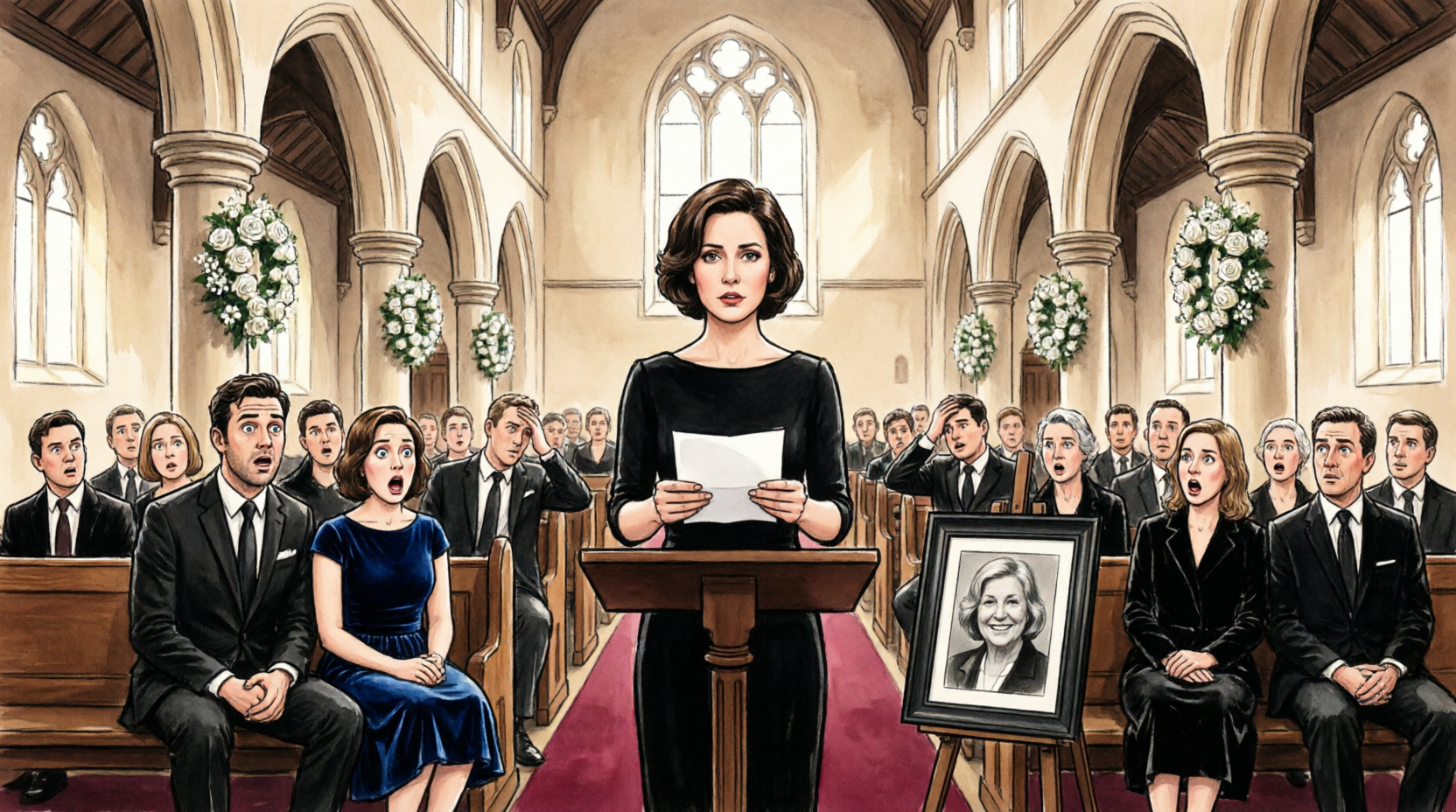
St. Augustine’s Cathedral was cool and dim when I arrived, all stone and wax and stained glass. The organ was already murmuring under people’s conversations. There were polished shoes on marble floors, damp tissues, men with their ties loosened even though the service hadn’t started yet. My father had known everyone in half the city, and apparently all of them had come.
I stood in the back of the cathedral for a second just to breathe.
At the front, his casket sat beneath a spray of white roses and blue delphiniums. Father Martinez was speaking softly to Mr. Blackwood, Dad’s attorney and oldest friend. My aunt Helen was directing people with the expression of a woman who would personally fistfight chaos if it tried her. All of it felt unreal, like I’d wandered into a performance of my own life and someone else had been cast as me.
Then I saw my husband.
Grant was seated in the front row where he should have been, except he wasn’t alone.
The woman beside him was wearing my dress.
For one bright, stupid second, my mind refused to make sense of it. All I could do was stare at the crystals flashing under the stained glass as she turned her head. Tiny shards of red and blue and gold danced across the pew in front of her. My father used to joke that the dress looked expensive enough to throw its own light. There it was, shining from the body of another woman while my father lay dead twenty feet away.
My feet started moving before I’d decided to confront anybody.
“Becca,” I said, the name coming out flat and strange in my own ears. “What the hell are you doing here?”
Rebecca Thornton turned around with the smoothest smile I’d ever wanted to slap off a face.
She was twenty-eight, maybe twenty-nine on a generous day, and worked in marketing at Grant’s firm. I’d met her twice at company events. She’d called me Natalie in that overly warm way women do when they want credit for friendliness without the burden of sincerity. She had glossy brown hair, expensive cheek filler, and a talent for standing a little too close to married men.
“Natalie,” she said softly, like we were meeting at brunch instead of my father’s funeral. “I’m so sorry for your loss.”
She had one hand on Grant’s. Not brushing. Holding.
My husband finally looked up at me, and the guilt on his face hit like a door slamming.
Not shock. Not confusion. Guilt.
The cathedral seemed to narrow around me. The air smelled suddenly metallic, like a cut lip. Every late night at the office, every “conference,” every trip he’d cut short with excuses about mergers or clients or red-eye flights started lining up in my head so fast I almost got dizzy.
“Why is she wearing my dress?” I asked.
Nobody answered immediately, which was answer enough.
Becca crossed one leg over the other and gave a tiny shrug. The hem shifted against her knee. I knew that dress so well I could tell by the way it moved that she’d had it taken in at the waist.
“Oh, this?” she said. “Grant gave it to me. He said you never wore it.”
I looked at Grant.
His eyes flicked away so fast it was almost funny. Fifteen years of marriage, and the man still thought not making eye contact counted as strategy.
“Tell me she’s lying,” I said.
“Natalie,” he muttered, leaning forward like he was trying to quiet a child at church. “Not here.”
The words hit harder than if he’d shouted. Not here. As if the problem was my timing and not his mistress in my father’s front pew wearing my birthday gift.
“Family supports family during hard times,” Becca said, loud enough for the nearest rows to hear.
I turned to her slowly. “Family?”
She smiled again, but this time I caught the nerves underneath. “I’m practically family now.”
The sentence landed like a dropped tray. Heads turned. Somewhere to my left, someone actually gasped. Grant’s shoulders tensed. Good. Let him feel something.
“Practically family?” I repeated.
Becca lifted her chin. “Grant and I have been together for almost a year. It seemed appropriate that I be here.”
A year.
The number moved through me like ice water. A year gave shape to everything. Our anniversary weekend in Paris, when Grant had “missed” the first flight and arrived smelling like airport whiskey and a different hotel soap. The sudden flood of conferences. The nights he came home too tired to talk but smelling faintly of a floral perfume I didn’t own. Cabo, supposedly for clients. My father’s second round of chemo, which Grant had skipped because of “board pressure.”
A year.
“Natalie.”
Aunt Helen appeared at my side in a cloud of Chanel No. 5 and rage. She was small, sharp, and built like a woman who’d survived the seventies by setting problems on fire. Her red lipstick never moved, not even at funerals.
“The service is about to begin,” she said quietly. “Sit down. We will deal with this.”
“There’s no seat,” I said, because that was suddenly the detail my brain chose to cling to. “My seat is there.”
Helen’s mouth went thin. She took one look at Grant, one at Becca, and the temperature around us dropped ten degrees.
“Then they can sit in hell,” she said under her breath.
But she guided me to the row behind them because the organ had swelled and Father Martinez was stepping to the front and three hundred people were turning toward the casket. My knees felt unreliable. I sat. In front of me, I could see the back of my husband’s head and the familiar line of my own dress against another woman’s spine.
The service began.
Father Martinez spoke about my father’s generosity, his integrity, the way he gave quietly and helped loudly. I heard every word and none of them. I could only stare at the crystals on Becca’s neckline, at Grant’s arm stretched behind her on the pew, at the neat blond widow from Dad’s sailing club dabbing her eyes while my marriage bled out one row ahead of me.
My father would have hated this.
James Crawford had adored good manners, but he adored loyalty more. When Grant asked for permission to marry me, Dad took him sailing in rough water and came back with windburned cheeks and a split lip that he claimed came from “an overly enthusiastic boom.” Grant had laughed about it for years. Much later, Dad told me, I just wanted the young man to understand weather can turn fast.
The eulogies started. Mark spoke. Then Dad’s law partner. Then Father Martinez looked down the row and said my name.
I stood on shaky legs and felt Helen squeeze my hand once before letting go.
As I walked past Grant, he finally looked up at me. There was panic in his face now. Not sorrow. Not shame. Panic.
Good, I thought.
Very good.
At the podium, I unfolded the pages I’d brought. On top was my eulogy. Underneath it was the note my father had made me promise to keep with me, though he’d been too weak to explain why. The paper trembled in my hand.
I looked out at the cathedral, at the crowd, at my father’s casket, at my husband and his mistress in my dress.
And for the first time all morning, I understood that whatever my father had meant two nights ago, it had started before I stepped into that church.
I cleared my throat, met Grant’s eyes, and said, “My father called me from hospice two days before he died, and what he told me changed everything.”
Grant went pale.
What exactly had my father known—and how much was about to explode in front of everyone?
Part 2
There are moments when grief feels private, like a hand closing around your throat in the dark. And then there are moments when grief turns theatrical and drags your whole life onto a stage you never asked for.
Standing at that podium, I felt both.
The microphone smelled faintly metallic, and I could hear the soft pop of the speakers when I adjusted it. Somebody in the back coughed. A baby fussed and got carried into the vestibule. The stained glass threw blue and gold patches over the stone floor at my feet, and my father’s casket gleamed under the lights like polished mahogany and goodbye.
I had planned to tell a story about sailing.
That was the safe version. The respectable version. The daughter at the funeral talks about the time her father taught her to read the wind off the water and laughed when she got sprayed in the face. The daughter says words like integrity and generous and impossible shoes to fill. Everybody cries, and then they eat finger sandwiches in the parish hall and remember him kindly.
But safe had already been dragged out into the aisle and humiliated in my dress.
So I looked at my father’s casket and chose honesty.
“My father,” I said, “was the kind of man who noticed details other people missed. He could walk into a courtroom and tell which witness was lying by the way they held a pen. He could step onto a sailboat and feel a weather shift before the sky changed. And he could look at me from across a room and know when something in my life was wrong before I admitted it to myself.”
My voice wobbled, and I paused long enough to let it steady.
“When I was ten, he taught me how to tie a bowline in our backyard using one of his good neckties. My mother nearly killed him for it. He told me there were two things a person should always know how to do—secure what matters and get themselves loose from danger.”
A few people smiled through their tears. Aunt Helen made a small sound that might have been a laugh.
I could feel Grant watching me now. Becca too. The air around them had changed. She’d come in smug. He’d come in cowardly. Now both of them looked like they were sitting on a detonator.
“My father called me two nights ago from hospice,” I continued. “He was tired. His voice was barely there. But he told me he’d hired a private investigator.”
A murmur moved through the church like a breeze through dry leaves.
Grant sat up straighter.
“I didn’t understand at first,” I said. “I asked him why he’d do that. He told me I’d looked unhappy for months. He said I smiled too quickly and then stopped too fast. He said I made excuses for my husband that sounded practiced.”
My hand tightened around the papers.
“He wanted to make sure I was safe,” I said. “He wanted to make sure I wasn’t being lied to.”
Now the church was silent. Even the baby in the vestibule had stopped crying.
I looked directly at Grant. He shook his head once, almost imperceptibly. A warning. A plea. Hard to tell with him anymore.
“The report included photographs,” I said. “Hotel lobbies. Candlelit dinners. Airport arrivals. Weekends I had been told were business. It included enough dates and timestamps to make the pattern very clear.”
Someone in the third pew whispered, “Oh my God.”
Becca’s spine had gone completely rigid in front of me. I could see the pulse beating at the base of her throat, right above the crystals on my dress.
“I spent the last two days grieving my father,” I said, “and learning that while he was dying, my husband was having an affair.”
The words echoed. I heard them hit the stone and wood and stained glass and come back bigger.
Grant stood up.
“Natalie,” he said, voice low and urgent. “Stop.”
The irony was so sharp it nearly made me laugh. Stop. After a year of lies, now he wanted timing.
Aunt Helen, blessed woman, slid into the aisle like she’d been waiting her whole life for this specific assignment. She folded her arms and planted herself at the end of the pew. Grant looked at her, looked at the people turning to stare, and slowly sat back down.
I kept going.
“My father’s last coherent words to me were not about his cases or his legacy or the value of the house or the yacht or any of the things people usually fight over when someone dies. He said, ‘Don’t let him take anything else from you, sweetheart. I’ve made sure of it.’”
That got a reaction I could physically feel. A ripple. Heads turning toward Mr. Blackwood. Toward Grant. Toward me.
I hadn’t fully understood those words when Dad said them. He was propped up in that narrow hospice bed under a thin blanket the color of weak oatmeal. There’d been a machine clicking softly to his left and the smell of antiseptic and lemon wipes in the room. His skin had looked almost translucent. His hands, which once hauled sails and shook down hostile witnesses, were paper and bones. He had reached for my wrist with surprising strength and repeated it: Don’t let him take anything else.
At the time, I thought he meant emotionally. Dignity, maybe. The last of my blind trust.
I knew better now.
“This morning,” I said, “Mr. Blackwood explained what my father meant.”
In the third row, Blackwood stood up slowly. He was in a dark suit, silver hair neat as always, legal folder in hand. He looked less like an attorney in that moment than a stage manager waiting for his cue. His face was composed, but I’d known him since I was twelve. There was satisfaction tucked into one corner of his mouth.
Becca turned half around. “Grant,” she whispered, and though the microphone didn’t catch it, the church was so quiet I heard every syllable. “What is she talking about?”
Grant wouldn’t look at her.
The stained glass above the altar spilled a deep red stripe across the floor near his shoes. It looked almost biblical. Or maybe I was just angry enough to start assigning symbolism to architecture.
I lowered my eyes to the second sheet in my hand.
“This isn’t how I wanted to honor my father today,” I said, and that part was true enough to ache. “He deserved peace. He deserved a room full of stories about the people he helped, the races he won, the impossible number of stray teenagers he somehow convinced to love sailing and college applications in equal measure.”
My throat tightened. I swallowed hard.
“But my father also believed that truth delayed becomes truth weaponized. He hated secrets that fed on silence. And he was very clear with his attorney about what he wanted read in public, in front of witnesses.”
Grant made a sound then, a half-choked, half-angry noise.
“Natalie, don’t,” he said.
That was when I knew, finally and absolutely, that whatever came next was going to hurt him more than the affair had hurt me.
I looked at him over the podium and felt something inside me settle into place. Not peace. Not yet. But shape. Structure. A spine where there had been collapse.
“Would you like to know what it says, Grant?” I asked.
His face lost what little color it had left.
Mr. Blackwood took one step into the aisle, opened the folder in his hands, and nodded at me.
That was when Becca let go of Grant’s hand.
And that was when I realized she didn’t know the real reason he’d brought her there at all.
Part 3
I had always thought revenge would feel hot.
I thought it would feel like yelling, breaking plates, throwing clothes off a balcony, the kind of thing people do in movies while orchestral music swells and everyone claps for the wounded wife. What I felt instead was cold. Focused. Clean around the edges.
Maybe that was my father’s influence. James Crawford had spent forty years dismantling liars for a living, and he’d always said the trick was to keep your pulse lower than theirs.
So I lowered mine.
I unfolded the second page and steadied it against the podium.
“To my daughter, Natalie Crawford Morrison,” I read, the paper crackling softly in the microphone, “who has shown more grace than those around her deserved—”
A murmur rolled through the church. People shifted in their seats. Somewhere behind me a woman whispered, “James wrote this?”
“Yes,” I said without looking up. “Last week.”
Then I kept reading.
“I leave the bulk of my estate in a protected trust for her sole benefit, inaccessible to any spouse, current or future, and shielded from marital claim under every mechanism my attorney can legally devise.”
That got them.
Not the sentimental people. The practical ones. The lawyers. The business associates. The club members who understood exactly what shielded from marital claim meant.
I heard a soft laugh from Aunt Helen.
I looked up just long enough to see Grant staring at Blackwood like he’d been physically struck.
“The Martha’s Vineyard beach house, the investment portfolio, the yacht Integrity, and all holdings designated under Schedule A shall remain my daughter’s separate property in perpetuity.”
“Grant,” Becca whispered again, but this time there was fear in it.
He still didn’t answer.
I read the next paragraph because my father had asked me to and because every word felt like a hand on my back, steadying me.
“To my son-in-law, Grant Morrison, I leave the sum of one dollar and one piece of advice: a man who betrays his wife while her father is dying deserves exactly what he has earned on his own.”
The church erupted. Not loudly at first. It started in pockets—sharp intakes of breath, a disbelieving laugh, somebody saying, “Jesus Christ,” too close to the altar for comfort. Then it spread.
Grant surged to his feet. “This is inappropriate.”
I lowered the paper. “You brought your mistress to my father’s funeral in my dress.”
His mouth opened, then shut.
“No,” I said. “You made inappropriate. I’m just supplying context.”
I heard Mr. Blackwood clear his throat behind me, but I wasn’t finished yet.
“There’s more,” I said.
That was when Becca stood up too, crystals flashing like a disco ball in church light. Her face had gone tight and shiny.
“What estate?” she asked, looking at Grant now instead of me. “What is she talking about? You said—”
“Sit down,” Grant snapped.
The whole cathedral went still on that one.
Becca blinked like she’d been slapped.
I had hated her for the last thirty minutes with a purity that almost felt medicinal. But that look on her face—shock curdling into humiliation—gave me my first hint that she had not, in fact, come there fully briefed. She had come to make an entrance. He had let her believe she’d be admired.
My father would have adored the cruelty of that trap, if only because he hadn’t set it for her. He’d set it for Grant, and she’d simply walked in holding his hand.
I glanced at Blackwood. He gave the slightest nod.
“Furthermore,” I said, reading again, “to Rebecca Thornton, who according to the investigator’s report appears to be under the impression she is entering a life of considerable financial comfort, I leave this clarification: the house, the cars, the investment accounts, the club membership, and nearly every visible luxury attached to my son-in-law have been subsidized by Crawford family assets, not by his independent success.”
Becca turned fully toward Grant then. “What?”
The word cracked.
Grant looked murderous now. At me, at Blackwood, maybe at the entire concept of public consequence.
“Rebecca,” he said through clenched teeth, “this isn’t the time.”
She laughed once, sharp and disbelieving. “Apparently it is.”
A few rows back, someone coughed into what sounded suspiciously like a laugh. Aunt Helen didn’t bother pretending. Her laugh came out full-bodied and rich, the way it did when she watched bad people discover arithmetic.
Mr. Blackwood stepped into the aisle and said in his smooth courtroom voice, “Since the matter has been raised publicly, let me add for the sake of accuracy that California community property does not extend to inherited assets protected by trust and affirmed by prenuptial agreement.”
Becca stared at Grant. “Prenup?”
Oh, she truly hadn’t known. That was almost beautiful.
Grant swung toward Blackwood. “You can’t do this in a church.”
“My late client requested it be read before witnesses,” Blackwood said. “And since you chose to stage your own personal disaster in the front pew, the setting appears unusually appropriate.”
There are some moments in life when even grief has to step aside for structure. This was one of them.
Father Martinez rose from his chair near the altar with the expression of a man reconsidering every choice that had brought him to the priesthood. “Perhaps,” he said carefully, “we should take a brief recess.”
“No need,” I said.
I folded the pages. My fingers had stopped shaking.
“Thank you all for coming to honor my father,” I said into the mic. “He was a man of loyalty, precision, and timing. I think he would have appreciated that all three arrived today.”
Then I stepped down.
Grant called my name immediately. “Natalie—”
I walked right past him.
Up close, I caught his scent—cedar cologne, sweat, and the stale coffee he drank every morning from the blue travel mug I’d bought him ten Christmases ago. Familiar smells. Strange man.
Becca backed away from him as if money itself had turned contagious.
“You lied to me,” she hissed.
He grabbed for her elbow. “Rebecca, stop.”
She jerked free and hurried down the aisle, heels cracking against marble. My dress flashed one last time under the stained glass before she disappeared through the cathedral doors.
Grant started after her.
Aunt Helen blocked him with terrifying elegance. “Don’t you dare,” she said. “You’ve embarrassed this family enough for one lifetime.”
Outside, the California sun hit me like a hard, bright hand. The sky was indecently blue. Cars lined the curb. A few reporters had gathered because my father had been a public figure, but they were suddenly interested in more than his obituary. I could hear the cathedral doors open behind me, then voices rising, then Blackwood’s measured tone cutting across them all.
I sat on the stone steps because my knees went weak without warning.
And then, to my own horror, I laughed.
Not because anything was funny. Because sometimes when pain gets too crowded, your body chooses the wrong exit.
A shadow fell across me. Mr. Blackwood lowered himself onto the step beside me with the careful stiffness of a man who billed by the hour and had never once in his life sat on church stairs for free.
“Your father,” he said, handing me a cream envelope with my name written in shaky blue ink, “would have been very proud of your timing.”
My chest tightened at the sight of his handwriting. “Did he really change everything last week?”
“The night he got the investigator’s report,” Blackwood said. “He made me drive over at two in the morning. I have not forgiven him for the timing, but I respect the style.”
I opened the envelope right there, with funeral guests and reporters and sunlight and my whole ruined marriage humming around me.
My darling Natalie, the letter began. If Blackwood has just detonated the bomb I left in my will, then your husband is learning what it means to stand on his own legs without leaning on mine.
I swallowed hard and kept reading.
He wrote that he was sorry he wouldn’t be there to see Grant’s face. He wrote that pain was weather, not geography—that I was not required to live inside it forever. He wrote that the yacht was mine now and that when I was ready, I should take her out beyond the harbor and let the wind do some of the talking.
At the bottom, beneath All my love, Dad, there was a postscript.
P.S. Check the safe in my study. Combination is your birthday. I left something else for you.
I read that line twice.
Because my father had already shattered my funeral. Which meant whatever was waiting in that safe had to be something even bigger.
And suddenly, in the middle of all that sunlight, I realized the funeral might only have been the opening move.
Part 4
By the time the reception started in the parish hall, I was already leaving.
People tried to stop me—clients of my father’s with damp eyes, women from the auxiliary committee holding paper plates of tea sandwiches, cousins who wanted details before they offered condolences—but I didn’t have room for anybody else’s curiosity. Grief had one hand around my throat. Adrenaline had the other. The only thing I wanted was the safe in my father’s study.
I made my statement to the reporter because she caught me halfway to my car and because Dad would have hated me letting someone else control the story.
“My father protected his family until his last breath,” I told her. “Today was about honoring his life. If the truth embarrassed anyone, that speaks to their choices, not mine.”
She asked about Grant.
“Soon-to-be ex-husband,” I said.
Then I got in the car and drove home.
The house sat in the afternoon light looking exactly the same as it had that morning—Spanish tile roof, climbing roses, blue shutters Dad had paid to repaint when Grant insisted the old color was “too East Coast.” I parked in the circular drive and just sat for a moment with my hands on the wheel.
This had been my home for eleven years. My father bought it when Grant and I got married because, as he put it, “If I’m going to have grandchildren under a roof one day, I’d like that roof not to leak.” We never had the grandchildren, and the roof did not leak, but the marriage had apparently been taking on water for quite some time.
Inside, the house was silent.
No TV. No footsteps. No Grant calling from his office that he’d just be another ten minutes on a deck before dinner. The stillness felt expensive. Earned.
Dad’s study was at the back of the house, tucked behind the library alcove and the bar no one used except at Christmas. I opened the door and was hit by the smell of leather, old paper, and the cedar humidor he’d never quite stopped believing made him look like a statesman. His reading lamp cast a warm circle over the desk. On the wall above it hung the framed black-and-white photograph of him at thirty, one foot braced on the deck of a sailboat, grinning into wind.
The safe sat behind a painting of Carmel cliffs in winter. Dad used to think that was hilarious, the way men of a certain age think moving a painting counts as spy craft.
My birthday clicked in under my fingertips. Month, day, year. The lock released with a small mechanical sigh.
Inside were four thick folders, one flash drive, a ring of keys, and a handwritten note on top that simply said: Start with the red file.
Of course he’d organized it.
I sat in his desk chair and opened the red file first.
Private investigator report.
The tab was labeled with brutal neatness. Inside were dates, hotel receipts, photographs, restaurant reservations, flight records, timelines. Grant exiting a boutique hotel in San Francisco with Becca in sunglasses and jeans. Grant touching the small of her back outside a steakhouse in Chicago. Grant kissing her in the shadow of a valet stand while I was apparently home making lasagna and answering texts about my father’s white blood cell counts.
My stomach rolled, but I kept turning pages.
There had been more than I knew. Of course there had. Birthdays missed. Dinners “with clients.” A supposed conference weekend in Seattle that was actually Cabo. In one picture, taken through the windshield of a parked car, Becca was laughing with her head thrown back and her hand on Grant’s thigh. The date on the bottom corner was the same day my father started hospice.
I pressed my fist to my mouth and tasted salt where I’d bitten the inside of my lip too hard.
The yellow file held financial statements.
The blue file held copies of my prenup, highlighted sections tabbed like battle plans.
The black file held something that stopped me cold: copies of forms requesting information about my father’s medical capacity, blank power-of-attorney templates, notes in Grant’s handwriting, and an email chain between Grant and someone from his office with the subject line Timing after James.
I stared at it until the letters blurred.
Timing after James.
Not after the funeral. Not after mourning. After James.
The note Dad left on top of that file said only: Blackwood to explain.
A key turned in the front door.
I didn’t move at first. I heard Grant come in—fast steps, then slower when he realized the house was quiet. He called my name once, twice. There was a strange hoarseness in his voice, as if his throat had gone raw trying to stitch together a defense during the drive home.
I closed the black file and stood.
He appeared in the doorway a second later, tie half undone, hair messed from dragging his hands through it. He looked wrecked. Good.
“Natalie,” he said, exhaling like he’d just found a missing child. “Thank God.”
I stared at him from behind my father’s desk. “That’s an odd choice of words.”
“Please don’t do this.”
I actually laughed at that. “Don’t do what? Read? Notice? Finally catch up?”
His eyes dropped to the files. For the first time, I watched fear move through him in real time. It tightened his face from the outside in.
“You went into the safe.”
“My father wanted me to.”
He stepped into the room, palms out like I was a frightened animal. “The funeral got out of control. Becca shouldn’t have been there.”
“No,” I said. “She definitely should have been there. It saved me time.”
He flinched.
“I can explain the affair.”
“Can you explain why she was wearing my dress?”
He opened his mouth, closed it, and went for a different lie. “I didn’t know she took it.”
I held up a photograph from the PI file—him in a hotel lobby, handing a garment bag to Becca.
He stared at it. “That’s not—”
“Don’t,” I said. My voice came out low and flat. “You are done improvising in this room.”
The house was so quiet I could hear the ice maker kick on in the kitchen. That stupid domestic sound almost undid me. We had bought that refrigerator after arguing for three weekends because Grant wanted paneling and I wanted efficiency. We had spent years building a life out of those kinds of choices. Tile, insurance, dinner reservations, whose family got Thanksgiving. All the ordinary bricks of a marriage. And underneath it, apparently, rot.
He rubbed a hand over his face. “I was going to tell you.”
“Since when?”
His silence answered.
“Was it before or after you started drafting plans for ‘timing after James’?” I asked.
His head snapped up. “What?”
I pulled the email from the file and held it where he could see the subject line.
For the first time all day, Grant looked genuinely cornered. Not exposed. Cornered. There’s a difference. Exposure makes liars cry. Corners make them dangerous.
“That’s not what you think,” he said.
“What do I think, Grant?”
“That email is about work.”
I laughed again, softer this time. “Of course it is.”
“It is.”
“Then why are there blank medical authorization forms in the same folder?”
He took one step toward the desk. “Let me see that.”
“No.”
His jaw tightened. “Natalie, stop acting like I was trying to steal from your father.”
The sentence landed between us. He heard it too, because his expression changed a fraction too late.
I hadn’t said steal.
He had.
We stood there with the late afternoon light slanting through the shutters, laying stripes across the rug my father chose from a shop in Santa Barbara because “good rugs make people tell the truth.” I used to think that was one of his more theatrical sayings.
Maybe not.
“I want you out,” I said.
He blinked. “You can’t throw me out of my own house.”
Something inside me went very still.
“This house,” I said carefully, “is not your own anything.”
That was when his face changed again. Not fear this time. Calculation.
And in that instant, I knew the affair had never been the whole story.
It was just the part careless enough to get photographed.
Part 5
Grant didn’t leave right away.
Men like Grant never leave when asked. They negotiate. They stall. They circle language like raccoons around a locked trash can, looking for the latch.
“You’re upset,” he said, as if he were narrating weather to a child. “This is not the time to make permanent decisions.”
My father had died forty-eight hours earlier. His mistress had worn my dress to the funeral. There were emails in front of me suggesting my husband had been planning around my father’s death like it was a quarterly earnings report. And still he went with you’re upset.
I leaned against the desk and looked at him. Really looked.
Fifteen years is long enough to memorize a person’s face by the map of it. I knew the notch in his left eyebrow from a college soccer injury. I knew the tiny white scar on his chin from a Thanksgiving knife accident. I knew the exact expression he wore when he wanted to sound reasonable while lying through all his teeth.
He wore it now.
“Blackwood told me you have thirty days to vacate,” I said. “If you make this difficult, I’ll enjoy shortening the process.”
“Natalie, be rational.”
“You brought your girlfriend to my father’s funeral in my stolen dress.”
“She shouldn’t have come.”
“But she did.”
“That wasn’t my idea.”
I thought about the way Becca had sat in the front row, glowing with confidence right until the money turned out not to be his. “You’ll forgive me if I don’t find you credible.”
He dragged a hand through his hair again. “She thought—”
“I do not care what she thought.” My voice cracked like a whip between us, and for a second even he looked surprised. “For once in your life, Grant, this is not about managing the mood of the youngest woman in the room.”
The room smelled like paper and cedar and the faint smoke from the fireplace no one had lit since Christmas. Outside, a sprinkler clicked on in the front yard. Water hissed over the roses. Everything ordinary kept going.
He tried a different angle. “The marriage has been over for a long time.”
“No,” I said. “Your honesty has.”
He stared at me, then looked at the files again. “What exactly did James tell you?”
Not Dad. James.
There it was again, that tiny shift from family to transaction.
“He told me enough,” I said.
“That man never trusted me.”
I actually smiled at that. “Turns out he had excellent instincts.”
Grant’s expression hardened. “He controlled everything. This house, your trust, every financial decision. Do you know how emasculating that was?”
I let out a breath through my nose. “Ah. Good. We’ve arrived at your true feelings.”
“It mattered, Natalie. Every time I wanted to make a move, there he was with another condition, another document, another reminder that nothing in our life was really mine.”
I stared at him. “And you think the appropriate response to feeling insecure was adultery and possible fraud?”
“It wasn’t fraud.”
“Then what was it?”
He hesitated again. Too long.
That was all I needed.
“Get out of my father’s study,” I said. “Now.”
For one awful second I thought he might refuse. His mouth tightened. His shoulders squared. He looked at me like he was trying to decide whether intimidation still worked on me. Maybe it had, once. Maybe the old me would have stepped back just to keep the peace.
But the old me had buried her father that morning.
He turned and left without another word.
I waited until I heard the guest room door slam upstairs before I sat back down.
Then I called Blackwood.
He answered on the second ring. “I was wondering how long before you found the black file.”
“What am I looking at?”
A pause. Paper shifting. The measured inhale of a man choosing exact wording.
“You are looking,” he said, “at evidence suggesting your husband anticipated your father’s death as an opportunity.”
My hand tightened around the phone. “Opportunity for what?”
“For control,” he said. “Access. Possibly leverage over you while grieving.”
I closed my eyes.
“He made inquiries through intermediaries about medical capacity and power-of-attorney procedures. Nothing was successfully filed. Your father was lucid when he changed the will. We made certain of that. But your husband appears to have been exploring ways to accelerate financial access in the event of incapacity.”
“He tried to go around me.”
“Yes.”
I looked at the blank forms again, at the neat margins, the polite language. So much damage always wore such tidy clothes.
“And the email subject line?”
“Likely shorthand,” Blackwood said. “Not proof in itself. But in context, ugly enough to matter.”
I swallowed against a fresh wave of nausea.
“There’s more,” he added. “The forensic accountant believes Grant has been using joint household accounts to support the affair, and there are discrepancies in a business investment presentation tied to your family assets. I didn’t want to bury you in everything today.”
The laugh that came out of me sounded thin and tired. “A thoughtful choice, given the funeral fireworks.”
“I try to pace trauma.”
That got a real laugh, brief as it was.
Then he said, gentler, “Natalie, your father knew this would be painful. He also knew that clarity is often cruel at first.”
After I hung up, I sat in that room until the light changed from gold to amber. Then I opened the other things from the safe.
The ring of keys had a faded leather tag attached to it.
Carmel cottage.
There was a deed in my name, dated last month, and a folded sticky note in Dad’s handwriting: For when you need quiet. The sunrise is spectacular.
My vision blurred all over again.
Under the keys was a small flash drive. I plugged it into Dad’s old laptop and found three files: scanned property documents, a recording of my father speaking from hospice, and a voicemail export labeled Dress.
I clicked that one first.
A woman’s voice filled the room. One of our housekeepers.
“Mrs. Morrison, I wanted to let you know Ms. Rebecca from your husband’s office stopped by Thursday while you were at the hospital. Mr. Morrison let her in to pick up some paperwork. I saw her leave with a navy garment bag. I thought maybe you knew, but then I remembered your blue dress was in your closet last week, so I wanted to mention it. Sorry if I’m mistaken.”
I sat there very still while the message ended.
He let her into my house.
Into my closet.
Into the room where I’d cried after Dad’s first surgery and the room where Grant had once stood behind me fastening that same dress while kissing the back of my neck.
Something inside me hardened so cleanly it almost felt like relief.
Upstairs, I heard a drawer slam. Then another. Grant, packing or pretending to.
I looked at the cottage deed again.
I could stay here and spend the night listening to him move around my house like a man who still had rights. Or I could leave him with silence, lawyers, and the exact weight of what he’d done.
I went to our bedroom, pulled a suitcase from the closet, and started packing.
Halfway through, my phone buzzed with a text from an unknown number.
We need to talk. He lied to both of us. — Rebecca
I stared at the message until the screen dimmed.
Then another text came in.
I have proof. And you need to know what he was saying about your father.
My suitcase lay open on the bed, black silk and toiletries and grief spilling into it.
I picked up the phone.
Because if I thought the worst of Grant was already on the table, Rebecca Thornton had just made it very clear I was still missing pieces.
Part 6
I didn’t answer Becca that night.
I packed. I showered. I changed into jeans and a soft gray sweater that still smelled faintly like the lavender detergent I bought in bulk because Grant said it made the sheets feel “expensive.” I deleted that thought as quickly as it arrived. Then I drove to Carmel with the windows cracked and the Pacific beside me like a dark, breathing animal.
I left Grant a note on the kitchen island. It said exactly this:
You have thirty days. Do not contact me except through Blackwood.
I thought about adding something vicious. Something about my dress. Something about funerals and parasites and basic human decency. But he wasn’t worth the extra ink.
The cottage sat on a narrow bluff behind a stand of wind-bent cypress trees. It was smaller than I expected, white clapboard with black shutters and a porch that faced the ocean. When I unlocked the door, the place smelled like salt, lemon wood polish, and a house that had waited to be lived in.
Dad had furnished it simply. Linen sofa. Weathered oak table. Built-in bookshelves with novels and sailing manuals and exactly four mismatched coffee mugs. One bedroom upstairs. One tiny office downstairs. Wool blankets folded in a basket beside the fireplace. Through the back windows, the ocean spread out in layers of slate and silver under the moon.
It was perfect.
And it broke me.
I set down my bag, leaned both hands on the kitchen counter, and cried so hard I had to sit on the floor. Not about Grant, not at first. About Dad. About the fact that even from a hospice bed he had been thinking ahead to my escape route. About the unbearable tenderness of a father buying his grown daughter a place to land before pushing off from the world himself.
When the crying passed, I made tea in one of the mismatched mugs and took it onto the porch wrapped in a blanket.
The ocean at night is loud in a way that fills your body. Waves hit rock below the bluff with a hollow boom and a hiss afterward, like the sea reconsidering something. The wind smelled sharp and clean. I sat there until my tea went cold and my phone buzzed again.
Rebecca.
I let it ring out. Then she texted.
Please. I know you hate me. But he told me things about your dad, and if I were you, I’d want to hear them.
That did it.
I typed one line.
Tomorrow. 11 a.m. Carmel Coffee Roasters. Come alone.
Her reply came instantly.
I will.
I barely slept.
At ten fifty-five the next morning, I walked into the coffee shop and saw her immediately.
Without the hair and makeup and the borrowed confidence, she looked younger. Not innocent—life had already polished that possibility out of her—but younger. Tired. Her eyes were swollen. She wore a black turtleneck and jeans and no crystals. Good.
She stood when I approached, then sat back down when she realized I wasn’t going to hug her, throw coffee at her, or perform any of the scenes she probably feared and deserved.
I took the chair opposite hers.
The place smelled like espresso and cinnamon scones. Milk steamed behind the counter with little angry screams. A couple in bike helmets argued over almond milk near the pastry case. Normal life everywhere. It felt obscene.
“You have five minutes,” I said.
She flinched. “Okay.”
She slid a manila envelope across the table.
I didn’t touch it yet. “Start talking.”
Her fingers worried at the cardboard sleeve of her coffee cup. “I didn’t know about the money.”
I said nothing.
“I know that sounds stupid.”
“It sounds irrelevant.”
She winced. Fair enough.
“He told me you were unhappy,” she said. “That your marriage was dead, that you stayed because it was easier and because your father controlled everything. He said the house was basically his, the accounts were his, that once the divorce happened you’d both be fine because there was more than enough to go around.”
“And you believed him.”
She looked up at me. “Yes.”
There was no point pretending I found her sympathetic. But I did find her useful.
“When did it start?”
She hesitated. “About eighteen months ago.”
I actually felt the floor tilt a little. “At the funeral you said almost a year.”
“That’s what he told me to say if anyone ever asked.”
Of course.
I finally took the envelope. Inside were printouts of texts and emails. Screenshots. A hotel invoice. Photos of the two of them together that she’d apparently kept because women in affairs always think they’re collecting memories when what they’re really collecting is evidence.
My eyes landed on one date and stopped.
It was the day of my father’s second chemo crash. The day I’d called Grant three times from the ER because Dad’s blood pressure had dropped and I was scared. He eventually texted, In a meeting, can’t talk. Love you.
The attached receipt showed room service for two at a boutique hotel in Napa. Champagne. Late check-out.
My mouth went dry.
“He told me your father was manipulative,” Becca said quietly. “He said once your dad died, he’d finally be free.”
I looked up so fast she recoiled.
“Free?”
She nodded, already crying now. “He said your father kept him on a leash. That he had to act a certain way until things were settled. He said there would probably be a period of public grief, but after that everything would open up.”
Open up.
Like a trust. A house. A widow’s guard dropping.
I sat back slowly.
“He brought me to the funeral because he said…” She wiped her nose with a paper napkin, humiliated and angry in equal measure. “He said it was time people got used to seeing us together. He said your marriage was basically over, and after the service there would be conversations and maybe some scandal, but then we could stop hiding.”
I thought about her in my dress, sitting in my seat, holding his hand while my father’s casket faced the altar. Public grief. Public transition. He really had been trying to debut her.
My skin went cold.
“What about the dress?” I asked.
Her face crumpled. “He told me you’d donated it. He took me to your house when you were at the hospital. He said he had permission.”
That lined up perfectly with the housekeeper’s voicemail.
“He also asked me to do something else,” she said.
I held very still.
She reached into her bag and pulled out a USB drive. “A few weeks ago he had me print some documents at the office because he didn’t want them going through his home printer. Medical forms. Financial summaries. He said it was for estate planning. I didn’t think…” She swallowed. “I didn’t think.”
I stared at the drive.
“What’s on that?”
“Scans. And a recording.” Her voice shook. “He left me a voicemail by accident one night. I think he meant to call someone else. He was talking about your father.”
My heartbeat thudded in my ears.
“Play it.”
She slid her phone across the table. The screen was already cued up.
Grant’s voice filled the tiny space between us, tinny through the speaker but unmistakable.
“…No, not yet. She’s still at hospice every night. Once James is gone, she’ll be too wrecked to question anything for a while. I just need the numbers lined up before then.”
The recording ended.
The bike-helmet couple was still arguing three tables away. Milk still screamed behind the counter. Somebody laughed near the register.
I sat frozen with a coffee shop around me and hell opening right under the table.
Becca whispered, “I’m sorry.”
I looked at her. Really looked. Mascara smudged. Hands trembling. No glamour left, only consequence.
“You didn’t show up at that funeral because you loved him,” I said.
“No.”
“You showed up because you thought you’d won.”
Her eyes filled again. “Yes.”
I nodded once. “At least you’re honest now.”
I stood to leave.
“Natalie,” she said, scrambling up. “What are you going to do?”
I looked down at the USB drive in my hand, then back at her.
“The thing he never expected,” I said.
I walked out into the salt-bright air of Carmel with proof in my coat pocket and my pulse pounding hard enough to hurt.
Because cheating was one thing.
But planning to use my father’s death as a financial opening was something else entirely.
And I had just heard it in my husband’s own voice.
Part 7
Anger becomes easier to carry when it has paperwork.
That was the first useful thing I learned in the weeks after the funeral.
The second was that there is no polite way to dismantle a marriage built around lies. People tell you to take care of yourself, to rest, to hydrate, to breathe. What they do not tell you is that divorce—real divorce, money-and-property-and-reputation divorce—is mostly spreadsheets, signatures, calendar invites, and finding out how many times one man can say “misunderstanding” before the word loses all contact with English.
I spent those weeks between Carmel and my lawyer’s office in Los Angeles. I slept at the cottage, woke to gulls and the smell of salt, then drove south for meetings where Blackwood and a forensic accountant named Priya unfolded my life into columns.
Grant had not been subtle so much as sheltered.
Because he’d spent years cushioned by my father’s money, he’d developed the carelessness of a man who believed consequences were for other people. He used joint accounts to pay for hotel suites and gifts. He charged dinners with Becca to a household card labeled entertainment because apparently if you write a lie into QuickBooks it becomes elegant. He had also, more seriously, used my family name in business presentations to imply backing he did not actually control.
Priya slid a binder across the conference table one Tuesday morning and said, “The problem with mediocre liars is they always think they’re the smartest person in the room.”
I liked her immediately.
The office smelled like toner and lemon polish. Outside the windows, downtown shimmered in heat. Inside, the conference room was cold enough to preserve a body.
“There’s one thing you should see,” Priya said.
She opened to a flagged page. It was an email chain between Grant and a private banker. The wording danced around specifics, but the meaning was clear enough: he had been exploring a line of credit secured against expected future liquidity tied to “forthcoming family asset access.”
I read it twice.
“He was borrowing against money that wasn’t his yet,” I said.
“He was trying to,” Priya corrected. “The banker got nervous and asked for documentation. He never produced it.”
Blackwood leaned back in his chair. “Your father’s timing may have prevented a much larger mess.”
The room went quiet.
That happened sometimes. In the middle of all the legal strategy and anger, grief would rise like groundwater. My father was still dead. Everything he protected me from, he protected me from while dying. There was no version of this where I got to thank him properly.
I closed the binder.
“What’s Grant doing now?”
Blackwood’s mouth flattened. “Contest posture. He’s implying emotional instability, trying to frame your funeral remarks as evidence of impulsivity, and making noise about challenging the will on capacity grounds.”
I stared at him. “Capacity?”
“Yes.”
I actually laughed. The sound came out sharp enough to make Priya glance up. “My father cross-examined a hospice doctor about dosage levels from his own bed because he thought the man was oversimplifying. He was lucid enough to rearrange three trusts and add a personal insult clause.”
“Agreed,” Blackwood said dryly. “But that doesn’t stop desperate people from filing motions.”
Desperate.
That word followed Grant everywhere now. People who had once described him as polished or ambitious had updated their vocabulary after the funeral. Desperate. Opportunistic. Overreaching. A few of his colleagues sent me carefully worded condolence notes that managed to communicate both sympathy and professional distancing. Becca, for all her bad judgment, had apparently disappeared from the firm within a week.
Good.
The only person who still seemed to think charm could solve this was Grant himself.
He kept trying to contact me. New numbers. New email addresses. A letter mailed to the cottage in an envelope so expensive it practically hissed. The messages cycled through apology, blame, nostalgia, self-pity, and once—truly impressively—an attempt to suggest that the affair had happened because he felt “financially sidelined in the marriage.”
I did not respond.
One Friday afternoon, after six straight hours of document review, I drove to the marina and took Integrity out alone.
The yacht had always been my father’s happiest place. He bought her the year after my mother died and spent the next decade sanding teak, replacing lines, and swearing at weather apps with the devotion some men reserve for religion. As a child, I thought he loved the boat because he loved winning races. When I got older, I realized he loved the boat because the ocean didn’t care who you were off the water. Out there, you were either honest about the conditions or stupid enough to sink.
The marina smelled like diesel, wet rope, and fried fish from the shack near the bait shop. I cast off with hands that still remembered what Dad taught them. The harbor opened. The wind filled. The deck tilted under me with the old familiar grace of a thing built to move forward.
Out past the breakwater, the city fell away.
I let the boat run on a broad reach and felt my shoulders drop for the first time in days. Salt stuck to my lips. Sun flashed off the water in white knives. My father had been right: some grief loosens when the horizon gets wide enough.
I was halfway through adjusting the jib when my phone buzzed in the waterproof pocket of my jacket.
Blackwood.
I answered on speaker. “If this is another filing, I’m throwing myself overboard.”
“That would complicate service,” he said. “So please don’t.”
I smiled despite myself. “What happened?”
A beat.
“Grant filed the motion,” he said. “He’s formally contesting the amended will.”
I looked out at the water, hard bright blue under a clean sky. “On what basis?”
“Undue influence, lack of capacity, emotional duress. The usual desperation package.”
A wave slapped the hull. I tightened the line in my hand.
“He’s willing to drag my father through probate court after everything?”
“Yes.”
The anger came back then, not hot but dense. Like ballast dropping into place.
“There’s more,” Blackwood said. “His counsel is requesting disclosure of the hospice records and seeking depositions from the attending nurse and physician. He’s going to make a public argument that your father was confused, manipulated, and unfairly alienated from Grant by you and me.”
I laughed once, with no humor in it at all. “He’s really going with widow hysteria and elderly confusion. How very vintage.”
“I thought you’d appreciate the sexism,” Blackwood said.
I looked up at the mainsail snapping clean in the wind, then back toward the harbor, barely visible now as a low line on the horizon.
“Tell me we can crush him.”
A pause.
Then: “I think your father anticipated this. There’s one item from the safe we haven’t discussed yet. I was saving it for the hearing.”
I felt my stomach drop. “What item?”
“The video.”
The boat surged forward on a gust, spray hitting my face.
“What’s on it?” I asked.
Blackwood’s voice softened.
“Your father,” he said, “explaining exactly why he changed the will.”
I went still with the salt drying on my skin and the tiller warm under my palm.
Because if my father had left behind a direct statement, Grant’s challenge wasn’t just cruel.
It was about to become catastrophic.
Part 8
The video was worse and better than I expected.
Worse because it hurt to watch him alive again.
Better because my father had always known exactly how to speak when he wanted history arranged in his favor.
Blackwood played it for me in his office three days after Grant filed the motion. He closed the blinds first, which I appreciated. There are some griefs you do not want lit by downtown sunlight and the glow of a conference-room monitor.
Dad sat propped against hospice pillows in a pale blue gown, looking too thin and too sharp at the same time. The room behind him was soft and beige and anonymous in the way all hospice rooms are, like comfort designed by committee. His hands rested on the blanket, veins blue beneath the skin. But his eyes were clear. Clear enough to cut glass.
The timestamp in the corner showed three days before he died.
“My name is James Crawford,” he said. “It’s Thursday, October 14th. I am of sound mind, though somewhat irritated by the pudding in this facility.”
I laughed and cried at once.
Blackwood, off camera, said, “State why you requested this recording.”
Dad looked straight into the lens.
“Because my son-in-law is a vain opportunist with mediocre judgment, and I prefer to remove future ambiguities before I become inconveniently unavailable.”
That was my father.
He went on. Calmly. Methodically. He stated that he had received a private investigator’s report documenting Grant’s infidelity. He stated that he believed his daughter’s financial interests required immediate protection. He stated that no one had pressured him and that if anyone later argued otherwise, they were “either ignorant, dishonest, or billing aggressively.”
By the end, even Blackwood looked a little moved, and he had probably watched it six times already.
“That should help,” I said thickly.
“It should annihilate,” he corrected.
The hearing was set for the following Thursday.
In the meantime, my life acquired a strange rhythm. Mornings at the cottage with coffee on the porch, watching fog drag itself off the water. Then calls with lawyers, document requests, financial affidavits, text messages from Aunt Helen that alternated between emotional support and inventive insults for Grant. Afternoons, if I could stand being still, I sorted pieces of the old house. If I couldn’t, I went to the marina.
That was where I met Daniel.
Not in a cinematic way. No dropped keys. No dramatic collision. He was the harbor sailing instructor who looked to be in his mid-forties, sun-browned, with laugh lines around his eyes and the calm competence of a man who fixed problems before announcing them. The first time we spoke, he watched me dock Integrity in a crosswind, nodded once, and said, “Nice recovery on that turn.”
“Recovery implies mistake,” I said.
He smiled. “That’s why I only said nice.”
It was the first uncomplicated male interaction I’d had in months, and I nearly mistrusted it on principle.
Over the next week, he helped me replace a worn line on the boom and never once asked why a woman who looked like she’d stepped out of a court hearing kept taking out a beautiful racing boat alone on Tuesdays. That restraint earned him more goodwill than grand gestures ever would have.
Still, I kept him in the category of Useful Harbor Human. My life did not have room for romantic foreshadowing. It barely had room for clean laundry.
The night before the hearing, Grant cornered me in the parking garage beneath Blackwood’s office.
I had just come down the elevator with a banker’s box full of copies and notes when I heard my name.
“Natalie.”
I froze, then turned.
He stood beside one of the concrete pillars in a navy suit that fit a little worse than it used to. He’d lost weight. His tie was crooked. The golden confidence he wore for years like a second skin had thinned to something strained and frantic. He looked tired in a way money usually prevents.
“You shouldn’t be here,” I said.
“I just need five minutes.”
“No.”
“Please.”
That word again. Men never use please until the world stops arranging itself around them.
I shifted the box higher against my hip. “Talk to your attorney.”
“I’m trying to talk to my wife.”
“I don’t think you are.”
His face twisted. “You think I don’t know what this looks like?”
“I know exactly what it looks like.”
He took a step closer. “I made mistakes.”
I almost admired the smallness of that phrase. Mistakes. As if he’d forgotten dry cleaning, not built a side relationship while leveraging my father’s death.
“You betrayed me,” I said. “You lied to me for at least eighteen months. You used our money to finance the lie. You let your mistress into my house to steal from me. You explored financial access to my father’s assets while he was dying. Those are not mistakes. Those are choices with administrative follow-through.”
His jaw tightened.
“I was angry,” he said. “You and James—”
“Careful.”
“He never treated me like family.”
I laughed, because there in the concrete echo of that garage, he was still auditioning for sympathy.
“You brought another woman to his funeral.”
“He was dead, Natalie.”
The sentence hung there, ugly and revealing.
He heard it immediately. So did I.
Yes, that was the point. He was dead. Therefore, to Grant, certain protections had expired. Certain optics could be managed. Certain assets might finally loosen.
I set the banker’s box down on the hood of my car and looked at him with a clarity so bright it almost hurt.
“You know what’s amazing?” I said quietly. “You still think this is about who loved me more.”
His expression faltered.
“It’s not. It’s about who saw me as a person and who saw me as a path.”
He shook his head. “I loved you.”
“Maybe,” I said. “In the way selfish people love what makes them comfortable.”
He opened his mouth. Closed it. Started over. “We can fix this.”
There it was. The delusion.
I smiled then, and whatever he saw in my face made him go still.
“No,” I said. “What we can do is finish it.”
I lifted the banker’s box, unlocked my car, and slid inside before he could regroup. He knocked once on the window as I started the engine. Not hard. Just enough to remind me how much he still believed access was a right.
I drove away without looking back.
At nine the next morning, the probate hearing began.
At nine fourteen, Grant’s attorney requested a recess after seeing the video in chambers.
And at nine twenty-three, I realized my father had left one final performance for an audience that still underestimated him.
Part 9
Probate court is less dramatic than television and more vicious than people imagine.
No wood-paneled speeches. No surprise witnesses bursting through doors. Just fluorescent lights, low voices, exhausted clerks, and the terrible intimacy of watching strangers discuss your dead father as if his mind were a filing category.
I wore charcoal gray because black felt too theatrical for court and I had already done theatrical at the funeral. Blackwood wore one of his razor-sharp dark suits and carried his legal pad like a priest carrying last rites. Aunt Helen came too, in pearls and an expression that promised blood.
Grant sat across the aisle with his attorney, who looked as though he had aged five years between the filing and the hearing. That made sense. He had, after all, chosen to represent a man trying to argue that James Crawford was too confused to know exactly how much he despised him.
When the judge came in, everyone stood. Papers rustled. Chairs scraped. The room smelled like old air-conditioning and stale coffee and the cold paper smell of legal records.
Grant avoided my eyes.
That changed after the video played.
The judge watched it once all the way through. Then she asked to replay the section where my father identified the date, his condition, his reasons for the amendment, and his intent to protect me from “any spouse who confuses proximity to wealth with entitlement to it.”
The second time through, Grant stared at the table.
By the time it ended, his attorney’s shoulders had taken on the defeated slope of a man mentally drafting a withdrawal.
The hospice physician testified next. Calm. Precise. My father had been medicated, yes, but lucid. Oriented. Capable of understanding his decisions. Capable, the doctor added dryly, of correcting me on the historical origin of palliative compounds while I attempted to adjust his dosage.
Even the judge smiled at that.
Then the nurse testified that Grant had attempted to visit after visiting hours with paperwork and had been denied access because my father was resting and because, in her words, “the patient had specifically requested that legal documents go only through Mr. Blackwood and his daughter.”
That one landed.
Grant’s attorney tried to recover by suggesting concern, confusion, miscommunication. But concern doesn’t usually come with private banker emails and power-of-attorney templates. Miscommunication doesn’t wear cologne and take a mistress to a funeral in stolen couture.
By lunchtime, the challenge was effectively dead.
By two o’clock, it was embarrassing.
The judge didn’t just deny the motion. She did it with the kind of crisp irritation judges reserve for people who mistake their desperation for legal theory. She upheld the amended will, noted the clarity of the recorded statement, and added that further harassment of the estate would invite sanctions.
Aunt Helen squeezed my knee under the counsel table hard enough to bruise.
Afterward, in the hallway outside the courtroom, people moved around us in that strange legal way—quick, impersonal, clutching files, already onto the next disaster. Grant’s attorney murmured something to him and then walked away without a backward glance. I watched Grant realize, in stages, that he was now very close to being professionally alone.
He saw me and approached.
Blackwood shifted, but I touched his sleeve once. Let him.
Grant stopped three feet away. The fluorescent lights overhead flattened his face and showed every sleepless night he’d earned.
“Natalie.”
I waited.
“I never thought he’d record something.”
The absurdity of that sentence almost knocked the breath out of me.
“That’s your opening line?”
He looked around, lowered his voice. “I’m trying to say this got out of control.”
“Again,” I said, “you talk as if weather happened to you.”
His hands opened helplessly. “I’m losing everything.”
There it was. Not I hurt you. Not I dishonored your father. Not I lied for nearly two years.
I’m losing everything.
“No,” I said. “You’re losing access.”
His face tightened.
“I did love you.”
“Not enough to tell the truth.”
“I was trapped.”
“In a house my father bought, wearing a watch he helped pay for, sleeping beside a woman who trusted you. What a prison.”
He flinched.
For a moment, I thought he might finally say something real. Something ugly and honest, even if it was selfish. Instead he went soft around the edges, that old practiced remorse.
“We had good years.”
That one hurt, because it was true.
Yes, we had good years. Christmas mornings with cinnamon rolls. A road trip up Highway 1 with no destination, just playlists and gas station coffee and my feet on the dashboard. The night we painted the guest room and laughed until two in the morning because he got primer in my hair. The first dog we fostered and failed to give back. The ordinary intimate scaffolding of a life.
Betrayal doesn’t erase that. It contaminates it.
“I know,” I said.
Hope flickered in his face.
And I killed it.
“That’s what makes you unforgivable.”
He stared at me as if I’d slapped him.
Good. Let the sentence land where pity used to.
I turned and walked away with Blackwood and Helen beside me, my heels clicking across the polished floor in a rhythm that felt almost ceremonial. Outside, the afternoon sun hit the courthouse steps hard and hot. Reporters waited near the curb, though fewer than at the funeral. Scandal gets less glamorous once it becomes paperwork.
One of them called my name. I didn’t stop.
At the house that evening, I began sorting what was left of my old life.
Grant had moved most of his personal things out by then. The closet was cleaner. The bathroom emptier. The silence less crowded. I opened drawers, filled boxes, made piles: keep, donate, shred, never look at again. In the back of the hall closet, behind old picnic blankets and a broken lamp, I found a narrow storage box I didn’t recognize.
Inside were mementos from my marriage.
Anniversary cards. Boarding passes from Paris. A concert ticket stub from the first show we went to after we got engaged. A Polaroid of us in the backyard the summer after Dad bought the house, both of us sunburned and laughing, his hand on my waist like it belonged there forever.
At the bottom of the box sat a small velvet case.
My pulse jumped stupidly. For one wild second I thought it might be the missing crystals from the dress, or some other betrayal artifact, or proof that he’d stolen more than I knew.
I opened it.
Inside was the simple silver compass necklace my father gave me on my twenty-first birthday. I’d thought I lost it years ago.
There was a folded note beneath it in Grant’s handwriting.
Kept this safe because you always lose the things that matter when you’re moving too fast.
I sat down on the floor with the box beside me and the necklace cold in my palm.
Because some part of him had once known me carefully.
And some part of me had once trusted that to mean something.
A knock sounded at the front door.
I wiped my eyes, stood, and went to answer it.
No one was there.
Only a package sitting on the mat.
No return address.
My heartbeat kicked.
I looked down at the box, at the neat brown paper wrapping, at the shape beneath it too flat to be harmless and too deliberate to be random.
Then I saw the small square of navy fabric tucked under the twine.
And I knew, before I even bent to pick it up, exactly which ghost had finally found its way home.
Part 10
The package held my dress.
Folded with surprising care. Dry-cleaned. Pressed. Slid into tissue paper as if that could make the history come out of it.
The crystals still caught light when I lifted it from the box. Tiny blue-white sparks flashed across the foyer wall and disappeared. For one disorienting second I was back in the cathedral, watching another woman glow in my place while my father lay dead in front of us.
My hands started shaking.
There was a note tucked into the tissue.
I’m sorry.
—B.
That was it. No explanation. No plea. No performance. Just the bare minimum of an apology from a woman who had learned, a little too late, the difference between being chosen and being used.
I stood there in the quiet foyer with the dress over my arm and realized I didn’t want it back.
Not because it was ruined physically. It wasn’t. The fabric was intact. The crystals were all there. No stains. No tears. On paper, it was whole.
But some things, once worn into an act of disrespect, stop being yours in the same way. They become evidence.
I carried it upstairs anyway and laid it across the bed in the guest room while I finished packing the last of the house.
Six months had passed since the funeral.
The divorce papers were nearly final. Grant had stopped trying to contact me directly after his attorney advised him, in what I imagined was very tired language, that continued outreach was not helping. His firm had quietly asked for his resignation after questions arose about expense reports and client disclosures. He kept the ten-year-old BMW he’d bought before our marriage, a watch collection of debatable taste, and a talent for blaming other people for outcomes with his fingerprints on them. Everything else shook out exactly the way Blackwood predicted.
The house sold in late spring.
I signed the final paperwork at the dining room table because I couldn’t bear one more trip downtown in heels for the ceremonial burial of my former life. Through the open windows came the smell of roses and cut grass and the low mechanical hum of a pool vacuum. I had once thought this house represented adulthood. Stability. Arrival. Now it felt like a beautifully staged set from which the actors had finally been dismissed.
A week later I met Grant one last time at the mediation office to finalize the divorce.
He looked older than six months. Men who build themselves around reflected wealth do. Once the mirror cracks, age finds them quickly.
We signed in silence for a while. Pens scratching. Pages turning. My attorney on one side, his on the other. The mediator explaining clauses in a voice so neutral it could have narrated weather satellites.
Then, when the attorneys stepped out to review one last addendum, Grant spoke.
“Are you happy?”
I kept my eyes on the page. “That’s a strange question from you.”
“I’m serious.”
I looked up.
The office was bland in the expensive way—cream walls, abstract art, filtered water in glass bottles. Somewhere down the hall, a copy machine beeped. Life reduced to signatures.
“You first,” I said.
He laughed once, tired and brittle. “Becca left.”
“I know.”
That had happened less than a week after the funeral. Apparently discovering your boyfriend’s wealth belongs to his wife’s family can take the shine off a romance. A mutual acquaintance reported that Becca cleaned out the desk at the firm, blocked his number, and transferred to a startup in Austin. I had not sent flowers.
“She didn’t know,” he said.
“No,” I agreed. “Neither did I.”
He looked down at his hands. “I messed up.”
There it was again—the small language. The coward’s phrasing. As if “messed up” covered infidelity, manipulation, theft, and strategic opportunism around my dying father.
“I’m not going to help you feel better about what you did,” I said.
“That’s not what I’m asking.”
“What are you asking?”
He met my eyes then, and for the first time I saw something close to stripped honesty. Not noble honesty. Not redemptive honesty. Just a man staring at the wreckage he caused and realizing charm had finally run out.
“I’m asking whether any of it mattered to you in the end,” he said quietly. “Us. The good parts.”
The question hit old bruises.
I thought about Paris in the rain. About the first apartment with bad pipes and no insulation where we used to eat takeout on the floor because we couldn’t afford furniture yet. About the years before my father started financing the larger life, when Grant had still seemed hungry rather than entitled. About how love can be real and still become insufficient, then rotten.
“Yes,” I said. “It mattered.”
He closed his eyes briefly, like that hurt worse than anger.
“But it doesn’t outweigh the rest,” I said. “And no, I don’t forgive you.”
He inhaled sharply. “Natalie—”
“I don’t forgive you,” I repeated. “Not now. Not later. Not when you’re lonely. Not when enough time has passed that you think nostalgia counts as redemption. Some endings are supposed to stay ended.”
The room went completely still.
Maybe he expected softness because I had once been soft with him. Maybe he expected grief to leave me pliable. Maybe he mistook civility for unfinished love.
All he got was clarity.
The attorneys came back in. We signed the final pages.
When it was done, I stood, gathered my bag, and left without offering my hand.
Outside, the sun was bright and ordinary. Cars moved through the intersection. A woman in scrubs hurried past carrying an iced coffee and talking into a headset. Somewhere nearby, a dog barked twice in quick offended bursts. The world did not mark my divorce with thunder or violins. It just kept going.
That night, back in Carmel, I took the dress box into the spare room and closed the door.
Then I called a local women’s charity resale boutique and arranged a donation pickup.
The next morning, before they arrived, I stood in front of the dress one last time.
My father had bought it because he liked seeing me feel beautiful. Not admired. Not envied. Beautiful in that private, grounded way that has nothing to do with strangers and everything to do with standing straight in your own skin. He wouldn’t have wanted it hidden in a closet like contaminated evidence.
So I let it go.
A few days later, I met Aunt Helen for lunch on the patio of a seafood place overlooking the water. She wore white linen and sunglasses the size of dessert plates and ordered two martinis before I even sat down.
“To truth,” she said, lifting her glass.
“To consequences,” I answered.
She smiled. “Your father would be insufferably pleased.”
I looked out at the harbor where masts swayed against the blue. “I know.”
“What will you do with the house money?”
The question would once have made me flinch. Now it felt practical, almost hopeful.
“I’m setting up a scholarship in Dad’s name,” I said. “For young women going into law.”
Helen’s smile changed. Softer. Real.
“Oh, sweetheart,” she said. “That’s exactly right.”
The breeze smelled like lemon and salt and grilled fish. Down at the marina, the rigging on a dozen sailboats chimed together in the wind.
And for the first time since the funeral, when I pictured the future, I didn’t see wreckage first.
I saw open water.
Then my phone lit up with a message from Daniel at the harbor.
Wind looks perfect at sunset. If you’re taking Integrity out, I’ll be on the next dock if you want company.
I stared at the screen for a second, surprised by the small lift in my chest.
Not rescue. Not fate. Just the quiet possibility of being seen without being used.
I slipped my phone back into my bag and smiled into my martini.
Because my life was no longer about what had been taken.
It was finally about what I might choose next.
Part 11
On the first anniversary of my father’s funeral, I took Integrity out alone before sunrise.
The marina was half asleep when I arrived. Fog hung low over the water, turning the harbor lights into blurred amber pearls. The docks smelled like wet wood and salt and diesel from a trawler already heading out. My shoes tapped softly on the planks. Somewhere a halyard knocked against a mast in a steady metal rhythm, like a clock with better scenery.
I loved this hour.
No performance in it. No audience. Just the practical work of untying lines, checking cleats, feeling weather settle against your skin before the day starts naming things.
Dad used to say dawn on the water was the one time rich men and honest men could look exactly the same.
I cast off as the sky began to lighten over the horizon.
By the time I cleared the breakwater, the eastern edge of the world had turned from charcoal to blue to that impossible thin peach that lasts maybe two minutes if you’re lucky. The sea rolled under me in long patient swells. Gulls wheeled overhead, white flashes against waking color. I set the sail, found the wind, and let the boat lean.
It had been a year.
A year since I stood in a cathedral and watched my marriage split open under stained glass.
A year since my father protected me one last time with legal documents and timing sharp enough to outlive him.
A year since I learned that grief and humiliation can arrive in the same dress.
The divorce was long over now. The scholarship in Dad’s name had awarded its first two recipients that spring—one future litigator from Fresno with a laugh like a trumpet, one first-generation student from Oakland who wanted to go into public defense because, in her words, “systems don’t scare me, just lazy people.” Dad would have adored both of them.
The big house was gone. Good riddance. The cottage in Carmel had become home in the real way, not the staged one. My mornings belonged to me. My money belonged to me. My silence belonged to me, which turned out to be one of the greater luxuries.
As for Grant, I knew only the broad outlines because gossip is lazy and affluent zip codes are basically aquariums. He’d downsized to a rental in Marina del Rey. Switched firms. Lost some friends, kept others of similar moral flexibility. Sent one final letter six months after the divorce saying he hoped that someday we might “remember each other with kindness.” I put that letter through the shredder without answering. Some men mistake access to your memory for a right to occupy it peacefully.
He did not get forgiveness.
He did not get friendship.
He did not get a noble, tearful scene where I acknowledged his growth and released him into emotional comfort. Real life is not obligated to provide moral abusers with closure. Sometimes the cleanest ending is a locked door and no forwarding address.
I trimmed the sail and turned farther out, letting the shoreline shrink behind me.
My father’s letter lived in a waterproof sleeve inside the cabin now, creased from rereading. I knew most of it by heart.
The best sailors aren’t the ones who avoid storms, Natalie. They’re the ones who learn how to navigate through them.
I had hated that sentence a little when I first read it. It sounded too wise for what I wanted then, which was vengeance with legal formatting. But over the year it settled differently inside me. Not as comfort. As instruction.
Storms do not make you noble. They make you busy. Cold. Practical. Sometimes ugly. Sometimes stronger. Mostly they reveal what was sound and what was already rotten.
The marriage had been rotting before I knew the smell.
The love, or whatever version of love Grant was capable of, had not survived the pressure of proximity to money, status, and his own insecurity. My father had seen that before I did. It used to bother me, how much he noticed. Now I understand that being loved by wise people can feel invasive right up until the moment their wisdom saves you.
The sun finally broke free of the horizon in a clear molten line.
Light spilled over the water in a path straight toward the bow.
I laughed out loud, alone and not lonely.
My phone buzzed once in the pocket of my jacket. A text from Daniel.
Coffee after? No pressure. I’ll trade you a fresh cinnamon roll for a sailing story.
I smiled and slipped the phone back without answering right away.
Daniel had become part of my life slowly, the way trustworthy things do. Coffee after harbor mornings. Help replacing a stubborn winch. A walk on the beach that turned into dinner because neither of us wanted to stop talking. He never pushed. Never performed suffering to demand softness. Never mistook my independence for a problem to solve. Maybe it would become love. Maybe it would remain the lovely beginning of something not yet named. Either was fine.
That was another thing the storm taught me.
Not every future has to be forced into meaning on day one.
I eased the tiller and looked back once toward shore.
From here, the land was just shape and color. The cottage somewhere among the bluffs. The marina tucked into the curve of the bay. The city beyond that, with all its gossip and lawsuits and memory. Small now. Manageable.
I thought of the dress, hanging in a charity boutique for some stranger to buy and wear to a gala or anniversary dinner or maybe just because it made her stand differently in a mirror. I hoped it gave her joy. I hoped none of my old ghosts fit her.
I thought of Becca too, though less often now. She’d sent one more note months after the dress, longer this time, saying she was in therapy and had learned some things about greed disguised as romance. I did not answer, but I no longer needed to hate her. She had been selfish, yes. Cruel, yes. But also foolish enough to think a man who lied to his wife would tell the truth to his mistress. That punishment wrote itself.
Mostly, though, I thought of Dad.
Of his hands on a line, showing me where to pull. Of the way he always smelled faintly of cedar and sea air and expensive pens. Of the look in his eyes when he realized I was hurting and decided, even dying, that there was still something he could do about it.
People talk about inheritance like it’s money.
They are wrong.
The real inheritance is discernment. Backbone. A sense of what you are and are not required to tolerate. A father’s voice in your head when a man lies to your face. A place to land. A boat to take beyond the harbor. Enough love, stored in letters and habits and memory, to rebuild a life without begging the past to return in a kinder shape.
The wind freshened. Integrity leaned, eager and sure.
I took out my phone and texted Daniel back.
Cinnamon roll first. Story after. Meet me at the dock in an hour.
Then I put the phone away, faced the sunrise, and sailed farther into the morning.
Not because the storm hadn’t happened.
Not because I’d forgiven it.
Because I had survived it, and the water ahead was mine.
THE END!