
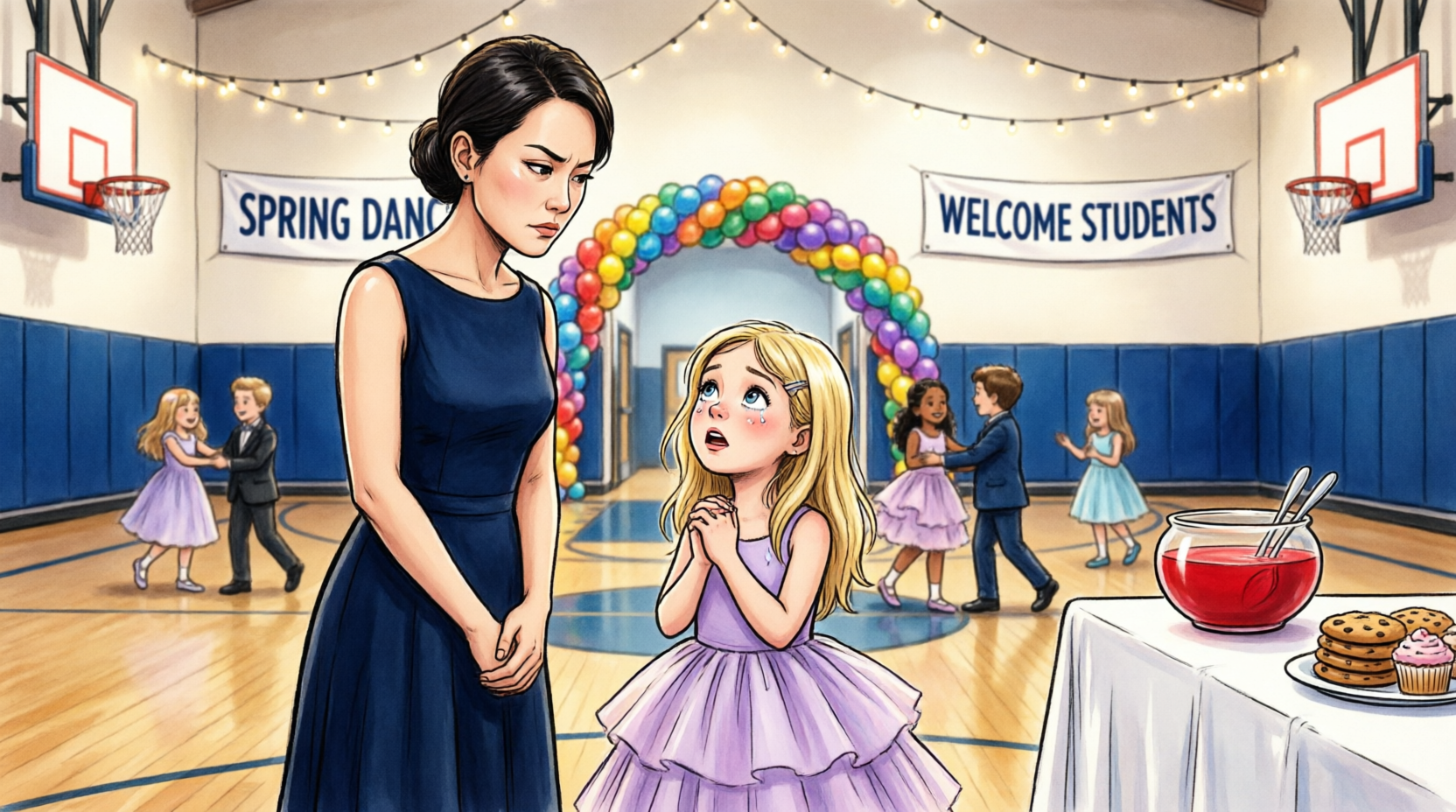
Emma’s brows pulled together. “The green one?”
“The very one,” he said solemnly. “He told us the dragon was brave because rain boots are not regulation battle gear and it wore them anyway.”
A small, confused sound escaped her. It might have been a laugh trying to remember itself.
The general continued, “He also told us that if there was ever a dance or a recital or any big night he missed, and if somehow the universe gave us a chance, then one of us had better step in.”
My hand flew to my mouth.
Daniel had said things like that. Always half-joking, always as if death or distance were merely logistical inconveniences that could be outsmarted by loyalty and planning.
The Marines remained motionless behind General Hale, but I could see something change in their faces, tiny shifts around the eyes, as if they too were no longer in a school gym but somewhere else entirely, carrying the memory of a man I loved through their own bodies.
Melissa made a small sound then, some uncertain intake of breath that suggested she wanted to reclaim the room by speaking. General Hale did not even glance at her.
Instead he lowered himself to one knee so he and Emma were eye level.
“I heard what was said to you,” he said quietly. “And I need you to understand something very clearly. You are not out of place. Not here. Not tonight. Not anywhere.”
Emma’s lower lip trembled. She looked at him with a seriousness that seemed too old for her face. “You really knew my dad?”
“I did.”
“Was he…” She stopped and swallowed. “Did he miss me?”
The general’s jaw tightened just once before he answered. “Every day,” he said. “And he was proud of you every day too.”
Tears rose to her eyes so fast I felt my own vision blur in sympathy.
General Hale stood again, slowly. Only then did he turn toward Melissa Harding.
I have spent much of my adult life watching power move around rooms. At school meetings. At military functions. At funerals. At hospitals. Usually power is loud or petty or self-advertising. What I saw then was something else entirely. The general did not loom. He did not raise his voice. He simply faced Melissa with the full composure of a man who had spent decades making decisions under pressure and no longer needed volume to be obeyed.
“You were speaking about belonging,” he said.
Melissa clutched her cup harder. “General, I was only trying to—”
“No,” he said calmly. “You weren’t.”
The word was not loud. It didn’t need to be.
He took one step closer, not threatening, just enough to make it clear that evasion was no longer an option.
“That child’s father served this country in uniform,” he said. “He gave his life in service to people he would never meet, in communities he would never see, so that rooms like this could stay bright and safe and full of children who still believe in music and paper stars.” He paused. “And you told his daughter she didn’t belong.”
The entire gym seemed to hold its breath.
Melissa’s face flushed scarlet, then pale. “I didn’t mean—”
“To manage the atmosphere?” he supplied. “To preserve the mood?”
She said nothing.
He let the silence lengthen just enough to become unbearable.
Then he looked beyond her, out over the room, and his voice carried farther. “Community is not measured by how comfortable we are with celebration. It is measured by what we do when grief walks into the room in party shoes and tries to stand quietly in the corner.”
No one moved.
One of the fathers lowered his eyes. A woman near the raffle table began to cry silently into a cocktail napkin. The DJ stood frozen over his laptop, as if afraid any sound he produced might break something sacred.
General Hale turned back to Emma and extended his hand.
“Your father can’t be here in the way we all wish he could,” he said. “But you are not alone tonight.”
Behind him, the Marines stepped forward in a line so smooth it barely looked like movement. Not surrounding. Not crowding. Forming, instead, a kind of human honor guard at the edge of the dance floor.
The general glanced toward the DJ. “Music, please.”
The DJ jumped like he’d been shocked and then fumbled frantically through a playlist before a slow instrumental version of “What a Wonderful World” drifted through the speakers, tinny at first, then fuller once he corrected the volume.
General Hale looked back at Emma. “May I have this dance?”
For one heartbeat she didn’t move.
Then she placed her hand in his.
He led her to the center of the floor with the careful dignity of a man escorting something far more fragile than a little girl in a lavender dress. She stepped onto the tops of his polished shoes instinctively, just as the other girls had done with their fathers all evening, and laid one small hand against the dark blue of his coat. He bowed his head slightly toward her. The room seemed to tilt around them.
Then the Marines behind them began clapping softly in time with the music.
One by one, other fathers joined in. Then mothers. The sound built, not loud enough to overwhelm, but steady enough to become a pulse. I stood at the edge of the floor with my hand still over my mouth and watched my daughter smile for the first time that night.
It wasn’t a tiny smile. It was startled, radiant, helpless as sunrise.
Halfway through the song, another Marine stepped forward from the line and approached a little girl at the edge of the room whose father, I suddenly realized, was deployed because she wore a yellow ribbon bracelet I had seen around school. He bent, asked her something, and when she nodded, led her onto the floor too. Then another fatherless girl joined. Then another. Within minutes the center of the gym had become something none of us had expected: not a rescue of only my daughter, but an expansion of the room to include every child who had come there carrying absence.
A man in a fire department dress uniform took the hand of a girl whose mother whispered that her father had died the year before. One of the teachers stepped in with a niece. A grandfather rose from the bleachers, slower than the rest, and asked his granddaughter if she’d like another turn. What had been an event defined by one category—father and daughter—became, under the pressure of real tenderness, something wider and truer: a room where no child stood alone if an adult had any decency left.
Melissa slipped away at some point. I didn’t see her leave. I doubt anyone cared enough to track it.
I could not stop watching Emma.
Her head tipped back when the general said something that made her laugh. He moved carefully, letting her guide the tiny awkward circles because children do not so much dance as announce joy with their feet. Every now and then she looked up at him with that searching expression grieving children wear when they are listening for echoes, and each time he answered with the kind of attention that says I know exactly whose daughter you are and I am going to treat that fact like an honor.
The song ended. The clapping continued. Then another slow song started. Emma did not leave the floor. The general leaned down and said something to her; she nodded gravely. Then he led her toward me.
When they reached the edge of the floor, Emma came straight into my arms so hard I had to take two steps back to steady us both. She smelled like vanilla lip gloss, clean hair, and the faint starch of her dress.
“Mommy,” she whispered into my neck, breathless and crying and laughing all at once, “he knew about the dragon boots.”
I pressed my face into her hair and closed my eyes. “I know, baby.”
When I looked up, General Hale was standing there with his cap tucked beneath one arm. Up close, I could see that his face was more tired than commanding. There was no self-importance in him. Only a profound kind of gentleness sharpened by discipline.
“Mrs. Reeves,” he said.
I almost said you knew him, too, as if that were the only fact that mattered, but all that came out was, “Thank you.”
He inclined his head. “Your husband was one of the finest officers I ever served with.”
The sentence nearly knocked the breath out of me.
Most of the condolences in the months after Daniel died had blurred together into a soft, useless fabric of phrases: he made the ultimate sacrifice, he was a hero, he loved his family. All true. All somehow insufficient. But one of the finest officers I ever served with—that was specific. It belonged to a real man, not a memorial poster.
“He talked about Emma constantly,” the general continued. “And about you. He once missed an event because he was on a communication detail with me in Germany. He complained about it so thoroughly for two straight days that by the end of the trip the entire team knew the color of the dress she’d worn and what flavor cake had been served.”
Despite everything, I laughed. Daniel would absolutely have done that. He had never believed in keeping home and duty separate; he carried us into every room he entered, confident the world should want to hear about us.
“How…” I began, then stopped because the whole evening still felt impossible. “How are you here?”
General Hale glanced briefly toward one of the Marines, a broad-shouldered man with a scar along his jaw who stood respectfully back. “Sergeant Moreno reached out to a family liaison after hearing from Emma’s teacher that there was a father-daughter dance and some concern about whether she’d attend. By chance, I was at the base ninety minutes away for an inspection. When he told me the date, I knew Daniel had mentioned it once. It seemed unwise to ignore that.”
I looked at the sergeant, who gave me the smallest nod, almost embarrassed by being noticed.
Emma tugged on my sleeve. “Can he stay for cake?”
The general looked so taken aback by the question that for the first time his command presence cracked into something almost boyish. “I can stay for one piece,” he said solemnly. “If invited.”
“You’re invited,” she said at once.
So he stayed.
The rest of the night moved in a haze of soft astonishment. The Marines did not dominate the room; they diffused it. The hard edges around other people’s discomfort began to dissolve. Fathers who had stood awkwardly near the bleachers loosened. Mothers came over to introduce themselves properly, as if embarrassed by their earlier silence. A teacher whose husband was deployed asked if one of the Marines would dance with her daughter. He did. The DJ, perhaps relieved to discover he was not actually presiding over the collapse of civilization, started choosing better songs. Someone refilled Emma’s cup twice. An older janitor named Mr. Jenkins, who had known Daniel from school pickup years earlier, came over with a napkin-wrapped brownie and slipped it into Emma’s hand like contraband.
I watched my daughter dance with a four-star general, eat cake beside Marines in dress blues, and laugh with a fullness I had not heard since before the funeral. The sound of it was almost painful at first. Like hearing birdsong after months underground.
At one point, while Emma sat between two Marines asking whether medals were heavy and whether tanks counted as cars, General Hale stood beside me near the bleachers.
“I’m sorry we’re meeting under these circumstances,” he said quietly.
“So am I,” I admitted.
He folded his hands behind his back and looked across the room at Emma. “Daniel was unusual,” he said. “In command environments you meet a lot of talented men. Competent men. Ambitious men. Your husband was competent, yes, but what set him apart was his orientation toward other people. Even at his busiest, he seemed fundamentally unavailable to cynicism.”
The description was so exact it hurt.
“That sounds like him.”
“He made a point of showing us her drawings,” the general said, almost smiling. “Once, during a planning review, he passed around a crayon portrait labeled Daddy Fighting Bad Guys But Also Smiling. I still remember that because he said, with perfect seriousness, that the smile was operationally significant.”
I laughed, then covered my mouth because the sound came out dangerously close to a sob.
“He could be impossible,” the general added. “He once told a colonel that if the briefing ran ten more minutes, he’d miss FaceTiming his daughter and become insubordinate out of principle.”
“That also sounds like him.”
General Hale was quiet for a moment. Then he said, “He saved lives on the day he died.”
I looked at him sharply. The official account I had been given was clean and abstract, full of phrases like hostile engagement and tactical response and casualty evacuation. Necessary language. Dehumanizing language. I knew the broad shape, but not the texture. Most people, seeing widowhood in my face, assumed I did not want more details. The truth was I wanted only the details that belonged to Daniel as a man, not as a line in a report.
The general did not make me ask.
“He exposed himself to draw fire away from a damaged vehicle,” he said. “There were younger Marines pinned. He knew exactly what he was doing. He moved before anyone gave the order.” The general’s voice remained level, but the memory was alive inside it. “Men are alive because he refused to hesitate.”
I gripped the edge of the bleachers until the metal dug into my palm. “Did he suffer?”
The question came out small. I hated how small.
General Hale answered without flinching. “No.”
I do not know if he told me the whole truth. I do know he told me the kindest truth he could carry honestly. That matters.
“Thank you,” I whispered.
He inclined his head once, and for the first time all evening I let myself believe the room was holding more than spectacle. It was holding witness.
The dance ended later than scheduled because no one seemed willing to be the first person to restore ordinary time. Eventually the music softened, the lights brightened, and volunteers started gathering centerpieces and stacking cups. Children wilted in stages, heels kicked off, hair slipping loose, sugar and emotion combining into exhaustion. Emma, who had refused to sit down for the final hour, suddenly leaned against my side with the boneless heaviness of a child on the edge of sleep.
General Hale and the Marines walked us to the parking lot.
Outside, the air was cold enough to shock after the overheated gym. The stars above the school were faint, half-drowned by the parking lot lights. Emma had one hand in mine and the other wrapped around a napkin with two untouched cookies she insisted on saving “for later or maybe for angels if they eat sugar.” The Marines halted near my car with the same unconscious precision they had carried all evening, then relaxed slightly when the general turned to Emma.
He reached into the inner pocket of his coat and drew out a small coin.
It was heavier than it looked, gold-toned in the parking lot light, stamped with insignia on both sides.
“This is a challenge coin,” he said, placing it in her palm. “Your father had one from our unit. I thought you should have this.”
Emma stared down at it with reverence. “For me?”
“For you,” he said. “And because sometimes a person needs something in her pocket that reminds her who she belongs to.”
She closed her fingers around it. “If someone says I don’t belong again, I can show them this?”
The general’s mouth softened. “You can. Or you can just remember this night and know you never had to prove it in the first place.”
She nodded solemnly, accepting the responsibility of memory as if it were a real object.
Then, to my absolute astonishment, she threw her arms around his waist.
For one tiny startled second, General Thomas Hale, four-star officer, seemed unsure what to do with a small girl’s full-speed gratitude. Then he put one hand lightly on her back and closed his eyes.
When she let go, Sergeant Moreno stepped forward and saluted her again, less formal this time, almost playful. One by one, the others did too. Emma returned the salute with crooked seriousness, which made every grown man standing there look suddenly close to smiling and crying at once.
As we drove home, she fell asleep in the back seat before we reached the first stoplight, her cheek pressed to the side of the car seat, the challenge coin clutched tight in her hand. I kept glancing at her in the rearview mirror, afraid the whole night might somehow evaporate if I stopped looking.
When I carried her inside, she stirred just enough to murmur, “Daddy sent friends,” and then slipped back under.
I stood in her doorway long after tucking her in, the hallway light laying a pale strip across her blanket, and listened to her breathe. The coin was still in her fist. I kissed her forehead, whispered goodnight to the room at large because there was no one else to say it to, and went into my bedroom where Daniel’s closet still waited in its half-preserved silence.
For the first time in months, I pulled out one of his uniform jackets and sat with it across my lap.
I didn’t cry immediately.
I ran my fingers over the fabric, the buttons, the places where his body had shaped the seams. I thought about him telling stories in some operations office about Emma’s dragon in rain boots. I thought about him being irritated on principle over a missed FaceTime. I thought about him saying, somewhere in his vast impossible confidence, that if he ever couldn’t be at a dance somebody had better step in.
And they had.
Not because magic was real. Not because grief had been outsmarted. Not because absence could be filled. It couldn’t. Daniel was still dead. My bed was still too large. Emma would still wake up someday and remember with fresh pain that the man who called her Peanut and put jellybeans in his uniform pockets for emergencies was never going to stand at the kitchen counter again……………………