
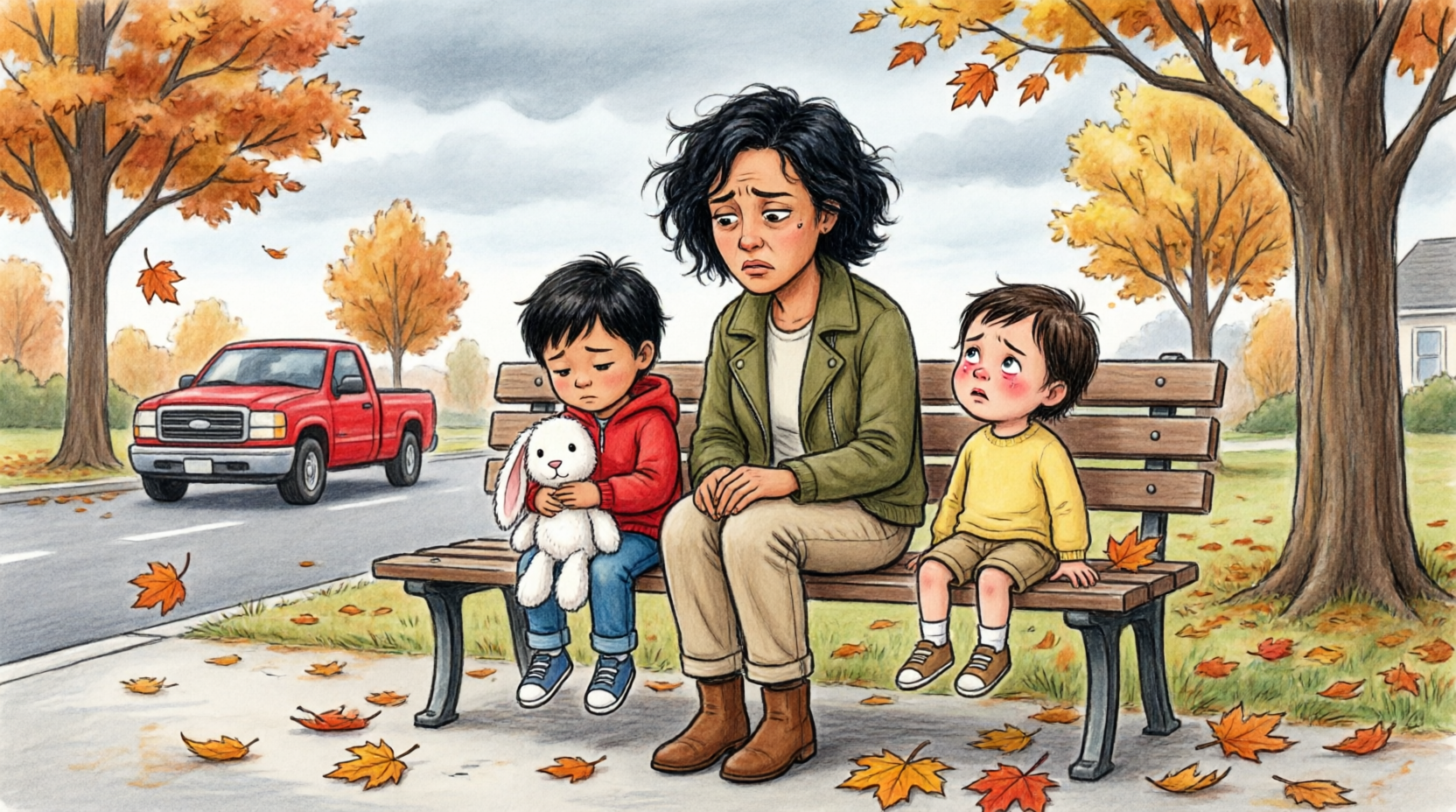
The thing inside the rabbit’s ear was a tracking tag.
I know that now because Denise Harlan cut the seam open with the tiny folding scissors she kept on her keychain, tipped the stuffing into her palm, and said, very calmly, “Don’t panic.
But we need to move right now.”
Three minutes earlier, I had been frozen on that bench in Deeds Point MetroPark, staring at the red pickup rolling through the lot like my worst thought had taken shape in steel.
Three minutes after, my daughters and I were hurrying through a side door of the park’s small nature center behind a woman I had never met before, while she spoke into her phone with the even, practiced voice of someone who knew how to make fear obey instructions.
“Female adult, two children,” she said.
“Confirmed tracker. Likely active pursuit.
Need an emergency transport pickup at the south service entrance.”
That was the first moment in nine days that I felt something stronger than terror.
Three minutes after, my daughters and I were hurrying through a side door of the park’s small nature center behind a woman I had never met before, while she spoke into her phone with the even, practiced voice of someone who knew how to make fear obey instructions.
“Female adult, two children,” she said.
“Confirmed tracker. Likely active pursuit.
Need an emergency transport pickup at the south service entrance.”
That was the first moment in nine days that I felt something stronger than terror.
I felt handled.
Denise was fifty-eight, with silver hair pinned into a loose knot and the kind of posture school counselors and ER nurses seem to share—upright, alert, impossible to rush.
I found out later she had once been both.
By the time she saw me in the park, she was volunteering twice a week with a domestic violence outreach program that partnered with the county shelters and public libraries.
At the time, all I knew was that she had sat on the far end of our bench ten minutes before the truck appeared, pretending to rummage in a canvas tote while she studied my girls’ too-thin jackets, my split lip, and the way I checked the parking lot every time an engine turned over.
“Your daughter’s shoe is untied,” she had said gently.
It wasn’t.
Now I understand that was her way of seeing whether I would snap, flinch, or run.
When I didn’t answer, she tried again.
“There’s a warm restroom in the center building if you need one.
And a water fountain that actually works.”
I looked at her, really looked, and saw that she was giving me an exit without embarrassing me.
I almost took it.
Then Ruthie said, “Mommy… Bunny has a light.”
Everything after that moved with a speed that still feels unreal when I think about it.
Denise saw the blinking tag before I even understood what I was holding.
She didn’t waste time asking whether I was sure, whether maybe there was some innocent explanation, whether I wanted to talk it through.
She saw my face, saw the truck turning in, and chose action over politeness.
That choice may have saved our lives.
She led us through the nature center, locked the office door behind us, and crouched in front of Hadley and Ruthie until she was eye level.
“I need you girls to help me with something very important,” she said.
“I need quiet feet and brave hearts.
Can you do that?”
Hadley nodded first. Ruthie pressed her mouth tight and nodded too.
Denise sliced the rabbit ear open, removed the tag, wrapped it in a paper towel, and dropped it into a trash can by the front desk.
Then she changed her mind.
“No,” she muttered. “Too easy.”
She fished it back out, tucked it into a lost-and-found bin beneath a stack of old baseball caps, and sent a volunteer to carry that bin to the opposite side of the building.
“If he’s tracking by distance, let him be wrong on purpose,” she said.
I remember staring at her, stunned by the clarity of her thinking.
My mind had spent years in survival mode—duck, soften, appease, hide.
Denise’s mind was somewhere else entirely.
Strategy. Containment. Exit routes.
She looked at me and asked the question no one had asked in a long time.
“Do you want help, Shelby?”
Not do you want to call your husband.
Not do you want to file something later.
Not are you sure.
Do you want help.
I started crying so suddenly it scared me.
Not loud. Not dramatic. Just the kind of crying that arrives when your body realizes someone has finally used the right words.
I nodded.
That was enough.
A county outreach van picked us up at the service entrance seven minutes later.
Denise rode with us. Through the window I saw Trent’s truck pause in the main lot, idle, then move again as if circling.
He never looked toward the back drive where we were leaving.
For nine days I had thought survival meant staying invisible.
That afternoon I learned survival also means letting the right people see you.
The shelter was in an old brick building on the west side of Dayton, disguised from the street as an administrative office for a nonprofit.
No sign. Frosted windows. Security camera above the side door.
Inside, it smelled like coffee, laundry detergent, and the strange clean softness of places built from other people’s emergencies.
The first thing they gave my girls was hot macaroni and applesauce.
The second thing they gave them was coloring books.
The first thing they gave me was a legal pad.
“Write down everything you remember,” Denise said.
“Dates if you know them.
Incidents if you don’t. Threats.
Injuries. Witnesses. Money. Phones. Vehicles.
Anything that felt small at the time but doesn’t anymore.”
So I wrote.
The first shove. The first hole in the wall.
The time he blocked the doorway with one hand and smiled while doing it, as if that made it less frightening.
The way he’d say, “Look what you make me do,” in a tone almost bored, like I had inconvenienced him into violence.
I wrote about how control had arrived dressed as concern.
When Trent and I met, I was twenty-four and working the front desk at a dental office in Kettering.
He was funny then. Attentive.
The kind of man who brought coffee without asking how you took it because he’d already noticed.
My mother had been dead five years.
I was still walking around with that widow-like loneliness daughters can have after losing the one person who made them feel anchored.
Trent stepped into that empty space and acted like safety.
For a while, he was.
Then I got pregnant with Hadley.
Then daycare costs became a point of stress.
Then he said it made more sense for me to stay home until we were stable.
Then “until we’re stable” became our life.
He handled the bank account because he was “better with numbers.” He handled the rent because I was “already dealing with the girls.” He handled my phone plan because family plans were cheaper.
If I wanted to buy something, I asked.
Not because he made a speech about it.
Because he created a system where asking became normal.
He wasn’t cruel all the time.
I wish he had been.
Constant cruelty is easier to name.
He could be tender after.
He could make pancakes shaped like Mickey Mouse.
He could sit cross-legged on the living room floor and build block towers with Hadley until she squealed.
He could apologize in ways that sounded less like remorse and more like weather: “I’ve just been under pressure.” “You know I had a rough childhood.” “You know I’d never hurt the girls.”
Abuse does not require a man to be monstrous every minute.
Just consistently dangerous enough that your life bends around anticipating him.
The first time he hit me, Hadley was eighteen months old.
I had forgotten to pay the electric bill because Ruthie—still a baby then—had an ear infection and hadn’t slept for two nights.
He slapped me once, then stared at his own hand as if I had somehow put it there.
He cried afterward. He told me he was horrified.
He took the girls to the park the next day and came home with flowers and a toy doctor kit for Hadley.
I didn’t leave.
I told myself it was the shock.
I told myself it was stress.
I told myself women with no savings and two babies do not get to make brave cinematic choices on command.
And then life did what life does.
It continued.
The years after that were not one long nightmare.
They were worse.
They were livable………………………