
I came home on a Tuesday evening in late October, when the maple trees on Elmwood Drive had already turned that dark, burning red that makes the whole street look briefly dramatic before winter levels it into gray.
The air held that hard Ontario edge that gets into your lungs and reminds you the warm months are over whether you are ready or not.
My tires rolled over a skin of windblown leaves in the driveway, and I remember noticing the sound because after enough years in one house, even the little noises begin to feel familiar.
The driveway had its own language.
So did the front step.
So did the old brass hook by the back door where I always hung my scarf.
For thirty-one years I was a registered nurse at St.
Michael’s Hospital in Toronto.
Thirty-one years of night shifts, swollen feet, hurried coffee, family conferences, and those long fluorescent corridors where grief and hope passed each other hourly.
Nursing teaches you plenty about medicine, but that is never the whole education.
It teaches you how to look at a scene before you speak.
It teaches you that the first emotion in a room is not always the most important one.
It teaches you that if you react too quickly, you can lose sight of what is really happening.
I retired at sixty-six, later than my niece thought wise and earlier than my pride would have preferred.
My body had been negotiating with me for years.
My lower back complained when I rose from chairs.
My hands cramped after long charting sessions.
My niece finally looked me in the eye over coffee and said, very softly, that I had spent decades caring for everybody else and was beginning to treat my own body like borrowed equipment.
She was right.
So I said goodbye to the unit, cleared out my locker, accepted a ridiculous cake with buttercream roses, and drove home with a paper bag of cards on the passenger seat and the faint, disorienting feeling that a life can change in the time it takes to hand over an ID badge.
I was coming home to the house on Elmwood Drive, the one my husband Gerald and I bought before prices went insane and neighborhoods became brands.
We painted that house ourselves.
We argued over flooring.
We learned the drafty corner in the back bedroom and the exact place the roof liked to complain after hard rain.
When Gerald died, I kept the place because leaving felt too much like erasing him.
I paid it off in 2009.
Every year after that, I paid the taxes, the insurance, the furnace repairs, the gutter cleaning, the little humiliations of ownership that nobody mentions when they talk sentimentally about home.
Peace in a house is not accidental.
It is maintained.
My son Derek and his wife Clare had moved in eight months earlier.
Temporary, they said.
Their landlord had sold the building.
The condo deal they were counting on fell apart.
They only needed a few months to get back on their feet.
Derek stood in my kitchen one rainy March evening with that sheepish expression he wore when he was asking for something, and Clare stood beside him looking appropriately apologetic, holding a bakery box she had brought
as if lemon squares might soften the request.
I said yes because Derek was my son and because a mother’s generosity often arrives disguised as hope.
I hoped proximity might make us feel like a family again.
The first month was manageable.
They stayed mostly out of my way.
Clare called me Dot in that overfamiliar voice people use when they want to sound warm without actually being intimate.
Derek thanked me often.
They said they’d save aggressively.
They said they’d be gone by summer.
By May, the language had shifted.
Clare began talking about household systems.
She relabeled shelves in the fridge.
She moved my dish towels because my arrangement was apparently inefficient.
She took down the little calendar Gerald had liked and replaced it with a minimalist planner nobody used.
Every change was small enough to sound petty if I objected, which was exactly why she chose them.
Then came the comments.
Not open insults.
Clare was too polished for that.
She specialized in the kind of correction that arrives dressed as reason.
She told me the dining room table worked better as a workspace when I was eating breakfast there.
She suggested I use the side entrance because Derek had early meetings and the front hall noise carried.
She began referring to the living room as the common area, a phrase that made my skin crawl in my own house.
Once, when a friend of hers visited, I heard Clare laugh lightly and say, “It’s a multigenerational setup for now,” as if I were a retired relative being accommodated rather than the woman who owned the walls around them.
Derek saw all of it.
That was the part that hurt most.
He saw it and chose the cheap safety of silence.
He never backed Clare openly when I was right in front of him, but he let her go unchallenged often enough that the effect was the same.
Weakness can look very gentle if you don’t examine it closely.
My son had perfected the nod-and-withdraw.
He would say, “Let’s all just keep the peace,” which really meant, “Mother, absorb this so I don’t have to be uncomfortable.”
The pantry lock appeared on my first evening home after retirement.
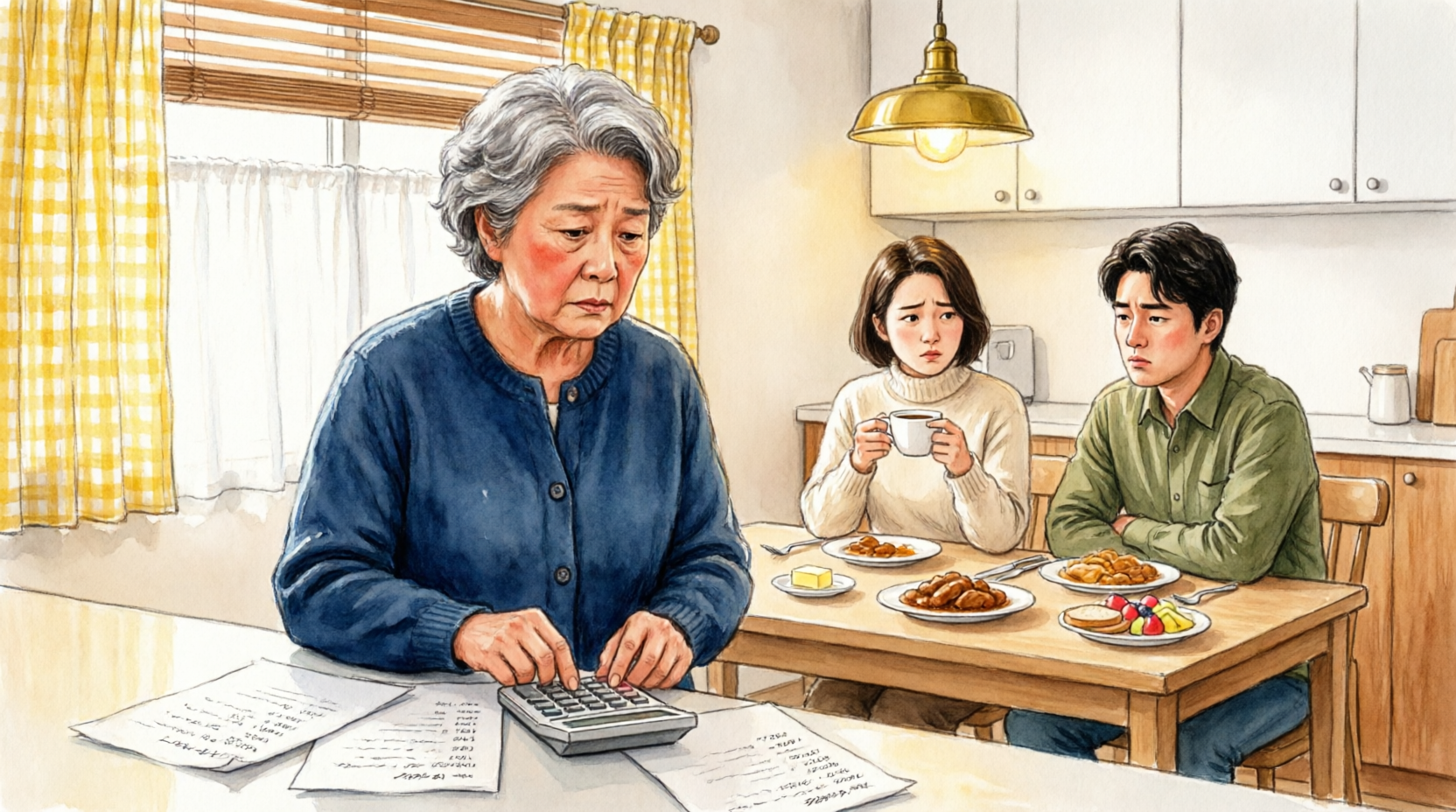
It was heavy-duty, black, and absurdly out of place in a warm suburban kitchen with yellow curtains and a bowl of McIntosh apples on the counter.
Someone had installed a metal bracket near the frame and threaded the lock through it and the pantry handle.
My pantry stood there in plain view, inaccessible in my own kitchen.
I set down my bag.
I hung my scarf.
I placed my keys in the ceramic bowl by the door.
Then I stood in front of that lock and let my body register the insult before my mouth did anything foolish.
Clare came around the corner holding a mug of tea.
She did not look surprised that I had noticed.
The lock had not been hidden.
It had been staged.
“Oh, that,” she said, nodding toward it.
“We needed to separate the groceries.
Derek and I buy our own things, and it just makes more sense this way.”
I looked at her for a long second.
“That’s my pantry, Clare.”
She took a sip.
“It’s a shared space,” she said.
“This keeps
things cleaner.”
Cleaner.
Organized.
Efficient.
Clare’s gift was making control sound hygienic.
In that moment, all the previous months rearranged themselves into a pattern.
The pantry lock was not an isolated irritation.
It was escalation.
It was a flag planted in the middle of my kitchen.
And because nursing had trained me to distrust surface explanations, I did not give her the scene she wanted.
I simply said, “I see,” and walked to my bedroom.
From the top drawer of my dresser, I took out a spiral notebook.
I sat on the edge of the bed and wrote the date, the time, the appearance of the lock, and the exact wording Clare had used.
Then I wrote three earlier incidents I had been minimizing: May 14, Clare telling me not to leave “personal items” on the entry table, which in this case meant my mail; June 2, Derek asking if I could avoid using the blender before nine because Clare worked from home; September 11, Clare moving my canned goods to a lower shelf and saying, in front of guests, that I sometimes forgot what I had.
I had not forgotten anything.
She wanted the idea of me forgetting to be available in the room.
When Derek came home that evening, he kissed his wife, loosened his tie, glanced once at the pantry, and said nothing.
At supper he picked around the roast vegetables while Clare described an article she had read about sustainable storage systems.
I watched my son eat at my table and pretend not to notice that his mother had been locked out of a part of her own home.
There are moments when sadness matures into something more useful.
That was one of them.
The next morning I started making calls.
First I called Irene Bell, a retired social worker two houses down who had once helped a cousin of mine find a paralegal after a messy estate dispute.
Irene listened without interrupting, then said, “Dot, document everything and stop being polite about your own rights.” She gave me the number for Marlene Shaw, a local lawyer who handled property and family occupancy issues.
Marlene saw me the following afternoon.
She was in her fifties, sharp-eyed, neatly dressed, and refreshingly uninterested in sentimentality.
I brought my notebook, the house deed, utility bills, and a handful of texts I had printed.
She read quietly for ten minutes, then looked up and said, “You are the sole owner.
They are living there with your permission, not by right.
Because you share the kitchen and bathroom, this is not the kind of tenancy people imagine when they hear renter protections.
You need a clear written notice, a firm date, and no wavering language.”
I asked her what counted as firm.
She slid a yellow legal pad toward me.
“This does.
A notice giving them a reasonable move-out date.
A follow-up letter from me.
Photographs of the lock and anything else showing interference with your use of the home.
And if they do not leave when the notice ends, we escalate properly.
Calmly.
No threats.
No drama.
Records win.”
Records win.
That phrase lodged in me like a small blessing.
Nurses believe in records for a reason.
Memory gets argued with.
Documentation doesn’t.
On my way home I stopped at
a locksmith.
A young man named Pavel came out the next morning, took one look at the pantry door, and whistled softly.
“This in your house?” he asked.
“It is,” I said.
He removed the lock cleanly, handed it to me, and gave me a receipt noting that he had been called by the owner to remove an obstructive locking device from an interior pantry door.
I put both the lock and the receipt in a tote bag with my notebook.
Then I took photographs of the bracket holes, the pantry shelves, and the labeled bins Clare had stacked inside as if she were building a private annex in my kitchen.
Over the next two days, I kept writing things down.
Clare texted me, “Please don’t mix pantry items again.
We need better boundaries.” I printed it.
Derek sent, “Can we all talk tonight? Clare feels stressed.” I printed that too.
Stress is a flexible word.
It often means: the person pushing too far is upset that somebody finally noticed.
I also began seeing things I might have overlooked earlier.
A piece of mail addressed jointly to Derek and Clare at my house with a redirection sticker that suggested they had changed more accounts to Elmwood than I knew.
An email accidentally left open on the family desktop referring to “when the house is eventually ours.” A conversation I overheard between Clare and a friend in which Clare said, lightly, “You have to set the tone early with older people or they’ll never hand over control.” That one I did not need to print.
I wrote it down the moment she left the room.
By Friday, my hurt had cooled into method.
I bought a good chicken.
Not because I was celebrating, but because ritual matters when you are reclaiming order.
Derek had loved my roast chicken since he was a boy.
Gerald had always said he could smell rosemary from halfway down the block on those nights.
I peeled potatoes, trimmed carrots, rubbed butter under the skin the way my mother taught me, and set the table with the heavy white plates instead of the everyday stoneware.
Clare seemed pleased by the effort.
She assumed, I think, that I had yielded.
At six-thirty, the kitchen smelled like garlic, thyme, and the kind of domestic comfort people mistake for softness.
Clare came in wearing a cream sweater, sat at the table, and said, “This looks lovely.” Derek poured himself water and kept rubbing his thumb over the condensation on the glass.
He had the look he gets when he senses weather changing but wants to believe it might pass.
I served the chicken.
I let them begin eating.
Then I stood, walked to the sideboard, took out the broken black lock from my tote bag, and set it in the center of the table between the salt and the gravy boat.
Neither of them spoke.
Next I laid a single sheet of paper in front of Derek.
It was handwritten in blue ink and deliberately simple.
This is formal notice that my permission for you and Clare to occupy 14 Elmwood Drive ends on November 30.
I require a move-out date in writing tonight.
I have legal counsel and written records.
I sat down and folded my hands.
“I want
a move-out date,” I said.
“In writing.
I have a lawyer.
And I have been keeping records.”
The silence that followed had weight.
I could hear the ticking clock above the stove.
I could hear the soft crackle of the chicken skin cooling on the platter.
Clare recovered first.
“Dorothy, this is completely unnecessary.”
I did not look at her.
I looked at my son.
Derek swallowed.
His eyes moved from the note to the lock to my face.
Then, very quietly, he said, “Mom… Clare told me you agreed to the pantry.
She said you wanted separate food because you were getting confused about what belonged to whom.”
There are lies that sting, and lies that clarify.
That one clarified everything.
I turned to Clare.
For the first time that evening, some of her composure slipped.
“I said you were overwhelmed,” she replied quickly.
“You are overwhelmed.
We were trying to help create structure.”
“By locking my pantry?” I asked.
“It was temporary,” she said.
“So were you.”
Derek flinched.
Clare’s mouth tightened.
“This is not just your house anymore in practical terms,” she said.
“We live here.
We contribute.
We use the space.
There has to be some shared authority.”
Shared authority.
I reached into my tote and pulled out the notebook, the locksmith receipt, and the stack of printed texts.
I set them down one by one.
Then I read aloud several entries, calmly, exactly as I would have charted a difficult patient interaction.
“September 11.
Clare told guests I sometimes forget what food I have.
False.
October 4.
Derek asked me not to use the front hall before eight because Clare had calls.
October 24, 5:42 p.m.
Clare stated the pantry lock was installed because it made things cleaner.
October 24, 8:15 p.m.
Derek observed the lock and made no objection.
October 25.
Text from Clare: Please don’t mix pantry items again.
We need better boundaries.
October 26.
Consultation with counsel.
October 27.
Locksmith removed obstructive lock from interior pantry at owner’s request.”
I slid the receipt toward Derek.
Then I slid the printed text.
Then I looked him full in the face.
“I am not confused,” I said.
“I am not declining.
I am not in need of management.
I am your mother, and this is my home.”
Derek stared at the papers.
Shame moved across his face slowly, like dawn reaching a room that had been shut too long.
“Mom,” he said, “I didn’t know she told people that.”
Clare snapped, “Don’t do that.
Don’t make me the villain because you can’t handle conflict.”
And there it was.
The truth from the only mouth that didn’t mean to help me.
Derek sat back as if something had struck him physically.
“Clare…”
She turned on him then, faster and sharper than she had ever turned on me in front of him.
“What? You wanted me to take charge because you never say anything.
You said your mother would never set boundaries.
You said she’d probably leave you the house anyway, so we needed a real system if we were going to build a life.”
The room went still.
Derek looked at her, then at me, and in that instant he looked younger than I had seen him in years.
Not innocent.
Just stripped of excuses.
“Mom,” he whispered, “I’m sorry.”
I believed he was sorry.
I also knew sorry is not the same as sufficient.
“You will both be out by November 30,” I said.
“If you prefer, Marlene Shaw can send the formal letter tomorrow morning instead of us settling this privately tonight.
Either way, the date does not change.”
Clare’s chair scraped back.
“You can’t just throw family out.”
“Yes,” I said.
“I can.
Especially when family forgets they are family and starts behaving like a hostile committee.”
She opened her mouth again, but Derek lifted a hand without looking at her.
He pulled the paper toward himself.
His pen shook once before settling.
Then he wrote: We will vacate the property by November 30.
Derek Haynes.
He slid it back to me.
Clare did not sign.
She stood up, pushed her plate away untouched, and went upstairs with that brittle, furious posture of a person who has mistaken somebody else’s patience for permanent access.
A minute later we heard drawers opening and shutting hard.
Derek remained at the table.
For a while neither of us spoke.
Finally he said, “I kept thinking if I stayed quiet, it would work itself out.”
“That is not peace,” I replied.
“That is cowardice wearing slippers.”
He let out a broken little laugh that turned, almost immediately, into tears.
I had not seen my son cry since Gerald’s funeral.
He told me then, in halting pieces, about the debts he and Clare had hidden, the condo deposit they lost, the credit cards she kept calling manageable, the way every bad decision became one more reason to postpone leaving.
Clare had talked about my house the way people talk about a future inheritance before the person is dead.
Derek had been weak enough to let her.
Weak enough to convince himself none of it meant harm because naming the harm would require him to oppose it.
I listened.
Then I said, “You can be ashamed and still move boxes.”
He nodded.
The month that followed was not pleasant, but it was orderly.
Marlene sent the letter anyway because I wanted the paper trail complete.
Clare alternated between icy silence and theatrical politeness.
She tried once to rally me with the language of misunderstanding.
She tried once to imply that at my age I should be grateful for company.
I told her all further discussions could go through counsel.
When she realized I meant it, she stopped trying charm and settled into resentment.
Derek did most of the packing.
I watched him carry boxes down the front steps he had once jumped from as a child.
I watched Clare wrap her mug collection in the Sunday flyers from my recycling bin.
On the final afternoon of November, a rental van pulled away from the curb just after three.
The house became quiet so suddenly it felt like a held breath finally released.
I stood alone in the kitchen for a long time after they left.
The pantry door was open.
Inside were my canned tomatoes, my tea tins, Gerald’s old jar of barbecue rub I still couldn’t bring myself to throw out, bags of flour, lentils, pasta, and the little basket of soup packets I kept for cold nights.
Perfectly ordinary things.
Yet I felt something close to
reverence looking at them.
Not because groceries matter that much, but because dignity does.
Privacy does.
The right to reach into your own cupboard without seeking permission matters more than people realize until somebody tries to take it away.
A week later I unscrewed the metal bracket from the frame and sanded the little scar it left behind.
I repainted the area myself.
The patch was slightly brighter than the older trim, and I liked that.
It looked honest.
Houses carry repairs the way people do.
Not invisible.
Just healed.
Derek came by alone two months later.
He stood on the porch with his shoulders tucked in against the cold and asked if we could talk.
He had moved into a rental in Mississauga.
He and Clare were separated.
He told me he had started therapy because he was tired of confusing passivity with kindness.
I let him in for tea, not because everything was fixed, but because boundaries and love are not enemies.
We spoke for an hour.
He apologized properly that time—without excuses, without blaming stress, without using words like situation or misunderstanding.
I told him trust returns slowly or not at all, and that whichever way it went would depend on what he built next, not what he felt in that moment.
He nodded and accepted that.
That, more than the apology, gave me a small measure of hope.
Spring came.
I planted herbs by the back step.
I slept later than I used to.
I learned how to sit in my own quiet without feeling guilty for it.
Some mornings I still woke before dawn out of habit and reached for a shift that no longer existed.
On those mornings I made tea, stood in my kitchen, and let the calm settle around me again.
One Saturday my niece came over for lunch.
I made roast chicken with rosemary and garlic, the same meal I had served the night I ended the arrangement.
We ate at the table with the windows cracked for fresh air, and when she asked how retirement was treating me, I looked around at the yellow curtains moving gently above the sink, the open pantry, the bowl of apples on the counter, the chair where Gerald used to read the paper, and I told her the truth.
“It’s peaceful now,” I said.
And it was.
The lock is still in my junk drawer.
Not because I need the reminder of Clare, or even of Derek’s failure.
I keep it because it reminds me of something more important: a home does not stop being yours the day somebody else starts acting comfortable in it.
Peace is not maintained by avoiding conflict at any cost.
Sometimes peace is the thing you get back only after you have documented the damage, spoken clearly, and shown the door to the people who mistook your kindness for surrender.
That pantry has stayed open ever since.
So has the rest of the house.
To the people I choose.