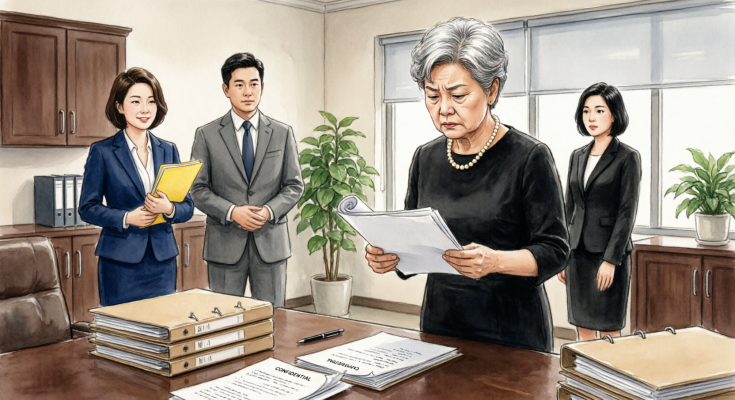
The kind that arrives late, after grief has already exhausted a person.
The kind that feels almost cold.
She sat in the back seat of the dark sedan, her small suitcase beside her, and watched San José thin into winding roads and climbing hills.
Tropical green spread on every side.
The sky looked lower here, as if the clouds had decided not to stay above the mountains but to rest inside them.
Teresa pressed her purse to her lap and tried to steady her breathing.
For forty-five years she had believed she knew the shape of her marriage.
Not every secret, perhaps.
Nobody knows every private corner of another person.
But the shape of it.
The essential truth of it.
The ways they had suffered.
The sacrifices they had made.
The small humiliations of getting older without money and with too much illness.
Now there was a lawyer in Costa Rica telling her that none of what had happened at the funeral was accidental.
Moisés drove carefully, as if he understood that she had not merely crossed a country.
She had crossed into a version of her life she had never been shown.
For the first twenty minutes, he spoke only enough to guide her through the silence.
Roberto had updated his will twice in the last year.
The plane ticket had been purchased months before his death.
Instructions had been left with dates, names, signatures, and contingencies.
If Teresa refused to travel, Moisés said, he had been instructed to wait thirty days and try again.
If her children attempted to interfere, there were additional documents prepared.
If Teresa arrived, he was to bring her directly to a property outside the city and place in her hands something Roberto had written only for her.
Teresa turned to the window so Moisés would not see how her mouth trembled.
Only for her.
All those nights she had changed bed linens, measured pills, washed damp cloths in the sink, and rubbed her husband’s shoulders while he apologized for being a burden—during all that time he had been making plans she knew nothing about.
At last she asked the question that had been burning under everything else.
“Who is Tadeo?”
Moisés glanced at her in the mirror.
“You found the photograph.”
“Yes.”
“He is the reason you are here,” he said.
That answer only made the silence heavier.
The road narrowed and rose.
The city disappeared behind them.
The car passed gates, scattered houses, and long stretches of steep green land planted in careful rows.
Teresa began to recognize coffee shrubs even though she had never seen so many at once.
Finally they turned onto a private road lined with old jacaranda trees.
Purple blossoms lay scattered across the gravel like scraps of torn fabric.
At the top of the hill stood a wide white house with a red-tiled roof and a deep veranda facing the valley.
It was not ostentatious.
It was not the kind of place built to announce money.
It was worse than that.
It was the kind of place built to last.
The kind of place people kept when they intended to hand it down.
Moisés parked in front of the…
Moisés parked in front of the house and turned off the engine. The silence that followed was not empty. It was the kind of quiet that settles over places that have been waiting.
Teresa stepped out slowly. Her knees ached from the flight, from the drive, from years of standing at Roberto’s bedside, from a lifetime of bending over a sewing machine. She closed the car door and felt the gravel shift under her worn shoes.
The house was larger up close, but not imposing. The white stucco was weathered in places, the red tiles faded by sun and rain. The veranda held wooden chairs, a small table, and a line of terracotta pots where orchids climbed toward the eaves. Beyond the porch, the land dropped away into terraced hills, shaded coffee trees, and a narrow stream that caught the morning light like a silver thread.
Moisés walked to the trunk, lifted her small suitcase, and set it beside her. He did not hand it to her. He simply stood there, waiting, as if he knew that some thresholds must be crossed alone.
“Take your time,” he said.
She nodded.
She walked to the front steps. They were stone, worn smooth by decades of footsteps. She placed her hand on the wooden railing and climbed.
At the door, Moisés appeared beside her with a heavy iron key. He placed it in her palm. The metal was warm from his grip.
“Roberto left instructions that you enter first,” he said. “Alone. When you are ready, come to the study down the hall. I will wait in the garden.”
He stepped back.
Teresa stood at the threshold. She had crossed oceans in her mind a hundred times. She had imagined death as the great unknown. She had never imagined a door.
She turned the key.
The lock turned with a soft, oiled click.
She pushed the door open.
The air inside was cool, shaded, and carried the faint scent of old paper, cedar, and dried herbs. Sunlight filtered through wooden slats, painting long golden stripes across a floor of polished hardwood. The foyer was simple. A woven rug. A small table with a ceramic bowl holding dried seeds. A mirror that showed her face, older than she remembered, eyes wide, mouth slightly parted, black dress clinging to a frame that had grown thin from years of carrying more than her body was meant to hold.
She closed the door behind her.
Her footsteps echoed softly as she moved down the hall. Rooms opened on either side, empty but not abandoned. Curtains drawn. Beds neatly made. Shelves holding books, jars, folded linens. It felt lived in, but not by anyone recent. It felt preserved. Waiting.
At the end of the hall, a door stood slightly ajar. Light spilled from within.
She pushed it open.
The study was lined with floor-to-ceiling shelves. A large desk sat near the window, covered not with clutter, but with deliberate order: a fountain pen resting on a blotter, a stack of blank paper, a leather-bound journal, a wooden box the size of a shoebox, closed but not locked.
On top of the box lay a single envelope.
Her name was written on it in Roberto’s hand.
Not the shaky, medicated scrawl of his final months. This was his younger hand. The one he used when he was focused. When he meant every word.
Teresa’s breath caught.
She stepped forward. Her fingers trembled as she touched the envelope. The paper was thick. Unopened.
She sat in the chair behind the desk. It creaked slightly under her weight. She pulled the letter out.
Inside, there was no salutation. No date. Just his voice, preserved in ink.
Teresa,
If you are reading this, you made it. I am sorry for the silence. I am sorry for the stage play at the office. I am sorry for the smiles you had to watch. But I could not warn you. Not openly. Not without risking what I spent forty years protecting.
You always believed I was a quiet man. That I lacked ambition. That I let life happen to us rather than shaping it. You were not wrong to think that. I chose it. I chose quiet so you would not have to carry the weight of my noise.
The children received what they asked for without knowing they were asking. The apartments. The cars. The accounts. They believe they won. They believe I loved them enough to leave them everything. They do not know that everything they inherited is tied to the company. The company that has been drowning in debt since 2019. The company I kept afloat by selling land, by taking loans, by working double shifts, by pretending we were fine when we were not. I left it to them because they wanted it. Because they will spend their lives chasing what they already hold. And because, legally, once it is in their names, the creditors cannot reach you. You were never part of the ledger. You were never meant to be.
I did not send you here to punish you. I sent you here to save you.
Tadeo was not a friend. He was my half-brother. My mother’s first child, born before my father married her. He was raised in the mountains, far from the city, far from our family’s eyes. I did not meet him until I was twenty-two. When I did, I found a man who knew how to read soil, how to negotiate with buyers who tried to cheat farmers, how to build something that outlasts men. We dreamed of a place where widows, artisans, and elders could live without begging for dignity. We called it Finca La Esperanza. We bought the first parcel in 1978. Tadeo stayed. I returned to you. But I never stopped sending money. I never stopped visiting. I never stopped writing him. He died in 2004. Before he closed his eyes, he made me promise to finish what we started. To make it a sanctuary. Not a charity. Not a hotel. A home for those the world forgets.
I have spent the last decade transferring assets, restructuring ownership, and shielding this land from every legal threat I could foresee. The deed, the trusts, the operating accounts, the community fund—all of it is yours. Not as a gift. As a return. You carried me. You carried our house. You carried our name when I was too proud to admit I was failing. This is what remains when the noise is stripped away.
Inside the wooden box, you will find the deed, the financial records, a list of names of people who are already waiting for you, and a key to the small safe behind the bookshelf. The safe contains cash, passports, and the legal documents that ensure no one can take this from you. Not Rebecca. Not Diego. Not the courts. Not time.
You are not discarded, Teresa. You are the foundation.
Forgive me for the ticket. I could not write the truth in a city where my children had ears in every office. I had to make it look like exile. It is an invitation.
Stay. Build. Live. You have earned more than comfort. You have earned purpose.
With all the love I never knew how to say aloud, Roberto
Teresa did not cry. Not at first. She sat perfectly still, the paper trembling slightly in her hands, her eyes tracing each line as if afraid the words would dissolve if she blinked too quickly.
She read it again.
Then a third time.
Her chest tightened. Her throat burned. Her fingers pressed against the edge of the desk until her knuckles turned white.
She had spent eight years believing she was invisible. She had spent forty-five years believing her love was a quiet thing, unnoticed, unrecorded, unvalued. She had watched her children take everything and thought it was because she had nothing left to give.
But she had been the only thing holding the structure together.
And Roberto had known.
He had known, and he had built a wall around her without telling her, so the collapse would not bury her.
She stood. Her legs felt unsteady. She walked to the wooden box and lifted the lid.
Inside, stacked neatly, were documents stamped with official seals. A leather-bound folder. A small brass key. A ledger filled with names, dates, and amounts. And at the bottom, a photograph.
Not Roberto and Tadeo this time.
Roberto, older, his hair more gray, standing beside a group of women on the veranda. They were holding baskets, tools, woven cloth. They were smiling. Not the polite smiles of funerals. The deep, unguarded smiles of people who have found ground beneath their feet.
On the back of the photograph, in Roberto’s hand: For Teresa. When you are ready.
She closed the box. She picked up the brass key. She walked to the bookshelf, found the small panel that looked slightly different from the rest, pressed it, and heard a soft click. A hidden safe door swung open.
Inside: stacks of crisp bills. Three passports. One in her name, with a visa already stamped. Legal documents bound in blue covers. A silver locket she had never seen before.
She opened it.
Inside, a tiny photograph of a young woman. Not Teresa. Not someone she recognized. On the back, a single word: Abuela.
Grandmother.
Roberto’s mother. The woman who had been erased from his family’s story. The woman who had given birth to Tadeo in silence. The woman whose blood now ran through a man who had loved her enough to build a world where she would never be forgotten.
Teresa pressed the locket to her chest. She finally let the tears come. They did not fall in sobs. They fell quietly, steadily, like rain after a long drought.
She sat on the floor of the study, her back against the desk, and wept for the years she had spent believing she was small. For the nights she had sewed until her hands bled. For the pills she had rationed. For the shame she had swallowed so her husband would not feel like a burden. For the children who had smiled over paper while their father faded.
And she wept for the man who had loved her in silence, in strategy, in sacrifice.
When the tears finally stopped, she wiped her face with the back of her hand. She stood. She picked up the ledger. She opened it to the first page……………….