
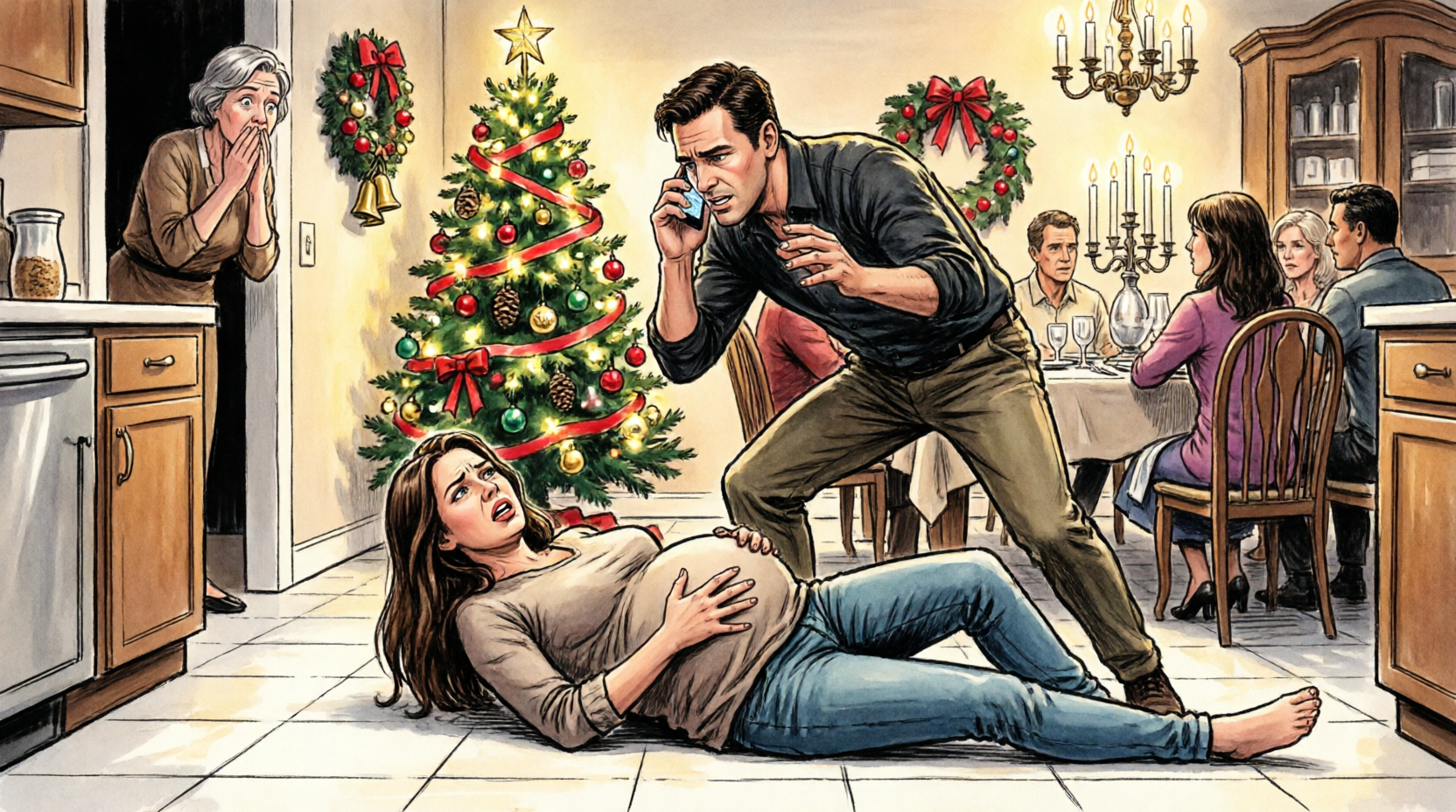
The moment David ripped the phone from my hand, something in me went still.
Pain was spreading through my back, warmth was pooling beneath me on Sylvia’s white kitchen tiles, and the Christmas music floating in from the dining room sounded insane against the reality of what was happening.
I was seven months pregnant, fighting to keep consciousness, and my husband was more worried about gossip than the child we had made together.
That was the moment I understood there was no marriage left to save, only a life left to protect.
To David and his family, I was Anna Miller, a soft-spoken woman with no connections, no siblings, no mother, and no one powerful enough to matter.
They thought the quietness in me meant weakness.
They thought my reluctance to speak about my past meant shame.
In truth, it was caution.
My mother had died when I was in college, and after years of media scrutiny surrounding my father’s career, I took her surname and built a life far away from courtrooms, cameras, and the ugly hunger people develop when they learn who your family is.
My father, Chief Justice Charles Whitmore, respected that choice, even when he hated it.
He loved me fiercely, but he also knew what his name did to rooms.
It bent them.
It made people perform.
When I met David at a charity gala in Boston, I told him only that my father worked in law and that we were not especially close.
That last part was partly true.
We loved each other, but our relationship had been shaped by distance, security details, and public obligations.
I wanted at least one part of my life to belong to me alone.
I wanted to know whether a man could love me without the shadow of influence standing behind me.
David seemed to be that man.
He listened.
He remembered small things.
He sent soup when I was sick and books when I mentioned liking a certain author.
What I mistook for steadiness was really calculation polished into charm.
By the time I realized how much he admired status, judges, private clubs, and powerful surnames, we were already married.
By then, too, he had absorbed the version of me that best served him: the woman with no family leverage, the wife who should be grateful to be chosen by a rising attorney.
His mother, Sylvia, adored that version even more.
Sylvia believed every relationship required a throne and a servant, and she had already decided who I was before I stepped through her front door.
If I cooked, it was expected.
If I stayed quiet, it was proper.
If I disagreed, it was disrespect.
Pregnancy did not soften her.
It seemed to annoy her, as if my swollen feet and doctor-ordered rest were inconveniences staged to disrupt her holidays.
When David made partner at his firm, she treated my exhaustion like sabotage against the great man she had raised.
Christmas dinner that year was her masterpiece.
She invited half the local legal community to her house: partners, judges, a deputy district attorney, two city council donors, and a retired prosecutor who still liked being called counselor.
She wanted crystal, silver, six side dishes, a perfect bird, handmade pies, and a daughter-in-law invisible enough to make all
of it look effortless.
So I started cooking at five in the morning with contractions of fatigue already tightening my lower back.
Every hour, my ankles swelled more.
Every time I leaned against the counter for a breath, Sylvia found another task.
By the time the guests sat down, the room smelled of cinnamon, rosemary, roasted garlic, and expensive wine.
Sylvia glowed at the head of the table.
David wore the smug smile he saved for people whose approval he craved.
I carried platter after platter into the dining room, pretending I didn’t feel the strain in my abdomen.
When I finally whispered that I needed to sit for a moment, Sylvia brought her hand down on the table so sharply that several forks jumped.
Servants do not sit with family, she said, without lowering her voice.
Eat later.
In the kitchen.
Standing up.
It will be good for the baby.
The table laughed awkwardly, that cowardly little laugh people give when they know something is cruel but have no intention of interrupting it.
David only sipped his wine and told me not to embarrass him in front of his colleagues.
In that instant, every polite fiction in our marriage fell away.
I was not his partner.
I was part of the staging.
Then the pain hit.
It was not the dull ache I had been ignoring all day.
It was sharp, low, and terrifying.
I caught the edge of the sideboard before I fell and whispered David’s name.
He barely looked up.
Sylvia rose, followed me into the kitchen, and accused me of pretending again.
I turned toward the island to steady myself.
Her hands hit my shoulders a second later.
Hard.
My lower back slammed into the granite.
The shock of it stole my breath.
Then came the heat between my legs.
I looked down and saw red spreading across white tile, bright as a warning flare.
My baby, I said, and it came out smaller than I expected, almost like a child’s voice.
David came running then, but not with horror.
With irritation.
He saw the floor, saw me folded around my stomach, and frowned as if I had broken a rule of decorum more serious than the one his mother had just broken against my body.
Get up and clean this before anyone sees, he snapped.
I begged for an ambulance.
Sylvia said I was being dramatic.
David took my phone, smashed it against the wall, and told me no police would enter his house on the night he was celebrating a promotion.
Then he crouched beside me and did the thing I still hear in nightmares.
He tangled his hand in my hair and forced my face up so I would have to look at him.
He told me he played golf with the sheriff.
He told me he knew how to make unstable women disappear into locked wards.
He told me nobody would believe an orphan over a partner at a respected firm.
There are moments when fear becomes so large it burns itself away.
What rises after it is not bravery exactly.
It is clarity.
Mine arrived in a single cold line.
You know the law, David, I told him.
But you do not know who wrote it.
I asked for his phone.
At first he laughed.
Sylvia laughed too.
They thought pain had made me delusional.
But David wanted an audience, so he dialed the number I recited and set the call on speaker, intending to humiliate me in front of the guests gathering at the dining room doorway.
The line clicked.
A deep male voice answered with two words that had frozen senators in hearing rooms and appellate advocates at lecterns.
Identify yourself.
David, still smiling, announced himself as Anna’s husband and said his wife was causing a scene.
There was a silence on the line.
Then the voice asked, very precisely, Is my daughter conscious? The room changed before my father even said his name.
One of David’s senior partners went pale.
The retired prosecutor took a full step backward.
Judge Elena Price, who had argued before my father in Washington less than a year earlier, went so still her wineglass trembled in her hand.
David’s smile loosened at the corners.
I pushed through the pain and said, Dad, Sylvia shoved me.
I am bleeding.
I need an ambulance.
What came through that speaker then was not rage.
It was something colder and much worse.
This is Chief Justice Charles Whitmore, my father said.
Whoever is standing in that kitchen will call emergency services right now.
No one will disconnect this call.
No one will destroy evidence.
And no one will touch my daughter again.
David tried to laugh it off, but the sound died halfway out.
Judge Price moved first.
She stepped around him, pulled out her own phone, and called 911 in a voice sharp enough to cut glass.
The deputy district attorney announced that everyone present was now a witness.
For the first time that night, Sylvia looked frightened.
Everything sped up after that.
Guests who had sat comfortably through my humiliation suddenly found consciences once my father’s title entered the room.
The same people who laughed at Sylvia’s servant remark began speaking over one another about what they had heard, what they had seen, how hard she shoved me, how David threatened me, how he smashed the phone.
David kept saying this was a misunderstanding.
Sylvia kept insisting I was unstable.
My father stayed on speaker the entire time, asking me to keep talking so he would know I was awake.
I told him I was trying.
I told him it hurt.
I told him I was sorry.
His voice broke only once, when he said, Anna, do not apologize for surviving this.
The ambulance arrived in eleven minutes.
It felt like a century.
Paramedics cut through the dining room while police officers separated guests and began taking statements.
David attempted to intercept them at the door, talking too fast, naming colleagues, invoking his firm.
One of the officers looked past him and saw the broken phone on the kitchen floor, my hair half torn from its clip, the blood, my condition, and simply told him to step aside.
Sylvia tried to follow my stretcher outside.
Judge Price blocked her path with a single arm and a stare that said her social season had just ended.
At St.
Matthew’s Medical Center, the emergency room became a blur of lights, clipped instructions, monitors, consent forms, and fear.
The doctors told me I had suffered a placental abruption
and was going into premature labor.
They needed to move fast.
I remember signing something with a shaking hand.
I remember asking whether my baby was alive.
I remember a nurse squeezing my shoulder and saying, We are doing everything we can.
Then the ceiling lights wheeled above me, bright and pitiless, as they rushed me toward surgery.
When I woke up, there was a soreness like fire across my abdomen and an emptiness that sent me into instant panic.
I reached blindly until a nurse caught my hand and told me to breathe.
My daughter was alive.
Very small, very early, but alive.
They had delivered her by emergency cesarean section and taken her straight to the neonatal intensive care unit.
She weighed just over three pounds.
She needed oxygen, warmth, and time.
I cried so hard I shook the bed.
Not because I was calm.
Because I wasn’t.
Because relief and terror can occupy the same body like rival storms.
My father arrived before dawn.
Not with cameras, not with an entourage, but with the exhausted face of a man who had driven through the night and spent half of it on the phone moving mountains.
When he stepped into my hospital room, his suit was wrinkled, his tie crooked, and his eyes red.
For a second he was not the Chief Justice.
He was just my father, the man who taught me to ride a bike in the dark because it was the only hour security would leave us alone, the man who missed school plays but mailed handwritten notes to every one of them.
He sat beside me, held my hand gently to avoid the IV line, and said he was sorry he had not seen sooner how alone I had become.
I told him the truth I had hidden even from myself.
David’s cruelty had not started in the kitchen.
It had started with corrections, with isolation, with the constant quiet reshaping of my confidence.
He dismissed my friends.
He mocked my hesitation to use my father’s name.
He liked introducing me as someone with nothing but him.
Every time I tried to confront his contempt, he made me feel oversensitive.
Every time Sylvia insulted me, he framed my pain as immaturity.
By the time I was pregnant, I had started measuring my words to avoid his irritation.
Saying it all aloud in that hospital room felt like lifting stones out of my lungs one by one.
My father listened without interrupting.
Then he said something I had needed to hear long before that night.
Love that demands your silence is not love.
By morning he had arranged the best trauma counselor in the city, a family law attorney I trusted, and security outside my hospital floor.
He did not try to direct my choices.
He simply made sure I would have choices again.
That distinction mattered more than any influence his office carried.
My daughter spent the first weeks of her life inside an incubator beneath a halo of wires and soft mechanical sounds.
I named her Grace because she arrived in the ugliest hour of my life and still managed to bring light into it.
The first time I slipped my finger through the incubator port and felt her tiny hand curl around
it, I understood with a clarity more profound than the one I had felt on Sylvia’s floor: I would never again confuse endurance with peace.
Endurance had nearly buried us.
Peace would have to be built differently.
Meanwhile, the legal avalanche David had trusted himself to outrun crashed down all at once.
The speakerphone call had been heard by a room full of attorneys, including people with far better judgment than loyalty.
The 911 recording captured the chaos in the background.
The paramedics documented my injuries.
Police photographed the kitchen before the cleaners Sylvia tried to summon were allowed inside.
One of David’s junior colleagues, trembling and ashamed, turned over a short video clip he had taken moments before the ambulance arrived.
It included David’s voice threatening me with commitment to a psychiatric ward.
That sentence alone destroyed the polished image he had spent a decade building.
David was arrested two days later after detectives finished formal interviews.
The charges included domestic battery, intimidation, witness tampering, destruction of evidence, and interference with emergency reporting.
Sylvia was charged as well, her shove no longer diluted by family denials because too many guests had seen my body hit the island and heard her mockery afterward.
The sheriff David bragged about golfing with did not rescue him.
In fact, he recused himself from anything related to the case within hours of the arrest report becoming public, which was perhaps the most decent thing he had done in years.
David’s law firm placed him on immediate leave before the mug shot even circulated.
By the following afternoon, the partners issued a statement about their commitment to ethics, professional conduct, and the dignity of all persons.
I recognized the language.
Corporate shame always sounds like a committee wrote it between boxed lunches.
But I did not care about their sincerity.
I cared that his office badge no longer opened any doors.
The state bar opened an emergency disciplinary review.
Judges who once nodded at him in hallways refused to return his calls.
Men like David survive on reflected power.
Once the mirrors crack, they are forced to meet themselves.
From the hospital, I filed for divorce and secured a protection order.
I also changed the narrative that had kept me trapped.
No more pretending I had nobody.
No more shrinking so other people could feel large.
Reporters eventually learned that the victim in the Christmas assault case was the Chief Justice’s daughter, but the story that mattered to me was not the name in the headline.
It was the record.
It was the fact that the official documents said what had happened in clear, unsentimental language.
He threatened.
She assaulted.
He obstructed.
She bled.
Facts can be a form of mercy when you have been gaslit long enough.
Sylvia tried, of course, to rescue herself with performance.
She sent flowers I refused.
She had church friends call my room with syrupy messages about forgiveness and stress and misunderstandings during the holidays.
She cried in one local interview about a broken family and ungrateful young women.
But then the witnesses began speaking.
Judge Price gave a statement.
The deputy district attorney corroborated the threats.
A caterer described seeing David snatch and smash my phone.
One by one, the people who had once preferred comfort over courage
discovered that silence becomes harder to maintain when police subpoenas arrive.
The disciplinary hearing for David took place three months later.
I did not attend in person.
I watched part of it from a quiet room near the NICU while Grace slept under blue lights after a routine treatment.
When the recording of his voice was played, clear and arrogant and certain that the law was his private weapon, the panel’s expressions changed.
He tried to say he had been under stress.
He tried to portray himself as a desperate husband managing a difficult pregnancy.
Then the video clip showed me on the floor and him standing above me with annoyance instead of fear.
No legal rhetoric survives contact with that kind of truth.
He lost his license before the end of the month.
The criminal case ended with guilty pleas.
David accepted a plea agreement that kept him from prison for as long as he complied with strict probation, batterer intervention, counseling, and a permanent no-contact order outside matters handled through counsel.
Sylvia pleaded to assault and endangerment, her social circle shrinking overnight as if cruelty were contagious now that it had consequences.
None of it gave me back the night.
None of it erased the memory of pleading for help while people held forks and watched.
But justice is not always restoration.
Sometimes it is simply the formal refusal to let powerful people rename violence as family business.
Grace came home in the spring.
She was still tiny, still delicate enough that I checked her breathing too often, but she was home.
My father visited without press staff, without staff of any kind, and sat at my kitchen table assembling a crib mobile with the concentration of a man reading constitutional text.
I laughed at him for putting the moon where the star should go.
He laughed back and said the moon had seniority.
For the first time in years, laughter did not feel like something borrowed from a safer person.
I bought a small house later that year with sunlight in the kitchen and chairs I actually sat in.
No one told me where to stand.
No one measured my value by how invisible I could make myself.
Sometimes when Grace napped, I would rest my palms on the table and let the quiet settle around us.
Real quiet.
Not the tense, watchful silence of an abusive home.
The kind of quiet that makes room for healing.
People still ask me why I hid who I was.
The answer is complicated, but the ending is simple.
I wanted to be loved without power.
What I learned is that hiding power does not make cruel people kinder.
It only makes them bolder.
The night David told me nobody would believe me, he truly thought the law belonged to men like him.
He was wrong.
The law did not belong to the loudest voice in the room.
It belonged to the truth.
And the truth, once spoken aloud, was finally louder than all of them.