
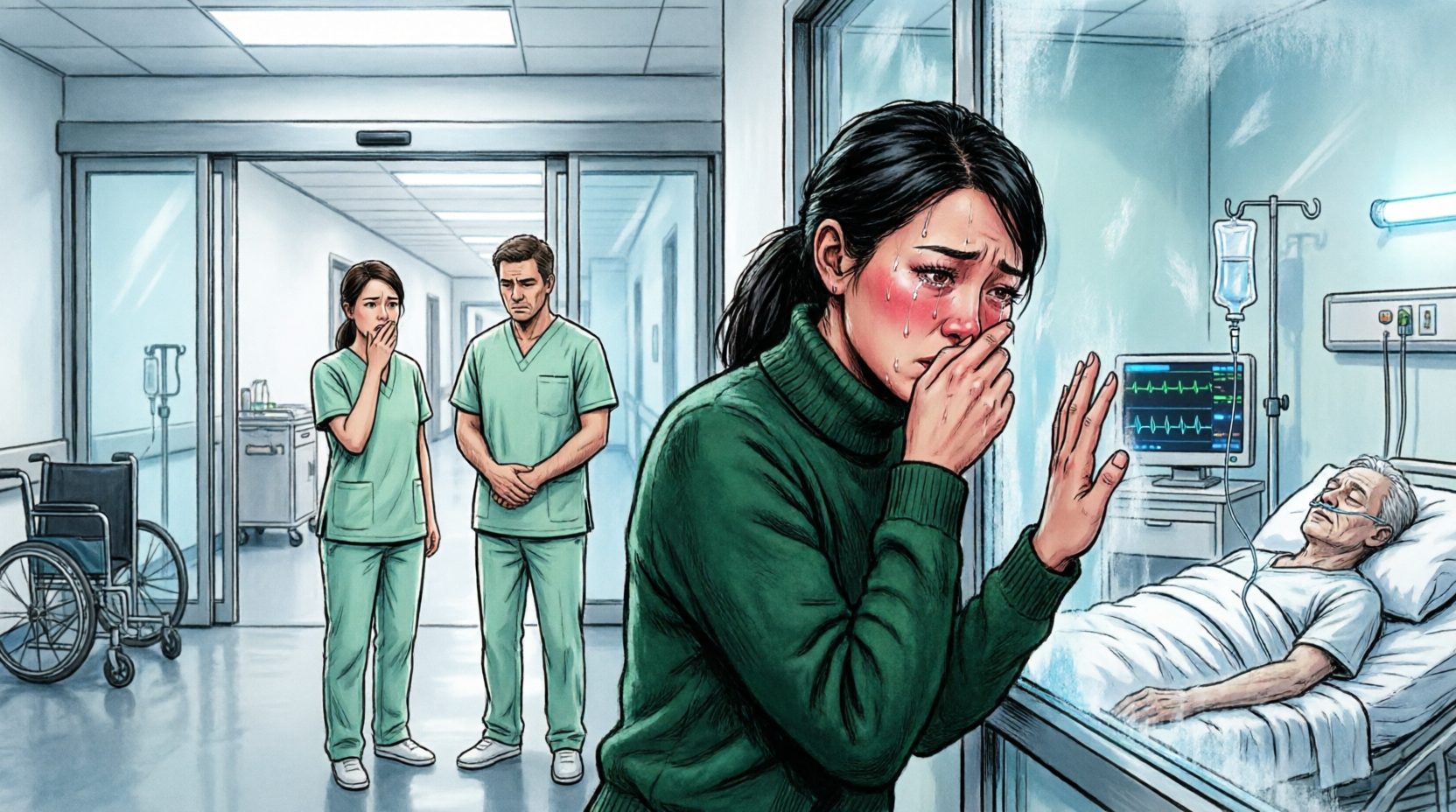
By the time the doctor told me my husband had less than forty-eight hours left, I felt like my body had forgotten how to belong to me.
For two weeks I had lived inside the ICU’s fluorescent weather, sleeping in a stiff vinyl chair with my head tipped against a wall that smelled faintly of bleach and overworked air-conditioning. I woke to the same monitor tones, the same clipped footsteps, the same strange hospital rhythm where every hour felt both too long and not long enough. My neck ached. My eyes burned. My grief had stopped moving in clean waves and settled instead into something heavier—a stone lodged just under my ribs, too solid to cry out of me.
So when Dr. Heller stepped into the hallway on October 1st wearing that careful expression doctors learn when they have bad news to deliver but don’t want to appear cruel by surviving it, I knew before he said a word.
He closed the chart against his chest and lowered his voice.
“Natalia,” he said, “I think you should prepare yourself.”
There are sentences that do not sound like language when they first hit you. They sound like pressure changing in a room.
I stood there in my wrinkled sweater, my hair still smelling faintly like hospital shampoo from the family lounge shower, and watched his lips keep moving. Multi-organ strain. Limited response. We’re doing what we can. It may be time to focus on comfort. I nodded when I was supposed to nod. I asked one practical question because that’s what people like me do when something inside us is breaking—we go practical before we go to pieces.
“How long?” I heard myself ask.
He paused, and in that pause I knew the answer was no longer being pulled from medicine. It was being pulled from experience.
“Less than forty-eight hours,” he said.
I thanked him.
I thanked him.
That is the humiliating, ordinary thing grief does to you. It takes your mouth and fills it with manners.
Then I went back into the room where my husband was lying under white sheets and machine wires, and I tried to say goodbye like a brave woman in a movie. The room was dim except for the monitor glow and the thin October daylight slipping around the blinds. Graham’s face looked wrong in the way all beloved faces look wrong when you can’t tell whether they still belong to the future. Too still. Too pale. Shadowed under the cheekbones. His mouth was slightly open around the oxygen tubing. One of his hands rested outside the blanket, and I took it because I had taken it so many times in those two weeks that letting it sit there alone felt like a kind of betrayal.
“My love,” I whispered.
The words cracked immediately.
I thanked him for the life we built. I apologized for every stupid argument about laundry and schedules and dishes in the sink. I told him I loved him more than I had ever managed to say cleanly during normal life. I told him if he needed to rest, I understood. I told him wives learn these impossible sentences by instinct the second the room demands them.
Then my body noticed something before my heart let itself.
His skin didn’t feel like someone slipping away.
Not fever-hot.
Not cold.
Not clammy.
Just… normal.
I closed my eyes and told myself it was the medication. The blankets. The machines. Shock. Grief. Anything except the thought that I might be standing in the wrong kind of goodbye.
“You should go home for a few hours,” she said softly once I sat back down by Graham’s bed. “Just shower. Sleep in your own bed. I’ll call if anything changes.”
“I’m not leaving him.”
“You’ve barely slept.”
“I said I’m not leaving.”
Susan’s mouth tightened so slightly most people would have missed it. I didn’t. She had spent the entire four years of my marriage trying to package control as concern. I was familiar with the seam lines by then.
“Natalia,” she said, “if he wakes, I’ll call. If anything changes, I’ll call. But you need to take care of yourself.”
Grief has its own gravity. It pulls whether you agree or not. And exhaustion can make reasonable people suddenly look almost persuasive.
So after another hour, after another quiet apology whispered into Graham’s unmoving hand, after another round of machines and silence and Dr. Heller’s forty-eight hours echoing in my skull, I finally stood.
“I’ll be back,” I told Graham.
Then I kissed his forehead, picked up my bag, and walked out of the room.
The ICU hallway was cooler than the room had been. Nurses moved in soft-soled shoes between stations. A tech rolled a machine past me with practiced speed. Somewhere farther down, a woman was crying into her phone in the clipped, furious tone of somebody dealing with relatives and prognosis at the same time. Hospitals are full of public suffering arranged into private corners. Everybody is grieving near everybody else and pretending not to notice.
I was halfway past the nurses’ station when I heard them.
Not because I was trying to listen.
Because one of them said the words with the particular low urgency people use when they know they should have waited to be farther away.
“I still can’t believe they’re going through with it.”
I stopped.
Two nurses were walking toward the medication room, both in navy scrubs, badges swinging lightly. They weren’t looking at me. They were looking at each other in that tight, horrified way people do when speaking quietly about something they know is wrong and have not yet decided whether they are brave enough to touch it.
The other nurse answered, “The payout is huge.”
The first one gave a short incredulous shake of her head. “Three hundred grand.”
I didn’t breathe.
Because three hundred thousand dollars was not a random number.
That was the exact amount of Graham’s life insurance coverage.
We had sat at our kitchen table two years earlier, laptop open between us, deciding whether to increase the policy after we refinanced the house. He joked that it felt weird putting a neat number on death. I had rolled my eyes and told him married adults did boring responsible things because that was how roofs stayed over heads. Three hundred thousand. We both knew it. His mother knew it because she had once made a nasty little remark at Thanksgiving about how “young couples always think paper will save them.”
The second nurse sighed and said, “And she has no idea.”
The words hit harder than the number.
She.
Not they.
Not the wife and his family.
She has no idea.
My feet rooted to the floor.
The nurses kept walking. One of them noticed me then—just for half a second—and both women’s faces changed at once. Not guilt exactly. Alarm. They lowered their heads and disappeared through the medication room door.
I stood frozen in the hallway long after it shut behind them.
Because in that moment it didn’t feel like grief anymore.
It felt like a plan.
I went back to Graham’s room with my face smooth and my stomach turning.
Susan was standing by the bed, tugging absently at the edge of the blanket as if she had decided busy hands would make her look more sincere. The room smelled faintly of saline, stale coffee, and the citrus hand lotion she always used. Graham’s phone sat on the nightstand plugged into a white charging cable, screen dark.
I crossed to the bed and rested my hand on the rail.
Susan looked up. “You forgot something?”
I glanced at the phone as if only just noticing it. “I’m going to take this. I don’t want it to get misplaced.”
She didn’t stop me.
That should have been the first confirmation.
Susan was the sort of woman who questioned every movement around anything she considered family property. She noticed if someone shifted a framed photo in her living room by half an inch. She had once called me after a holiday dinner to ask whether I had accidentally taken home the wrong pie server because one was missing from the drawer. If she thought there were private messages on that phone that supported her version of events, she would have found a reason to object. Instead she gave me a tight little nod and said, “Of course.”
I slipped the phone into my bag, told her I’d be back soon, and left the hospital.
Austin in early October still felt half-summer, half-exhaustion. The parking garage was warm and smelled like oil and wet concrete. My hands shook so badly when I unlocked the car that I dropped my keys once between the seats. I sat there for a moment without turning the engine on, the phone burning through the leather of my bag like a live thing.
Payout.
They’re going through with it.
She has no idea.
By the time I drove out onto Thirty-Eighth Street, my palms were slick on the wheel. Traffic lights bled in the afternoon glare. The neighborhood near the hospital looked insultingly normal—dog walkers, joggers, a woman carrying iced coffees, two teenagers laughing outside a taco place. The world had no idea it had tilted. That’s one of the cruelest parts of fear. It happens privately while everything else stays the same.
I live in Hyde Park, in a little green house Graham and I bought three years after we got married and painted ourselves one sweaty spring because we were too stubborn and too optimistic to hire painters. The front porch leans slightly to the left. The kitchen cabinets are the exact cream color we argued over for six hours before settling on because Graham said the warmer tone made morning look kinder. His shoes were still by the door when I came in. His coffee mug, half-rinsed, still sat by the sink where I had left it the morning he collapsed. The house was frozen mid-sentence, and the quiet inside it felt too intimate now, like it had been waiting for me to come home carrying suspicion.
I sat on the edge of our bed with Graham’s phone in my hand.
My name is Natalia Reyes. I was thirty-two that fall, a project coordinator for a local architectural firm, married to a man I believed I knew well enough to build a life around. Graham and I met at twenty-four, when he knocked my stack of case files off a downtown coffee shop table by swinging his messenger bag around too enthusiastically and then spent ten minutes helping me reorganize them by color and apologizing so earnestly it became charming instead of annoying. He was funny, bright, impulsive in ways that felt romantic before they started feeling expensive. He loved old houses and late-night tacos and said my name like it had more syllables than it did. He kissed me like he was always glad to have found me. When we got married, I believed, with the fierce stupidity of the hopeful, that being loved by him meant being safe with him too.
That belief did not die all at once. Betrayal almost never works that cleanly.
It frays. It asks for little concessions. It teaches you to smooth over odd moments because the larger feeling of love seems too valuable to challenge over details.
Graham had changed over the previous year, but I kept filing the changes under stress. His marketing firm had lost a major client in March. He started staying late more often, taking calls in the backyard instead of the living room, snapping at small things and apologizing after. Susan, his mother, began inserting herself into our life with new frequency. She brought casseroles we didn’t ask for, opinions we didn’t need, and constant commentary about “how hard men take financial pressure.” Graham’s older brother Derek started reappearing too after years of mostly floating at the edge of family events.
Derek was thirty-six, broad and careful, with the kind of face that always looked like it was rehearsing innocence just before somebody asked the wrong question. He had drifted through jobs—security, logistics, “consulting,” whatever that meant on the weeks it changed—while Susan explained every instability as evidence that life had failed to recognize his potential properly. Graham loved him the weary, bruised way younger brothers love the sibling who has been getting away with things longer than they have. I never liked Derek. He looked at rooms like exits mattered more than people in them.
Three weeks before Graham ended up in the ICU, Derek had started coming by more often. Beer in the garage. Long talks in the driveway. The two of them going quiet when I entered a room. When I asked Graham about it, he told me Derek was “going through some stuff.” That phrase—some stuff—became his answer to everything I should have pressed harder on.
Now I held his phone and stared at the black screen until my own reflection blurred over it.
Then I started trying passcodes.
His birthday.
My birthday.
Our anniversary.
Nothing.
Then I tried the stupid six-digit code we once used for everything when we first moved into the house and thought shared passwords were proof of romance instead of laziness.
The phone unlocked immediately.
That hurt almost more than if it had resisted.
Because it meant the door had been there all along. I just hadn’t imagined I would ever need to open it looking for betrayal.
At first, everything looked boring. Work emails. Group texts about fantasy football. Calendar reminders. Notes about prescriptions and grocery lists. I scrolled too fast, anger and panic fighting for control, until I forced myself to slow down.
When you don’t know what the truth is yet, you learn to look for what doesn’t belong.
The first thing that didn’t belong was a text thread with no name attached, just a Houston area code.
Are you ready?
Yes. Tomorrow.
Don’t mess this up.
I won’t. Trust me.
300k is a lot of money.
She’ll never know.
I stared at the last line until the screen dimmed.
Then I tapped it again and scrolled upward.
There were weeks of messages.
Not romantic, not exactly. Not obviously. But intimate in a way worse than flirtation because it meant coordination. Dates. Timing. Vague instructions. One message from Graham read: Susan’s handling her side. Another: Derek will be there when it matters. The Houston number answered at one point: Good. Once the papers are set, don’t hesitate.
Papers.
What papers?
A hot buzzing started behind my eyes.
I opened the files app. Most of it was junk—downloaded menus, PDFs from work, warranty information. Then I found a scanned document labeled policy_update_final.pdf.
My breath stopped again.
It was the life insurance policy.
Three hundred thousand dollars.
Updated beneficiary designation.
Primary beneficiary: Susan Whitaker.
Contingent beneficiary: Derek Whitaker.
There was a signature line where a spouse acknowledgment should have been. My name appeared there in looping cursive that was meant to look like mine and failed the way all imitations fail if you have spent enough time watching your own hand move across paper.
I didn’t scream. Didn’t cry. Didn’t even sit down farther than I already was.
I just got colder.
There was more.
A forwarding email thread between Graham and an address I didn’t recognize arranging “temporary housing” in Houston under the name G. Bennett. A flight itinerary not yet purchased but saved. A note in his drafts app with three bullet points:
Make sure she leaves hospital
Get phone back if needed
Once pronounced, no mistakes
Once pronounced.
I pressed the heel of my hand against my mouth so hard it hurt.
Then, in the middle of everything, another file caught my eye.
advance_directive_oct.pdf
I opened it.
A medical directive naming Susan as healthcare proxy in the event Graham was incapacitated.
Signed three days before he was hospitalized.
Witnessed.
Notarized.
I had never seen it in my life.
Graham and I had wills. We had reciprocal emergency authorizations. Married couples who own houses and refinance things and try to be grown-ups do boring document maintenance. If he had changed any of that, I would have known.
Unless the point was that I shouldn’t.
My hand had gone numb around the phone by then. I backed up everything to my laptop. Screenshots. PDFs. The call log. The text thread. I emailed copies to myself, to a new throwaway account, and then, after a long moment of staring at the contact name, to my college friend Lena Torres.
Lena had been my law-and-order friend since undergrad even though she was never a lawyer. She worked in fraud investigations for an insurance company now, the sort of job that made people careful about lying around her. We hadn’t talked in two months, but there are friends you can contact after silence if the sentence begins with, I think something is very wrong.
I wrote exactly that.
Then I took a breath, grabbed my keys, and went back to the hospital.
By the time I parked, the fear had burned down into something more focused.
Not calm exactly.
Resolve.
I had spent two weeks being the grieving wife at the bedside. But grief and stupidity are not the same thing, and somewhere between the forged signature and the line about once pronounced, my body had understood that crying was no longer the correct skill set.
The ICU looked the same when I returned. Same lights. Same humming air. Same rolling carts and neutral wall art meant to suggest peace to people who came there for unpeaceful reasons.
But when I reached Graham’s room, Susan wasn’t alone.
Derek stood by the window with his hands in his pockets, shoulders tense under a gray jacket. Susan turned at the sound of my shoes on the floor, and for the first time since this nightmare began, she did not look like a mother at her dying son’s bedside.
She looked like a woman caught mid-calculation.
Derek’s eyes dropped immediately to the phone in my hand.
“Natalia,” he said, voice low and careful, “you need to sit down.”
The way he said it told me the next sentence had nothing to do with Graham’s health.
I didn’t sit.
I closed the door behind me instead.
“That’s interesting,” I said. “Because I was about to say the same thing to both of you.”
Susan took one step toward me, palms lifted, the universal sign for we can discuss this if you remain manageable.
“Natalia, whatever you think you found—”
“Oh, I found plenty.”
Her face changed.
Derek did not move, but every part of him looked ready to.
I held up the phone. “Houston area code. Policy change. Forged signature. Healthcare proxy that somehow replaced a spouse without the spouse noticing. Would either of you like to start with the fraud or should we jump straight to why two nurses were whispering about three hundred thousand dollars in the hallway like they’d just walked past a crime?”
Susan went white under her makeup.
Derek said, “Lower your voice.”
That almost made me smile.
“No.”
Susan’s expression tightened. “You are exhausted and upset.”
“Yes,” I said. “Which part did you think would make me easier to fool?”
“Natalia,” Derek said, taking a slow step forward, “Graham was trying to protect you.”
I laughed once, a short ugly sound that startled even me. “With what? Insurance fraud?”
“It’s more complicated than that.”
“It always is when men want mercy for a decision they’d call monstrous if a woman made it.”
Susan cut in then, her own fear finally overpowering the performance. “He didn’t want you dragged into his debts.”
The room went still.
I looked at her. “What debts?”
She pressed her lips together as if she had already given away too much.
Derek spoke instead. “He got in over his head.”
“With what?”
Neither answered immediately.
Then Susan said, “Investments.”
That was how people like Susan described gambling when they wanted the room to keep taking them seriously.
I looked at Graham.
He lay there exactly as I had left him, motionless under the sheets, lashes still against his cheeks, hand still on top of the blanket as if it belonged to a man too weak to move it.
And yet the phone in my hand contained a future arranged after his supposed death.
A proxy document.
A payout.
A plan.
“How sick is he really?” I asked.
Susan’s gaze flicked to the bed, then back to me.
“His body is under terrible stress,” she said carefully.
That wasn’t an answer.
Derek saw that I knew it.
“He collapsed,” he said. “There was medication involved. The doctors don’t know everything.”
“And you do?”
His silence was answer enough.
Something hot and terrible moved through me then. Not grief. Not panic. Rage so clean it felt almost clarifying.
“For two weeks,” I said, my voice shaking now despite me, “I have slept in that chair. I have held his hand. I have begged him to live. I have said goodbye to my husband while the two of you stood around me deciding when I should go home so whatever this is could continue without me.”
Susan’s own voice went sharp. “We were trying to save him.”
“No,” I said. “You were trying to save the money.”
“That money would have solved everything,” Derek snapped before he could stop himself.
There it was.
The room turned around that sentence.
Susan looked at him with open fury, but it was too late.
“What does that mean?” I asked.
Derek dragged a hand over his mouth. “He owed people, okay? Real people, not credit cards. He made some bad choices. Thought he could turn it around. Then he couldn’t.”
“Who is in Houston?”
Neither of them answered.
I took a step toward Susan. “Who is in Houston?”
Her eyes filled suddenly—not with grief, I realized, but with the strain of a lie collapsing under too much weight.
“A woman,” she whispered.
I closed my eyes for one second.
When I opened them again, the room looked sharper.
“A woman,” I repeated. “And the plan was what? He dies, you collect the insurance, and then what? He boards a plane in secret and starts over?”
Derek said nothing.
Susan looked away.
I understood.
The enormity of it almost pushed me backward.
They had not just planned to take the money.
They had planned to erase me with my own cooperation. To let me say goodbye, cry in hallways, sign whatever papers grieving wives sign, and then rebuild their son elsewhere with money purchased by my loss.
I was still staring at them when my phone vibrated in my hand.
Lena.
I looked at the screen, then back at Susan and Derek.
And suddenly I understood that whatever happened next could not happen with them in the room controlling the pace.
So I did the one thing none of them expected.
I softened.
Not all the way. Just enough.
I let my shoulders drop. Let the fury blur a little around the edges. Let my face show the kind of devastated confusion they had been counting on all along.
“I need air,” I said.
Susan blinked.
Derek frowned slightly, suspicious, but the advantage of having been underestimated your whole life is that people often believe the performance that flatters them most.
“Natalia,” Susan said cautiously, “we can explain.”
“Not right now.”
I turned and walked out before either of them could decide whether to stop me.
The second I got into the elevator, I answered Lena’s call.
“Natalia,” she said, no preamble, “tell me you did not touch any of those original files except to copy them.”
“I copied everything.”
“Good. Listen carefully. Do not confront anyone else alone. The beneficiary change requires spouse acknowledgment in Texas on that type of policy if community funds touched premiums. A forged signature is already bad. If there’s also medical proxy fraud and an attempted death claim setup, this is criminal in several directions.”
I leaned back against the elevator wall. “They admitted enough to know Graham has debts and a woman in Houston.”
“Of course he does,” she said grimly. “Men never commit one fraud. They accessorize.”
Despite myself, I exhaled a tiny laugh.
“Natalia, where are you?”
“Hospital elevator.”
“Good. Stay there until you can get somewhere private. You need hospital administration and law enforcement involved before anyone moves him, pronounces him, or gets you to sign a single thing.”
My heart kicked hard. “Pronounces him.”
“Yes,” she said. “That draft note about ‘once pronounced’ is the part that matters most. If this is a staged or accelerated death scenario, the paperwork around pronouncement, release, and next-of-kin communication is where they’ll try to trap the outcome.”
I pressed a hand to my forehead. “How could they even do that?”
“Doesn’t matter yet. What matters is stopping them before the system decides something based on fraudulent documents.”
The elevator opened onto the lobby.
I stepped out and found a quiet alcove near the chapel where the carpet swallowed sound.
“What do I do?”
Lena’s voice changed. More controlled. Investigator voice.
“First, email me the policy and proxy docs now. Second, call hospital risk management or the nursing supervisor—not the unit desk. Third, tell them you have evidence of forged medical documents and possible financial motive surrounding an imminent end-of-life decision. Those are magic words in institutional language. Fourth, you need police, not because they’ll solve it in ten minutes, but because once the possibility of fraud is documented, it becomes harder for the family to quietly move the patient or control the chart. Can you do that?”
“Yes.”
“And Natalia?”
“Yes?”
“You need to assume Graham is part of it. Not confused. Not pressured. Part of it.”
That was the hardest sentence of the day.
Harder than forty-eight hours.
Harder than three hundred thousand.
Harder than the woman in Houston.
Because some part of me, the humiliated loyal part, still wanted the man in the bed to be a victim of his mother and brother rather than the architect of my destruction.
But I knew the texts.
I knew the draft note.
I knew the line: She’ll never know.
“I know,” I whispered.
The next hour moved fast.
Risk management first. Then the hospital’s patient safety administrator. Then a nursing supervisor named Carla who met me in a glass-walled office and listened without interrupting while I explained, as calmly as I could, that forged documents might be in the chart, that I had evidence of insurance fraud motive, that my husband’s phone contained messages referencing pronouncement and payout, and that I needed any transfer, release, or comfort-care decision halted immediately pending review.
Carla’s face went from concern to cold institutional focus in under thirty seconds.
“Do you have copies?” she asked.
“Yes.”
“Email them to this address. Now.”
I did.
Then she stood and said, “No one is moving your husband anywhere or changing his status without executive review. I need you to stay available. Security will be notified.”
The word security made the whole thing feel suddenly real in a different way.
After that, two Austin police detectives arrived. One was a patient middle-aged woman named Renee Walker with hair pulled into a low bun and the alert eyes of someone who had learned not to underestimate domestic fraud just because the people committing it wore expensive cardigans. The other was younger, quieter, and mostly took notes.
I told them everything.
The nurses’ whispers.
The phone.
The forged spouse signature.
The fake proxy.
The confrontation.
The debts.
Houston.
The detectives didn’t promise miracles. That alone made me trust them more.
“We’re going to talk to hospital administration and secure copies of what you’ve shown us,” Detective Walker said. “Until then, do not go back into that room alone.”
“I need to see him.”
“You can,” she said. “But not alone.”
That was when I realized my life had crossed all the way over from tragedy into investigation.
They found the first concrete crack faster than I expected.
The advance directive in the hospital chart had been brought in by Susan three days after Graham was admitted, presented as a recent update, and scanned into the system. But when administration pulled the metadata from the scanned copy and compared it to the alleged notarization seal, something was off. The document had been printed from a home office scanner at 6:14 a.m. the same day it was delivered to the hospital. The notary commission number belonged to a notary in Harris County—Houston area code.
The same area code as the number in Graham’s phone.
By six that evening, the hospital had locked the chart, flagged the family dispute, and assigned a different attending physician to review Graham’s actual condition independent of any family-provided documents. Susan and Derek were separated and interviewed. The two nurses from the hallway were found and, after a great deal of visible nerves, admitted they had overheard Susan and Derek in the family lounge the night before talking about “the policy,” “the timing,” and whether Natalia “needed to be out of the room” when things shifted.
“Shifted how?” Detective Walker asked them.
They couldn’t say.
But they knew enough to be scared.
At seven-thirty, Dr. Heller’s replacement, a critical care physician named Dr. Meera Shah, came into the consultation room where I sat with Detective Walker and Carla from patient safety.
Dr. Shah closed the door and said, “Mrs. Reyes, I want to be careful here. Your husband is very ill. But based on the review so far, I am not prepared to support the prognosis language you were given earlier today.”
I stared at her.
“What does that mean?”
“It means less than forty-eight hours was not a medically defensible certainty.”
The room tilted.
Not because it proved the whole scheme.
Because it proved enough.
“He may still die,” she said gently. “He has serious complications and possible toxic exposure. But he is not currently on an inevitable, irreversible trajectory in the way that was represented.”
I looked down at my own hands. They were folded in my lap like somebody else’s.
“Did someone tell Dr. Heller otherwise?” I asked.
Dr. Shah exchanged a glance with Carla. “That is under review.”
Everything under review. Everything suddenly language. Hospitals and police departments survive by translating horror into process. I understood that. But I also understood that while they processed, Graham was still in that bed and Susan was still somewhere in the building trying to keep her story intact.
“Can I see him?” I asked.
Dr. Shah nodded. “Yes. But there will be a staff member nearby.”
When I went back into the room, Graham looked exactly as he had before and yet not at all the same.
Because now I knew.
I stood beside his bed and watched the monitor trace its little green certainty through the dim light. His lashes still lay dark on his cheeks. His hand still rested outside the blanket. There was no movie scene waiting for me. No sudden confession. No fluttering eyes. Just the body of a man I had loved and the knowledge that he had built a room around my grief and walked me into it on purpose.
I sat down in the chair again.
For a long time I said nothing.
Then I leaned forward and said quietly, “I know.”
Nothing changed.
But I still said it.
“I know about Susan. And Derek. And the policy. And Houston.”
The monitor continued.
His fingers did not twitch. His face did not move. If he heard me, he was either deeply sedated or better at stillness than I had ever understood.
I looked at his hand.
The hand I had held while saying goodbye.
The hand that had once reached across a paint-splattered floor to brush white primer on my nose and then kiss it off while we laughed in the echoing emptiness of our first house.
The hand that had written texts promising I’d never know.
I sat there until tears came, not dramatic this time, just exhausted and furious and hot. I wiped them away with the heel of my hand because I suddenly hated the thought of crying decoratively in any room he might have expected it from.
By midnight the outline of the scheme had started to emerge.
Not all at once. In pieces.
Graham had taken on private debt through a series of disastrous sports betting losses and “short-term bridge loans” Derek had connected him to through people no one reputable would borrow from. When the firm lost its client in March, the debt stopped being theoretical. He increased the life insurance coverage in July. In August, he began talking to a woman in Houston named Elise Warren, who, it turned out, had a prior arrest involving document fraud and a history of moving through men with financial distress like a scavenger through construction debris.
The medical collapse was real, but not in the way I had been led to believe.
Hospital toxicology review suggested an interaction between prescription sedatives and another depressant not properly disclosed at admission. Graham had likely taken something that worsened his underlying condition dramatically. Whether he intended to nearly kill himself or only appear sicker than he was remained unclear. Susan and Derek filled in the rest. They pushed the updated directive. They leaned on prognosis language. They discussed “timing” and “pronouncement.” They got greedy enough to move before they had control of all the facts.
The part no one could yet prove was what they meant to do next.
Maybe Graham had planned to recover just enough after some staged withdrawal crisis to vanish through a private transfer. Maybe Susan thought the money would come faster if his death looked imminent. Maybe Derek was making his own side calculations. Families in fraud rarely agree perfectly. They merely align for as long as greed points the same direction.
At two in the morning, Detective Walker came back into the waiting room with a paper cup of coffee and news that made my skin crawl.
The beneficiary change paperwork had been submitted electronically from Graham’s laptop, but the spouse acknowledgment had been attached later from a different IP address associated with Derek’s apartment. The fake medical directive had likely come through the same Houston notary who had handled a set of “temporary identity documents” found in Elise Warren’s old case file.
Temporary identity documents.
There it was.
Not just payout.
Escape.
A death on paper. A man elsewhere.
“Do you think they were going to fake it?” I asked.
Walker took a sip of coffee and chose her words carefully. “I think they were building options.”
That was somehow worse.
By dawn, Susan had lawyered up. Derek started talking and then stopped once counsel appeared. Graham remained sedated, still medically unstable, but now under a different care protocol and watched more closely than anyone in that hospital had ever been watched in their lives.
I went home at six in the morning because Detective Walker and Dr. Shah both insisted I was becoming useless from exhaustion and because there was nothing left to do in that moment but wait.
The house felt different this time.
Not paused.
Contaminated.
I showered until the water went cold. Put on clean clothes. Made toast I could not eat. Then I sat at the kitchen table while pale morning spread across the cabinets we had painted together and tried to understand how a life becomes evidence.
Lena called at eight.
“I pulled public records on the Houston notary,” she said without greeting. “He’s been associated with three fraudulent beneficiary disputes in the last five years. Also, Natalia?”
“Yes?”
“Elise Warren leased a storage unit in Houston six weeks ago under one of her aliases. Guess whose name appears as an alternate authorized access?”
I closed my eyes.
“Graham.”
By noon, Detective Walker had a warrant.
They found cash, a duffel bag, clothes, and copies of identification documents in that storage unit. Not all in Graham’s legal name. Some under G. Bennett, the same alias from the email. There were printed maps. Burner phones. A notebook with dates. One page simply said: as soon as legal death is locked, wait 10 days.
That afternoon, Dr. Shah called me to the hospital again because Graham was waking.
Not fully. Not dramatically. But enough to respond to voice, enough that the doctors wanted a spouse present and law enforcement nearby.
I almost didn’t go.
That is the ugly thing no one writes into vows: sometimes the person you promised to stand beside becomes the person you most dread seeing conscious.
But I went.
Of course I did.
When I walked into the room, Detective Walker stood near the wall with another officer. Dr. Shah adjusted something on the monitor and then stepped back. Graham’s eyes were half-open, unfocused at first, then slowly sharpening.
He saw me.
For one long second, his face was pure confusion.
Then memory returned.
Not all of it. But enough.
The change in him was visible. Fear has a way of stripping men back to whatever they were before they learned posture.
“Natalia,” he rasped.
I did not move closer.
His throat worked around dryness and sedation. “Where’s—”
“Susan?” I said. “Derek? Houston?”
He stared at me.
And because I had spent the last twenty-four hours having everybody else’s language translated for me into policy and evidence and motive, I gave him one clean sentence in return.
“I know.”
He closed his eyes.
That was his first real answer.
Not denial.
Not surprise.
Recognition.
Dr. Shah watched the monitors. Detective Walker did not move. No one interrupted.
When Graham opened his eyes again, they were wet.
“I can explain,” he whispered.
I laughed then, quietly and without joy. “No. You can account. Explanations are for accidents.”
He swallowed with visible pain. “It wasn’t supposed to go like this.”
That sentence will probably stay with me forever.
Not I’m sorry.
Not what have I done.
It wasn’t supposed to go like this.
Of course it wasn’t.
In his version, I imagined, he would have died tidily. Or almost died. Or disappeared at exactly the right moment between paperwork and grief. I would have signed things. Wept. Buried a body or ashes or some official narrative. Susan would have collected. Derek would have taken his slice. Graham would have become a man elsewhere with a new phone and a Houston apartment and a woman who liked money more than history.
In that version, my pain would have been part of the machinery.
“You were going to let me say goodbye,” I said.
He looked at me and started crying then. Actual tears. The kind that once, before yesterday, would have broken me open with sympathy.
Now they just made me tired.
“I panicked,” he whispered. “I couldn’t fix it. The debt got bigger. Susan said—”
“Do not tell me your mother made you fake your death while I held your hand.”
He flinched.
Good.
Detective Walker stepped forward at that point and read him his rights because the room had crossed fully into criminal territory and nobody wanted later claims about confusion. Graham tried to speak twice during it and stopped both times. When she finished, he looked at me and said the most pathetic thing I had ever heard from a grown man.
“I was going to leave you the house.”
I actually laughed out loud.
Not because it was funny.
Because there it was again: even now, even with the police in the room and the storage unit and the forged papers and the woman in Houston and the mother and brother and the staged prognosis, some part of him still believed he was the kind of man who could make betrayal sound generous if he trimmed the edges right.
“The house?” I said. “You mean the little Hyde Park house I helped pay for with every normal year of my life while you arranged to make me a widow for administrative purposes?”
His face folded.
I looked at Detective Walker. “I’m done.”
And then I was.
That was the cleanest moment in the entire nightmare. Not discovering the truth. Not catching them. Not hearing Dr. Shah say the prognosis wasn’t defensible. Just realizing there was nothing left in me that needed his reasons.
What followed took months.
Because that is how the world handles crimes committed in polo shirts and family group texts instead of ski masks. Slowly. With hearings and motions and forensic reviews. Susan was charged with fraud, conspiracy, and attempted exploitation related to the forged directive and insurance documents. Derek got worse charges because he touched more of the paperwork and more of the money. Elise Warren disappeared for eleven days before being picked up at a motel outside San Antonio with one of the burner phones and enough cash to prove she had not been planning to leave the state by bus. Graham survived, physically. He faced his own list of charges once he was stable enough to understand them. His firm fired him. His debts did not disappear. His mother’s tears in arraignment court were every bit as dry as they had been in the ICU.
I moved through those months like a woman carrying a tray with too many glasses on it. Carefully. One step at a time. Work. Statements. Lawyers. Therapy. Sleep when I could. Coffee when I couldn’t. I changed the locks even though the detectives said no one from his family would be returning. I boxed up his clothes one Saturday and cried halfway through a drawer of T-shirts because grief does not care that betrayal arrived later and louder. It still remembers the ordinary intimate shape of a marriage and will cut you on it whenever it likes.
People often imagine that discovering a grand betrayal kills love instantly.
It doesn’t.
It ruins trust. It burns innocence. It makes memory dangerous. But love is stubborn and humiliating. It remains for a while in places your pride hates. In the mug by the sink. In the jacket on the hook. In the instinct to turn when you hear a key at the door you know will not be his. Part of me kept mourning the man I had believed I married even while the state prepared its case against the one who actually existed.
That was the hardest truth to explain to anyone.
My best friend Camila understood without needing much explanation. She came over every Tuesday night with groceries and blunt tenderness and sat at my kitchen table while I talked in circles until the circles widened enough to resemble thought.
One night, about six weeks after Graham woke, I said, “I don’t know what I’m grieving anymore.”
She handed me a spoon because I was staring at ice cream without eating it.
“You’re grieving two people,” she said. “The husband you had and the husband you thought you had. One is gone. The other never existed right. Of course it feels impossible.”
That helped more than most professional wisdom.
The insurance company froze the policy immediately once the fraud surfaced, which became its own strange bitter joke. Three hundred thousand dollars had nearly bought my grief twice over and in the end froze in place because greed got sloppy. Lena helped me navigate all of that. She also helped me understand how many women end up doubting themselves because the first stage of fraud is usually emotional conditioning. You get taught not to notice, then not to ask, then not to trust your own noticing when it finally alarms you.
I thought about the ICU goodbye a lot.
Not every day. But often.
The way his skin felt normal.
The way Susan urged me to leave.
The way I almost didn’t hear the nurses.
Sometimes I woke in the dark and felt a bolt of nausea at how close I came to becoming the widow they needed me to be.
If those two nurses had waited another thirty seconds to whisper, maybe I would have driven home grieving instead of suspicious. Maybe I would have slept. Maybe Susan would have produced the forged directive at the right moment. Maybe pronouncement would have become paperwork. Maybe by the time I opened the phone, if I ever did, the whole machine would already have moved too far to stop cleanly.
I wrote both nurses thank-you notes by hand two months later. Not dramatic ones. Just honest ones.
You spoke in a hallway and changed my life.
One replied with a card that said simply: We almost didn’t say anything. I’m glad we did.
So am I.
When the criminal case moved toward plea deals the following spring, Graham asked through his attorney whether I would meet with him once before final filings.
My first instinct was no.
My second was also no.
Then I thought about the years ahead, about unfinished things, about whether refusing him the conversation was truly for me or merely against him.
So I said yes.
We met in a lawyer’s conference room in Austin nine months after the ICU. Graham looked older in a way that had little to do with time. Not just thinner from illness, though he was. Not just paler. Structurally older, as if his own choices had finally settled into his face where charm used to do more of the work.
He sat across from me in county-issue beige and could not quite meet my eyes.
“I’m not here for you to forgive me,” he said.
“Good,” I said. “That would save time.”
He nodded once.
For a while neither of us spoke. The room smelled like coffee and toner and legal caution. Outside the glass wall, somebody laughed too loudly at the copier. Life continuing next to wreckage.
Finally he said, “It started smaller.”
That is what all catastrophes say in retrospect.
He told me about the betting. The debt. Derek introducing him to people he thought were friends and who were really just men with money arranged like a trap. He told me about being ashamed. About not wanting me to know. About Susan insisting there were ways out if he just stopped panicking and listened. About Elise, who began as “someone who knew paperwork” and became everything that happens when weak men mistake coordination for rescue.
He cried when he talked about the hospital.
Said he didn’t realize how far it had gone until I said goodbye.
That was the closest he came to honesty that day and maybe in our entire marriage.
Because I believed that part.
I believed he was cowardly enough to build the machine and then horrified enough to hear it working only when my grief became audible right beside him.
It did not make him smaller in guilt.
It made him more ordinary in it.
“I loved you,” he said finally.
I looked at him.
This is the problem with love used as an alibi. The person saying it often thinks the feeling itself should reduce the damage of what they did in pursuit of something else.
“Maybe,” I said. “But not enough to stop using me.”
He closed his eyes.
That landed. Good.
Then he asked the question I think he had been carrying the whole time.
“Do you think any of it was real?”
For a second I saw us in the little Hyde Park kitchen painting cabinets cream and laughing because we had primer in our hair. I saw our first cheap couch. His hand reaching for mine in movie theaters. The way he once drove across the city at midnight because I was crying over my father’s surgery and forgot how to be alone. I saw all the ordinary tendernesses that made betrayal so difficult to narrate cleanly later.
“Yes,” I said.
His eyes opened.
“I think some of it was real,” I continued. “That’s what makes this worse. You had something real and still decided it wasn’t enough if it couldn’t also rescue you from consequences.”
He looked at me like I had hit him.
Maybe I had.
Then I stood.
He started to say my name.
I stopped him with one look.
“I don’t need you to tell me you were scared,” I said. “I know you were scared. I need you to understand that fear doesn’t make you tragic when you built someone else’s funeral around it.”
And then I left.
That was the last time I saw him.
The divorce finalized three months later.
I kept the house. That wasn’t a dramatic legal victory. It was just math, documentation, and the quiet advantage of not having tried to fake my own widowhood. I repainted the bedroom the next spring because I couldn’t sleep in the color we had chosen together anymore. I donated half the furniture and bought a new couch in rust-colored velvet that made the room look like it belonged to a woman with better instincts than the one who first furnished it.
Maybe it does now.
There are still days when October finds me unexpectedly. The smell of hospital sanitizer in a grocery store aisle. The rhythm of soft shoes on polished floor. The sight of a charging cable curled on a nightstand in a movie scene. Grief does not move out just because the crime section of the newspaper takes over the narrative for a while.
But fear left.
That is the important part.
Fear left the day I stopped needing my husband’s goodness to explain what had happened.
I think about the two nurses sometimes. About the exact angle of the hallway light. About the moment my whole body stopped feeling like a widow and started feeling like a witness.
That was the true dividing line.
Before that moment, I was still inside the story they built for me.
After that moment, I was writing down details.
And details, it turns out, can save your life.
Last month, nearly a year after the ICU, I was repainting the porch railing when Camila came by with iced coffee and asked, “Do you ever think about how close it was?”
I laughed softly.
“Almost every day.”
She leaned on the railing beside me. “Does that make you crazy?”
I looked out at the quiet street, the house, the porch we had once painted together and that now belonged entirely to me.
“No,” I said after a while. “It makes me grateful that I listened when something felt wrong.”
That is the thing I would tell any woman now if I could press one truth into her hands and make her keep it.
Your body notices before your pride is ready.
Your instincts are not dramatic just because they arrive before evidence does.
If the room changes around a sentence, pay attention.
If your grief suddenly feels like choreography, pay attention.
If somebody wants you exhausted, separated, rushed, or guilty before paperwork appears, pay attention.
I almost became the widow in somebody else’s plan.
Instead, I became the person who heard one sentence in a hallway and stopped walking.
Everything changed there.
Not in the courtroom later. Not in the plea documents. Not in the conference room where Graham finally looked small enough to match his choices.
In the hallway.
“I still can’t believe they’re going through with it.”
“And she has no idea.”
They were right about one thing.
I had no idea.
Then I did.
And once I did, no one—not a husband in a hospital bed, not a mother-in-law with dry eyes, not a brother who thought careful voices made crimes cleaner—could put me back inside their version of the story.
THE END