
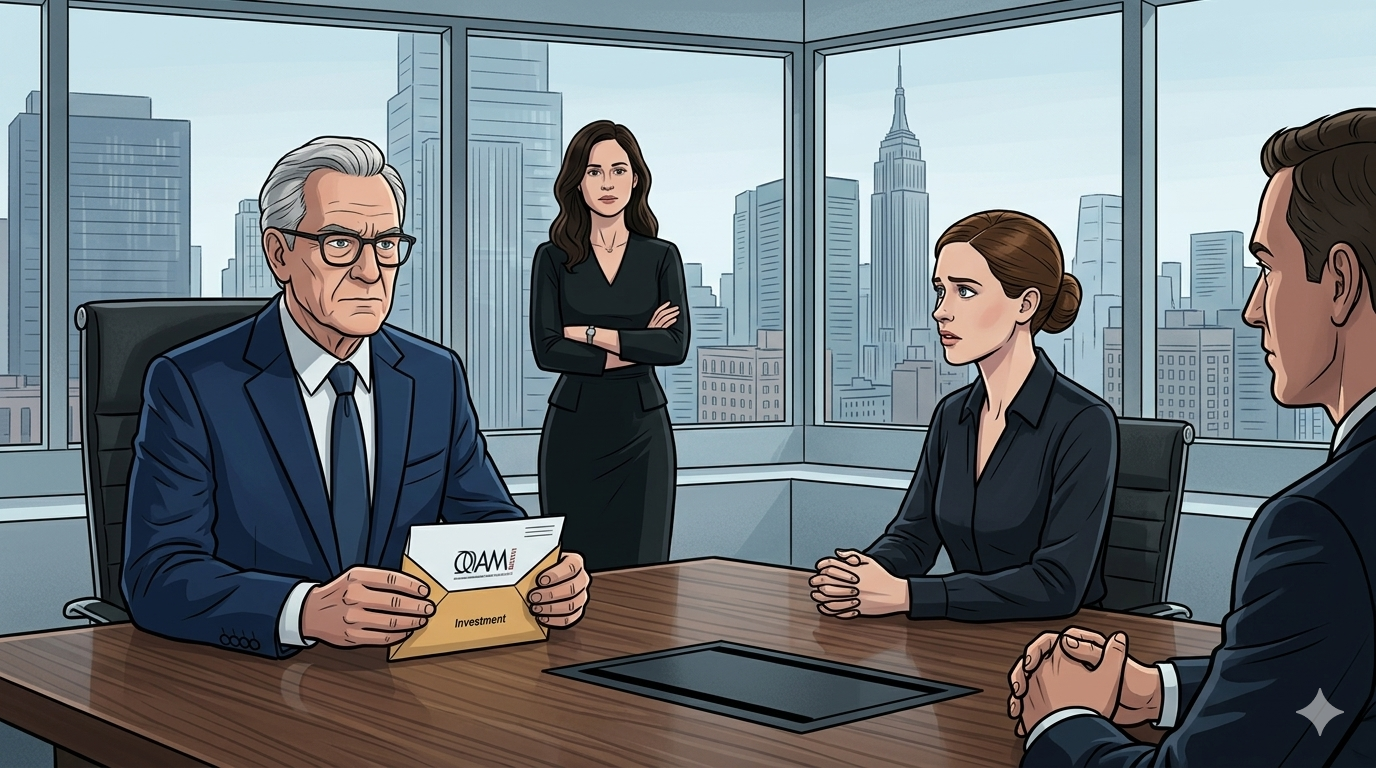
“Then explain this,” I said quietly.
I held up the medical records too.
“He found out when Alyssa needed a bone marrow transplant. He wasn’t a match. That’s when he ordered the test. He knew for twelve years.”
Vivian tried to pivot, fast.
“He raised her. He loved her. Legally she’s still entitled—”
“Mrs. Harper,” Martin cut in, “or rather Ms. Vivian Shaw, since your divorce from William Harper was finalized five years ago…”
Vivian went pale.
“You have no legal standing here,” Martin said. “And Alyssa’s claim depends entirely on biological relation, per the explicit terms of the will.”
Vivian turned to Alyssa, suddenly pleading, trying to pull her back into line.
But Alyssa’s voice came out thin, almost broken:
“You knew.”
She stared at Vivian like she was seeing her for the first time.
“You knew I wasn’t his daughter… my whole life.”
Vivian rushed to explain—protecting her, loving her, doing what a mother had to do.
But Alyssa shook, rage and grief colliding.
“You spent my entire childhood telling me Candace was illegitimate. You made me treat her like she was less. You convinced me I was the real daughter…”
Her voice cracked.
“And the whole time… it was me.”
She looked at me then, eyes red.
“Did you know?” she asked.
“I found out two days ago,” I said. “Dad knew for twelve years. He stayed silent because he didn’t want to destroy you.”
I paused, then looked at Vivian.
“But she knew from the beginning.”
Martin cleared his throat.
“Mr. Harper left a letter to be read at this time.”
And when my father’s words filled that room—about the lies, the control, the hidden letters, the way he watched over me from afar—Vivian stood alone, exposed, with no one left to hide behind.
Alyssa sank into her chair, hollow.
“I don’t know who I am anymore,” she whispered.
And I didn’t feel victory.
I felt the strange, aching clarity of the truth:
My sister tried to use a DNA test to erase me.
But when the envelope opened, it wasn’t my identity that collapsed.
It was hers.
The silence in Martin Chen’s office didn’t feel like victory. It felt like the quiet that follows a long winter storm, when the wind finally dies down and you’re left standing in the wreckage, unsure whether to rebuild or walk away.
Alyssa’s whisper hung in the air: *I don’t know who I am anymore.*
I didn’t offer comfort. I didn’t reach for her hand. Eighteen years of being treated as the stray, the accident, the ghost at their holiday table, doesn’t evaporate in a single afternoon. But I didn’t turn away, either. I watched her shoulders shake, watched Vivian’s carefully constructed world fracture into jagged pieces, and felt something heavy settle in my chest. It wasn’t triumph. It was grief. Grief for the father who loved me from behind locked doors. Grief for the sister who was raised to hate me. Grief for the eighteen years I spent running from a home that never truly wanted me, while my father kept every letter I wrote and every photograph I left behind.
Martin closed the folder gently. “I’ll begin the transfer process. The estate, the trusts, the property… it all moves to you, Candace. As Mr. Harper’s sole biological heir.”
Vivian stood abruptly, her chair scraping against the hardwood. Her face was pale, her lips pressed into a thin line. “This isn’t over,” she said, voice trembling but sharp. “You think a piece of paper erases eighteen years of life? You think you can just walk into my home and take everything?”
“It was never your home,” I said quietly. “Not legally. Not anymore.”
She flinched. For the first time, the mask slipped completely. I saw the woman beneath: not a villain, not a monster, just a person who had built her survival on a foundation of lies, and now watched it collapse.
She didn’t argue. She didn’t cry. She turned, walked out of the office, and didn’t look back.
Alyssa followed slowly, her steps unsteady. At the door, she paused. “I’m sorry,” she said, so softly I almost didn’t catch it. Then she left.
Martin exhaled, rubbing his temples. “I’ll handle the legal filings. The divorce decree, the estate transfer, the property deed. Vivian has no claim, but she’s already been moving assets quietly since his stroke. I’ll audit everything. It might take time.”
“I’m not in a hurry,” I said. “Thank you, Martin. For keeping his wishes. For keeping the truth.”
He nodded. “He made me swear. Said if anything happened to him, I was to protect what was yours. Even if it meant waiting.”
When I stepped out into the Chicago afternoon, the city felt different. Louder, sharper, but somehow lighter. I drove back to the Ohio mansion not as a guest, not as an intruder, but as someone returning to a place that finally belonged to me.
—
The house was quiet when I arrived. Too quiet. Vivian’s car was gone. Alyssa’s things were still in her room, but the bed was neatly made, the closet half-empty. I walked through the halls slowly, listening to the floorboards creak, remembering the years I’d spent tiptoeing through this place, trying to make myself smaller, quieter, less noticeable.
Rosa met me in the kitchen, wiping her hands on a dish towel. Her eyes were red-rimmed but steady. “They left this morning,” she said. “Your stepmother packed three suitcases. Alyssa only took a duffel. Didn’t say where they were going.”
I nodded. “Did Vivian take anything that wasn’t hers?”
“Some jewelry. The silver. A few paintings. I documented it. Mr. Chen said to keep a list.”
I smiled faintly. “Rosa, you’ve been the only constant in this house.”
She reached out, her calloused fingers briefly covering mine. “Your father loved you, Candace. He just didn’t know how to show it until it was almost too late. Don’t let his silence make you forget that.”
That night, I slept in my father’s study. Not out of sentiment, but because it felt like the only room in the house that held the truth. I spread the documents across the desk: the twelve-year-old DNA test, the medical records, the divorce decree, the trust papers, the stack of my teenage letters, and the unfinished note he’d written two months before he died.
I read it again, slowly. Every sentence heavy with regret. Every word a apology I hadn’t known I was waiting for.
*…I was a coward. I let fear and grief blind me. I let Vivian convince me that distance would protect you both. I was wrong. You were my daughter from the moment you were born, and I should have fought for you every day. I’m sorry I didn’t. I’m sorry it took me so long to see the truth. If you’re reading this, it means I finally found the courage to leave you what I should have given you all along: the truth. And the freedom to choose what comes next.*
I traced the shaky handwriting with my fingertip. Tears fell, but they weren’t bitter. They were clean. Like washing a wound that had festered for decades.
—
The weeks that followed were a blur of lawyers, accountants, and quiet reckonings. Martin Chen moved swiftly. The estate was valued, audited, and transferred. Vivian’s financial maneuvering during William’s final months was flagged: unauthorized withdrawals, altered investment accounts, hidden offshore transfers. Martin filed a civil claim for restitution. She wouldn’t go to prison, but she’d lose everything she’d tried to steal. The law moves slowly, but it moves precisely.
Alyssa didn’t call. Didn’t text. But three weeks after the reading, a letter arrived at my Chicago office. No return address. Just my name in familiar, careful handwriting.
I opened it at my desk, the city humming outside my glass windows.
*Candace,*
*I don’t know how to start. I’ve spent three weeks sitting in a cheap apartment in Columbus, staring at the ceiling, trying to figure out who I am when the name I’ve carried my whole life was built on a lie. Mom won’t talk to me. She says I betrayed her by doubting her. I told her she betrayed me by raising me to hate you. We haven’t spoken since.*
*I know I was cruel to you. I know I laughed when you didn’t belong in the photos. I know I pushed you out because I was afraid if I didn’t, I’d have to face the fact that I didn’t feel like I belonged either. I was raised on performance. On being the perfect daughter. I didn’t know how to be anything else.*
*I’m not asking for forgiveness. I don’t deserve it yet. But I want to know the truth. All of it. If you’re willing to meet, I’ll be at the diner off Route 12 near the old county library. Thursday, 10 AM. If you don’t come, I’ll understand. I’ll still be trying to figure out who I am without the Harper name.*
*Alyssa*
I read it three times. Folded it carefully. Put it in my desk drawer.
I went.
—
She was sitting in a corner booth, wearing a plain sweater, her hair pulled back, no makeup. She looked younger. Tired. Real.
I slid into the seat across from her. The diner smelled like coffee and burnt toast. A jukebox played something faint and old.
“You came,” she said.
“I said I would,” I replied.
She looked down at her hands. “I don’t know what to call myself anymore. I’m not a Harper. I’m not Vivian’s daughter in any way that matters. I’m just… me. And I don’t know who that is.”
“You’re the girl who grew up believing she had to be perfect to be loved,” I said gently. “That’s a heavy thing to carry. It doesn’t excuse what you did to me. But it explains it.”
She nodded, eyes glistening. “Do you hate me?”
“No,” I said. “I pity the version of you that was raised to see me as a threat instead of a sister. But pity isn’t love. And we don’t have to pretend to be something we’re not.”
She swallowed hard. “What happens now?”
“Now you live your own life. Not hers. Not his. Yours. If you want, I’ll help you find your biological father. The medical records might have clues. Or we can leave it alone. It’s your choice. And I’ll respect it.”
She looked up, surprised. “You’d help me?”
“I don’t have to. But my father spent his last years watching me from a distance because he was too afraid to step into the light. I won’t make the same mistake with you.”
She reached across the table, hesitated, then pulled back. “Thank you.”
We talked for two hours. Not about the past. Not about the will. About books. About Chicago. About the strange, quiet freedom of starting over. When I left, she didn’t hug me. But she didn’t look away, either.
Progress.
—
Back in Ohio, the house began to change. I sold the expensive furniture Vivian had bought to maintain appearances. I donated the silver, the designer dresses, the staged art. I kept the things that mattered: my father’s books, the grandfather clock in the hall, the piano my mother used to play before she died.
Rosa stayed on. Not as a housekeeper, but as a partner. I offered her a salary, benefits, a voice in how the estate would be used. She cried when I handed her the contract. “Your father always said you had his eyes,” she told me. “Now I see you have his heart, too.”
My grandmother Eleanor moved into the east wing. She was seventy-eight, sharp as ever, and refused to be treated like fragile glass. “I spent twenty years watching that woman treat you like dirt,” she said, unpacking her suitcase. “I’m not leaving until this house feels like a home again. And I’m not letting you do it alone.”
So we worked. Together.
I turned the estate into something my father would have recognized, even if he never said it out loud. The consulting grants he’d secretly funded? They became the Harper Foundation for Women in Leadership. The third-floor study? Opened as an archive and reading room. The grounds? Maintained, but shared. I hosted community events, scholarship interviews, quiet retreats for women rebuilding their lives after betrayal, loss, or systemic exclusion.
I didn’t do it for him. I did it for me. For the girl who packed a single suitcase at seventeen and told herself she wouldn’t be missed.
I was missed. Just not by the people who mattered.
—
Six months after the will reading, Vivian’s legal case concluded. She was ordered to repay $1.2 million in misappropriated funds. The house she’d tried to claim was legally mine. The social circle she’d cultivated abandoned her. She moved to a small apartment in Florida, where no one knew her name. I received one letter from her. No apology. Just a list of excuses, half-truths, and thinly veiled attempts to guilt me into sending money.
I didn’t respond. I filed it away. Some wounds don’t need closure. They just need to stop bleeding.
Alyssa found her biological father. He was a retired teacher in Michigan, living quietly with his wife, unaware he had a daughter. They met. It wasn’t a fairy tale. He was kind, confused, guilty. She was angry, grieving, searching. But they chose to try. She sent me a photo: two strangers sitting on a porch, holding coffee cups, not quite smiling, but not looking away either.
I taped it to the inside of my desk drawer.
—
One year to the day after my father’s death, I drove to the cemetery. The sky was overcast, the air crisp. I knelt beside his headstone: *William Harper. Beloved Father.*
I placed a single envelope on the grass. Inside was the rest of the letter he’d never finished.
I’d written it myself.
*Dad,*
*I’m not angry anymore. I’m just tired of carrying the weight of what you didn’t say. But I see you now. I see the man who kept every letter. Who tracked my career from afar. Who set up a trust so I’d never have to wonder if I was worthy. Who stayed silent because he was afraid of breaking something he couldn’t fix.*
*I forgive you. Not because you deserved it. But because I deserve peace.*
*I’m turning the house into a place where women don’t have to earn their belonging. Where truth matters more than performance. Where silence isn’t mistaken for love.*
*I’m not your ghost anymore. I’m your daughter.*
*And I’m finally home.*
I stood, brushed the dirt from my knees, and walked back to my car. The road ahead wasn’t perfect. It wouldn’t be. But for the first time in thirty-six years, I wasn’t walking away from it.
I was walking into it.
—
The years that followed weren’t dramatic. They were quiet. They were steady. They were mine.
I kept the foundation running. Hired staff. Funded scholarships. Partnered with universities, shelters, legal aid organizations. Rosa became its director. Eleanor served on the advisory board until she passed peacefully at eighty-two, surrounded by people who loved her, not just her name.
Alyssa and I never became sisters in the traditional sense. We were too scarred, too shaped by different truths. But we became something real: allies. Confidantes. Two women who survived the same house, learned different lessons, and chose to build separate lives without burning the bridge between them.
We met once a year. Coffee. No expectations. Just honesty.
Vivian faded from our orbit. I heard rumors: financial struggles, failed relationships, a quiet life of regret. I didn’t seek her out. I didn’t need to. Some stories end not with confrontation, but with distance. And distance, when chosen intentionally, is its own kind of justice.
I never married. Not because I didn’t want love, but because I finally understood that family isn’t something you’re given. It’s something you choose. And I chose myself. I chose the women who lifted me up. I chose the work that mattered. I chose the quiet dignity of a life built on truth instead of performance.
Sometimes, on rainy afternoons, I’d climb the stairs to the third floor. The study still smelled like old paper and cedar. The photographs of me were gone, replaced by archives of foundation recipients, scholarship essays, letters from women who said we saved their careers, their dignity, their futures.
I’d sit at the desk. Open a notebook. Write.
Not for him. Not for her. For me.
And when I finally closed the book, I’d whisper the words he never got to say out loud:
*You were always enough.*
Then I’d turn off the light, lock the door, and walk downstairs into a house that finally, quietly, belonged to me.