
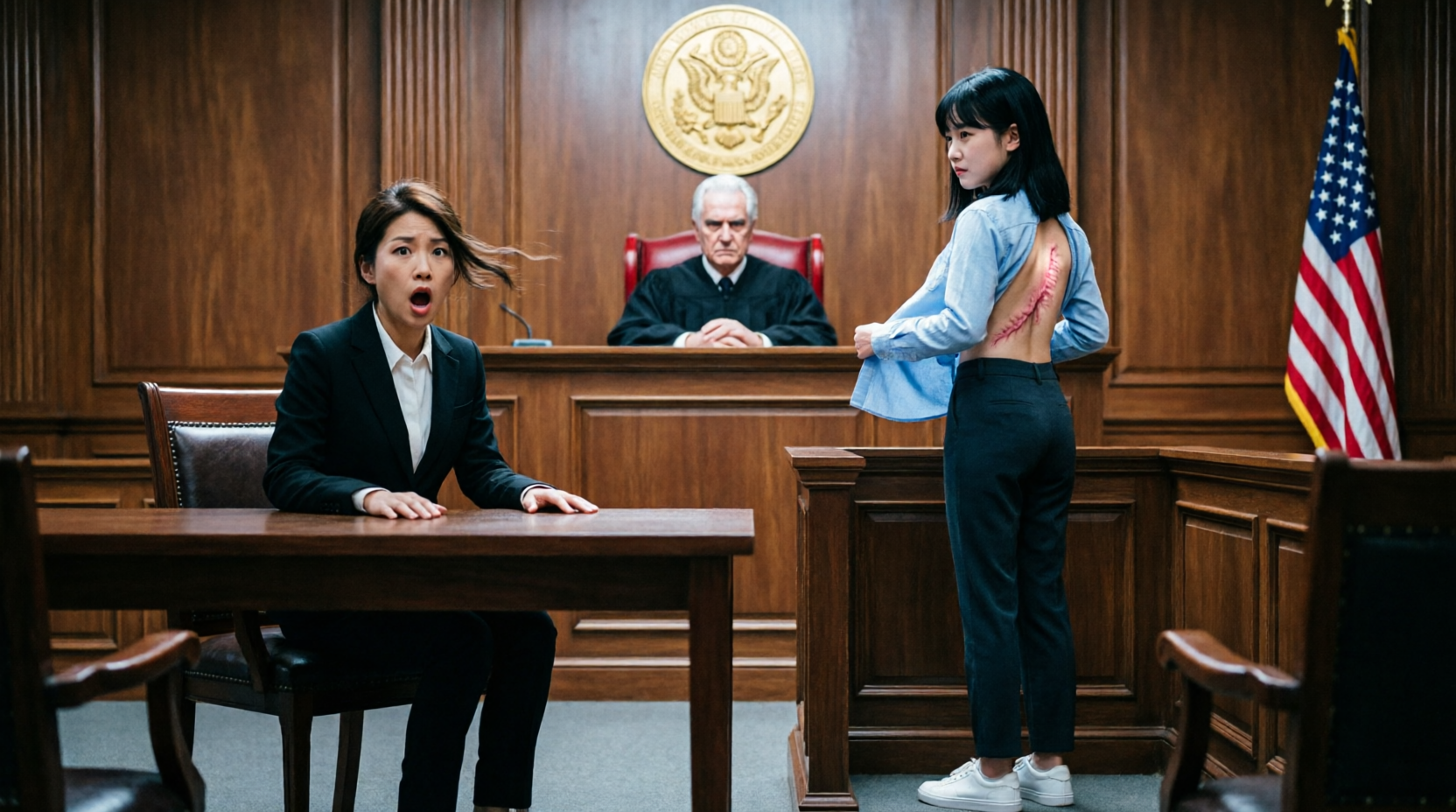
“That could be anything,” she said loudly. “People have scars all the time. That proves nothing.”
Judge Keane raised a hand and the gesture silenced my mother more effectively than any words could.
“Miss Harper Caldwell,” the judge said, turning her gaze to me, “what injury is that?”
“Shrapnel,” I said, in a clinical, objective tone. “Left shoulder. Debrided at Bagram Airfield Base.
I have a titanium plate there. I can provide the medical record and the line-of-duty report.”
Travis made a sound—half snort, half laugh. “So you Googled military words,” he said.
My attorney, Samuel Park, stood and handed the clerk a sealed packet. “Your Honor, certified copies,” he said.
“DD-214 discharge form, deployment orders, award citations, and Department of Veterans Affairs verification.
We also subpoenaed an Army records custodian to appear by video.”
Judge Keane flipped through the first pages calmly, slowing when she reached the discharge form with my name and dates clearly printed.
“Mrs. Caldwell,” she said to my mother without looking up, “have you seen these documents before?”
My mother’s gaze darted, quick and desperate, to Travis. “They can be faked,” she said. “She’s always been dramatic. Always known how to manipulate people.”
Judge Keane’s tone sharpened. “Perjury is not dramatic. Answer the question. Have you seen these documents?”
“No,” my mother snapped.
The evidence that couldn’t be explained away
The Army records custodian appeared on the courtroom monitor via videoconference: a woman in dress uniform who confirmed my service history with irrefutable official databases.
A Veterans Affairs advisor verified that I was enrolled and identified in their system as the same person listed in the military record.
Dr. Collins submitted a sworn affidavit confirming the plate in my shoulder and imaging showing embedded fragments: medical evidence that couldn’t be refuted by a mother’s denial.
My mother kept shaking her head as if denial could somehow rewrite government stamps and official signatures.
Then Travis made his mistake. He leaned forward and said loudly, his voice echoing through the room:
“If she’s a real veteran, why doesn’t she show her medals? Because she doesn’t have any.”
I swallowed. The truth was complicated. I did have medals—several.
But I had never displayed them, never worn them at town events, never used them as proof of anything. Because my service wasn’t about performance.
It was about the people I had treated, the skills I had developed, the weight I had carried.
“Because I didn’t serve for your entertainment,” I said quietly.
Judge Keane held my gaze for a long moment, and something in her expression shifted. It wasn’t anger, exactly. It was recognition.
Then she turned back to my mother. “Mrs. Caldwell, you swore under oath that your daughter never served in the military. You also alleged she committed fraud against your family. On what evidence do you base those statements?”
My mother straightened, suddenly regaining confidence. “The neighbors saw her here,” she said. “I have proof she was working at the restaurant during the years she claims she was serving.”
Mr. Park stood again, his expression changed. He had been waiting for this.
“Your Honor, Exhibit 12,” he said. With the judge’s approval, he handed the clerk a set of dated, timestamped payroll records.
“These are Mrs. Caldwell’s employment records from that very restaurant, during those very years.”
My mother’s jaw tightened.
“Mrs. Caldwell,” Mr. Park continued in a careful, measured voice, “isn’t it true that you used your daughter’s Social Security number to pick up extra shifts in her name while she was serving?
That you filed tax returns in her name for income you earned?”
My mother’s head snapped up. “Lies!”
But Mr. Park pressed a remote, and the monitor displayed a W-2 form with my name clearly printed at the top.
Below it was my mother’s address and a direct-deposit routing number linked to her checking account—verified by subpoena and confirmed by the bank.
In that moment, I understood the lawsuit had never been about honor or family reputation. It had always been about control and money.
The courtroom murmured. My relatives shifted in their seats. Travis went completely still.
Judge Keane’s tone turned cold and sharp as a blade.
“Mrs. Caldwell, did you file a false tax return using your daughter’s identity?”
My mother opened her mouth and then closed it. Her eyes locked on Travis as if searching for permission or an escape route.
Travis, apparently panicked, blurted the words that changed everything:
“She told me to! She said if we made Harper look like a liar, Grandpa’s money would stay in the family!”
The words hung in the courtroom like something that could not be undone, could not be retracted, could not be reframed into anything other than what they were: a confession.
When the punishment arrived without ceremony………………………….