
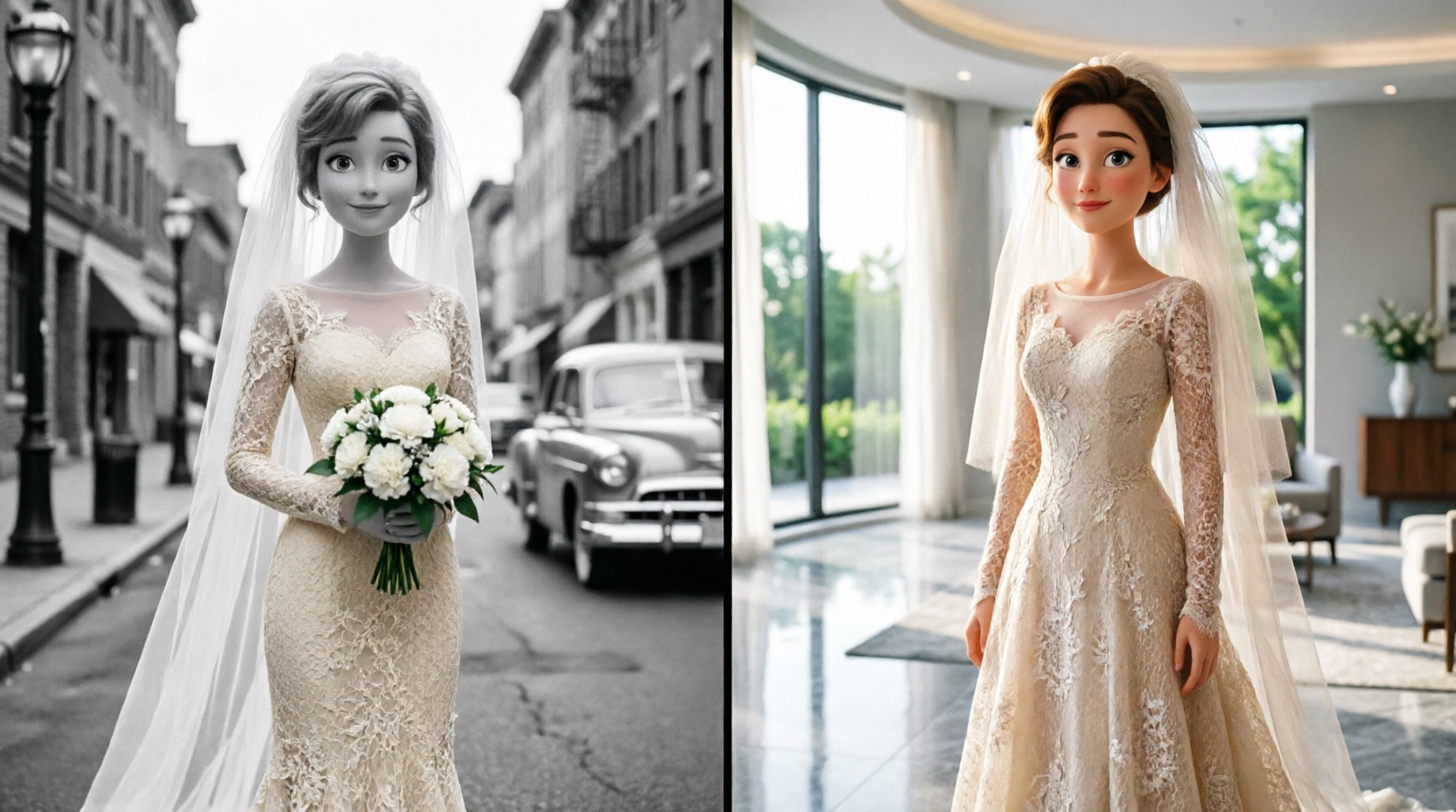
Grandma Rose used to say that certain truths only settle properly once you’re old enough to hold them.
She told me that on the night I turned eighteen. We were sitting on her front porch in rural Pennsylvania, the kind of late-summer night when the air hangs heavy and the cicadas scream like they’re trying to shake the sky apart. The porch light glowed soft yellow, catching the silver in her hair and the fine lines at the corners of her eyes.
She had carried out an old garment bag that evening. It was beige canvas, frayed along the zipper seam, the kind of thing you’d expect to find in the back of a closet untouched for decades.
Without ceremony—but with reverence—she unzipped it.
The wedding dress slid into view like something lifted from a dream.
Ivory silk. High lace collar. Long sleeves with delicate buttons at the wrist. A row of tiny pearls trailing down the back like a constellation.
“You’ll wear this someday, darling,” she said.
I laughed. “Grandma, this dress is sixty years old.”
“It’s timeless,” she replied, her tone firm in a way that ended arguments before they started. “Promise me something, Catherine.”
I rolled my eyes, smiling. “What?”
“When the time comes, you’ll alter it yourself. With your own hands. And you’ll wear it.”
“Why?”
“So you’ll know I was there.”
The way she said it—quiet, steady—settled somewhere deep in my chest.
I promised her.
At eighteen, promises feel easy. They float on sentiment. I didn’t understand what she meant by truths settling when you’re grown. I assumed it was just another one of her sayings, tucked between recipes and gardening advice.
Grandma Rose had raised me from the time I was five years old.
My mother died when I was little. I remember hospital smells and the sound of machines, but not her voice. Not clearly. What I knew of her came from photographs and the careful way Grandma would describe her—never too much, never too little.
My father, I was told, left before I was born.
That was the entirety of the story.
I asked once, when I was eight. Just once.
Grandma had been chopping carrots at the kitchen counter. The knife paused mid-slice. Her shoulders stiffened almost imperceptibly.
“He wasn’t ready to be a father,” she said.
“Did he know about me?”
Her gaze drifted to the window, to the maple tree outside.
“He left before you were born,” she repeated gently.
That was where the conversation ended.
I learned quickly that pressing further caused something to tighten inside her. And since she was my entire world—my stability, my safety—I stopped asking.
I grew up in her small white house with green shutters and a vegetable garden out back. She packed my lunches. Sat through every school recital. Taught me to sew when I was ten, guiding my fingers carefully along seams.
“Fabric remembers how it’s treated,” she used to say. “Be patient with it.”
When I left for college in Pittsburgh, I cried harder than I had at my high school graduation. She stood straight-backed in her sensible shoes and waved until my car turned the corner.
I came home every weekend that first semester.
Then every other weekend.
Eventually, life in the city filled in around me—classes, work, friendships—but I still drove home at least once a month. Because home wasn’t the house.
Home was wherever Grandma Rose sat at the kitchen table with her tea.
When Tyler proposed, I was twenty-eight.
We were standing on Mount Washington overlooking the skyline at sunset, the rivers below catching streaks of gold and pink. He got down on one knee with shaking hands and asked me to marry him.
I said yes before he finished the sentence.
Grandma cried when we told her.
Real tears—shining, unchecked—while she laughed and clapped her hands.
“I’ve been waiting for this since the day I held you,” she said.
She insisted on seeing the ring three separate times.
Wedding planning began immediately. Grandma had opinions on everything—flowers, music, cake flavors. She called me almost every day.
“Have you thought about the lace?”
“Don’t forget something old, something new.”
“You still have the dress, don’t you?”
Four months later, she was gone.
A heart attack.
Quick, the doctor said. Peaceful. In her sleep.
There is nothing peaceful about losing the person who anchored your entire existence.
I sat at her kitchen table for hours after the funeral, staring at the indentation in the wallpaper where her clock had hung for decades.
Without her, the house felt like a stage after the lights had gone dark.
A week later, I returned to sort through her belongings.
I worked methodically. The kitchen first—carefully wrapping dishes, boxing up recipe cards. The living room next, folding blankets that still carried the faint scent of lavender.
Her bedroom was the hardest.
In the back of the closet, behind winter coats and a dusty box of Christmas ornaments, I found the garment bag.
My chest tightened.
I unzipped it slowly.
The dress looked exactly as it had that night on the porch. Ivory silk. Lace collar. Pearl buttons.
I pressed my face into the fabric and breathed in what remained of her perfume.
The promise came back to me as clearly as if she’d whispered it in my ear.
You’ll alter it with your own hands.
I decided then.
No matter what adjustments it needed, I would wear this dress.
I set up at her kitchen table with her old sewing tin—metal, dented, decorated with faded roses. Inside were neatly wound spools of thread, a silver thimble, sharp shears worn smooth by decades of use.
Working with aged silk demands patience. The fabric was delicate but strong, like something that had survived more than it revealed.
About twenty minutes into adjusting the lining of the bodice, my fingers brushed something firm beneath the fabric.
A small lump.
I frowned.
I pressed gently.
It crinkled.
Paper.
My heart stuttered.
I fetched the seam ripper and carefully loosened the stitches along the inner lining. The thread was finer than the rest—meticulous.
A hidden pocket emerged.
Inside was a folded envelope, yellowed with time.
On the front, in Grandma’s familiar looping script:
For Catherine.
My hands began shaking before I even opened it.
The first line knocked the air from my lungs.
My dear granddaughter, I knew it would be you who found this. I’ve kept this secret for thirty years, and I am so deeply sorry. Forgive me—I am not who you believed me to be.
The world tilted.
I read the letter once.
Then again.
Grandma Rose was not my biological grandmother.
My mother—Elise—had come to work for her as a live-in caregiver after my grandfather died. Elise was young, grieving something of her own, and carrying a secret.
Grandma described her as radiant. Gentle. Sad in a quiet way that made you want to shield her from the world.
One afternoon, years ago, Grandma found Elise’s diary tucked beneath her mattress. She hadn’t meant to pry, she wrote—but a photograph had slipped out.
Elise and Billy.
Laughing.
Billy.
My Uncle Billy.
The man who brought me birthday cards and twenty-dollar bills every year. The man who had lifted me onto his shoulders when I was six. The man whose visits always made Grandma’s hands pause in mid-motion.
The diary entry beneath the photograph read:
I know I’ve done something wrong in loving him. He belongs to someone else. But he doesn’t know about the baby. He left before I knew for sure. And now I don’t know how to carry this alone.
Billy had been married.
He had left the country for work before Elise knew she was pregnant.
He never knew.
Elise never told him.
Five years after I was born, my mother died.
Grandma Rose made a choice.
She told her family that I had been abandoned by unknown parents and that she had chosen to adopt me.
She never told them whose child I actually was.
She raised me as her granddaughter.
She carried the truth alone.
Billy believed I was adopted.
He had no idea I was his daughter.
By the time I reached the end of the letter, my tears had soaked the paper.
Billy still doesn’t know, Grandma wrote. Some truths fit better when you’re grown enough to carry them. I trust you to decide what to do with this one.
I called Tyler from the kitchen floor.
He arrived within forty minutes.
He read the letter in silence. I watched his face shift from confusion to comprehension to something heavy and quiet.
“Billy,” he said finally.
“He’s not my uncle,” I replied. “He’s my father.”
The word felt foreign in my mouth.
Tyler pulled me into his arms.
“Do you want to tell him?” he asked.
I thought of every memory I had of Billy. The way he’d once told me my eyes reminded him of someone. The way Grandma would stiffen slightly when he entered a room.
Not resentment.
Burden.
“Yes,” I said. “I need to see him.”
We drove to his house the next afternoon.
Suburban, tidy, lined with family photos. His wife Diane called out hello from the kitchen. Their daughters’ music drifted down the hallway.
A full life.
Billy opened the door with his usual wide grin.
“Catherine!” He hugged me tight. “I’ve been thinking about you since the funeral.”
We sat in the living room. Coffee was poured. Conversation flowed.
He said, “Your grandmother was the finest woman I’ve ever known.”
My chest tightened.
You have no idea, I thought.
The letter burned in my bag.
I had rehearsed the words in the car.
There’s something you need to know.
Instead, when he looked at me with warmth and affection, I froze.
“I’m glad you’re coming to the wedding,” I said.
“Wouldn’t miss it.”
I swallowed.
“Uncle Billy… would you walk me down the aisle?”
His face softened instantly.
“I would be honored.”
“Thank you, Da—” I caught myself. “Uncle Billy.”
On the drive home, Tyler asked, “Why didn’t you tell him?”
I stared at the passing streetlights.
“Because Grandma spent thirty years making sure I never felt like I didn’t belong. I’m not going to destroy his marriage and his daughters’ world just so I can say the word ‘Dad’ out loud.”
Tyler didn’t argue.
We married in October.
The chapel doors opened. Billy offered me his arm.
Halfway down the aisle, he whispered, “I’m so proud of you.”
You already are, Dad, I thought.
You just don’t know it.
Grandma wasn’t physically there.
But she lived in every pearl button I had sewn back into place.
The letter now rested once again inside the hidden pocket.
Stitched closed.
Some secrets aren’t lies.
They’re love with nowhere else to rest.
Grandma Rose wasn’t my grandmother by blood.
She was something rarer.
She chose me.
Every single day.
Marriage did not quiet the truth.
If anything, it made it louder.
For weeks after the wedding, the letter felt like it had weight. Not paper weight—something heavier. Something that followed me from room to room, pressed against my ribs when I tried to sleep.
Tyler and I moved into a small brick house just outside the city. It had hardwood floors that creaked in winter and a narrow staircase that groaned under hurried footsteps. We painted the bedroom ourselves—soft gray, because we couldn’t agree on anything bolder.
The wedding dress hung in the closet in a new garment bag. I hadn’t had the heart to preserve it yet. The hidden pocket rested against the inside of the bodice, sealed once more with my careful stitches.
I told myself I had made my decision.
But decisions have echoes.
Three weeks after the wedding, Billy invited us to Sunday dinner.
Diane’s lasagna. Garlic bread. The kind of warm domestic ritual that hums with comfort.
I stood in the kitchen beside Diane while she drained pasta. She asked about thank-you cards and honeymoon plans. Her voice was kind. Familiar. She had known me since I was a child.
I looked at her hands—ring still shining after all these years.
Did she deserve to know?
Upstairs, one of Billy’s daughters laughed at something on her phone. The sound floated down the hallway like wind chimes.
Did they?
Billy stepped into the kitchen and clapped a hand on my shoulder. “Catherine, I’ve got something for you.”
He walked into the living room and returned with a small wooden box.
“I meant to give this to you after the service,” he said, rubbing the back of his neck. “But things were… busy.”
He opened the lid.
Inside was a delicate gold locket.
“It was your grandmother’s,” he said. “She asked me to hold onto it years ago. Said I’d know when to pass it along.”
My breath caught.
Inside the locket was a photograph.
Grandma Rose on her wedding day. Young. Radiant.
And beside it—
A faded picture of my mother.
Elise.
I had seen her before in albums, but never this one. She was smiling in this photo. Not the gentle, restrained smile from the framed pictures in Grandma’s hallway.
This was wide. Joyful.
Billy watched my face carefully.
“She was a good woman,” he said quietly.
“You remember her?” I asked.
He nodded. “She worked for my aunt after Uncle Thomas died. We all thought the world of her.”
There was something in his voice I couldn’t quite name.
Affection.
Regret?
“Do you ever think about… what happened?” I asked carefully.
Billy’s jaw tightened slightly. He leaned back against the counter.
“Life’s complicated,” he said. “Sometimes people leave before they understand what they’re leaving behind.”
The words struck like a bell.
Did he know something?
Or was that coincidence?
Tyler squeezed my hand under the table during dinner. A silent anchor.
On the drive home, I stared at the locket in my palm.
“She trusted him,” I said softly.
“Your grandmother?” Tyler asked.
“Yes. She gave him this. She had to know he would eventually give it to me.”
Tyler glanced at me. “Maybe she was preparing you for something.”
“Or maybe she wanted me to see that he loved her too.”
“And you.”
I swallowed.
That night, I dreamed of the porch when I was eighteen. Grandma sitting in her rocking chair, hands folded.
“Some truths,” she repeated in my dream, “don’t disappear just because you stitch them closed.”
I woke with tears on my pillow.
—
Months passed.
Married life settled into rhythm—work, groceries, bills, shared coffee in the mornings.
But the truth did not fade.
Billy began calling more often.
Checking in.
Asking about the house. Offering to help with repairs. Showing up with tools and easy smiles.
One Saturday afternoon, he stood in our backyard fixing a loose fence panel.
“You don’t have to do this,” I told him.
“I know,” he said. “I want to.”
The sun caught the silver at his temples. For the first time, I noticed how much I resembled him.
The shape of his jaw.
The slope of his nose.
Thirty years of resemblance I had never recognized.
“Billy,” I said slowly.
He looked up. “Yeah?”
“Have you ever… regretted anything?”
He laughed softly. “Every adult regrets something, Catherine.”
“I mean something that changed the course of your life.”
His hammer stilled mid-air.
He didn’t look at me immediately.
“There was someone,” he said finally. “A long time ago.”
My pulse roared in my ears.
“She worked for my aunt,” he continued. “It was a mistake. I was already married. I told myself it wasn’t serious.”
He swallowed.
“I left for a job overseas. I thought distance would fix it.”
My breath caught.
“I never saw her again,” he said. “She stopped answering letters.”
Letters.
Grandma had never mentioned letters.
“Do you ever wonder…” I began, my voice barely steady, “if she tried to tell you something?”
Billy met my eyes then.
A flicker of something crossed his face.
Fear.
“Sometimes,” he admitted.
Silence stretched between us.
The fence panel stood repaired, but neither of us moved.
“If she had something to tell me,” he said quietly, “I hope she found peace instead.”
The ache inside me deepened.
“She died,” I said.
He nodded once. “I know.”
There were a thousand words pressing at my throat.
I am your daughter.
You didn’t leave before I was born—you left without knowing.
Grandma carried it for you.
But behind Billy’s eyes, I saw his life.
His wife inside, humming as she cleaned the kitchen.
His daughters upstairs, arguing about music.
A lifetime built on foundations that did not include me.
Or rather—did not know they included me.
“What if the truth hurts more than the silence?” I asked softly.
Billy studied me.
“Sometimes,” he said carefully, “silence protects more people than the truth would.”
The air shifted.
Did he know?
Or was he speaking in generalities?
He stepped closer and rested a hand on my shoulder.
“You’re a good person, Catherine. Your grandmother raised you right.”
My grandmother.
Not his aunt.
My grandmother.
The woman who chose me.
That night, I took the letter from the dress.
I read it again, slower this time.
One paragraph stood out differently than before.
I never told Billy because I was afraid of breaking something that could not be mended. But if he ever learns the truth, I pray he understands that my silence was never about shame. It was about protecting a child who deserved certainty.
Certainty.
That was what she had given me.
I had never doubted where I belonged.
Not once.
Until now.
Tyler found me sitting on the bedroom floor, the letter spread across my lap.
“You’re going to tell him,” he said gently.
“I don’t know.”
“You’re not protecting him anymore. You’re protecting yourself.”
I looked up. “From what?”
“From losing the version of him you have.”
The words struck true.
If I told Billy, everything would change.
He might feel guilt.
He might feel joy.
He might feel resentment that thirty years were lost.
And Diane—
Would she see me as family?
Or as proof of betrayal?
I folded the letter carefully.
“I don’t want to blow apart their lives,” I whispered.
“And your life?” Tyler asked. “Doesn’t it deserve the whole truth too?”
I thought about the aisle. The way Billy’s hand trembled slightly as he walked me forward.
I thought about his whisper.
I’m so proud of you.
He meant it.
Not knowing why it mattered more than he could imagine.
“Maybe some truths,” I said slowly, “aren’t meant to be detonated. Maybe they’re meant to be carried.”
Tyler didn’t respond immediately.
“Carried by who?” he asked finally.
I pressed the letter to my chest.
“By me.”
—
Winter came early that year.
Billy slipped on ice in December and fractured his wrist. Tyler and I drove to the hospital when Diane called.
I sat beside Billy’s bed while a nurse adjusted his sling.
“You always did worry too much,” he teased.
“You always did walk too fast,” I shot back.
He smiled.
For a moment, it felt simple.
Family.
Uncomplicated.
But as visiting hours ended and Diane stepped out to take a call, Billy looked at me with unusual seriousness.
“Catherine,” he said.
“Yes?”
“There’s something I’ve carried for years.”
My heart slammed.
“I was young,” he continued. “Stupid. I hurt someone who didn’t deserve it.”
I held my breath.
“I sometimes wonder,” he said slowly, “if she had a harder life because of me.”
The room seemed to tilt.
“You don’t know that,” I said carefully.
“No,” he admitted. “I don’t.”
He looked at me for a long moment.
“You ever feel like you’re missing a piece of your story?” he asked.
Every day, I thought.
“Sometimes,” I said.
He nodded.
“Maybe some pieces stay missing for a reason.”
There it was again.
The echo of Grandma’s words.
Some truths fit better when you’re grown enough to carry them.
Was he giving me permission?
Or asking for it?
Diane returned, and the moment dissolved.
On the drive home, snow began to fall.
Tyler reached for my hand.
“You almost told him,” he said.
“I know.”
“Are you going to?”
I watched the snow blur against the windshield.
“I don’t think this story belongs only to me,” I said quietly. “It belongs to everyone in that house.”
“And?”
“And I’m not sure I have the right to rewrite it.”
Tyler squeezed my fingers.
“Whatever you choose,” he said, “make sure it’s not fear deciding.”
Fear.
Love.
Protection.
Silence.
They all wear similar faces.
That night, I took the dress from the closet.
I ran my fingers along the bodice, feeling for the hidden pocket.
The stitches were strong.
But thread, no matter how careful, can always be undone.
I sat on the edge of the bed and stared at the fabric.
The truth was still there.
Waiting.
By spring, the silence had grown roots.
It wasn’t loud. It didn’t scream at me in grocery stores or interrupt meetings at work. Instead, it settled into the quiet spaces—the pause before sleep, the moment before answering Billy’s calls, the split second when someone referred to him as my uncle.
Every time I heard it, something inside me shifted.
Uncle.
Father.
The difference was only two syllables.
But it carried thirty years of unspoken truth.
In March, Diane invited me to lunch.
Just the two of us.
We met at a small café downtown—white brick walls, chalkboard menus, the smell of espresso thick in the air. It was the kind of place she liked. Orderly. Predictable.
She hugged me warmly when I arrived.
“I’ve been meaning to do this,” she said. “Just us.”
We ordered salads and iced tea. For a while, the conversation stayed safely on surface ground—wedding photos, Billy’s wrist healing nicely, her daughters’ college plans.
Then she set her fork down.
“Catherine,” she said gently, “can I ask you something?”
My stomach tightened.
“Of course.”
“Have you ever felt like Billy sees you differently?”
The question landed hard.
“What do you mean?” I asked carefully.
She hesitated. “It’s not a bad thing. It’s just… sometimes the way he looks at you. It’s like he’s searching for something.”
The café noise faded around me.
“What kind of something?”
She studied her glass of water before answering.
“Like he’s trying to solve a puzzle he can’t quite name.”
My pulse hammered.
“Does that bother you?” I asked.
Diane met my eyes.
“No,” she said slowly. “But I’ve known my husband a long time. And there are parts of his past he never talks about.”
Elise.
The letters.
The affair.
“I found an old photograph once,” she continued quietly. “Tucked inside a book in the attic. A woman I didn’t recognize. He told me it was someone who worked for his aunt years ago.”
My breath caught.
“He said it was nothing,” Diane added. “And I chose to believe him.”
There it was.
Choice.
She had chosen her version of the truth.
Just as Grandma had.
Just as I was.
“Do you think,” Diane asked carefully, “that there are things we don’t ask because we’re afraid of the answers?”
I felt like the floor had tilted.
“Yes,” I said honestly.
She nodded.
“I think so too.”
We finished lunch gently, almost tenderly, as though something fragile had passed between us.
When I got home, I sat at the kitchen table and stared at the locket.
Two women inside.
One who chose me.
One who carried me.
Both tied to the same man.
A week later, Billy called unexpectedly.
“Can you come by?” he asked. “Just you.”
The tone in his voice was different.
Serious.
Tyler squeezed my hand before I left. “Whatever happens,” he said, “you’re not alone.”
Billy’s house felt quieter than usual when I arrived. Diane was out. The girls were at school.
He led me into the living room and closed the door.
“I’ve been thinking,” he said.
My throat went dry.
“About what?”
“About your grandmother.”
Relief and disappointment tangled in my chest.
“She was the strongest person I’ve ever known,” he continued. “Stronger than I understood at the time.”
I waited.
“There were things she never said,” he added. “But sometimes silence says more than words.”
He walked to the bookshelf and pulled down a worn envelope.
“I found this when I was cleaning out some old boxes.”
He handed it to me.
My hands trembled as I opened it.
Inside was a letter.
Not Grandma’s handwriting.
Elise’s.
The date was just months before I was born.
Billy,
I don’t know if I’ll ever send this. I don’t even know if you’d read it if I did. I won’t ask anything of you. You made your choice long before I knew what I was carrying. But I need you to know that what we had wasn’t nothing. It mattered to me. And whatever happens next, I will carry it with grace.
There was no mention of pregnancy.
No mention of me.
But the timeline—
Billy watched my face carefully.
“She never sent it,” he said. “My aunt must have kept it.”
Grandma.
“She found it after Elise died,” he added. “She gave it to me years later. Told me some things aren’t meant to be reopened.”
My heart pounded.
“What did you do?” I asked.
“I kept it,” he admitted. “I’ve read it a hundred times.”
He sat down heavily.
“I was selfish back then,” he said quietly. “I convinced myself it was harmless. That no one would get hurt.”
I wanted to scream that someone had.
Instead, I asked, “If there had been more—if she had needed you—would you have wanted to know?”
The room stilled.
Billy’s eyes met mine.
“Yes,” he said without hesitation. “I would have wanted to know.”
The words cut deeper than I expected.
“Even if it changed everything?” I pressed.
He swallowed.
“Yes.”
Silence stretched.
The letter from Grandma burned in my purse.
This was the moment.
The cleanest opening I would ever get.
I could tell him.
I could place both letters on the coffee table and let thirty years unravel.
Billy leaned forward slightly.
“Why are you asking me this, Catherine?”
Because I’m your daughter.
Because she did need you.
Because you did leave something behind.
The words rose to my lips.
And then—
Diane’s car pulled into the driveway.
The sound shattered the moment.
Billy leaned back, exhaling slowly.
“Forget it,” he said. “I’m just an old man revisiting ghosts.”
He stood as the front door opened.
I stayed seated.
Ghosts.
Was that what I was?
That night, I didn’t sleep.
I lay awake beside Tyler, replaying every second.
“Yes. I would have wanted to know.”
The certainty in Billy’s voice echoed relentlessly.
“Why didn’t you tell him?” Tyler asked quietly in the dark.
“Because it would change Diane’s life too.”
“And?”
“And she didn’t choose this.”
Tyler turned toward me.
“Neither did you.”
The truth of that sat heavy.
“I don’t want to be the reason their daughters question their father,” I whispered.
“Do you think they’d stop loving him?”
“I don’t know.”
“And if you found out tomorrow that you had a child you never knew about?”
I turned to face him.
“I would want them in my life,” he said softly.
The room was silent except for the ticking clock.
“I don’t know how to detonate something this big,” I admitted.
“Maybe it’s not detonation,” Tyler said. “Maybe it’s integration.”
Integration.
The idea felt both terrifying and impossible.
In early May, Billy invited Tyler and me to a small family barbecue.
It was warm. The kind of golden afternoon that makes everything feel possible.
Billy stood at the grill, laughing. Diane arranged salads on the picnic table. Their daughters teased each other over music choices.
I watched them all.
This wasn’t a fragile house of cards.
This was a family built over decades.
Strong.
Resilient.
But built without knowing one foundational truth.
At one point, Billy handed me a plate.
“You’ve always felt like mine,” he said casually. “Even when you were little.”
The world narrowed.
“What do you mean?” I asked carefully.
He shrugged. “Hard to explain. Just a feeling.”
He looked almost embarrassed.
“Maybe it’s because I was around when you were born,” he added. “Feels like I watched you grow.”
My heart slammed.
“You were there?” I whispered.
He nodded slowly. “At the hospital. Your grandmother called me. Said Elise wasn’t doing well.”
I felt dizzy.
“Why didn’t she tell me that?”
He gave a sad smile. “Your grandmother carried more than she shared.”
The weight of it all pressed in.
I stepped away from the table, walking toward the edge of the yard where the maple tree cast long shadows.
Tyler joined me.
“You’re shaking,” he said quietly.
“He was there,” I whispered. “When I was born.”
Tyler exhaled slowly.
“Catherine,” he said, turning me toward him, “how long are you going to carry this alone?”
I looked back at the table.
Billy was laughing at something Diane said. His daughters leaned into him easily.
“I don’t want to hurt them,” I said.
“And you?”
The question lingered.
I had spent thirty years believing my father abandoned me knowingly.
That wasn’t true.
He left before he knew.
And now he had told me he would have wanted to know.
The truth wasn’t only destructive.
It was redemptive.
It could give him something back.
A daughter.
But it could take something too.
Certainty.
Trust.
Maybe even peace.
As the sun dipped lower, Billy caught my eye across the yard.
He smiled.
The same unguarded grin he had always had.
The smile of a man who didn’t know he was missing a piece of himself.
My phone buzzed in my pocket.
A calendar reminder.
Mother’s birthday.
I stared at the screen.
Elise.
The woman who carried me in silence.
Grandma who chose me.
Billy who never knew.
Three lives tied together by one hidden truth.
I took a deep breath.
The letter felt heavier than ever.
And for the first time since finding it, I realized something undeniable:
Silence was no longer protection.
It was postponement.
I turned to Tyler.
“I can’t keep this forever,” I said.
He nodded once.
The maple leaves rustled overhead.
Billy called out, “Catherine! Come try the burgers before they disappear!”
I looked at him.
At the life he had built.
At the space beside him that had always been mine without anyone naming it.
The next move was mine.
And whatever I chose would echo for the rest of our lives.
I didn’t tell him at the barbecue.
But something had shifted.
Silence no longer felt noble. It felt unfinished.
That night, after we got home, I took the wedding dress out of the closet again.
Tyler leaned against the bedroom doorway, watching me carefully.
I unzipped the garment bag and lifted the ivory silk into the light. The pearls caught the lamp’s glow. My fingers found the seam beneath the bodice where the hidden pocket rested.
“For thirty years,” I said softly, “Grandma carried this alone.”
Tyler stepped closer. “And you don’t want to carry it for the next thirty.”
I shook my head.
“She trusted me to decide. Not to bury it.”
I sat down at the edge of the bed and retrieved the sewing tin from the nightstand. The same dented tin. I’d brought it home after cleaning out her house. It felt right that it stayed with me.
Thread remembers how it’s treated.
So do people.
I slid the seam ripper carefully under the stitches.
The thread gave way.
The pocket opened.
The letter rested exactly where I’d left it.
I unfolded it slowly.
I read it again.
But this time, I didn’t cry.
This time, I read it like a woman—not a granddaughter—trying to understand another woman’s choice.
Grandma hadn’t written from fear alone.
She had written from calculation.
She had weighed love against damage.
And she had chosen stability for a child.
But I wasn’t that child anymore.
“I’m going to tell him,” I said quietly.
Tyler exhaled, not in relief—but in respect.
“When?” he asked.
“Soon. Before I lose my nerve.”
Two days later, I called Billy.
“Can we meet?” I asked. “Just you and me.”
He paused for half a second.
“Of course,” he said. “Everything okay?”
“Yes,” I replied. “I just need to talk.”
We met at the small park near his house. The one with the walking trail that loops around a shallow pond. Ducks drifted lazily across the water. It was late afternoon. The air carried the first warmth of early summer.
Billy arrived in jeans and a navy windbreaker. He smiled when he saw me—but the smile didn’t fully reach his eyes.
He sensed something.
We walked side by side for a few minutes without speaking.
Finally, he said, “You look like your grandmother when you’re thinking too hard.”
I almost laughed.
“That’s fitting,” I said.
We reached a bench overlooking the pond. I stopped walking.
“Billy,” I began.
He turned toward me, attentive.
“I need you to listen. And I need you not to interrupt until I’m finished.”
His expression shifted instantly.
Serious. Focused.
“Okay,” he said.
My hands were trembling. I pressed them together to steady them.
“I found something when I altered Grandma’s wedding dress,” I said.
He frowned slightly.
“A letter,” I continued. “She sewed it into the lining. She knew I’d be the one to find it.”
Billy didn’t move.
“She told me something she never told anyone else.”
The wind stirred the surface of the pond.
“About my mother.”
His jaw tightened.
“About you.”
There it was.
The line crossed.
He went very still.
“What about me?” he asked quietly.
I reached into my bag and pulled out the folded letter.
“She wasn’t my grandmother by blood,” I said. “Elise worked for her.”
He nodded slowly. “I know that.”
“She found Elise’s diary after she died.”
Billy’s breathing changed.
“A photograph,” I continued. “Of you and my mother.”
His face drained of color.
“And an entry. About a man she loved. A man who left before she knew she was pregnant.”
The silence that followed felt endless.
“I’m going to finish,” I whispered.
He swallowed and nodded.
“You left for work overseas before she knew for sure. She didn’t tell you. She didn’t send the letters. And when she died, Grandma made a choice. She told everyone I was adopted. She never told you the truth.”
Billy’s lips parted, but no words came.
I forced myself to say it clearly.
“I’m not your niece.”
The wind moved through the trees.
“I’m your daughter.”
The word hung between us like something physical.
Billy blinked.
Once.
Twice.
He looked at me—really looked at me.
The slope of my nose. The shape of my eyes. The familiar line of my jaw.
His hand went to his mouth.
“No,” he breathed.
I held his gaze.
“Yes.”
He stood abruptly, pacing two steps away, then back again.
“No,” he repeated, shaking his head. “She would have told me. Elise would have—”
“She didn’t know when you left,” I said gently. “She found out after.”
His eyes filled suddenly.
“I would have come back,” he said hoarsely. “I would have—”
“I know,” I said.
His head snapped toward me.
“You don’t know that,” he insisted.
“You told me,” I said quietly. “You said you would have wanted to know.”
He stared at me.
Memory clicked behind his eyes.
The hospital.
The fence repair.
The letters.
The questions I had asked.
“You knew,” he whispered.
“Since October.”
His knees seemed to weaken. He sat heavily on the bench.
For a long moment, neither of us spoke.
The world carried on around us. Ducks gliding. Children laughing in the distance.
Finally, he looked at me again.
“How long?” he asked.
“I was born in April,” I said softly. “You were at the hospital. Grandma called you.”
His face crumpled.
“I held you,” he said faintly.
I nodded.
Tears spilled down his cheeks. He didn’t wipe them away.
“I left,” he whispered. “I left you.”
“You didn’t know,” I said firmly.
“But I left her.”
“Yes.”
The truth sat between us—not sharp, not explosive—but undeniable.
He leaned forward, elbows on his knees, hands clasped together as if bracing himself.
“Does Diane know?” he asked.
“No.”
“My girls?”
“No.”
“Does anyone else?”
“Tyler.”
He nodded slowly.
“Grandma didn’t tell you because she wanted me to have certainty,” I continued. “She didn’t want me to grow up as the result of an affair. She wanted me to belong.”
Billy closed his eyes.
“She was protecting you,” he said.
“Yes.”
“And now?”
I took a deep breath.
“Now I’m grown. And I don’t need protection. I need truth.”
He looked at me again.
“You’re sure?” he asked. “About this?”
I handed him the letter.
He read it.
Slowly.
Carefully.
His hands trembled.
When he finished, he stared at the last line for a long time.
Some truths fit better when you’re grown enough to carry them.
He folded the letter with reverence.
“She trusted you,” he said.
“She trusted both of us.”
The question lingered unspoken.
What now?
Billy’s voice was barely steady when he asked it.
“Why tell me?”
I met his eyes.
“Because you deserved to know. And because I deserve to stop pretending you’re only my uncle.”
The word only felt inadequate now.
He stood again—but this time he didn’t pace.
He stepped toward me slowly.
“May I?” he asked.
I nodded.
He wrapped his arms around me.
Not the easy, familiar hug from holidays.
This was different.
Tighter.
Careful.
As if he were holding something fragile and irreplaceable.
“My God,” he whispered. “My God.”
I felt his shoulders shake.
“I’m so sorry,” he said into my hair.
“You didn’t abandon me,” I said. “You were kept in the dark.”
“I should have fought harder for her,” he said brokenly.
“That’s between you and her,” I replied gently. “Not me.”
He pulled back slightly, looking at me with something I had never seen before.
Recognition.
“You look like me,” he said softly.
“I know.”
He let out a shaky breath that was half laugh, half sob.
“I don’t know how to do this,” he admitted.
“Neither do I.”
We sat back down on the bench.
The sun dipped lower across the water.
“What about Diane?” he asked finally.
“That’s your conversation to have,” I said.
“And if this breaks my marriage?”
I didn’t look away.
“Then the truth was already inside it. We just named it.”
He nodded slowly.
“And my girls?”
“They deserve honesty too. Eventually.”
He leaned back, staring at the sky.
“I missed your first steps,” he said quietly.
“Yes.”
“Your first day of school.”
“Yes.”
“Your wedding.”
I smiled faintly.
“No. You walked me down the aisle.”
His throat worked as he swallowed.
“God,” he breathed.
We sat in silence again.
But this silence was different.
Not protective.
Not postponing.
Just real.
Finally, Billy turned to me.
“Will you give me time?” he asked.
“Yes.”
“I need to think. I need to talk to Diane.”
“I understand.”
He nodded.
“And Catherine?”
“Yes?”
“I am proud of you.”
The words landed differently now.
Not whispered down an aisle.
Not casual.
Intentional.
“I know,” I said.
For the first time in my life, I meant it fully.
When I got home, Tyler was waiting in the kitchen.
He stood the moment he saw my face.
“Well?” he asked.
I stepped into his arms.
“I told him.”
He held me tightly.
“How did he take it?”
I closed my eyes.
“Like a man who just found out he’s been missing something precious his entire life.”
Tyler kissed my forehead.
“Whatever comes next,” he said, “it will be built on truth.”
I nodded.
But truth, I knew, was only the beginning.
The next part would be harder.
Because truth doesn’t just reveal.
It reshapes.
And Billy had a family to tell.
Billy didn’t call for three days.
They were the longest three days of my life.
I went to work. I answered emails. I made dinner with Tyler and pretended we were discussing normal things—paint colors for the guest room, a leak under the sink, weekend plans.
But every quiet second was filled with one question:
What was happening in that house?
On the fourth evening, my phone rang.
Billy’s name lit up the screen.
Tyler looked at me from across the couch. I nodded once and answered.
“Hi.”
His voice was steady—but only just.
“Can you come over?” he asked. “Diane and the girls are here. We need to talk.”
The words hit like a sudden drop in an elevator.
“Now?” I asked.
“Yes.”
“I’ll be there.”
Tyler stood immediately. “I’m coming.”
I hesitated, then nodded. “Okay.”
The drive felt shorter than it ever had before. Or maybe time had just stopped making sense.
When we pulled into the driveway, the porch light was on.
All the lights were on.
I took a deep breath before ringing the bell.
Diane opened the door.
Her eyes were red.
Not furious.
Not cold.
Red.
She stepped aside without speaking.
We walked into the living room.
Billy stood near the fireplace. His daughters sat on the couch, pale and tight-lipped.
The air felt thick.
Billy cleared his throat.
“I told them,” he said quietly.
My heart hammered.
Diane’s gaze met mine. It wasn’t accusatory.
It was searching.
“You’re my daughter,” Billy said aloud, as if he were still convincing himself it was real.
The word didn’t feel foreign anymore.
It felt fragile.
One of his daughters—Emma, the older one—spoke first.
“So… Dad cheated,” she said flatly.
Billy flinched.
“Yes,” he said. “A long time ago. Before either of you were born.”
“And you never knew?” the younger one, Claire, asked me.
“No,” I said softly. “He didn’t.”
Claire looked at Billy. “You really didn’t?”
“No,” he said. “I swear to you.”
Diane inhaled shakily.
“She showed me the letter,” Billy added. “From Aunt Rose. And the diary.”
Diane nodded slowly.
“I read it,” she said quietly.
The room went silent.
I braced for anger.
For accusation.
For the sound of something breaking.
Instead, Diane looked at me and asked the one question I hadn’t prepared for.
“Why didn’t you tell us sooner?”
There was no hostility in her tone.
Only hurt.
“I found out after Grandma died,” I said. “Right before the wedding. I didn’t want to destroy your family.”
Emma crossed her arms.
“You didn’t destroy it,” she muttered. “Dad did that thirty years ago.”
Billy lowered his head.
Claire looked between us all.
“So what now?” she asked.
No one answered immediately.
Because there wasn’t a script for this.
Diane finally stood.
She walked toward me slowly.
For a terrifying second, I thought she might slap me.
Instead, she stopped a few feet away.
“You’ve been in our lives since you were five,” she said quietly. “You spent holidays here. Birthday dinners. Barbecues.”
I nodded.
“You’re not an intruder,” she said. “You’re… already here.”
My throat tightened.
“I don’t know what this looks like yet,” she continued. “And I’m angry. I’m hurt. Not at you. At him.”
She didn’t look at Billy.
“But this isn’t your fault.”
The words nearly buckled my knees.
Emma stood up next.
“So that makes you our sister,” she said, her tone cautious but curious.
Technically, yes.
Emotionally?
That was still unfolding.
“If you want me to be,” I said gently.
Claire let out a breath that almost sounded like a laugh.
“This is insane,” she said. “But also… kind of obvious.”
We all looked at her.
“You look exactly like Dad,” she added.
For the first time that night, someone almost smiled.
Billy stepped forward then.
“I don’t expect forgiveness tonight,” he said. “From any of you. But I’m not walking away from this.”
He looked at me.
“I lost thirty years. I won’t lose another day.”
Diane closed her eyes briefly.
“Then we don’t walk away,” she said carefully. “We work through it.”
The strength in her voice startled me.
This wasn’t a fragile family.
It was a tested one.
And now it was being tested again.
The first few weeks were awkward.
There were long conversations. Hard ones.
Billy and Diane began counseling together.
Emma asked me questions about my childhood—what Grandma was like, whether I ever suspected.
Claire wanted to see baby photos.
We moved slowly.
Carefully.
No one tried to pretend it was simple.
But no one shut the door either.
One evening, Diane invited me over alone.
We sat at the same kitchen table where I’d once stood helping her drain pasta.
“I need to ask you something,” she said.
“Okay.”
“Do you resent me?”
The question stunned me.
“No,” I said immediately. “You didn’t know.”
She nodded slowly.
“And I need you to know something too,” she added. “I’m not threatened by you.”
I blinked.
“You’re not the affair,” she said plainly. “You’re the result of two people who made a mistake.”
The clarity in her voice steadied something in me.
“I’m sorry,” I said quietly.
“For what?”
“For existing in a way that hurts you.”
She shook her head firmly.
“Don’t apologize for being born.”
The words echoed something Grandma had once said to me when I was ten and feeling guilty for asking too many questions.
You don’t apologize for taking up space in the world, darling.
Thread remembers how it’s treated.
So do people.
Billy came by our house one Saturday afternoon alone.
He stood awkwardly in the doorway at first.
“Is it okay if I come in?” he asked.
It was the first time he’d ever asked that question.
“Yes,” I said softly.
We sat at the kitchen table.
He looked around, absorbing pieces of my life.
“I missed all of this,” he said quietly.
“You didn’t know.”
“I should have.”
“You couldn’t have.”
He rubbed his hands together, nervous.
“I don’t want to overstep,” he said. “But I’d like to try. To be in your life as… whatever you’re comfortable with.”
I studied him.
The man who had unknowingly left.
The man who had unknowingly returned.
“What does that look like?” I asked.
“I don’t know yet,” he admitted. “But I want to learn.”
I let the silence stretch before answering.
“You can start by not calling yourself my uncle anymore.”
His breath caught.
“Okay,” he said carefully.
“Dad.”
The word felt new.
Raw.
But right.
He covered his face briefly, overwhelmed.
“I don’t deserve that,” he whispered.
“Maybe not,” I said gently. “But it’s still true.”
Summer deepened.
Family dinners resumed, different but not broken.
Emma introduced me to her boyfriend as her sister without hesitation.
Claire texted me memes at midnight.
Diane still had quiet days—but she faced them head-on.
Billy showed up. Consistently.
Not dramatically.
Not to overcompensate.
Just present.
One afternoon, he asked if he could see the dress.
I brought it out carefully.
He ran his fingers over the lace.
“She wore this when she married Uncle Thomas,” he murmured.
“And she stitched a secret into it,” I said.
He nodded.
“May I?” he asked, gesturing toward the lining.
I handed him the letter.
He read it again—this time without shock.
Only gratitude.
“She saved us,” he said quietly.
“Yes.”
“She saved me from knowing too late.”
I looked at him.
“You didn’t know too late.”
He met my eyes.
“No,” he said. “I didn’t.”
On the first anniversary of our wedding, I visited Grandma’s grave.
The air was cool, early October again.
Tyler stood beside me, his hand steady in mine.
I placed a small bouquet of white roses at the headstone.
“I told him,” I said softly.
The wind moved through the trees.
“He knows,” I continued. “They all do.”
I knelt, brushing leaves away from the stone.
“You were right,” I whispered. “Some truths fit better when you’re grown.”
I stood slowly.
“I don’t think what you did was cowardice,” I added. “I think it was love.”
The world didn’t shift.
No sign appeared.
But something inside me settled.
Not because everything was perfect.
Not because no one got hurt.
But because the truth was no longer hiding in a seam.
It was living.
Breathing.
Rebuilding.
Billy stood a few steps back, giving me space.
When I finished, he approached.
“She was remarkable,” he said softly.
“She chose me,” I replied.
He nodded.
“And now,” he added carefully, “I choose you too.”
There it was.
Not obligation.
Not guilt.
Choice.
The rarest thing of all.
I took his arm as we walked back toward the car.
The same way I had down the aisle.
Only this time, neither of us was pretending.
The dress hangs in my closet still.
The pocket remains—but it’s empty now.
The letter rests in a wooden box on my nightstand.
Not hidden.
Not stitched away.
Some secrets are love with nowhere else to rest.
But some truths, when finally spoken, become something stronger than silence ever was.
They become foundation.
And this time, it’s built on both blood and choice.
Grandma Rose wasn’t my grandmother by blood.
She was something rarer.
She chose me.
And now, finally, so did he.