
The waiter set the leather folder in front of me as carefully as if he were presenting dessert.
I remember the shine of the brass button on his cuff.
The soft jazz in the room.
The smell of butter and rosemary from the plates being cleared around me.
I remember all of it because shock has a strange way of sharpening the world.
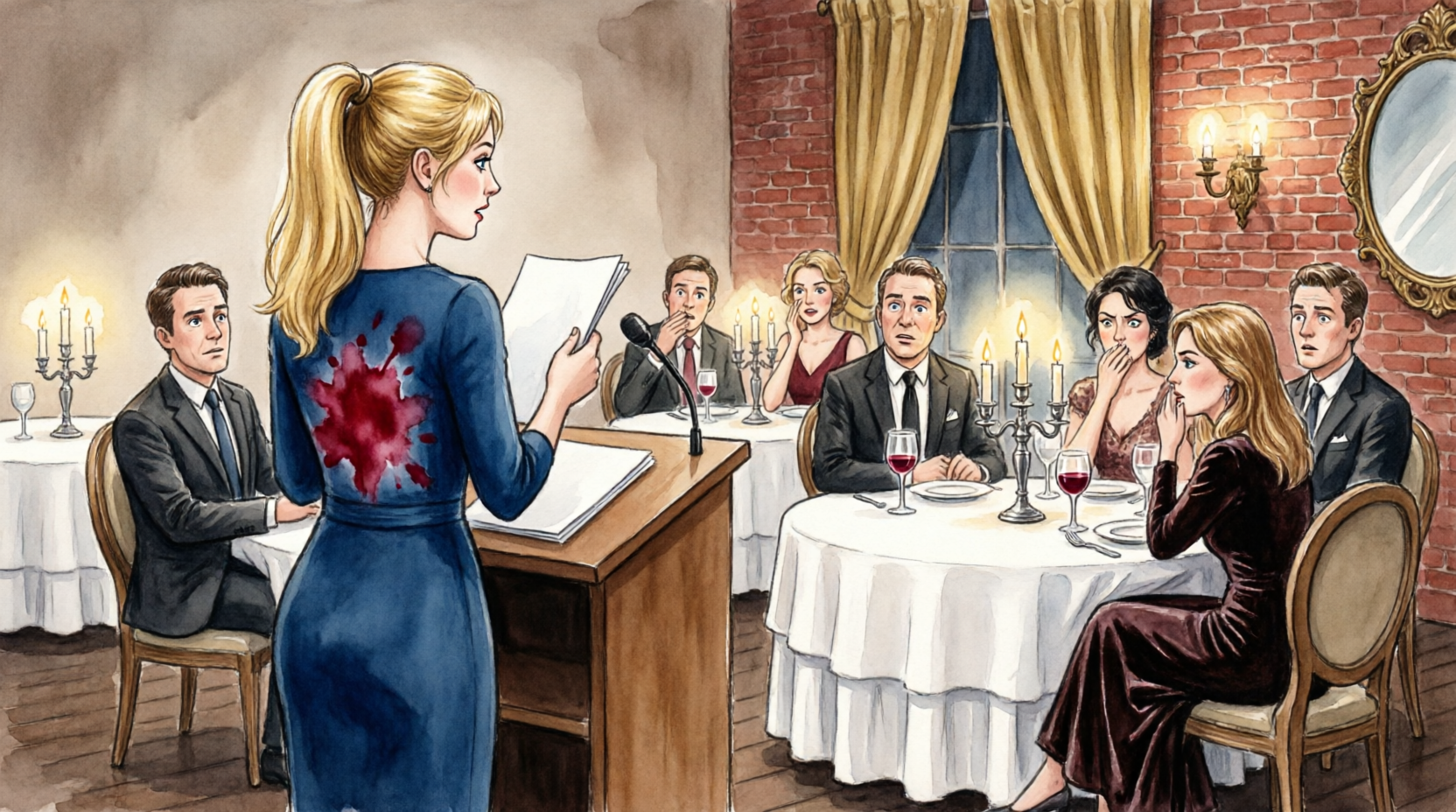
One second I was sitting at the bar in a navy dress stained with red wine, trying to disappear with whatever dignity I had left, and the next I was staring at a bill for $5,980 charged to my name as if humiliating me in front of thirty people still was not enough.
Across the room, my adoptive mother, Melissa Brooks, lifted her glass in my direction with a smile so small most people would have missed it.
I did not miss it.
My cousin Chloe had her phone angled toward me.
Ethan was watching too, waiting for my face to crack.
Victor, my adoptive father and my late father’s younger brother, did what he always did when things became ugly.
He lowered his eyes and let it happen.
So I paid.
I did not ask a question.
I did not make a scene.
My hand did not even shake when I pulled my card from my purse.
Years of living in the Brooks house had taught me how to survive shame by refusing to perform it for other people.
I signed the receipt, slid the pen back into the folder, and stood up from the bar stool prepared to walk out of the restaurant, out of that room, and maybe out of the Brooks family for good.
Then my grandmother spoke.
‘Wait,’ Margaret Brooks said from the head of the table.
Her voice was not loud, but every conversation in the room stopped anyway.
‘She does not leave until all of you hear this.’
There are people who command attention by force and people who command it because everyone in the room knows they should.
Margaret was the second kind.
At eighty, she was tiny, silver-haired, and elegant in a way that had nothing to do with clothing and everything to do with certainty.
She had raised three children through grief and lean years and illness.
She had buried one son, my father, and still somehow remained the warmest person I knew.
When she said the room would wait, the room waited.
The man seated beside her in the gray suit rose with his briefcase in hand.
Melissa’s smile faltered.
That was the first crack.
My name is Colleen Brooks.
I am twenty-nine years old, a registered nurse at Memorial in Savannah, and for most of my life I had believed there was something fundamentally temporary about me.
My parents died when I was five in a crash on I-16, and after the funeral my father’s brother Victor and his wife Melissa took me in.
Within the year they became my legal guardians, and over time most people simply referred to them as my adoptive parents because it was easier and sounded kinder.
What happened inside the house never matched the language outside it.
Melissa specialized in exclusions so subtle they looked accidental from a distance.
She never forgot my birthday, but somehow my gifts were
always practical while Ethan’s and Chloe’s were magical.
She never told me not to sit with them for family photos.
She just handed me the camera.
She never said I was a burden in front of guests.
She said things like, Colleen is so independent, which sounded like praise until you realized it meant nobody was expected to care for me.
The first time I truly understood the architecture of it, I was eight years old.
I stood in the hallway staring at framed portraits of Victor, Melissa, Ethan, and Chloe in matching church clothes, Christmas sweaters, beach outfits.
I asked why I was not in any of them.
Melissa smiled and told me those were family pictures.
I can still remember how gentle she sounded.
That gentleness did more damage than shouting ever could have.
Victor was harder to understand when I was young.
He was not openly cruel.
He was just absent in the exact moments when presence would have required courage.
If Ethan mocked my thrift-store shoes, Victor found a reason to step into the garage.
If Chloe cried over a ruined recital dress, the entire household spun around her.
If I cried, Melissa would say, Let’s not be dramatic, and Victor would stare at a newspaper until the feeling passed.
By the time I was sixteen, I had stopped expecting fairness and started building escape.
I got a job at Publix on Abercorn Street.
I bought my own school supplies, my own shampoo, my own used laptop.
Ethan got a car on his seventeenth birthday.
Chloe got violin lessons, orthodontics, summer camps, SAT tutoring.
When I asked Melissa once if there was money set aside for my college too, she smiled over the kitchen island and said college was not for everyone and that I was good with my hands.
She meant I should learn not to want more.
I wanted more anyway.
I took classes at community college while working evenings.
Then I went to nursing school.
I signed loan papers with a numb hand.
I studied in hospital cafeterias after clinicals and slept in scraps between shifts.
It was brutal and lonely and absolutely mine.
Every step felt like laying bricks across a river without knowing if the path would hold, but it held.
Slowly, a life began to rise under my feet.
The only person who ever treated my place in the family as unquestionable was Margaret.
My grandmother lived in a pale yellow Savannah house with deep porches and camellias along the front walk.
On Sundays she made biscuits from scratch and apple crumble that filled the kitchen with cinnamon and butter.
She kept old photo boxes in the hall closet, and after lunch she would bring them out and tell me stories about my parents.
My mother laughing on Tybee Island because the wind stole her sun hat.
My father dropping a wedding ring into a champagne glass and pretending he had lost it just to watch her panic for half a second.
The way they danced in the kitchen.
The way my father cried when I was born.
No one else talked about them that way.
In the Brooks house, grief had been packed away so neatly it felt suspicious.
At Margaret’s house, my parents were allowed to remain real.
I think that is why Melissa hated my bond with her so much.
Margaret saw through performance.
She saw what Melissa was doing to me and answered the only way she could before she had proof of anything bigger.
She made room for me.
Every week.
Consistently.
Publicly.
Two days before her eightieth birthday dinner, Victor called and said, in that careful voice he used when he wanted to pretend cowardice was diplomacy, that maybe it would be better if I skipped the event.
My presence, he said, might create tension.
That was how he framed my existence.
Not as a daughter.
Not as family.
As weather.
I nearly stayed home.
Then I called Margaret.
‘Are you coming?’ she asked the moment she heard my voice.
‘Victor said maybe it would be better if I didn’t.’
She made a sound in the back of her throat that I had heard only a few times before, usually right before she corrected someone at church who thought age made her soft.
‘You come,’ she said.
‘And you sit with me.’
So I went.
I wore a navy dress I had not touched in two years because I rarely had reason to attend candlelit dinners with people who disliked me.
I wore my mother’s pearl earrings, the one piece of jewelry of hers I still owned.
I brought Margaret a photo album I had spent weeks assembling from copied photographs, hospital snapshots, handwritten recipe cards, church bulletins, and small ordinary moments nobody else in the family would have thought to preserve.
The restaurant sat in one of those old Savannah buildings with high ceilings, low jazz, and enough candlelight to flatter even bad intentions.
Melissa had rented the private dining room and arranged everything the way she liked: white roses, crystal, polished silver, and a seating plan designed to display hierarchy.
Margaret reached for my hand the second she saw me and told me to sit beside her.
Melissa’s smile tightened, but she did not object.
Not yet.
At first the cruelty came in familiar doses.
Melissa introduced Ethan and Chloe to the guests as if the evening were an awards ceremony and they were the worthy heirs of the family story.
When one woman I did not know asked who I was, Melissa laughed softly and said, ‘Colleen grew up around us.’ Around us.
The phrase landed like a small slap.
Not with us.
Not our daughter.
Not even my niece.
Around us, like I had been a decorative inconvenience passing through the edges of their lives.
Later Chloe accidentally spilled red wine down the front of my dress.
Ethan smirked.
Victor examined his napkin.
Margaret squeezed my hand under the table so hard it hurt.
I remember thinking she was angrier than I had ever seen her.
But she said nothing then.
During the main course, Melissa looked directly at me and suggested the bar had some lovely seats where I might be more comfortable.
A few people laughed the nervous laugh of people who sense cruelty but prefer not to name it.
I stood, raised my glass to Margaret, wished her happy birthday, and moved to the bar because I was tired of begging silently for scraps of decency.
That is where I heard Chloe whisper, ‘We just need her
gone before Grandma’s lawyer says anything.’
I had noticed the gray-haired man beside Margaret earlier.
The briefcase at his feet.
The way he spoke very little and observed everything.
After Chloe said the word lawyer, the pieces clicked together too quickly for me to pretend they had not.
Something was coming, and Melissa wanted me out of the room before it happened.
Then came the bill.
Now, standing in the restaurant with every eye on us, I watched Margaret nod once to the man in the gray suit.
He stepped forward and placed his briefcase on the table.
‘My name is Arthur Whitaker,’ he said.
‘I am Mrs.
Brooks’s attorney.’
Melissa let out a brittle little laugh.
‘Margaret, honestly, this is a birthday dinner.’
‘No,’ Margaret said, still seated, her gaze fixed on Melissa.
‘It is my birthday dinner.
That means I decide what kind of evening it becomes.’
Arthur opened the briefcase and withdrew a thick folder.
Margaret turned her head and looked at me.
‘Colleen, come back to the table, honey.’
I do not know what moved me more in that moment: the word honey, the way she said it without hesitation in front of everyone, or the fact that for the first time in my life a member of that family was calling me back instead of sending me away.
I walked slowly to my chair and sat down beside her again.
My paid receipt was still in my hand.
Margaret rested her fingers over mine.
‘For years,’ she said to the room, ‘I have watched people at this table enjoy the comfort of calling themselves family while treating my eldest son’s child as if she were a houseguest who overstayed.
Tonight I am done watching it quietly.’
You could feel the air change.
Melissa’s expression sharpened.
Ethan crossed his arms.
Chloe lowered her phone.
Victor had gone pale.
Arthur removed several photocopied documents and handed them first to Melissa, then Victor, then Ethan and Chloe, and finally to two of the older family friends seated nearby.
‘These are records from the custodial account established after Daniel Brooks and his wife Anna died,’ Arthur said.
Daniel.
Anna.
My parents’ names spoken aloud in that room felt like a door opening.
Arthur continued in the same calm voice.
After the fatal accident, he explained, the insurance payout and wrongful death settlement on behalf of their minor child, Colleen Brooks, were placed into a protected account under the guardianship of Victor Brooks.
The account was intended for my support, education, and adulthood.
I stared at him.
‘What account?’ I asked.
Margaret squeezed my hand harder.
Arthur answered me gently.
‘An account that should have remained largely intact for you.
It did not.’
Melissa stood so abruptly her chair legs scraped the floor.
‘This is absurd.’
Arthur did not even look at her.
He stated the number in a voice so calm it made the room colder: four hundred and twenty-eight thousand dollars.
That was the original amount, including insurance and settlement funds.
Over the following years, he said, those funds were drained through transfers, withdrawals, tuition payments, vehicle purchases, home renovations, and discretionary expenses unrelated to me.
The room went silent in a way that felt physical.
I had to blink twice because suddenly the candlelight blurred.
Four hundred
and twenty-eight thousand dollars.
All those years of secondhand shoes, borrowed textbooks, double shifts, cheap dinners, and loan statements.
All those times I was told there was nothing.
Victor cleared his throat and failed to speak on the first try.
Finally he whispered, ‘It wasn’t like that.’
Arthur turned toward him.
‘Then perhaps you can explain the transfer used for Ethan’s vehicle at seventeen.
Or the one that paid for Chloe’s private summer arts program.
Or the kitchen renovation.
Or the line item marked household reimbursement that appears more than forty times.’
Melissa snapped, ‘She lived in our home.
We fed her.
We raised her.’
Margaret’s voice cut across hers like clean glass.
‘You were entrusted with a child and her future.
You do not get to steal from her and call it generosity.’
Several guests looked down at the papers in their hands with open disbelief.
I recognized one woman from church.
Another from a charity board Melissa loved to posture around.
Their faces had that stunned, almost embarrassed expression people wear when they realize they have been applauding the wrong person for years.
‘I borrowed it,’ Victor said weakly.
‘I meant to put it back.’
‘Over twenty-four years?’ Margaret asked.
He had no answer.
‘And while you were meaning to put it back,’ she continued, ‘Melissa was telling Colleen college was not for everyone.
She was making that girl pay for her own life with money that was already hers.’
Melissa looked around the table as if searching for someone who would rescue her from the facts.
No one moved.
Arthur took out another document.
That afternoon, he said, he had filed for a formal accounting and restitution.
A civil action was being prepared.
Margaret had also executed a new estate plan and revoked all prior fiduciary appointments.
Melissa turned white.
Victor looked at Margaret in a daze.
‘Mother—’
‘No,’ she said.
‘Do not mother me tonight.’
Then she did something I will remember for the rest of my life.
She rose slowly from her chair, took my paid dinner receipt from my hand, and held it up for the room to see.
‘This,’ she said, ‘is what they chose to do on my eightieth birthday.
They tried to humiliate the one person in this family who has carried herself with grace through every insult they handed her.’
She placed the receipt on the table in front of Arthur.
‘I asked him to come because I suspected Melissa would try to push Colleen out before the truth was spoken.
I did not know she would go so far as to charge the whole party to her.
But I am grateful for witnesses.’
Melissa made a sharp, desperate sound.
‘Margaret, you are making a mistake.
You’re letting Colleen poison you against your own family.’
Margaret turned to face her fully.
‘Colleen is my family.’
Not around us.
Not practically.
Not conditionally.
Family.
I wish I could say hearing that erased the ache of the previous twenty-four years.
It did not.
Some wounds are too old to vanish in one sentence.
But something inside me that had been bent for a long time straightened anyway.
Arthur cleared his throat and continued.
Margaret’s revised documents, he said, named me as her medical and financial power of attorney if needed, sole executor
of her estate, and principal beneficiary of the family residence on Jones Street.
She had also created a trust in my parents’ names to fund nursing scholarships at Savannah Technical College.
Margaret looked at Ethan and Chloe then, and there was sadness in her face as much as anger.
She had not left them with nothing, she said.
But what should have been theirs from her would be reduced by what their parents had taken from me.
Fairness had to begin somewhere.
Ethan went red.
‘I didn’t know.’
For the first time that night, I believed someone at that table might actually be telling the truth.
Chloe, however, found her voice first.
‘So this is all because of her? Because Grandma likes her best?’
Arthur answered before Margaret could.
‘It is because your parents stole from a child.’
Chloe shut her mouth.
Dinner ended without dessert.
Nobody wanted cake after that.
Melissa tried once to snatch the documents from Arthur’s hand and he simply stepped back.
Victor asked to speak privately and Margaret told him he could speak to counsel.
Guests left in a hush of perfume, shock, and whispered judgments.
A few came to me at the door and said awkward, guilty things about not knowing.
I did not know what to do with their sympathy, so I nodded and let it pass.
Outside, the Savannah air was damp and warm.
My stained dress clung lightly to my skin.
I stood under a gas lamp and suddenly realized I was shaking so hard I had to grip my purse with both hands.
Margaret came out a minute later with Arthur beside her.
‘I’m sorry,’ she said.
I looked at her, confused.
‘For what?’
‘For seeing enough to suspect and not moving fast enough to stop it sooner.’
I had spent so many years wanting someone in that family to say they were sorry that when it finally happened, it felt almost unbearable.
‘You were the only one who ever made room for me,’ I said.
She touched my cheek.
‘Not enough room.
But that changes now.’
It did change.
Not all at once.
Not cleanly.
Real life almost never gives you a perfect third act.
It gives you paperwork and court dates and bank statements and people revising their lies under oath.
It gives you the ugly work of attaching dollar amounts to years of neglect.
Arthur’s forensic accountant traced the money farther than any of us expected.
The original $428,000 had been drained over time, but the damage did not stop there.
Because Victor had mixed some of those funds into household accounts and investments, restitution calculations became larger once interest and appreciation were considered.
Faced with the documents, Victor stopped pretending everything had been a misunderstanding.
He admitted to borrowing from the account in the early years when his business was strained.
Melissa saw that it worked and kept going.
Private school deposits.
Home improvements.
A beach rental.
Ethan’s car.
Chloe’s camp fees.
Credit card payments.
All of it built on a dead man’s daughter being told to be grateful for leftovers.
The case never went to a full public trial because Arthur did exactly what good attorneys do when the facts are ugly and the other side knows it.
He cornered them with records so complete
there was nowhere dignified to stand.
Victor agreed to a settlement that included the sale of their house, liquidation of an investment account, and a structured restitution plan that returned the equivalent of what had been taken plus a negotiated amount for lost opportunity.
The first payment Arthur made sure reached me was the full restaurant charge, because he said symbolic debts mattered too.
Melissa fought longer, mostly because shame enraged her more than guilt ever did, but even she could not fight signatures, transfers, and guardianship papers bearing Victor’s name.
The social consequences arrived before the legal ones fully ended.
Savannah is too old and too small in the ways that matter.
News did not hit the paper, but it drifted through charity luncheons, church hallways, and porch conversations.
Melissa had spent years curating herself as polished, generous, and refined.
That image did not survive the truth that she had frozen out an orphaned child while spending the child’s money on her own children.
Invitations thinned.
Calls went unanswered.
The people who had laughed at dinner became the people who suddenly remembered appointments elsewhere.
Victor asked to meet me once the settlement was underway.
We met in a quiet coffee shop near Forsyth Park on a rainy morning.
He looked older than I had ever seen him, not because of age exactly, but because there was no place left for him to hide inside his own excuses.
He told me he had loved my father.
He told me he had meant to help.
He told me the first withdrawal had been temporary and the rest followed because every year it became harder to admit what he had done.
I listened.
When he finished, he said, ‘I am sorry, Colleen.’
The old version of me might have grabbed those words like water.
The girl in the hallway.
The teenager buying her own shampoo.
The nursing student eating crackers for dinner because rent was due.
But that girl had grown up.
‘I believe you are sorry now,’ I said.
‘I just don’t think you were sorry when it mattered.’
He cried then, quietly, into a paper napkin.
I did not comfort him.
Forgiveness, I have learned, is not the same thing as restoration.
I chose not to spend my life feeding the fire of what they had done to me.
I also chose not to invite Victor back into any place that required trust.
Both decisions were clean.
Both were mine.
Ethan wrote me a letter three months later.
Not a text.
Not an email.
A real letter on lined paper.
He said he had not known where the money came from, but ignorance did not excuse the way he had treated me.
He enclosed a cashier’s check from the sale of a boat Victor had given him after college and wrote that he did not expect me to answer.
I did not answer right away.
Eventually I sent a short note thanking him for doing one decent thing without asking for applause.
It was the beginning of something small and careful, not sibling closeness, but honesty.
Chloe never apologized.
For a while, that bothered me more than I wanted to admit.
Then one day I realized her silence was simply one more way of telling the truth about herself, and
I stopped waiting.
Margaret moved more slowly after the dinner, though her mind remained sharp as ever.
I began stopping by her house three evenings a week.
Sometimes I brought groceries.
Sometimes I brought charts from work and sat at her kitchen table while she quizzed me about medications as if she were reviewing for an exam.
Sometimes we did nothing except drink tea and look through the old photo album I had given her that night.
One Sunday, about eight months after the dinner, she opened the hall closet and handed me a framed photograph I had never seen before.
It was my parents on the porch of the Jones Street house, my mother visibly pregnant with me, my father leaning in toward her with that half-smile I had inherited around the eyes.
‘I kept this back because it hurt too much to look at,’ she said.
‘It belongs in your home now.’
My home.
The phrase stopped me.
Because by then, for the first time in my life, I actually had one.
Part of the settlement, combined with my own savings and the inheritance advance Margaret insisted on making while she was still alive, allowed me to buy and renovate a small cottage in Savannah with pale blue shutters and enough porch room for two rocking chairs.
It was not grand.
It was not old-money beautiful.
It was mine.
On the hallway wall, I hung that photograph of my parents, another of Margaret at twenty-three in a dress with padded shoulders, and one Arthur helped recover from estate storage: a picture of me at age four sitting on my father’s shoulders at the fair.
I had spent a lifetime being erased from walls.
I cannot explain what it does to a person to finally place herself back on one.
Margaret celebrated her eighty-first birthday at my house.
There were no white roses arranged for performance.
No strategic seating chart.
No private dining room full of people waiting to see who would be humiliated for sport.
I cooked with the windows open while late afternoon light slanted across the kitchen.
Ethan came and brought a lemon pie from a bakery on Habersham.
One of my closest friends from the hospital came too.
Arthur stopped by with flowers and left before dinner because he said birthdays should belong to family.
Before we sat down, Margaret took a slow look around the room.
There were four place settings at the table, though we had only three guests for dinner.
The fourth one held my parents’ framed photograph between two candles.
Not as a shrine.
Not as grief.
As presence.
Margaret noticed and smiled.
When we finally sat, she rested her hand over mine the same way she had in the restaurant a year earlier.
Then she looked at the table and said, very softly, ‘This is what family looks like.’
No one laughed.
No one looked away.
No one asked me to move.
After dinner I washed the plates while Margaret sat on the porch and told Ethan he was cutting the pie too thin.
The evening smelled like jasmine and rain on warm pavement.
Inside, the lights from the dining room glowed gold against the windows, and my parents’ photograph reflected there among the candles as if they had somehow
made it home too.
That was the night I understood something I wish I had known as a child.
Family is not the people who make you audition for a seat at the table.
It is the people who make room, tell the truth, and stay when staying costs them something.
Melissa had spent years trying to teach me I was temporary.
She failed.
I was my parents’ daughter.
I was Margaret’s granddaughter.
I was the woman who paid the bill, stayed standing, and lived long enough to hear the truth spoken in a room that had denied it for years.
And in the home that truth helped build, with the windows open and the table still warm from dinner, my life finally stopped feeling borrowed.
It felt like mine.