
I looked at Jason and saw him at 6 years old in a hospital bed, fever at 104, pneumonia stealing his breath. I had sold my 1978 Ford F-150 to pay that bill. I had worked 50 and 60 hours a week for 3 months to catch us up. I had sat beside his bed and held his small hot hand in mine and whispered a promise he was too sick to hear.
I’ll always take care of you.
No matter what.
Forty years later, that same boy could not look up while his mother tried to show him a photograph.
Tyler returned with the check in a black leather folder.
He set it in the center of the table.
“Whenever you’re ready.”
Amber reached for it first.
Of course she did.
Her eyes moved down the receipt.
Appetizers: $131.
Entrees: $314.
Desserts: $46.
Wine: $142.
Tax and gratuity.
Total: $687.42…………….
I already knew the number would be close to that. I had given Miguel $600 and trusted him to protect Kathy from the humiliation I knew was coming.
Amber set the folder down and looked up at Tyler.
“We’re going to need separate checks.”
Tyler blinked.
“Separate checks?”
“Yes,” Amber said. “Two checks. One for us.”
She gestured between herself and Jason.
“And one for them.”
Her finger pointed across the table toward Kathy.
Tyler looked confused.
“I’m sorry, ma’am. Would you like to split the check evenly, or—”
“No, no,” Amber interrupted. “We’ll pay for our meals. They can pay for theirs.”
Then she laughed lightly.
“Don’t worry. We’re not paying for her.”
The word hung in the air.
Her.
Tyler’s face went red.
“Ma’am, I don’t think—”
Jason cut him off.
“That’s fine,” my son said. “Separate checks. That works.”
Then he nodded.
A single clear nod.
He had heard what Amber said. He had heard the cruelty. He had heard his mother reduced to a burden at the table, and he agreed.
Kathy’s eyes went wide. Then glassy.
A tear slid down her cheek, then another. She did not wipe them away. She did not make a sound. She simply sat there while the tears fell onto the white tablecloth.
I picked up my water glass, took a sip, and set it down carefully.
My hand was steady.
Inside, I was burning.
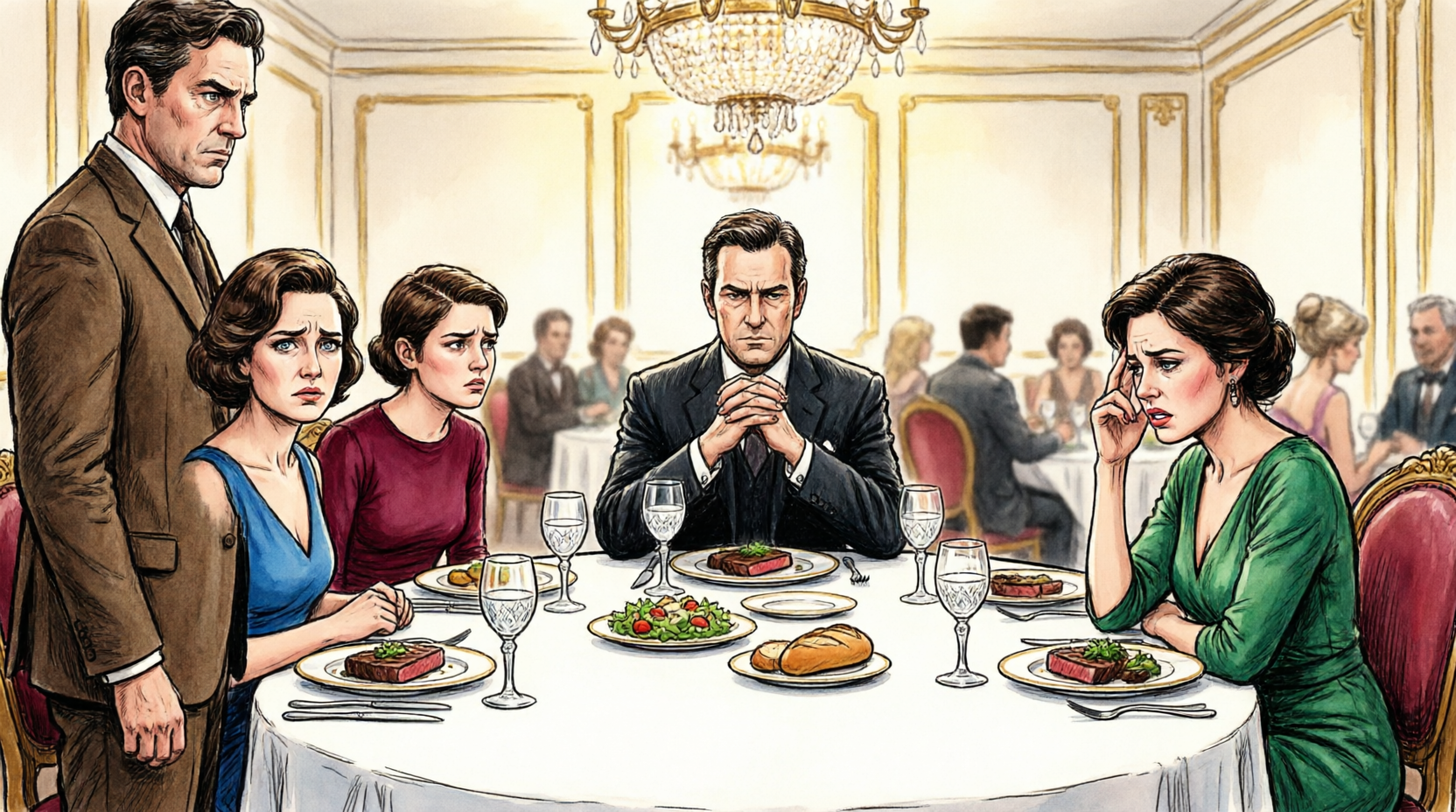
The tables around us had gone quiet. People were staring. The woman in scrubs at table 12 still had her phone pointed directly at us. Other phones were rising now. One by one. Little glowing rectangles capturing what shame looks like when it finally meets witnesses.
Amber leaned back, satisfied.
“I mean, honestly,” she said. “They’re on a fixed income. They understand, right?”
She looked at me, expecting me to nod. To agree that yes, we were old and poor and should be grateful for crumbs.
I reached into my jacket and pulled out the folder.
It was old, soft at the edges, held shut with a fraying elastic band. Inside were papers, documents, evidence. Forty years of truth.
“What’s that?” Amber asked.
I did not answer.
I pushed my chair back. The legs scraped across the floor, loud in the silence.
Then I stood.
Jason finally put his phone down.
“Dad, what are you—”
“$687.42,” I said quietly.
I did not shout. I did not need to. In that silence, my voice carried.
“That’s what this meal cost. That’s what you were about to ask your mother to pay for. Eighteen dollars for soup she couldn’t eat while you ordered $185 steak.”
Jason opened his mouth.
Closed it.
Amber started to speak.
I lifted one hand.
“I’m not finished.”
Before I could open the folder, Miguel appeared beside the table. He moved quickly but not urgently, with the smooth command of someone who understood exactly when a room was about to rupture.
Tyler stepped back with visible relief.
Miguel looked at him first.
“There’s no check.”
Tyler blinked.
“Sir?”
“There’s no check to split,” Miguel said, louder now. “The bill has already been paid.”
Amber’s head snapped up.
“What?”
Jason stared at him.
“What do you mean it’s already been paid?”
Miguel turned to me. His eyes asked permission.
I gave him a small nod.
“Mr. Sullivan paid for this entire meal earlier this afternoon at 3:00 in cash.”
Amber stared at him as if he had spoken another language.
“That doesn’t make sense. Why would—”
“Six hundred dollars,” I said.
Every eye shifted back to me.
“I gave Miguel $600 at 3:00 this afternoon. That was our rent money for May. We’re already 2 months behind. Our landlord started sending eviction notices last week.”
Kathy made a small sound beside me.
I placed one hand gently on her shoulder.
“I took our rent money,” I continued, looking directly at Jason, “and I paid for this dinner in advance because I knew. I knew you would do exactly what you just did.”
No one breathed.
Phones stayed raised.
Jason’s face went gray.
“Dad, I didn’t know—”
“You didn’t know because you didn’t ask. You didn’t wonder. You just assumed we would figure it out.”
Amber found her voice.
“This is ridiculous. You didn’t have to do that. We would have—”
“Paid for her?” I asked.
Amber flinched.
“You just told the waiter, in front of this entire restaurant, that you wouldn’t pay for her.”
I gestured to Kathy.
“You said it loud enough for everyone to hear. And he nodded.”
Jason looked down.
I opened the folder.
The first document was a bank statement, preserved in a plastic sleeve. The date was March 15, 2008. The transaction line was highlighted in yellow.
Transferred to Jason Michael Sullivan.
Amount: $2,000,000.
“Do you remember this?” I asked.
Jason stared at the paper.
“Dad—”
“Do you remember? The day I sat you down in our kitchen and gave you everything your grandparents left me. Every cent. You were 30 years old. You said you would make me proud.”
Kathy was crying openly now.
I set the bank statement down and pulled out the next document.
A hospital bill.
March 10, 2024.
Patient: Catherine Sullivan.
Diabetic ketoacidosis.
Amount due: $12,847.
Status: unpaid.
I laid it beside the transfer record.
Then I pulled out the stack.
Hospital bills. Pharmacy receipts. Insurance denial letters. Collection notices. Three years of paper held together with a binder clip, edges worn from being handled too many times.
“This,” I said, holding the stack where everyone could see, “is what your mother and I have been paying since we gave you everything.”
Amber tried to recover.
“That was 16 years ago. You can’t expect—”
“I can’t expect what?” I asked. “My son to remember that his parents gave him $2 million? That we kept nothing? That we trusted him?”
Her mouth snapped shut.
I looked at Jason.
“Your grandparents worked their whole lives to leave that money. They died in a car accident on I-10. Three weeks later, I signed every cent over to you because I thought you’d do something good with it. Something that mattered.”
My voice caught, but I forced it steady.
“Instead, your mother is dying by inches because we can’t afford to keep her alive. I’m working myself into the ground at 71. We’re about to be evicted. And you ordered $185 steak and didn’t even ask if she was okay.”
Jason put his head in his hands.
Amber sat frozen.
But I was not done.
The next document was about me.
I held up a single page with medical letterhead.
“My legal name is Frank Sullivan,” I said. “Everyone calls me Hank. This is my diagnosis from March 3, 2024.”
I read it aloud.
“Stage 2 prostate cancer. PSA level 47. Recommended treatment: immediate radiation therapy and hormone treatment. Estimated cost: $78,500.”
The restaurant became impossibly still.
“I have cancer,” I said, looking at Jason. “I’ve had it since March 3, 7 days before your mother collapsed. I haven’t treated it. I haven’t told anyone. I haven’t done anything because we didn’t have $78,000. We didn’t have $7,800. We barely had 78.”
Kathy grabbed my arm.
“Hank,” she whispered. “You didn’t tell me.”
“I couldn’t,” I said, turning toward her. “We couldn’t afford your insulin. How was I supposed to tell you we needed another $80,000 for me?”
Jason stood so fast his chair scraped.
“Dad, no. You have to get treatment. You have to.”
“I chose your mother over my own life,” I said. “That’s what you do when you love someone. You sacrifice.”
Then I reached into the folder one last time.
“And this is what the opposite of love looks like.”
Amber’s eyes widened when she saw the printed pages in my hand.
“What is that?”
I held up the first receipt.
“BabyBump.com. Order date March 25, 2024. One silicone pregnancy belly. Fourteen-week size. Price $47.99.”
The crowd gasped.
Amber shot to her feet.
“That’s insane.”
I held up the second page.
“Fake Ultrasound Generator. Upload a photo, add a date, and it creates a medical-looking ultrasound image in 5 minutes.”
I set both pages on the table.
“Your wife is not pregnant,” I told Jason. “She never was.”
Amber’s voice went shrill.
“You’re crazy. You’re making this up because you’re jealous that we’re successful and you’re not.”
She put her hand on her stomach, as if protecting something real.
But when she moved, the silicone belly shifted.
The elastic band had loosened during the meal. As she stood, gesturing in panic, the bottom edge separated from her actual stomach. It slipped just enough for everyone nearby to see the gap.
The prosthetic.
The fake.
The lie.
Someone cried out.
Amber grabbed at it with both hands, trying to smooth her dress, trying to hide what was already visible to 30 or 40 phones.
“She faked it,” someone whispered.
“The pregnancy was fake,” another voice said.
Amber stood with both hands pressed to her stomach, face burning, tears streaming down her cheeks. Not tears of sorrow. Tears of humiliation.
“I can explain,” she said.
“No,” I said quietly. “You can’t.”
I picked up the receipts.
“You told Kathy she was going to be a grandmother. You watched her cry tears of joy. You lied to a sick woman about the one thing that might have comforted her.”
Then I turned to Jason.
“And I heard you.”
His face went gray.
“Eight weeks ago, in the hospital hallway, while your mother was in ICU fighting for her life. I heard you talking to Amber about her $50,000 life insurance policy. I heard you ask how much longer she had. I heard Amber say maybe a year, maybe less. And I heard you agree to wait.”
“No,” Jason whispered. “Dad, no, I didn’t mean—”
“You asked how long your mother had left. Then you agreed to wait for her to die.”
Jason sank back into his chair, his hands covering his face. His shoulders shook with sobs.
“I’m sorry,” he choked. “Dad, I’m so sorry. I don’t know what I was thinking. What have I done?”
Kathy stood beside me.
Her hand found mine.
“We’re leaving,” she said quietly.
Her voice was steady.
Strong.
I put my arm around her waist and supported her as we walked out. Around us, the restaurant remained silent. Some people were crying. Some lowered their phones. Some kept recording.
In the parking lot, Amber came after us, mascara streaked, hair coming loose.
Jason followed at a distance, broken and pale.
Then the last piece of their fantasy cracked open.
Amber shouted something about money, about Derek, about the business failing. Jason stared at her as she admitted that Derek had been stealing from him for years and that she had been trying to keep them afloat.
“How much?” Jason asked.
“Two hundred and 30 thousand,” she snapped. “The business is failing. Derek’s been stealing from you, and I’ve been trying to keep us afloat while you—”
“You never told me,” Jason said hollowly.
“You said your parents were going to leave it to you anyway,” Amber shouted. “The insurance money, the house, everything. Why should they keep it when we need it now?”
There it was.
Plain.
Kathy and I had become obstacles between them and money they had already decided belonged to them.
Jason looked at his wife for a long moment.
Then he said quietly, “Get away from me.”
“Jason—”
“We’re done. Whatever this was, whatever I thought we had, it’s done.”
Amber looked at him, then at me, then at Kathy sitting in the Honda.
She lunged toward Kathy’s door handle.
“You did this,” she screamed. “You ruined everything.”
I stepped between her and the car and hit the lock button.
“Don’t,” I said.
My voice was low, calm, the same voice I used years ago talking people back from ledges.
“Don’t touch her.”
Amber backed away, crying now with rage and humiliation.
I got into the driver’s seat. The Honda started with that grinding noise from the transmission, but that night, it sounded almost like freedom.
Jason stood alone in the parking lot and raised one hand, halfway between a wave and a plea.
I did not acknowledge it.
Kathy reached over and took my hand.
We drove home in silence.
Part 3
I did not know what happened after we left until days later.
The woman from table 12 was named Rachel. At 10:17 that night, she uploaded the video. Not to her private page, but to one of those viral platforms where ordinary cruelty becomes national evidence before sunrise.
She titled it, Son Refuses to Pay for Dying Mother on Mother’s Day. Watch What Happens.
She cut the full 18 minutes down to the key moments: Amber saying she would not pay for “her,” Miguel revealing that I had prepaid with rent money, the $2 million transfer, Kathy’s medical bills, my cancer diagnosis, the fake pregnancy receipts, the belly slipping, the stunned restaurant, the silence, the standing phones.
By morning, it was everywhere.
By the end of the week, millions had seen it.
By August, it had reached 40 million views.
For 3 days after the dinner, Kathy and I stayed home. Reporters knocked. Unknown numbers called. Neighbors left food on the porch. Miguel somehow made sure money got back to us—enough to cover Kathy’s medicine and a clinic visit. I dressed her ulcer twice a day, drove her where she needed to go, and tried not to think about the fact that the world now knew our shame.
On the third day, Jason called.
I stared at his name on the screen for 4 rings.
Then I answered.
“Dad,” he said.
His voice was hoarse and broken.
“Can we talk? Please. I know I don’t deserve it, but please.”
I was quiet for a long moment.
“Tomorrow,” I said. “May 18. Two in the afternoon.”
Jason came in the Porsche, but he did not look like the man who had stepped out of it on Mother’s Day. No suit. No expensive watch flashing beneath a cuff. Just jeans, a wrinkled T-shirt, and eyes red from not sleeping.
We sat at the same kitchen table where I had signed over $2 million 16 years earlier.
“I found something,” he said quietly.
His hands shook as he pulled out papers.
“Yesterday, I couldn’t stop thinking about what you said about the cancer. So I went to your house. I know I shouldn’t have, but I needed to know.”
He had found the cancer bills in the glove compartment of my truck. The diagnosis from March 3. The treatment plan. The $78,500 estimate.
He looked up, tears running down his face.
“Stage 2,” he whispered. “And you didn’t tell anyone. You didn’t get treatment. You chose Mom over yourself.”
I said nothing.
Then he pulled out a small spiral notebook.
Kathy’s handwriting covered the pages: dates, insulin doses, notes to herself.
He opened to March 8.
“Half dose again,” he read, voice breaking. “God forgive me for what I’m doing, but we can’t afford the full amount. Maybe tomorrow. Maybe next week.”
He turned the page.
“March 9. Half dose. Hank doesn’t know I’m cutting back this much. I can’t tell him. He’d give me his last dollar, and we need it for rent.”
Jason set the notebook down and put his head in his hands.
“What have I done?” he whispered. “Dad, what have I done?”
There are moments when apology is not enough, but it is still the first true thing a person has said in years.
So I let him cry.
Later, Rachel came to the house.
I expected a stranger from a viral video. Instead, she brought a photograph.
It showed a man in his 60s, gray-haired and kind-eyed, standing with his arm around a teenage girl. On the back, in faded ink, someone had written: Dad and Rachel, 1995.
I stared at the man in the photograph.
My father.
Rachel watched me understand.
“We share a father,” she said quietly. “Your father was my father too. He and my mother were together before he met your mother. I was born in 1976. He stayed in my life. Not full time, but he was there. He loved me, and he loved you.”
I looked at her then, really looked at her. The familiar eyes. The curve of her mouth. The shape of memory in someone else’s face.
“I found out about you when I was 16,” she said. “He told me I had a half brother. A firefighter. A good man. But he said your mother didn’t know about me and that it would hurt her to find out, so I stayed away.”
“Why now?” I asked.
“Because I saw you in that restaurant,” she said. “Because Miguel told me a retired firefighter named Sullivan was coming in, and I wondered. His father was the man you saved in that warehouse fire. Miguel recognized your scar from the stories his father told. I was there because Mo’s was our father’s favorite place, and when I saw what was happening, I knew I had to record it.”
She reached across the table and took my hand.
“I posted the video because I wanted the world to see what I saw. A good man forgotten by the people who should have loved him most.”
Tears ran down my face.
“You’re my sister,” I said.
“I’m your sister,” Rachel said. “And I’m not going anywhere. Not anymore.”
I stood and hugged her.
This stranger who was not a stranger.
This sister I never knew I had.
For the first time in months, I felt something like hope.
The next day, Jason called again.
“Dad,” he said, “I did something.”
He had started a fundraiser online.
Help My Parents After I Failed Them.
He set the goal at $250,000, enough to cover medical debt, cancer treatment, rent, and Kathy’s care. Within 24 hours, it raised $180,000. By August, it had reached $427,000.
Jason paid off Kathy’s medical debt on June 15. Every cent of the $146,300.
He paid for my cancer treatment on June 20.
He bought Kathy an insulin pump on July 10 for $18,000. It changed her life almost immediately.
It did not erase what he had done.
Nothing could.
But it was the first real repayment that had nothing to do with money.
Amber’s fall came harder.
On October 10, 2024, a Maricopa County grand jury returned a superseding indictment: 12 counts total. The video had been analyzed frame by frame. The fake pregnancy belly. The blank Mother’s Day card from April 28, the one Amber had given Kathy with no message inside and called “simple” because “at your age” she would not remember words anyway. The refusal to pay. The hospital conversation Jason had finally confirmed. The life insurance discussion. All of it became part of the record.
That same afternoon, Derek Hartman was arrested at his home in Paradise Valley. Federal prosecutors charged him with embezzling $3.2 million over 4 years from Jason’s business. The forensic accounting reports uncovered everything. Derek’s Bentley, his second home in Sedona, his wife’s jewelry—all of it came from money that should have been in the company Jason was supposed to build.
Jason called me that night.
“They got Derek,” he said.
“I heard.”
“He stole everything, Dad. Everything I was supposed to build for you and Mom.”
I did not answer immediately.
Then I said, “You’re building it now.”
There was a long silence.
Finally, Jason whispered, “Yeah. I am.”
Amber’s trial began on December 15, 2024, in the Sandra Day O’Connor U.S. Courthouse in downtown Phoenix.
Kathy and I did not attend.
Our part of the story was over.
Jason went. He sat in the back row every day alone.
The trial lasted 4 days. Amber’s public defender, Carla Mendes, had advised her to plead guilty. The evidence was too much. Forty million people had watched her refuse to pay for a dying woman’s dinner on Mother’s Day. The jury pool had been poisoned by public fury before a single formal question was asked.
Amber wanted to fight at first.
Then, on day 3, prosecutors played the full 18-minute raw video in open court, including the moment she laughed about the blank card and said, “At your age, simple is best.”
On day 4, she entered a guilty plea on all 12 counts.
Judge Patricia Moreno sentenced her to 5 years in federal prison with no parole, restitution of $230,000 to be paid after release, 3 years of supervised probation, mandatory financial counseling, and a permanent ban from holding fiduciary responsibility over anyone aged 65 or older.
Derek Hartman was sentenced the following week.
Eight years.
No possibility of early release.
The accounting records were irrefutable.
I read about it all in the newspaper.
Jason sent me a text after Amber’s sentencing.
It’s done.
I replied, How are you?
He did not answer for 6 hours.
When he finally did, he wrote, I don’t know, Dad. I really don’t know.
That night, I sat at the kitchen table with the paper spread in front of me. The headline read: Guilty Verdict in Mother’s Day Elder Abuse Case. 5 Years for Influencer.
There was a photo of Amber being led from the courthouse in handcuffs, head down, hair covering her face.
I stared at it for a long time.
I did not feel victorious.
I felt tired.
Sad for Jason, who had loved a woman capable of turning his mother’s suffering into strategy. Sad for Amber, who had traded her future for handbags, attention, lies, and restaurant bills. Sad for the waste of it all.
“Hank?” Kathy called from the living room. “You coming to bed?”
“In a minute.”
I folded the newspaper carefully.
When I walked into the living room, Kathy had fallen asleep on the couch. Her head rested on a pillow Jason had bought her the month before, soft and hypoallergenic, the kind that did not irritate her skin. Her insulin pump was clipped to her waistband. Her foot, finally healing, rested on a cushion.
I sat beside her and took her hand.
Outside, the December night was cool and still. Somewhere across town, my son was probably sitting in his apartment trying to make sense of what he had lost and what he still might repair. Somewhere in federal custody, Amber was learning the cost of cruelty. Somewhere else, Derek was beginning to do the same.
But in that small living room, Kathy breathed steadily, her hand warm in mine.
Justice had been served.
The law had spoken.
But none of that mattered as much as this:
Kathy was alive.
Jason was trying.
And for the first time in years, I believed we might actually be okay.
On June 20, 2025, 13 months after that Mother’s Day dinner and 6 months after Amber’s sentencing, Kathy and I sat together in Dr. Sarah Morrison’s exam room.
Dr. Morrison walked in with 2 thick folders under her arm and a smile doctors give when the news is better than expected.
“Hank,” she said, setting the folders down. “Your PSA is 0.8.”
I blinked.
“Down from 47 in March of last year,” she said. “Thirty-five radiation treatments completed in September. No detectable masses on your latest scan. I’m calling it complete remission.”
Kathy squeezed my hand so hard I felt her wedding ring press into my skin.
I did not speak at first.
I had prepared myself for the opposite. Months instead of years. Pain management instead of remission. Quiet decline instead of life.
But there I was.
Still breathing.
Still fighting.
“Thank you,” I finally managed.
Dr. Morrison turned to Kathy.
“And you, Mrs. Sullivan. Your A1C is 7.2.”
Kathy’s eyes widened.
“Seven?”
“Down from 10.2 last March. Your glucose levels have been stable for 3 months. The insulin pump is working beautifully, and the continuous monitor Jason set up is logging every reading. You’re doing everything right.”
Kathy looked down at her hands.
“Jason did that,” she said softly. “He checks it every morning and every night. He sets alarms on his phone so he doesn’t forget.”
“I know,” Dr. Morrison said. “He calls me twice a week with questions.”
A year earlier, Jason could not look up from his phone when his mother tried to show him childhood photos.
Now he used that same phone to make sure she stayed alive.
That did not erase the past.
It did not make the restaurant disappear.
It did not remove the words Amber had spoken or the nod Jason had given.
But healing is not erasure.
Sometimes healing is proof that people can still choose differently after they have failed terribly.
That afternoon, Jason came over with groceries, insulin supplies, and a notebook full of questions for Dr. Morrison. He looked older now. Less polished. More human. He kissed Kathy on the forehead and asked how her foot felt. Then he asked me whether I had taken my afternoon medication.
I almost smiled.
The boy I had protected was learning, late and painfully, how to protect someone else.
That night, after Jason left, Kathy and I sat together by the window while the last light faded across the neighborhood.
“Do you forgive him?” she asked.
I watched the streetlights come on.
“I don’t know,” I said honestly. “Not all the way.”
She nodded.
“Me neither.”
We sat quietly for a while.
Then she reached for my hand.
“But he came back,” she said.
“Yes,” I said. “He came back.”
And for that night, that was enough.