
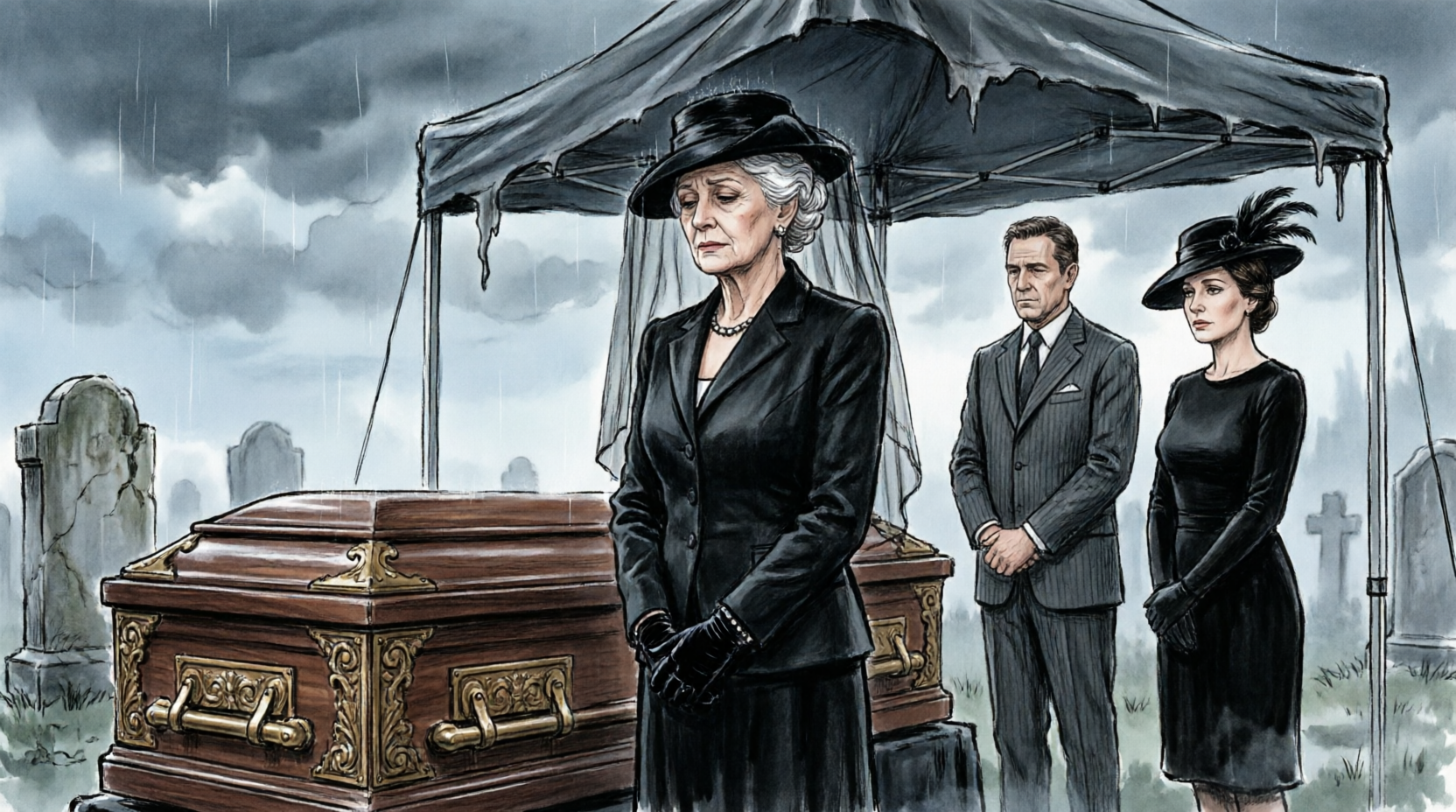
My son skipped his father’s funeral to stay at his wife’s birthday party, and by the time the coffin touched the bottom of that wet Chicago grave, I knew something inside our family had died long before Richard did.
The rain came down hard that afternoon, beating against the green canopy over the burial site with a steady, unforgiving rhythm.
Beneath it stood hundreds of people who had known my husband in different ways: dockworkers, captains, executives, old friends, competitors who had become allies, and employees who still called him Mr.
Mitchell even after thirty years.
And beside me, where my only son should have been, there was an empty chair.
It was not a mistake.
It was not traffic.
It was not a medical emergency or a delayed flight or one of those cruel accidents life sometimes uses to make grief even heavier.
Thomas was at his wife’s birthday celebration.
“He said he would try to come back for the burial, Mrs.
Mitchell,” Jennifer whispered beside me.
She had been Richard’s executive assistant for twenty years, and her eyes were swollen behind her black veil.
“He said Victoria’s party was running late.”
For a moment, I did not answer.
I only looked at the chair.
The funeral director stood several feet away, his hands folded, waiting for direction.
The pastor held his Bible against his chest.
Around us, people shifted carefully under umbrellas, pretending not to hear, pretending not to notice that the heir to Mitchell Shipping had not bothered to appear while the man who built it was being laid into the ground.
I felt something burn through my grief.
Not anger exactly.
Anger is loud.
This was colder than that.
“Begin,” I said.
The pastor stepped forward.
His words floated around me in pieces.
Beloved husband.
Devoted leader.
A life of service.
A man of rare vision.
I watched the coffin instead.
Richard had chosen mahogany because he had loved wood with history in it.
He said a good piece of mahogany had survived storms, shipping routes, careless hands, and changing owners, yet it still held its dignity.
I had teased him for being sentimental about furniture.
He had smiled and said, “Everything lasting has to survive being handled badly.”
Now my husband lay inside that polished wood, and his son was somewhere beneath chandeliers, raising a glass to a woman in a party dress.
Richard’s illness had been brutal.
Eight months from diagnosis to death, and every month stole something different.
First his appetite.
Then his strength.
Then his hands, which had once gripped railings on storm-tossed decks, began to tremble when he tried to lift a water glass.
Near the end, even speaking cost him.
But his mind never lost its edge.
Three weeks before he died, I sat beside his hospital bed in the room we had arranged on the top floor of our Lakeshore Drive penthouse.
He had refused to spend his final days in a hospital.
He wanted to see the lake.
He wanted to hear the gulls in the morning.
He wanted, he said, to leave the world looking at movement.
Walter Harrington, his attorney and oldest friend, had come that morning with a leather folder and a face too solemn to hide what was inside it.
When Walter left, Richard asked me to close the door.
“He is not ready, Ellie,” Richard said.
His voice was rough from the tubes.
His once broad shoulders had narrowed under the blanket.
But his eyes, those steel-gray eyes that had unnerved bankers and charmed port officials from Singapore to Rotterdam, were still entirely his.
I knew who he meant.
“Thomas is forty-two,” I said, almost automatically.
Richard’s mouth moved into something like a smile, but there was no humor in it.
“You have been saying some version of that since he was twenty-two.”
I looked away.
That hurt because it was true.
Thomas had been our only child, born after two miscarriages and years of fear that motherhood would never come to me.
Richard adored him from the first moment.
He used to carry Thomas through the old shipping office on his shoulders, pointing out maps and routes and models of vessels.
When Thomas was little, he asked questions about everything.
Why did ships float?
Why did storms form?
Why did his father leave before sunrise and come home after dark?
Richard answered every question as if the boy were already his successor.
But somewhere along the way, curiosity became entitlement.
Thomas loved the prestige of the Mitchell name, not the work behind it.
He liked the private schools, the club memberships, the penthouse views, the vacations, the access.
He did not like discipline.
He did not like accountability.
He did not like anyone telling him no.
I told myself he would mature.
Richard told himself that too, for longer than he later admitted.
“He has never stayed through a difficult thing unless there was something in it for him,” Richard said that day, pausing between breaths.
“Not once.”
“That is not fair.”
The words came out because I was his mother.
Mothers defend even when their hearts already know.
Richard reached for my hand.
His fingers were dry and fragile around mine.
“I need you to listen to me as my wife, not as his mother.”
The room became very still.
“I have taken precautions,” he said.
He nodded toward the leather folder on the table.
“Walter has finalized everything.
There is a provision in the will.
A moral fitness clause.
The controlling interest in Mitchell Shipping will not pass automatically to Thomas.”
I stared at him.
“What do you mean?”
“I mean the company cannot belong to a man who sees people only as instruments.
It would destroy everything we built.”
“We?” I whispered.
His eyes softened.
“Yes, Ellie.
We.
You think I did not know who kept me human all these years?”
My throat tightened.
Richard continued, slowly now.
“The final determination will be yours.
After my funeral, Walter will give you the necessary document.
You will decide whether Thomas has demonstrated the character required to inherit.”
I pulled my hand away, frightened by the responsibility.
“Richard, don’t do this to me.”
“I am doing it because I trust you more than anyone alive.”
“He is our son.”
“And that is why I cannot be the one to make the final judgment while I am dying and angry.”
He closed his eyes for a moment, gathering strength.
“You will know when the time comes.”
I wanted to tell him the time would never come.
I wanted to insist that grief would change Thomas, that losing his father would crack something open in him.
I wanted to believe the boy who once fell asleep on Richard’s chest was still hidden somewhere inside the man who forgot birthdays unless an assistant reminded him.
So I said nothing.
Now, standing in the rain beside Richard’s grave, I realized my husband had not been cruel.
He had been clear-sighted.
After the burial, we returned to the penthouse for the reception.
The home felt too large without Richard in it.
Every room carried him.
The framed maritime charts in the hallway.
The brass telescope by the window.
The old leather chair he refused to replace because he said it knew the shape of him.
People came and went in quiet waves.
They told stories I had heard and stories I had not.
A retired captain described the night Richard personally stayed on the phone for seven hours to coordinate a rescue after a vessel lost power in the North Atlantic.
A warehouse supervisor said Richard had paid for his wife’s surgery without ever telling anyone.
The director of the charitable foundation cried openly as she remembered how he approved emergency grants without asking whether the publicity would benefit the company.
“He always asked one thing,” she said, gripping my hand.
“Will this help someone who has run out of options?”
That was Richard.
All afternoon, I checked my phone.
No call from Thomas.
No message.
No apology.
At 6:27 p.m., the private elevator opened.
Thomas stepped out first.
He looked immaculate.
Navy designer suit.
Silver tie.
Hair perfectly arranged.
Not a single sign that he had spent the afternoon grieving.
Victoria followed, her hand tucked possessively through his arm.
She wore a champagne-colored dress that caught the light whenever she moved, far too bright and celebratory for a room filled with mourners.
Conversations thinned into silence.
“Mom,” Thomas said, crossing the marble foyer.
He kissed my cheek quickly, the way one greets a hostess.
“I’m sorry we couldn’t stay for all of it.
Victoria’s birthday had been planned months ago.
You know how these things are.”
I looked at him.
For years, I had looked at Thomas through layers of memory.
A toddler with jam on his fingers.
A nervous boy on his first day of school.
A teenager Richard hugged too tightly after his first sailing race.
A young man smiling beside us at fundraisers, handsome and polished and full of promise.
That evening, those memories fell away.
I saw a middle-aged man irritated by inconvenience.
“The reading of the will is tomorrow at ten,” I said.
“Walter Harrington requires every beneficiary to be present.”
Thomas exhaled as though I had mentioned a dental appointment.
“About that,” he said, lowering his voice.
“Victoria and I were hoping to fly to Aspen tonight.
We both need to decompress.
Can’t Walter handle the paperwork next week?”
Behind him, Jennifer made a small sound.
Richard’s sister Margaret, seated near the fireplace, lowered her eyes.
One of Richard’s oldest business partners turned away as if the sight physically pained him.
“No,” I said.
Thomas blinked.
I had said no to him before, but rarely like that.
Not as a wall.
Not as a verdict.
“No?” he repeated.
“No.
You will be there at ten in the morning.
If you are not, the consequences will be serious.”
Victoria’s expression sharpened.
She studied me more carefully then, as if sensing money moving somewhere she could not see.
Thomas gave a short laugh.
“Mom, it’s a will reading, not a board vote.”
“It is both more and less than you think.”
That silenced him for half a second.
Then he recovered, smoothing his cuff.
“Fine.
We’ll change the flight.”
He stayed less than fifteen minutes.
Victoria never offered a word of comfort that did not sound rehearsed.
She drifted through the living room, pausing near Richard’s antiques, his paintings, the porcelain vases he had collected during trips to Asia and Europe.
Her gaze lingered on each piece with a collector’s interest, but not with affection.
Charlotte arrived shortly after they left.
She was Thomas’s daughter from his first marriage, twenty-two years old, quiet, observant, and nothing like him.
Her mother, Claire, had raised her mostly alone after the divorce.
Richard and I had remained close with her, despite Thomas’s complaints that it was “awkward.”
Richard said children should never be punished for adult failures.
Charlotte walked into the penthouse wearing a simple black dress, her face pale from crying.
The moment she saw me, she folded into my arms.
“I’m sorry I wasn’t at the reception earlier,” she whispered.
“I went back to the cemetery after everyone left.
I just needed another minute with him.”
That nearly broke me.
“You were there when it mattered,” I said.
She pulled back, wiping her cheeks.
“He asked me to read to him last Tuesday.
Did he tell you?”
I nodded.
“The Churchill biography.”
She smiled through tears.
“He fell asleep before the chapter ended.
I kept reading anyway.”
Richard had loved that.
During the last two months, when his eyesight became unreliable, Charlotte came three or four times a week after her graduate classes.
She read history, business memoirs, even old shipping records when he requested them.
Sometimes he corrected her pronunciation of port names.
Sometimes he just listened.
Thomas visited twice.
Both times, he took calls in the hallway.
That night, after the last guest left and the penthouse sank into a silence so complete I could hear the elevator cables hum, I went to our bedroom.
Richard’s side of the bed was untouched.
His robe still hung on the back of the chair.
His slippers remained angled toward the window.
A glass of water, half-full from his final night, sat on the table because I had not yet found the courage to move it.
I stood before the portrait that concealed the wall safe.
Richard had installed it twenty years ago after a string of robberies in our building.
I used to joke that hiding a safe behind one’s own portrait was the most Richard Mitchell thing imaginable.
Inside was an envelope marked in his handwriting.
For Eleanor
After the funeral.
My hands shook as I opened it.
The letter was several pages long.
His handwriting had weakened toward the end, but every word was deliberate.
My dearest Eleanor,
If you are reading this, two things have happened.
I have left this world, and Thomas has finally shown you who he truly is.
I pressed one hand to my mouth.
I am sorry.
I know the pain of that sentence will cut you more deeply than anything I could have said while alive.
I did not want your last memories of me filled with arguments about our son.
But I have watched him with clearer eyes than you have been able to, not because you are blind, but because you are his mother.
He does not understand stewardship.
He understands ownership.
Those are not the same.
I sat on the edge of the bed and kept reading.
Richard described incidents he had hidden from me or softened to spare me.
Thomas pressuring an executive to approve a reckless expansion because it would raise his performance bonus.
Thomas mocking a dockworker’s injury in a private meeting.
Thomas suggesting they reduce contributions to the employee emergency fund because “charity does not scale.”
Then there was the part that made my blood run cold.
Richard had known Thomas was already courting investors to break apart Mitchell Shipping after inheriting it.
Sell the port assets.
Spin off the logistics division.
Liquidate the older routes that were less profitable but supported hundreds of long-term employees.
Keep the name only long enough to extract value from it.
He was not waiting to inherit his father’s legacy.
He was waiting to dismantle it.
The moral fitness clause had been Richard’s shield.
Walter had drafted it carefully.
As surviving spouse, executor, and co-founder in all but title, I had authority to determine whether Thomas had demonstrated loyalty, integrity, and respect toward Richard, the family, and the company during Richard’s final illness and funeral rites.
If I found that he had not, Thomas would lose all claim to the controlling shares.
Such shares would pass into a protected voting trust.
The trustee would be Charlotte.
Not immediately with unrestricted power.
Richard was too wise for that.
She would be mentored by the board, by Walter, by Jennifer, and by the two senior executives who had built the company with him.
Dividends would support her education and future role.
A major portion would fund the employee foundation.
The company itself could not be sold for at least fifteen years without unanimous trustee and board approval.
Thomas would receive a fixed annual allowance from a separate family trust, enough for comfort, but not control.
That allowance could be suspended if he challenged the clause in bad faith.
At the end, Richard had written one final paragraph.
Do not confuse mercy with surrender, Ellie.
Thomas may one day become a better man, but he cannot be allowed to become a powerful one at the expense of everyone who trusted our name.
You will make the right decision.
You always do.
I cried then.
Not softly.
Not gracefully.
I cried like a woman who had lost her husband twice: once to cancer, and once to the truth he had carried alone because he knew it would hurt me.
At dawn, Lake Michigan turned silver, then pale gold.
I had not slept.
I sat at Richard’s desk wearing the black dress from the funeral, his letter beside me and Walter’s document in front of me.
For one last moment, I hesitated.
Thomas was my son.
I remembered his first fever.
His first steps.
The way he once ran into my arms after a nightmare and asked if people could disappear while you slept.
I had told him no, not the people who loved you.
But Richard had loved him.
And Thomas had disappeared anyway.
I signed.
The conference room at Harrington and Associates was colder than I remembered.
Mahogany panels lined the walls.
A long table stretched beneath recessed lights.
Richard had attended countless meetings there, negotiating acquisitions, settling disputes, planning expansions that employed thousands of people.
Now his absence sat at the head of the table.
Walter Harrington stood with a folder in front of him.
He looked older than he had two days ago.
Grief had hollowed the skin beneath his eyes.
Around the table sat Richard’s sister Margaret, Jennifer, two senior executives, the director of the Mitchell Foundation, Walter’s associate, Charlotte, Thomas, Victoria, and me.
Thomas arrived seven minutes late.
He did not apologize.
“Traffic,” he said, though his watch was visible beneath his cuff and his expression made it clear he did not believe anyone’s time mattered more than his own.
Victoria sat beside him, elegant and alert.
Her phone remained in her lap.
Every so often, her eyes flicked toward Walter’s folder.
Charlotte sat across from them.
Her eyes were red, but her posture was straight.
When she saw me, she gave a small nod, the kind people give when words might cause them to fall apart.
Walter cleared his throat.
“Before we begin, Eleanor, I want to express my deepest condolences.
Richard was not only my client.
He was my dear friend.”
“Thank you, Walter,” I said.
“Please continue.”
Walter began with the standard provisions.
Personal items.
Charitable gifts.
Bequests to longtime employees.
Richard had left Jennifer a generous sum and the option to remain with the company in any role she chose until retirement.
She pressed a handkerchief to her mouth.
He left Margaret the lake house where they had spent childhood summers.
She closed her eyes and whispered, “Oh, Richie.”
He gave specific antiques and paintings to museums, with instructions that no piece be sold into private collections.
Victoria’s mouth tightened almost imperceptibly.
Thomas shifted in his chair.
At last, Walter turned a page.
“Now we come to the controlling interest in Mitchell Shipping and its affiliated holdings.”
Thomas leaned back slightly, as though preparing to be admired.
Victoria’s hand found his under the table.
Walter continued.
“Richard Mitchell’s will contains a moral fitness provision governing the transfer of controlling shares.
Under this provision, the surviving spouse and executor, Eleanor Mitchell, is empowered to determine whether the named heir, Thomas Mitchell, has demonstrated the character, loyalty, and stewardship required to inherit said shares.”
Thomas’s smile faded.
“Excuse me?” he said.
Walter did not look up.
“This provision was executed legally and reviewed independently by two outside counsel.”
Thomas turned to me.
“Mom, what is he talking about?”
I met his eyes.
For once, I did not rescue him from discomfort.
Walter lifted a document from the folder.
“Mrs.
Mitchell made her determination this morning.”
The room became silent enough to hear Victoria’s nails stop tapping against her phone.
Thomas gave a short laugh, but it came out wrong.
“This is ridiculous.”
Walter read aloud.
“I, Eleanor Mitchell, surviving spouse of Richard Mitchell and executor of his estate, find that Thomas Richard Mitchell failed to demonstrate the loyalty, respect, integrity, and moral fitness required under Article Twelve of the Last Will and Testament of Richard James Mitchell.”
Thomas sat upright.
Victoria whispered, “Thomas.”
Walter continued.
“This determination is based on conduct observed during Richard Mitchell’s final illness, during his funeral proceedings, and in relation to the family and corporate responsibilities entrusted to him.”
My son’s face changed.
The arrogance drained first.
Then the color.
“Therefore,” Walter read, “Thomas Richard Mitchell shall not inherit controlling interest in Mitchell Shipping or any affiliated voting shares.
Such interest shall pass into the Mitchell Stewardship Trust, under the terms established by Richard James Mitchell.”
Charlotte’s hand flew to her mouth.
Walter’s voice remained steady.
“The initial trustee shall be Charlotte Claire Mitchell.”
“No,” Thomas said.
It was not loud.
Not yet.
Walter looked at him.
“The document is valid.”
“No,” Thomas repeated, louder now.
“She is twenty-two.”
“She is also the person Richard named.”
Thomas shoved his chair back.
“This is insane.
I am his son.”
Margaret spoke for the first time.
“Then perhaps you should have behaved like one.”
The words landed harder than a shout.
Thomas turned on me.
“You did this because I missed part of a funeral?”
I felt every eye in the room move toward me.
“No,” I said.
“I did this because missing the funeral was the last thing, not the first.”
His jaw tightened.
“You have no idea what I have done for this family.”
“I know exactly what you planned to do to the company.”
That stopped him.
Victoria went still.
Walter opened another folder and slid several copied pages across the table.
Emails.
Term sheets.
Preliminary investor communications.
A breakup model for Mitchell Shipping prepared before Richard was even dead.
Jennifer looked at the documents and inhaled sharply.
One of the senior executives muttered, “My God.”
Thomas stared at the papers.
“Those were exploratory.”
Richard’s foundation director looked sick.
“You were going to liquidate the older routes.”
“They were underperforming assets,” Thomas snapped.
“They were communities,” Jennifer said, her voice trembling.
“People’s jobs.
Families.”
Thomas ignored her and pointed at Charlotte.
“And you think she can run this?
She read books to a dying man and now she gets an empire?”
Charlotte lowered her hand from her mouth.
Her voice shook, but she did not look away.
“I did not ask for this.”
“No,” I said gently.
“You earned his trust without asking for it.”
Thomas laughed bitterly.
“This is emotional manipulation.
All of you are grieving and letting a dead man punish me.”
Walter’s expression hardened.
“Be very careful.”
Victoria leaned toward Thomas and whispered something.
I could not hear it, but I saw the panic behind her composure.
She had not married Thomas for an allowance.
She had married proximity to an empire.
Thomas turned back to Walter.
“I will contest it.”
“You may attempt to,” Walter said.
“However, the clause includes a bad-faith challenge provision.
Should the court find your challenge frivolous or coercive, your family trust distributions may be suspended.”
Thomas froze.
There it was.
The first real fear.
Not grief.
Not regret.
Fear of losing access.
I took Richard’s letter from my handbag.
I had not planned to read it aloud, but suddenly I knew the room needed to hear his voice.
“Walter,” I said.
“May I?”
He nodded.
I unfolded the pages carefully.
Thomas looked almost bored at first.
Then I began reading Richard’s words about stewardship and ownership, about power without character, about the difference between inheriting a name and honoring it.
When I reached the sentence, “Our son may one day become a better man, but he cannot be allowed to become a powerful one at the expense of everyone who trusted our name,” Thomas looked down.
For one brief second, I thought shame had found him.
Then he said, “He wrote that because you poisoned him against me.”
The room seemed to recoil.
I folded the letter.
“No, Thomas,” I said.
“Your father defended you longer than you deserved.
So did I.”
He looked at me with raw disbelief, as if motherhood were supposed to be an unlimited line of credit.
“You would choose her over me?” he asked, nodding toward Charlotte.
“I am choosing what your father built.
I am choosing the employees who stood in the rain while you celebrated.
I am choosing the granddaughter who sat beside him when you could not spare an hour.
And I am choosing, at last, to stop confusing love with permission.”
Charlotte began to cry silently.
Thomas’s mouth opened, but nothing came out.
Victoria stood abruptly.
“We should go.”
Of course she said we.
For the first time all morning, she understood there was no empire waiting for her to decorate.
Thomas did not move.
He was staring at the table, at the documents, at the inheritance that had vanished not because Richard was cruel, but because Richard had finally told the truth on paper.
Walter closed the folder.
“The board will meet next week to begin transition under the terms of the trust,” he said.
“Charlotte will not be alone in this responsibility.
Richard designed this structure to protect both her and the company.”
Charlotte wiped her face.
“I want Jennifer involved.”
Jennifer looked startled.
“And Mr.
Alvarez and Ms.
Chen,” Charlotte added, naming the two executives.
“Granddad trusted them.
I trust them too.”
For the first time that morning, I felt something loosen in my chest.
Not happiness.
Not yet.
But possibility.
Thomas finally stood.
His chair scraped loudly against the floor.
“This family is dead to me,” he said.
Margaret looked at him with exhausted sadness.
“No, Thomas.
You simply arrived too late to notice what you had already killed.”
He flinched, though he tried to hide it.
Victoria took his arm, but he pulled away from her and walked out first.
She followed after one last glance at the folder, the table, the people she had miscalculated.
The door closed behind them.
For several seconds, no one spoke.
Then Charlotte whispered, “I don’t know if I can do this.”
I reached across the table and took her hand.
“Neither did your grandfather when he bought his first vessel,” I said.
“He was terrified.
He just never let fear make his decisions.”
Walter removed his glasses and wiped his eyes.
Richard would have pretended not to notice.
In the weeks that followed, Thomas did file a challenge.
Walter had expected it.
The court moved quickly after reviewing the documents, the independent legal opinions, the investor communications, and the testimony regarding Thomas’s conduct during Richard’s illness and funeral.
The clause held.
Thomas kept his allowance, reduced by legal fees and strict conditions.
Victoria moved out before summer ended.
I heard she told friends she had been “deceived about the family’s liquidity,” which was perhaps the most honest thing she had ever said.
Charlotte did not become a miracle executive overnight.
Richard would have laughed at the idea.
She studied.
She listened.
She made mistakes small enough to learn from because the trust protected her from making catastrophic ones.
Jennifer stayed.
The senior executives stayed.
The foundation expanded.
And every year, on the anniversary of Richard’s death, Charlotte comes with me to the cemetery.
The first time, she brought the Churchill biography and read one chapter aloud in the wind.
I stood beside her, one hand on the cold stone, and thought about the empty chair at the funeral.
I thought about how much damage we do when we excuse selfishness because it shares our blood.
I thought about Richard, who had loved our son enough to stop him.
People still ask whether I regret it.
The answer is complicated in the way motherhood is always complicated.
I grieve the son I hoped Thomas would become.
I grieve the boy who once asked if people could disappear while you slept.
But I do not regret protecting Richard’s legacy from the man that boy became.
Because love may forgive an absence.
It does not have to finance one.
The first year after Richard’s death changed the shape of our family completely.
Not loudly at first.
Not with one grand explosion after the will reading.
But slowly, painfully, like a ship turning in deep water.
Thomas disappeared for three months.
No calls.
No visits.
No flowers at Richard’s grave.
Only legal letters, angry messages through attorneys, and one bitter email to me that began with, “You chose a stranger over your own blood.”
I read that sentence at my kitchen table with Richard’s old coffee cup sitting beside me.
A stranger.
Charlotte.
His own daughter.
The girl who had sat beside Richard’s bed when Thomas could not be bothered to stay longer than twenty minutes.
The girl who had read to him when his eyes failed.
The girl who had held his hand when his breathing became shallow.
If Charlotte was a stranger to Thomas, then Thomas had made her one.
I printed the email.
Not because I wanted to punish myself by rereading it.
Because I had finally learned something Richard understood long before I did.
Some truths need to be kept where memory cannot soften them.
Charlotte came to the office every morning at seven.
At first, the employees watched her carefully.
Not cruelly.
Not suspiciously.
Just cautiously.
She was young.
She was grieving.
And she carried a last name that had already frightened many of them because of Thomas.
But Charlotte did something Thomas never did.
She listened.
She took notes.
She asked questions without pretending she already knew the answer.
She walked the docks in practical shoes.
She learned the names of captains, schedulers, mechanics, customs specialists, warehouse clerks, and the woman in payroll who had worked there since before Thomas was born.
When she did not understand a term, she asked Jennifer.
When she made a mistake, she corrected it.
When an executive tried to flatter her, she looked uncomfortable.
When a dockworker told her plainly that people were afraid she would sell the company piece by piece like her father planned, Charlotte looked him in the eye and said, “Then I need to spend every day proving I won’t.”
That sentence traveled faster through Mitchell Shipping than any official memo.
By autumn, people stopped calling her “the granddaughter.”
They started calling her Ms. Mitchell.
Not because she demanded it.
Because she earned the respect one morning at a time.
Thomas heard about it.
Of course he did.
Men like Thomas do not watch a door close without pressing their ear against it afterward.
He called me in November.
I answered because he was my son.
Not because I was ready.
“Mom,” he said.
His voice was softer than I expected.
For one foolish second, I thought grief had finally found him.
Then he continued.
“I think enough time has passed for everyone to calm down.”
I closed my eyes.
There it was.
Not remorse.
Strategy.
“Enough time for what, Thomas?”
“For us to talk like family.”
“Family does not begin after the lawsuit fails.”
His silence hardened.
“You’re enjoying this.”
“No,” I said.
“I have not enjoyed one moment of this.”
“You humiliated me in front of the board.”
“No, Thomas. Your father’s documents revealed you. There is a difference.”
He exhaled sharply.
“So that’s it? I’m supposed to live on an allowance while my daughter plays CEO?”
“Charlotte is not playing.”
“She’s a child.”
“She is older than your character.”
The line went quiet.
I had never spoken to him that way before.
I had corrected him.
Warned him.
Protected him.
Excused him.
But I had never named him.
When he spoke again, his voice was low.
“You’ll regret choosing her.”
I looked out at Lake Michigan, gray and restless beyond the glass.
“No,” I said.
“I regret not choosing truth sooner.”
He hung up.
That winter, Victoria filed for divorce.
It should not have surprised me, but it did.
Not because I believed in their love.
Because I had underestimated how quickly a person built on ambition abandons a sinking ship.
She sent me one message after the news became public.
I hope you’re satisfied.
I did not answer.
Satisfaction had nothing to do with it.
Richard was still dead.
My son was still hollowed out by entitlement.
My granddaughter still carried a burden she had not asked for.
And I still woke some mornings reaching for Richard’s hand before remembering the bed beside me was empty.
No.
I was not satisfied.
I was simply awake.
The second year was quieter.
Thomas stopped fighting the trust and started performing repentance.
He attended charity events.
He gave interviews about grief.
He spoke of his father’s legacy with that practiced expression public men use when they want sincerity photographed.
But he never visited the docks.
He never called Jennifer.
He never asked Charlotte what she needed.
He never apologized to the employees whose jobs he had planned to sell.
That was how I knew nothing had changed.
A man can learn shame without learning humility.
Charlotte changed differently.
She grew slower, deeper.
She took business courses at night.
She asked Margaret about Richard as a boy.
She asked me about the early years, the debt, the risk, the little leased cargo vessel that smelled of oil and salt and seemed too small to carry a dream.
One evening, she came to the penthouse and found me in Richard’s study.
His chair still sat by the window.
I had not moved it.
“Grandmother,” she said softly, “do you think he would be disappointed in me?”
I turned.
“In you?”
She nodded.
“I’m not him.”
“No,” I said.
“Thank God.”
Her eyes filled.
“I mean, I don’t have his certainty.”
“Richard did not begin with certainty. He began with terror and refused to let it steer.”
She sat across from me.
“What if I fail?”
“Then fail honestly. Learn quickly. Repair what you can. That is more than many powerful people ever do.”
She looked toward the lake.
“Do you miss Thomas?”
The question hurt because the answer was not clean.
“I miss the son I believed I was raising.”
“That isn’t the same.”
“No,” I said.
“It isn’t.”
That night, after Charlotte left, I opened Richard’s letter again.
Do not confuse mercy with surrender.
I understood it more with time.
Mercy was not giving Thomas the company.
Mercy was giving him a life where his damage was limited.
Mercy was not letting him destroy thousands of families in order to preserve my fantasy of motherhood.
Mercy was not soft.
Sometimes mercy has locks.
By the third year, Mitchell Shipping was stronger than it had been in Richard’s final months.
Charlotte did not do it alone.
That was her wisdom.
She formed a stewardship council with Jennifer, Mr. Alvarez, Ms. Chen, and two younger employees from operations.
She expanded the employee emergency fund Thomas had mocked.
She refused a private equity offer that would have made her rich and ruined the company’s oldest routes.
She opened a training academy for workers’ children who wanted to study logistics, engineering, or maritime law.
At the dedication ceremony, she stood at the podium beneath a banner that read The Richard Mitchell Stewardship Academy.
Her voice shook at first.
Then it steadied.
“My grandfather taught me that ownership asks, ‘What can I take from this?’ Stewardship asks, ‘What must I protect so others can stand after me?’”
I wept openly.
So did Jennifer.
Even Walter removed his glasses and looked away.
After the ceremony, Thomas appeared.
No one had invited him.
But he came in a black suit, thinner than before, with gray at his temples and a look I did not immediately recognize.
Not arrogance.
Not exactly humility either.
Something between exhaustion and hunger.
He waited until the crowd thinned before approaching Charlotte.
I moved toward them, but Charlotte lifted one hand slightly.
She wanted to handle it herself.
Thomas looked at the academy sign.
“Granddad would have liked this,” he said.
Charlotte studied him.
“Yes.”
The simplicity of her answer seemed to unsettle him.
He cleared his throat.
“I wanted to say congratulations.”
“Thank you.”
There was a long pause.
Then he said, “I was angry at you.”
“I know.”
“I blamed you.”
“I know.”
His mouth tightened
“That was easier than admitting he trusted you more.”
Charlotte did not soften.
“Trust was not a prize I stole from you, Dad. It was something you stopped earning.”
He flinched.
I saw it.
For the first time, he did not defend himself.
“I know,” he said.
Those two words moved through me like a door opening an inch after years of being sealed shut.
Charlotte nodded once.
Not forgiveness.
Not rejection.
Acknowledgment.
That was all.
Thomas turned to me next.
“Mom.”
I waited.
He looked older than forty-five.
“I went to the cemetery this morning.”
I said nothing.
“I should have been there that day.”
“Yes,” I said.
His eyes reddened.
“I don’t know how to fix that.”
“You cannot fix it.”
He swallowed.
“I know.”
“No,” I said gently.
“I need you to understand. Some things are not repaired. They are carried.”
He lowered his head.
For a moment, I saw the boy again.
Not fully.
Not enough to erase the man.
But enough to remind me why grief and love are so difficult to separate.
“I’m sorry,” he whispered.
I had imagined those words for years.
I had thought they would heal something instantly.
They did not.
But they mattered.
“I believe you are sorry today,” I said.
His face tightened.
“Today?”
“Sorry must survive inconvenience before I trust it.”
Charlotte looked at me.
Thomas nodded slowly.
“That’s fair.”
It was the first fair thing he had accepted in a long time.
He did not regain the company.
Richard had made sure that could never happen.
He did not regain automatic access to our lives.
I had made sure of that.
But over the years, Thomas began appearing in ways that cost him something.
Not at galas.
Not with cameras.
At small foundation meetings.
At employee memorials.
At the docks in February, when the wind off the lake cut through wool coats and left everyone’s eyes watering.
The first time a retired captain refused to shake his hand, Thomas accepted it.
No complaint.
No outrage.
Just a nod.
Good.
Consequences should be felt in the hands.
Victoria remarried a real estate developer in Miami.
Thomas did not attend.
Charlotte eventually became chair of the stewardship trust.
Not because Richard handed her power.
Because she grew strong enough to hold it.
And me?
I learned how to be a widow without becoming only a widow.
I traveled once to Rotterdam, where Richard had made his first international deal.
I stood by the harbor and watched ships move like enormous shadows across the water.
I wore his old scarf.
I spoke to him there, quietly, like he was standing beside me.
“You were right,” I told him.
“But I wish you had been wrong.”
The wind took the words.
Maybe that was enough.
Ten years after Richard’s death, we gathered at the cemetery.
Charlotte was thirty-two by then.
Confident.
Compassionate.
Still careful with power.
Thomas came too.
He stood a little apart at first, hands folded, waiting to be invited closer.
That alone told me something had changed.
Charlotte opened the Churchill biography and read the same chapter she had read at the first anniversary.
Her voice was steady.
When she finished, Thomas stepped forward and placed one white rose on Richard’s grave.
“I was late,” he said quietly.
No one answered.
“I’ve been late to many things.”
He looked at Charlotte.
“To fatherhood.”
Then at me.
“To being a son.”
He looked back at the stone.
“But I’m here now. I know that doesn’t erase anything.”
It did not.
But it was true.
And truth, even late, has weight.
I reached for his hand.
He looked startled.
I did not forgive him in that moment as if forgiveness were a curtain falling over all the damage.
I simply held my son’s hand at his father’s grave.
That was enough for that day.
As we left, Charlotte walked beside me.
“Do you think Granddad would forgive him?”
I watched Thomas ahead of us, walking slowly beneath the gray sky.
“Your grandfather loved him,” I said.
“That is not the same question.”
Charlotte nodded.
Then she asked, “Do you?”
I took a long breath.
“I am learning how to forgive without handing him the keys.”
She smiled sadly.
“That sounds like something Granddad would say.”
“No,” I said.
“That one is mine.”
And it was.
Because Richard had left me a decision.
But life had left me the aftermath.
I learned that inheritance is not only wealth.
It is also responsibility.
It is grief.
It is memory.
It is the courage to say no when love begs you to say yes.
Richard’s company survived.
Charlotte grew.
Thomas changed in pieces, never quickly enough to undo what he had done, but perhaps enough to stop doing worse.
And I remained the woman who signed the paper at dawn.
Not because I stopped being a mother.
Because I finally understood that motherhood without truth can become a form of surrender.
People still ask whether I regret disinheriting my son.
I tell them the same thing every time.
“I did not disinherit him from love. I disinherited him from power.”
That is the difference many people do not understand.
Love may leave a chair open.
Power must be earned before anyone is allowed to sit in it.
The Morning After The Will Reading
Part 1 — The Morning After The Will Reading
The morning after the will reading, Chicago woke beneath a sheet of freezing rain and steel-gray clouds.
Mitchell Shipping headquarters stood against the lake like a fortress, forty-two stories of glass and polished stone carrying Richard Mitchell’s name in silver letters above the entrance.
For thirty years, employees entered that building believing the future was predictable.
Richard would lead.
Then Thomas would inherit.
That was the story everyone accepted.
Until yesterday.
Now the entire company was holding its breath.
I arrived at 7:10 a.m.
Earlier than usual.
Jennifer was already there, sitting at her desk outside Richard’s office with swollen eyes and untouched coffee.
She stood immediately when she saw me.
“Mrs. Mitchell.”
I hated how fragile her voice sounded.
“Sit down, Jennifer,” I said softly.
“You’ve cried enough for one lifetime this week.”
She tried to smile.
“I’ve worked here twenty-one years.
I still keep expecting him to walk through that elevator yelling because someone changed a shipping route without asking him.”
I looked toward the closed office doors.
“So do I.”
The silence between us was interrupted by the sound of raised voices from the executive corridor.
Thomas.
Even before Jennifer looked panicked, I already knew.
He stormed around the corner without knocking.
His coat was unbuttoned.
His face was pale from lack of sleep and fury.
Behind him came Victoria, trying to keep pace in heels too delicate for anger.
“You blindsided me,” Thomas snapped the second he saw me.
Jennifer stood instinctively.
I raised one hand slightly.
“Sit.”
She obeyed immediately.
Thomas noticed.
For the first time in his life, he was beginning to understand something terrifying:
his authority no longer existed automatically.
“You used my father’s death to humiliate me,” he continued.
“No,” I said calmly.
“Your behavior did that.”
Victoria crossed her arms.
“This entire thing is emotional manipulation.
Richard was sick.
People near death become paranoid.”
Jennifer inhaled sharply.
Thomas looked grateful she had said it instead of him.
I walked slowly toward Richard’s office doors.
“Careful, Victoria.
You’re speaking about a man whose company still pays for your lifestyle.”
Her expression tightened instantly.
Money.
That was the language she understood best.
Thomas followed me as I opened Richard’s office for the first time since his death.
The room still smelled faintly like cedarwood and coffee.
Richard’s reading glasses rested beside unfinished paperwork.
A fountain pen lay exactly where he had left it.
Grief hit me so suddenly I had to steady myself against the desk.
Thomas noticed.
For one second, guilt flickered across his face.
Then pride buried it.
“I’m not leaving quietly,” he said.
“You don’t have a choice.”
“The board will never support Charlotte.”
“They already do.”
That stopped him cold.
Because deep down, Thomas understood something terrible:
people respected Richard.
People tolerated him.
There is a difference between inheriting power and inheriting trust.
And only one of those survives a crisis.
He stepped closer to me.
“You think this makes you strong?”
I looked at my son.
Really looked at him.
At the expensive watch his father bought him for his fortieth birthday.
At the tailored coat.
At the exhaustion beneath his eyes.
At the man who still believed consequences were temporary inconveniences designed for other people.
“No,” I said quietly.
“I think losing your father should have made you human.
That’s what breaks my heart.”
For the first time since the funeral, Thomas looked wounded instead of angry.
But before he could answer, another voice entered the room.
“She’s right.”
We turned.
Charlotte stood in the doorway holding a leather notebook against her chest.
She looked terrified.
And steady.
Both at once.
Thomas stared at her.
“You really think you belong here?”
“No,” Charlotte answered honestly.
“I think Granddad believed I could learn.”
The simplicity of that response unsettled him more than arrogance ever would have.
Because humility exposes insecurity faster than pride.
Victoria laughed sharply.
“This is unbelievable.
A graduate student is suddenly running a multibillion-dollar company because she read bedtime stories to an old man?”
Charlotte flinched.
I watched it happen.
But she did not retreat.
“He wasn’t an old man,” she said quietly.
“He was my grandfather.”
Silence filled the office.
Jennifer looked down quickly, pretending to organize papers because tears had filled her eyes again.
Thomas shook his head.
“You manipulated him.”
“No,” I said.
“Your father spent his final months seeing people clearly.”
That sentence landed harder than shouting.
Because Thomas knew it was true.
Richard had watched carefully near the end.
Illness strips away illusion.
Dying people stop wasting energy pretending not to notice what hurts them.
Thomas turned toward his father’s desk.
“You really expect me to just disappear while she plays executive?”
Charlotte spoke before I could.
“No.
I expect you to decide whether you want to become someone your father could have trusted.”
That hit him harder than the will.
I saw it in his face instantly.
Because beneath all the arrogance, Thomas had spent his entire life wanting Richard’s approval.
And now he had proof written in legal documents that he died without giving it.
Victoria touched his arm.
“We’re leaving.”
He didn’t move immediately.
Instead, he stared at Richard’s empty chair.
And for one brief moment, he looked like a lost little boy standing in a room too large for him.
Then the moment vanished.
“Enjoy your victory,” he muttered.
“It won’t last.”
After they left, the office became silent again.
Charlotte exhaled shakily.
“I thought I was going to throw up.”
Jennifer laughed through tears.
“Congratulations.
That means you’re already more qualified than most executives.”
Even I smiled faintly at that.
Charlotte walked slowly toward Richard’s desk.
“Do you think he knew this would happen?”
“Yes,” I answered.
“He just hoped he would be wrong.”
Charlotte touched the leather chair carefully.
“I miss him.”
“So do I.”
Outside the office windows, snow began falling over Lake Michigan.
Slow.
Cold.
Relentless.
And for the first time since the funeral, I realized something important:
Richard’s death had not ended the battle for his legacy.
It had only begun
Part 2 — The First Board Vote
Three days after the will reading, Mitchell Shipping held its first executive board meeting without Richard Mitchell alive to command the room.
The building felt different now.
Not weaker.
More cautious.
Like everyone inside had suddenly remembered how quickly power can shift when the wrong person reaches for it.
Snow pressed against the windows of the forty-second-floor boardroom while senior executives filed in one by one carrying tablets, reports, and carefully controlled expressions.
Nobody said Thomas’s name immediately.
That alone said enough.
I sat near the center of the long mahogany table wearing one of Richard’s dark wool coats over my black dress.
Across from me sat Charlotte with a legal pad in front of her and fear hidden beneath professionalism.
She looked too young for this room.
Richard had looked too young once too.
Power ages people quickly.
Jennifer distributed folders quietly.
Mr. Alvarez reviewed shipping projections.
Ms. Chen adjusted her glasses while reading legal summaries regarding the trust transition.
Walter Harrington arrived last, carrying another thick folder beneath his arm.
The empty chair at the head of the table remained untouched.
No one sat there.
No one even suggested it.
Because some absences are too large to rearrange around immediately.
At exactly 8:00 a.m., Walter cleared his throat.
“We’ll begin.”
The room settled instantly.
Charlotte glanced toward me once.
I gave her a small nod.
Not reassurance.
Permission to breathe.
Walter opened the meeting with the official trust transition procedures.
“The Mitchell Stewardship Trust now controls fifty-one percent of voting shares,” he explained.
“Miss Charlotte Mitchell is acting trustee under supervised governance provisions established by Richard Mitchell.”
Several executives nodded.
Others looked thoughtful.
Nobody objected.
That mattered.
Then Walter slid another document onto the table.
“There is, however, an immediate issue.”
The room stiffened slightly.
“Thomas Mitchell filed an emergency injunction request this morning attempting to freeze all trust operations pending litigation.”
Charlotte’s face drained of color.
Jennifer whispered, “Already?”
Walter nodded.
“He’s asking the court to argue emotional coercion during Richard’s final illness.”
I closed my eyes briefly.
Of course he was.
Men like Thomas rarely believe they lost because of their own behavior.
They believe someone manipulated the outcome against them.
Charlotte spoke carefully.
“Does he have a case?”
Walter looked directly at her.
“No.
But he can create delay.
And delay creates instability.”
Mr. Alvarez leaned forward.
“Our investors are already nervous.
Rumors are spreading.”
“About what?” Jennifer asked.
He hesitated.
“That the company may be sold anyway.”
Charlotte straightened immediately.
“No.”
Her voice surprised everyone.
Including herself.
“No one is dismantling this company.”
Ms. Chen studied her quietly.
“That confidence will need to become public very soon.”
I watched Charlotte absorb that sentence.
Leadership is not just decision-making.
It is visibility.
People need to see steadiness before they believe in it.
Walter handed Charlotte a printed statement draft.
“We recommend a formal address to senior management and shareholders by tomorrow morning.”
Charlotte blinked.
“I’ve never addressed shareholders.”
Jennifer smiled sadly.
“Neither had Richard once.”
That room loved Richard enough to keep telling his story through practical advice.
I realized then that Charlotte would never truly be alone here.
Not if she listened.
The meeting continued for nearly two hours.
Shipping contracts.
International delays.
Fuel negotiations.
Insurance renewals.
Charlotte filled pages with notes while asking careful questions whenever terminology confused her.
Not once did she pretend expertise she didn’t possess.
By the end of the meeting, even the executives who doubted her looked slightly less tense.
Competence begins with honesty.
Pretending certainty destroys trust faster than ignorance ever does.
At 10:42 a.m., Jennifer’s phone buzzed sharply.
Her face changed immediately.
“What is it?” I asked.
She swallowed.
“Thomas is downstairs.”
The room went silent.
Walter cursed softly beneath his breath.
“He’s not supposed to be here without authorization.”
“He brought reporters,” Jennifer whispered.
Charlotte looked stunned.
“Reporters?”
Mr. Alvarez stood immediately and walked toward the window overlooking the front entrance plaza.
“Oh my God.”
I joined him.
Three news vans had parked near the entrance.
Cameras stood ready outside in the snow while Thomas exited a black SUV beside Victoria.
He looked polished.
Controlled.
Prepared.
Victoria wore white, absurdly enough, like some grieving political wife.
Charlotte came beside me slowly.
“What is he doing?”
Walter answered flatly.
“He’s starting a public war.”
Down below, Thomas faced the cameras with tragic dignity carefully arranged across his features.
Even from forty-two floors up, I recognized the performance instantly.
He had inherited Richard’s charisma without inheriting Richard’s conscience.
A dangerous combination.
Jennifer turned on the muted television mounted inside the boardroom.
Within seconds, local business coverage switched live to the building entrance.
Thomas appeared on-screen holding prepared notes.
“I am devastated,” he told reporters solemnly.
“My father’s death has already shattered our family.
Unfortunately, certain individuals are exploiting grief and confusion to seize control of Mitchell Shipping during a vulnerable transition period.”
Charlotte looked physically ill.
“He means me.”
“No,” I said quietly.
“He means himself.
People like Thomas always accuse others of their own behavior first.”
The reporter asked whether he believed the will was legitimate.
Thomas lowered his eyes dramatically.
“My father was heavily medicated near the end.
I believe outside influences manipulated him while he was dying.”
Jennifer slammed her folder shut.
“That’s disgusting.”
Walter already had his phone out.
“I’m calling legal communications immediately.”
But before he could dial, Charlotte spoke.
“No.”
Everyone turned toward her.
She looked pale.
Terrified.
And suddenly very much like Richard.
“No hiding,” she said softly.
“If he wants this public, then we answer publicly.”
Walter hesitated.
“You understand what that means?”
“Yes.”
Her hands trembled slightly against the table.
“But Granddad spent his whole life standing behind this company openly.
I won’t start leading it by hiding upstairs while he lies downstairs.”
For several seconds, nobody spoke.
Then Ms. Chen nodded once.
“She’s right.”
Mr. Alvarez followed.
“So am I.”
Jennifer smiled through tears again.
“That sounded exactly like Richard.”
Charlotte looked startled by that.
I touched her hand gently.
“That’s because courage sounds familiar when you’ve heard it before.”
Downstairs, Thomas continued speaking dramatically about betrayal, manipulation, and family division while cameras captured every angle.
But upstairs, something quieter and stronger was forming.
Not certainty.
Not victory.
Trust.
And unlike inheritance, trust cannot be demanded.
It must be built slowly in moments exactly like this.
Walter finally lowered his phone.
“Then we do this properly.”
He turned toward Charlotte.
“Miss Mitchell, would you like to prepare your first official statement as acting trustee?”
Charlotte inhaled deeply.
Outside, snow battered the windows harder.
Below, reporters crowded around Thomas.
Inside the boardroom, Richard’s granddaughter lifted her chin slightly and said:
“Yes.
I would.”
Part 3 — The Statement That Changed Everything
The media briefing was scheduled for noon.
That gave us less than ninety minutes to prepare Charlotte for the kind of public scrutiny that normally takes executives decades to survive.
Downstairs, Thomas continued feeding reporters carefully measured outrage beside the revolving front doors.
Every few minutes another notification appeared across business channels:
MITCHELL HEIR DISPUTES WILL.
QUESTIONS RAISED ABOUT COMPANY CONTROL.
FAMILY CIVIL WAR THREATENS SHIPPING GIANT.
I watched the headlines crawl across television screens inside the executive lounge and felt exhausted in a way grief alone cannot explain.
This was not mourning anymore.
This was strategy.
And Thomas had mistaken cruelty for intelligence his entire life.
Charlotte sat inside Richard’s office with legal pads spread around her while Jennifer adjusted the conference livestream settings nearby.
Walter stood by the windows speaking quietly with corporate attorneys.
The room smelled like coffee that nobody remembered to drink.
Charlotte stared at the blank page in front of her.
“I don’t know how to sound like him.”
“You shouldn’t,” I answered immediately.
She looked up.
Richard’s chair remained empty behind the desk.
Still untouched.
Still impossible.
“You’re not replacing your grandfather,” I told her softly.
“You’re continuing him.
Those are different things.”
Charlotte swallowed hard.
“What if I freeze?”
Jennifer finally spoke from across the room.
“Richard froze once during a shareholders meeting in 1994.”
Charlotte blinked.
“He did?”
“Oh yes,” Jennifer said, smiling faintly at the memory.
“He completely forgot the quarterly projections halfway through presenting them.
Just stood there staring at the papers.”
“What happened?”
Jennifer laughed quietly.
“He said, ‘Well, this is embarrassing,’ and everyone laughed.
Then he kept going.”
Even Walter smiled slightly at that.
Because Richard’s strength had never come from perfection.
It came from honesty.
That is far rarer.
Charlotte lowered her eyes toward her notes again.
“What if they hate me?”
Walter answered this time.
“Some will.
Some already do.
Leadership is not consensus.
It’s responsibility.”
That sentence settled heavily into the room.
Because every person there understood its cost.
At 11:12 a.m., another alert appeared on television.
Thomas had escalated further.
“Audio obtained from outside sources suggests Richard Mitchell may have been pressured during hospice treatment.”
Jennifer gasped softly.
My blood went cold.
“What audio?”
Walter was already checking his phone.
His expression darkened immediately.
“Jesus Christ.”
Charlotte stood quickly.
“What?”
Walter looked furious now.
“He’s implying hospice recordings exist.
He’s trying to plant suspicion before the court hearing.”
I felt physically ill.
Richard had spent his last weeks struggling to breathe while people adjusted morphine schedules and whispered medical updates outside his bedroom.
And now his own son was turning those final moments into a public weapon.
Charlotte pressed both hands against the table.
“How can he do that?”
I answered before anyone else could.
“Because he’s desperate.”
The room fell silent again.
Not because the answer surprised anyone.
Because it didn’t.
At 11:26 a.m., Jennifer’s computer chimed softly.
“We’re live in thirty minutes.”
Charlotte closed her eyes briefly.
Then something changed in her expression.
Not confidence.
Something steadier.
Decision.
She stood and walked slowly toward Richard’s desk.
For several seconds she simply looked at it.
At the reading glasses.
At the framed photo of the company’s first cargo ship.
At the fountain pen lying beside unfinished paperwork.
Then she picked up the pen.
“My grandfather hated public dishonesty more than private failure,” she said quietly.
Walter nodded once.
“That’s true.”
Charlotte turned toward us holding the pen carefully between her fingers.
“Then I know what I want to say.”
By 11:58 a.m., the executive conference hall downstairs was full.
Reporters lined the walls.
Camera lights glared across polished wood floors.
Corporate managers filled the back rows whispering anxiously among themselves.
Outside, snow continued falling across downtown Chicago.
Thomas remained near the side entrance with Victoria beside him, both pretending confidence while monitoring media coverage on their phones.
When Charlotte entered the conference hall, conversation stopped almost immediately.
She wore a navy suit that had belonged to Richard’s late wife once upon a time.
Jennifer had altered it overnight.
The fit was nearly perfect.
She looked young.
Terrified.
And unmistakably like family.
I stayed near the back beside Walter.
Not hidden.
Just allowing her the space to stand alone if she chose.
The microphones waited at the center podium.
Charlotte approached them slowly.
Camera flashes exploded instantly.
For one terrible second, I thought she might panic.
Instead, she adjusted the papers in front of her exactly the way Richard used to before major announcements.
Jennifer covered her mouth quietly from the side of the room.
The resemblance hurt.
Charlotte looked directly into the cameras.
“My name is Charlotte Mitchell.”
Her voice shook slightly at first.
Then steadied.
“I know many of you expected to see someone else standing here today.”
A few reporters shifted.
Pens moved quickly.
Charlotte continued.
“My grandfather believed leadership was not inherited automatically.
He believed it was earned through responsibility, honesty, and accountability.”
Down the side corridor, Thomas appeared near the rear entrance watching through partially opened doors.
Charlotte saw him.
Everyone did.
But she didn’t stop.
“The past twenty-four hours have been painful for my family and destabilizing for this company.
I will not discuss private grief publicly.
But I will address one thing directly.”
Now even reporters stopped typing.
“You cannot claim to honor a man while publicly dismantling the dignity of his final days.”
The room became completely still.
Somewhere behind me, Walter exhaled slowly.
Charlotte looked straight toward the cameras again.
“My grandfather built Mitchell Shipping over forty years with one guiding principle:
that trust matters more than image.
If mistakes happened, you corrected them.
If people failed, they accepted responsibility.
And if you loved someone, you protected them when they were weakest.”
Thomas’s expression hardened visibly from the back hallway.
Charlotte continued anyway.
“I am not standing here because I demanded power.
I am standing here because Richard Mitchell made a decision after careful legal consultation while fully competent and fully aware.”
Then came the sentence that changed everything.
“And unlike others, I will not insult his memory by pretending he didn’t know exactly what he was doing.”
Even the reporters looked stunned.
Because suddenly this was no longer a story about inheritance.
It was about character.
Thomas pushed through the rear doors then.
“What you’re doing is manipulation!”
Gasps spread instantly through the room.
Security moved immediately, but Walter lifted one hand slightly.
Wait.
Charlotte looked directly at her father.
The silence between them felt enormous.
“You called hospice nurses yesterday asking for medication records,” she said quietly.
Thomas froze.
“You leaked private medical speculation to reporters this morning.”
Another silence.
Camera flashes intensified wildly now.
Charlotte’s hands trembled slightly against the podium.
But her voice remained steady.
“You keep asking everyone to believe Granddad was confused.
But the only person behaving irrationally since his death has been you.”
Thomas stepped forward.
“You have no idea what this company requires.”
“No,” Charlotte admitted honestly.
“But I know what integrity requires.”
That landed harder than shouting ever could have.
Because truth usually does.
Security finally approached Thomas carefully.
He looked around the room expecting support.
No one moved toward him.
Not one executive.
Not one investor.
Not even Victoria.
That was the moment he understood the room had shifted beneath him.
Power leaves quietly sometimes.
Like air escaping a punctured room.
Thomas pointed toward me suddenly.
“She poisoned him against me.”
Every head turned.
I stood slowly.
“No,” I said calmly.
“Your father spent years begging you to become someone trustworthy.
You just kept assuming love would replace respect.”
Thomas looked like I had slapped him.
Maybe I had.
Some wounds are verbal.
Security escorted him out moments later while reporters shouted questions behind him.
Charlotte remained standing at the podium breathing carefully through visible panic.
But she did not collapse.
She did not run.
And when the room finally settled again, she finished her statement anyway.
That mattered most.
Afterward, as reporters rushed to file breaking updates and executives gathered anxiously in side conversations, Jennifer approached Charlotte with tears streaming openly down her face.
“What?” Charlotte asked nervously.
Jennifer laughed shakily.
“You sounded exactly like him when you got angry.”
Charlotte looked overwhelmed suddenly.
“I was angry.”
Jennifer squeezed her hands gently.
“Good.
Richard always said anger becomes useful the moment it starts protecting someone besides yourself.”
Across the conference hall, Walter checked his phone and allowed himself the smallest smile of the entire week.
“What happened?” I asked.
He turned the screen toward me.
MITCHELL INVESTORS BACK TRUST TRANSITION AFTER HEIR’S PUBLIC OUTBURST.
Below it, another headline had already appeared:
RICHARD MITCHELL’S GRANDDAUGHTER EMERGES AS UNEXPECTED COMPANY LEADER.
I looked across the room toward Charlotte standing beneath the conference lights still holding Richard’s fountain pen.
She looked exhausted.
Heartbroken.
Unprepared.
And for the first time since Richard died, I finally understood why he chose her anyway
Part 4 — The Safe In Richard’s Office
By evening, every major business network in the country was replaying clips from the press conference.
Charlotte standing steady behind the podium.
Thomas shouting from the back of the room.
The moment security escorted the heir apparent from his own company headquarters.
Commentators called it shocking.
Investors called it necessary.
The Mitchell family called it betrayal.
But inside the forty-second floor executive offices, none of us were thinking about headlines anymore.
Because at 7:43 p.m., Jennifer found something Richard had left behind.
The building had mostly emptied by then.
Snow continued falling outside in heavy waves, coating Chicago in white silence while cleaning crews moved quietly through darkened corridors.
Charlotte sat curled in one corner of Richard’s office sofa reviewing shipping reports with tired eyes.
Walter was on his third call with legal counsel.
I stood near the windows staring down at the city lights reflecting across Lake Michigan.
None of us had eaten properly all day.
Grief and adrenaline make poor substitutes for nourishment.
Jennifer appeared hesitantly at the office doorway holding a small brass key.
“I found this taped under Richard’s desk drawer.”
Walter looked up immediately.
“What kind of key?”
“I think…” she swallowed softly.
“I think it’s for the old wall safe.”
Every head in the room turned toward the bookshelf behind Richard’s desk.
The safe had been hidden there for years behind a framed maritime painting.
Richard barely used it anymore.
Or so everyone assumed.
Walter crossed the office quickly and slid the painting aside.
The steel door appeared beneath it instantly.
Old.
Heavy.
Silent.
Charlotte stood slowly.
“I didn’t even know that was there.”
“Most people didn’t,” Jennifer whispered.
Walter inserted the brass key carefully.
The lock clicked.
A strange sound.
Soft.
Final.
For one moment nobody moved.
Then Walter opened the safe door.
Inside sat three thick folders.
One sealed envelope.
And a small digital recorder.
Charlotte stared.
“What is all this?”
Walter removed the top folder first.
His expression changed immediately as he opened it.
“Oh my God.”
I moved closer.
Inside were financial audits.
Private investigations.
Transaction histories.
Years of them.
Walter flipped pages rapidly.
Then slower.
Then stopped completely.
“This goes back almost eight years.”
Charlotte frowned.
“What does?”
Walter looked up at her grimly.
“Your grandfather knew Thomas was diverting company money long before the affair.”
The room went completely still.
Charlotte blinked.
“No.”
Jennifer covered her mouth again.
Walter continued reading.
“Luxury accounts hidden through subsidiaries.
Corporate expenditures disguised as consultant fees.
Private property transfers.”
He turned another page.
Then another.
And suddenly his entire posture stiffened.
“What?”
I asked quietly.
Walter held up a document.
“A second mortgage against the lake property.”
Charlotte frowned.
“That property was fully paid off.”
“Yes,” Walter said slowly.
“It was.”
I took the page carefully.
Thomas’s signature sat at the bottom beside falsified authorization approvals.
The date was four years earlier.
My stomach dropped.
“He leveraged company assets privately.”
Walter nodded once.
“And Richard found out.”
Charlotte sat down hard against the sofa edge.
For several seconds she couldn’t speak.
Because betrayal becomes something different when it develops slowly over years.
An affair wounds you.
A long deception rearranges your entire understanding of someone.
Jennifer whispered softly,
“Richard knew.”
“Yes,” Walter answered.
“And apparently he spent years trying to contain it quietly.”
Charlotte looked toward the recorder still sitting inside the safe.
“What’s on that?”
Walter lifted it carefully.
A small label beneath the buttons read:
IF NECESSARY.
R.M.
Nobody wanted to press play.
Which probably meant we already understood whatever waited inside.
Charlotte finally spoke.
“Do it.”
Walter pressed the button.
Static crackled softly through the office.
Then Richard’s voice filled the room.
Weak.
Tired.
But unmistakably Richard.
“If you’re listening to this, then things unfolded exactly the way I feared they would.”
Charlotte inhaled sharply.
I closed my eyes instantly.
Hearing the dead speak destroys something inside you every single time.
Richard continued:
“I spent most of my life believing I could fix problems quietly.
Protect the company.
Protect the family.
Protect my son.”
Walter lowered his head slightly.
“But protection without accountability eventually becomes permission.
And I gave Thomas too much permission for too long.”
Charlotte started crying silently.
Not dramatically.
Just tears falling while she listened to her grandfather confess regret from beyond the grave.
Richard coughed harshly somewhere in the recording.
Then continued.
“If Thomas challenges the trust publicly, it means he still believes inheritance matters more than integrity.
If he humiliates Charlotte, it means he learned nothing from me at all.”
Jennifer wiped tears quickly.
Even Walter looked shaken now.
Richard’s breathing sounded labored.
“There are documents in the safe proving financial misconduct.
I did not report them because I kept hoping my son would choose differently if given enough chances.”
His voice cracked slightly there.
Not weakness.
Heartbreak.
“But a company cannot survive forever beneath the weight of one man’s denial.
And a family certainly cannot.”
Charlotte pressed both hands against her mouth.
Richard continued more softly now:
“Charlotte.
If you’re hearing this, then I’m gone.
And you’re probably terrified.”
A broken laugh escaped her through tears.
“Yes,” she whispered instinctively toward the recorder.
Richard almost sounded amused suddenly.
“Good.
Fear means you understand responsibility.
Your father stopped fearing consequences years ago.”
Walter looked away toward the windows.
Even now, hearing Richard say it aloud hurt.
“Do not become cruel trying to become strong,” Richard continued.
“That mistake destroys more leaders than weakness ever will.”
Then came a long silence.
Static.
Breathing.
And finally:
“Your grandmother used to tell me legacy is not what survives after you die.
It’s what survives after people learn the truth about you.”
Another cough.
Fainter this time.
“If this family survives what comes next, let it survive honestly.”
The recording ended.
Nobody spoke for nearly a full minute afterward.
Snow battered the windows harder outside.
Chicago glowed cold beneath us.
And inside Richard’s office, grief settled over the room like another living presence.
Charlotte finally looked up.
“He knew he was dying.”
“Yes,” I whispered.
“He knew.”
She wiped her face slowly.
“And he knew Dad would do this.”
Walter answered carefully.
“I think Richard hoped he wouldn’t.
But prepared in case he did.”
Jennifer suddenly looked toward the final sealed envelope still inside the safe.
“There’s one more thing.”
Walter removed it carefully.
The front bore only four handwritten words:
FOR THOMAS.
PRIVATE.
Charlotte stared at it.
“What do we do with that?”
Nobody answered immediately.
Because despite everything Thomas had done, Richard still left him something separate.
Something personal.
Something not meant for boardrooms or court filings.
Walter handed the envelope slowly toward Charlotte.
“That decision belongs to you now.”
She took it with trembling hands.
For several seconds she simply stared at her father’s name written in Richard’s handwriting.
Then quietly asked the question none of us wanted to face:
“What if there’s still a chance to stop this from destroying everyone?”
I looked toward Richard’s empty chair.
At the dark windows.
At the safe standing open like a wound finally exposed after years beneath the surface.
Then back toward Charlotte.
“Sometimes,” I said softly,
“the destruction started long before anyone finally turned on the lights.”
Part 5 — The Envelope For Thomas
The envelope sat untouched on Richard’s desk for nearly an hour.
Nobody wanted to be the person who opened it.
Not because we feared documents.
We had already survived those.
What frightened us was something smaller and far more dangerous:
the possibility that Richard’s final words to his son might still carry love.
Because love complicates anger.
And hatred is always easier to organize than grief.
Charlotte stood beside the windows holding the envelope carefully between both hands while snow continued drifting over the city outside.
Walter remained seated near the safe reviewing financial records again with growing concern.
Jennifer had quietly left and returned with coffee nobody touched.
The office lights felt too bright now.
Too clinical for sorrow.
Finally Charlotte spoke without turning around.
“Do you think he deserved this?”
Walter looked up slowly.
“The envelope?”
“No,” she whispered.
“All of it.”
Nobody answered immediately.
Because truth becomes slippery inside families.
Especially wealthy ones.
Especially broken ones.
I walked toward her carefully.
“Your grandfather spent years trying to save Thomas from consequences,” I said softly.
“But eventually consequences arrive anyway.
Usually larger.”
Charlotte looked down at the envelope again.
“He still wrote him a letter.”
“Yes.”
“Why?”
I glanced toward Richard’s empty chair.
“Because parents don’t stop loving their children simply because they become disappointed in them.”
That sentence hurt me to say.
Maybe because I understood it too well.
Charlotte finally sat beside the desk and ran her thumb slowly across the sealed edge.
Then she opened it.
Inside was only a single handwritten page.
No legal threats.
No financial disclosures.
Just Richard’s handwriting.
Steady despite the illness that must already have been consuming him.
Charlotte read silently at first.
Then her expression changed.
Confusion.
Pain.
Disbelief.
Walter stood.
“What?”
She looked up slowly.
“It’s not what I expected.”
“Read it,” Walter said gently.
Charlotte swallowed hard and began.
“Thomas.
If you are reading this, then I failed somewhere along the way.
Not as a businessman.
As a father.”
The office became still again.
Richard’s words filled spaces nobody else knew how to reach.
“I spent too much of your life protecting you from discomfort because I confused protection with love.
Every mistake became someone else’s responsibility to clean up.
Every consequence became negotiable.
Every warning became temporary.”
Walter lowered his eyes.
Charlotte continued reading.
“You inherited my confidence but not my discipline.
And that is partly my fault.”
A tear slipped down her face quietly.
I realized then she had never heard Richard speak honestly about Thomas before.
Not like this.
Not without excuses wrapped around the truth.
“By the time I recognized who you were becoming, you had already learned to mistake forgiveness for weakness.
You thought the family name would always shield you.
Perhaps because I allowed it to.”
The wind rattled faintly against the windows.
Chicago below us looked frozen beneath layers of white and silver.
Charlotte’s voice grew quieter.
“I know you believe this company belongs to you.
But ownership without responsibility becomes corruption eventually.
I watched it happen slowly.
Then suddenly.”
Walter closed the financial folder carefully.
Because every sentence now matched the evidence surrounding us.
Charlotte kept reading.
“You think I chose Charlotte because I loved her more.
That is not true.
I chose her because she still listens when someone tells her she is wrong.
And because she understands that leadership is stewardship, not entitlement.”
Charlotte stopped there briefly, trying to regain composure.
Then she continued.
“If you still possess enough honesty to admit your failures, there may yet be a future where this family survives.
But if you choose pride over truth, then eventually you will lose everything worth keeping.”
Silence swallowed the room after that.
Then came the final paragraph.
And it broke something open inside all of us.
“I never stopped loving you, Thomas.
That was never the question.
The question was whether loving you meant allowing you to destroy everyone around you.
I pray one day you understand the difference.”
Charlotte lowered the paper slowly.
Nobody moved.
Nobody spoke.
Because suddenly Thomas no longer looked like a villain from a distance.
Now he looked like what he truly was:
a man shaped by decades of unchecked weakness and mistaken mercy.
That realization did not excuse him.
But it made the tragedy larger.
Walter finally exhaled deeply.
“Richard should have confronted him years ago.”
“Yes,” I whispered.
“He knows.”
Charlotte folded the letter carefully again.
“What do we do with this?”
“That depends,” Walter answered quietly,
“on whether you believe Thomas is still reachable.”
The question hung heavily between us.
Reachable.
As if Thomas were trapped somewhere beneath his own arrogance waiting for someone to pull him back toward humanity.
I wasn’t sure anyone could.
At 9:18 p.m., Jennifer knocked lightly before entering again.
Her face looked pale now.
“There’s another problem.”
Walter immediately straightened.
“What happened?”
Jennifer swallowed.
“Thomas just filed an emergency media interview with CNBC for tomorrow morning.”
Charlotte closed her eyes briefly.
“Of course he did.”
Jennifer hesitated.
“There’s more.”
Every person in the room tensed instantly.
“He’s accusing the company of internal fraud coverups under Richard’s leadership.”
Walter cursed openly this time.
“He’s going nuclear.”
Charlotte stood quickly.
“But that hurts Granddad too.”
“Yes,” Walter said grimly.
“And right now Thomas is angry enough not to care.”
I watched Charlotte process that.
The betrayal.
The desperation.
The sheer recklessness of a man willing to scorch his father’s legacy rather than lose control.
Then she looked down at Richard’s letter again.
“He warned him.”
“Yes,” I said softly.
“He did.”
For several seconds Charlotte said nothing.
Then quietly:
“I want to see him.”
Walter stared at her.
“Tonight?”
“Yes.”
“Absolutely not,” Walter snapped immediately.
“He’s unstable, embarrassed, publicly cornered, and probably drinking.”
“He’s still my father.”
“And he’s actively trying to destroy this company.”
Charlotte’s voice remained calm.
“He’s also the man Granddad still loved enough to write this letter.”
Walter rubbed both hands across his face exhaustedly.
“You cannot reason with someone who thinks consequences are persecution.”
“Maybe not,” Charlotte said.
“But I need to know whether there’s anything left to save before this becomes permanent.”
I watched her carefully then.
At some point during the last forty-eight hours, fear had transformed into something else inside her.
Not confidence.
Responsibility.
And responsibility often forces people toward painful conversations they would otherwise avoid.
Walter finally looked toward me.
“She shouldn’t go alone.”
“I know.”
Charlotte shook her head immediately.
“No lawyers.
No board members.
No witnesses.
If I go, I go as his daughter.”
Walter looked horrified by the idea.
I understood why.
But deep down, I also knew Richard would have approved.
Not because it was strategically wise.
Because humanity rarely is.
At 10:02 p.m., Charlotte stood in front of the executive elevators wearing her winter coat over trembling shoulders while Richard’s letter rested inside her purse.
Snow still fell heavily outside.
The city looked buried beneath silence.
Walter handed her a phone.
“You call immediately if anything feels wrong.”
She nodded.
Then looked toward me.
“What if he hates me now?”
I stepped closer and fixed the collar of her coat gently the way I used to do for Thomas when he was young and still reachable.
“Sometimes,” I said quietly,
“people hate the person who finally stops helping them lie to themselves.”
Charlotte’s eyes filled instantly.
Then the elevator doors opened.
And Richard Mitchell’s granddaughter descended alone through forty-two floors of grief, scandal, inheritance, and unfinished love—
toward the father who might already be too lost to save…
Part 6 — The Hotel Suite
Thomas Mitchell was staying at the Langford Hotel overlooking the river.
Not home.
Not the penthouse he shared with Victoria.
Not the lake house Richard once hoped would become a place for grandchildren and holidays and repaired relationships.
A hotel.
Temporary.
Anonymous.
The kind of place people choose when they know something permanent is collapsing beneath them.
Charlotte arrived just after 10:40 p.m.
Snow swirled violently between skyscrapers while black sedans crawled through icy downtown traffic below.
She stood in the lobby for nearly a full minute before approaching the front desk.
Her hands were shaking despite the warmth inside.
“Thomas Mitchell,” she said quietly.
The receptionist recognized her instantly from the news coverage.
His posture changed carefully.
“He asked not to receive visitors.”
Charlotte reached slowly into her purse and removed Richard’s letter.
“Tell him his daughter brought something from Richard.”
That changed everything.
Five minutes later, she stood inside the private elevator ascending toward the executive suites.
Every floor felt heavier than the last.
Because grief is difficult.
But confronting someone you still love while they are becoming someone unrecognizable?
That is a different kind of fear entirely.
Suite 4108 opened before she could knock twice.
Thomas stood there in shirtsleeves with whiskey in one hand and exhaustion carved deeply into his face.
He looked older than he had forty-eight hours earlier.
Public humiliation ages people quickly.
Especially men who built their identities around admiration.
For several seconds neither of them spoke.
Then Thomas stepped aside silently.
The suite smelled faintly of alcohol, expensive cologne, and stress.
A television glowed muted across the room replaying business coverage about the Mitchell scandal.
Charlotte saw her own face appear on-screen behind scrolling headlines.
THOMAS MITCHELL FACES BOARD BACKLASH.
GRANDDAUGHTER GARNERS INVESTOR SUPPORT.
She looked away immediately.
Thomas noticed.
“Funny, isn’t it?”
His voice sounded rough now.
“No matter how rich people are, eventually the entire world still gets entertained by watching families destroy each other.”
Charlotte removed her coat slowly.
“I didn’t come to fight.”
Thomas laughed once without humor.
“Then why are you here?”
She held out the envelope.
“Granddad left this for you.”
The moment Thomas saw Richard’s handwriting, something changed in his expression.
Not anger.
Pain.
He took the letter carefully.
Almost reverently.
For a long moment he simply stared at his own name written across the folded paper.
Then quietly:
“When did he write this?”
“We found it in the office safe tonight.”
Thomas swallowed hard.
“He still kept a safe there.”
The sentence sounded strangely childlike.
As if part of him still expected his father to remain permanently frozen in familiar habits.
Charlotte stayed standing while he moved slowly toward the windows overlooking the snowy river.
Then finally he opened the letter.
She watched his face while he read.
At first came defensiveness.
Then confusion.
Then something worse.
Recognition.
By the time he reached the final paragraph, his hand was visibly trembling.
Charlotte had never seen her father cry before.
Not when Richard died.
Not at the funeral.
Not during the board meeting.
But standing there beneath the lights of Chicago holding his dead father’s final words, Thomas suddenly looked devastated in a way she had not believed possible.
“He blamed himself,” he whispered.
Charlotte said nothing.
Thomas read part of the letter again silently.
Then again.
As if searching for a different ending the third time through.
“He always thought discipline could fix everything,” he said eventually.
Charlotte answered carefully.
“Maybe because nobody ever disciplined you.”
Thomas laughed sharply at that.
And to her surprise, there was no anger inside it.
Only exhaustion.
“You sound just like him.”
“He sounded like himself.”
Thomas lowered the paper slowly.
“You think I don’t know what everyone’s saying about me?”
Charlotte stayed quiet.
Because yes.
Of course he knew.
Business media was dissecting him hourly now.
Former executives were beginning to leak stories anonymously.
Investors were publicly distancing themselves.
And somewhere beneath all of that noise waited the deeper horror:
Richard had truly trusted someone else more.
Thomas poured another drink with unsteady hands.
“I spent forty years believing this company was my future.”
“You spent forty years believing it was guaranteed.”
That landed harder than shouting.
Thomas stared down into the whiskey glass silently.
Then finally:
“Do you hate me?”
Charlotte blinked.
The question sounded so unexpected.
So small.
She thought carefully before answering.
“No.
I think you disappoint me.”
For several seconds the room remained completely still.
Then Thomas nodded once slowly like someone receiving a sentence already expected.
“That’s worse.”
Outside, snow hammered softly against the windows.
The city below glowed gold and white beneath winter darkness.
Charlotte moved toward the couch finally and sat carefully across from him.
“I don’t understand how this happened.”
Thomas gave a tired smile.
“Neither do I.”
“Yes, you do.”
That smile vanished immediately.
Charlotte leaned forward.
“You lied for years.
You stole.
You cheated on Victoria.
You humiliated Granddad publicly after he died.
At some point those became choices.”
Thomas closed his eyes briefly.
“You think people become terrible all at once.
They don’t.
It happens in pieces.”
He looked suddenly older again.
“First you justify one thing because you’re angry.
Then another because you feel entitled.
Then another because admitting the truth would destroy the version of yourself everyone already believes.”
Charlotte listened carefully.
Because this was the first honest thing her father had said in years.
“Did you love Camila?”
Thomas laughed bitterly.
“No.
I loved how she looked at me.”
That answer hurt more than if he had said yes.
Because it exposed the emptiness underneath everything.
“Granddad knew about the money for years,” Charlotte said quietly.
Thomas froze slightly.
Then nodded.
“He confronted me twice.”
“What did you say?”
“The same thing people like me always say.”
His voice sounded hollow now.
“That I’d fix it.
That it wasn’t what it looked like.
That pressure made me reckless.
That I deserved flexibility because of everything expected from me.”
Charlotte realized suddenly that her father had spent most of his life explaining himself instead of changing himself.
And somewhere along the way, everyone around him had confused those explanations for accountability.
Thomas rubbed one hand across his face tiredly.
“You know what the worst part is?”
“What?”
“He still loved me anyway.”
Charlotte felt tears rising unexpectedly.
Because yes.
That was the tragedy.
Richard knew exactly who his son had become.
And still could not stop loving him enough to keep hoping.
Thomas looked toward her again.
“Do you know what your grandfather said to me the last time I saw him conscious?”
Charlotte shook her head slowly.
Thomas swallowed hard.
“He told me being loved by someone good is not the same thing as deserving them.”
Silence swallowed the suite.
Charlotte looked down at her hands.
“What happens now?”
Thomas laughed softly without humor.
“Now?”
He looked toward the television where analysts continued discussing the collapse of his reputation.
“Now everyone watches whether I burn down the company on my way out.”
Charlotte studied him carefully then.
And for the first time since this nightmare began, she understood the real danger.
Not Thomas’s anger.
His emptiness.
Men with nothing left to protect become unpredictable.
Thomas noticed her expression and smiled sadly.
“Relax.
I’m not suicidal.”
“That’s not what scares me.”
For the first time all night, genuine shame crossed his face.
Then suddenly his phone buzzed sharply across the glass table.
Thomas glanced down.
His expression changed instantly.
Charlotte noticed.
“What?”
He didn’t answer immediately.
Instead he picked up the phone slowly and stared at the message.
Then looked toward her with something close to alarm.
“It’s Victoria.”
Charlotte frowned.
“What about?”
Thomas swallowed once.
“She says the FBI contacted corporate counsel tonight.”
The room went cold.
Not emotionally.
Literally.
Like all the air inside the suite disappeared at once.
Charlotte stared at him.
“What did you do?”
Thomas looked genuinely frightened now.
And that terrified her far more than anger ever could.
Because powerful men do not fear scandal nearly as much as they fear investigations.
“I think,” he whispered slowly,
“this may have become bigger than the family.”
Part 7 — The Federal Investigation
For three full seconds after Thomas spoke, neither of them moved.
The city lights outside the hotel windows flickered across the glass like distant warning signals.
Charlotte stared at her father while her heartbeat pounded hard enough to make her dizzy.
The FBI.
Not auditors.
Not shareholders.
Not another civil lawsuit buried beneath expensive attorneys and quiet settlements.
Federal investigators.
That changed everything.
Thomas stood abruptly and walked toward the minibar again, though his hands were shaking too badly now to pour the whiskey cleanly.
Amber liquid splashed across the marble counter.
He didn’t seem to notice.
Charlotte rose slowly from the couch.
“What exactly did you do?”
Thomas laughed once.
A hollow sound.
“That’s the problem.
I’m not completely sure anymore.”
The answer chilled her more than certainty would have.
Because honest criminals know their crimes.
Careless ones lose track.
Thomas pressed one hand against his forehead.
“There were offshore transfers tied to the Singapore expansion.
Consulting contracts.
Tax adjustments.
Expense restructures.”
Charlotte frowned.
“Dad, those are accounting terms.”
“They’re hiding terms.”
The confession landed heavily between them.
Thomas looked toward the dark windows.
“I never thought it was criminal.
Not really.
Everyone does versions of it.”
Charlotte crossed her arms tightly.
“Granddad didn’t.”
“No,” Thomas whispered.
“He didn’t.”
That silence afterward felt enormous.
Because suddenly Richard’s disappointment no longer seemed personal.
It seemed prophetic.
Thomas picked up his phone again and reread Victoria’s message.
“She says federal agents contacted outside counsel requesting preservation of financial communications dating back six years.”
Charlotte’s stomach dropped.
“The same years Granddad documented in the safe.”
Thomas looked toward her sharply.
“What safe?”
She realized her mistake instantly.
But it no longer mattered.
“There were records.
Private audits.
Evidence he knew money was disappearing.”
Thomas closed his eyes briefly.
“Jesus Christ.”
“Did you think he never noticed?”
“He noticed everything.”
That answer came immediately.
Automatically.
Like breathing.
Charlotte realized then that Thomas had always known exactly how intelligent Richard was.
Which meant every theft carried an additional layer of betrayal beneath it:
he stole while knowing his father would eventually discover it.
Thomas sat heavily on the edge of the couch.
“I kept telling myself I’d fix everything before it became permanent.”
Charlotte answered quietly.
“That’s what people say when they want permission to keep doing wrong things temporarily.”
Thomas looked at her strangely then.
“You really are like him.”
“No.
I’m just listening to what he spent years trying to tell everyone.”
Outside the suite, thunder rolled faintly across the snowy skyline.
Winter storms moved fast over the lake.
Inside, the room suddenly felt too small for all the damage gathering around them.
Thomas’s phone rang again.
This time he answered immediately.
“Victoria.”
Charlotte could hear muffled panic through the speaker.
Thomas’s face hardened slowly while listening.
“What do you mean they seized the server backups?”
Another silence.
Then:
“No.
Do not delete anything.
Are you insane?”
Charlotte watched the color drain from his face further.
Finally Thomas hung up.
“What happened?”
He looked toward her with exhausted disbelief.
“Someone from finance already tried wiping archived communications tonight.”
Charlotte felt physically sick.
“Who?”
“I don’t know.”
He rubbed both hands over his face.
“But if federal agents are already preserving evidence, attempted deletion becomes obstruction.”
Charlotte remembered Walter’s warning from earlier.
This was no longer just family warfare.
This had become survival.
Thomas suddenly stood and grabbed his coat.
“What are you doing?”
“I need to get to the office.”
“No.”
He looked stunned by the force in her voice.
Charlotte stepped directly in front of him.
“If you walk into headquarters tonight after trying to challenge the trust publicly and the FBI already contacted counsel, every camera in the building will record panic.”
Thomas stared at her.
For a second he looked almost impressed.
Then immediately ashamed for feeling it.
“You think clearly under pressure.”
“Because Granddad taught me consequences don’t disappear just because you’re emotional.”
Thomas flinched slightly.
Richard again.
Every conversation eventually circled back to Richard now.
His absence controlled the room more than his presence ever had.
Charlotte took a slow breath.
“You need a criminal attorney.”
“I already have attorneys.”
“You have corporate attorneys.
That’s different.”
Thomas sat back down slowly.
For the first time all evening, he looked less like an executive and more like a frightened man approaching the edge of something irreversible.
“Do you think I’m going to prison?”
Charlotte hesitated.
Not because she wanted to lie.
Because she suddenly understood the terrifying power of truthful answers.
“I think you need to stop assuming this is manageable.”
Thomas laughed bitterly again.
“That bad?”
“Yes.”
Silence returned.
Long.
Heavy.
Then Thomas whispered something so quietly Charlotte almost missed it.
“I didn’t mean for any of this to happen.”
And there it was.
The sentence beneath every disaster caused by privileged people who mistake intention for innocence.
Charlotte sat slowly across from him again.
“Dad.
People still get hurt by things you didn’t mean to do.”
Thomas looked down at Richard’s letter resting beside him on the table.
“He tried so hard.”
“Yes.”
“I hated him sometimes.”
Charlotte said nothing.
Because honesty finally sounded exhausted instead of defensive.
Thomas continued staring at the letter.
“He made me feel weak every time I failed.”
“No,” Charlotte answered softly.
“He made you aware you failed.
That’s different.”
Thomas looked toward her sharply.
Then unexpectedly:
“You think I’m a monster now.”
Charlotte took time answering that.
Because this mattered.
Not strategically.
Humanly.
“I think you became someone who kept choosing comfort over honesty until you stopped recognizing yourself.”
Thomas stared at her.
Then slowly sat back.
The exhaustion in his face deepened.
“That sounds like something your grandmother used to say.”
Charlotte smiled sadly.
“She probably learned it from experience.”
A knock suddenly sounded at the suite door.
Both of them froze instantly.
Thomas looked toward the entrance sharply.
Another knock.
Firm.
Professional.
Not hotel staff.
Charlotte’s pulse exploded.
Thomas stood slowly.
The room seemed to shrink around them.
“Were you expecting someone?” she whispered.
“No.”
Another knock came.
Then a voice:
“Mr. Mitchell?
Federal agents.
We need to speak with you.”
Everything inside the room stopped.
The storm outside.
The television.
The city itself.
Charlotte looked at her father.
And for the first time in her life, Thomas Mitchell looked truly afraid.
Part 8 — The Interview
Neither of them moved immediately.
The knock echoed again through the suite, calm and controlled.
Not aggressive.
Not loud.
Which somehow made it worse.
Thomas stared at the door as if refusing to look directly at reality might delay it from entering.
Charlotte stood slowly.
Her pulse hammered so violently she could feel it behind her eyes.
“Dad…”
He lifted one shaking hand.
Not to silence her.
To steady himself.
The voice outside came again.
“Mr. Mitchell, this is Special Agent Caroline Reeves with the Federal Bureau of Investigation.
We’re not here to arrest you.
We need to ask a few questions.”
Thomas swallowed hard.
Charlotte watched years of confidence collapse quietly inside a man who had once commanded boardrooms with a single glance.
His expensive watch.
His tailored coat.
The penthouse suite.
None of it mattered now.
Because federal agents do not care about appearances.
Only timelines.
Evidence.
Records.
Truth.
Thomas finally moved toward the door.
Each step looked heavier than the last.
Charlotte followed several feet behind him.
He paused with his hand on the handle.
Then looked back at her.
For one brief second, he no longer resembled the ambitious executive Richard had spent years fighting with.
He looked like a terrified son who realized too late that the rules still applied to him.
Thomas opened the door.
Two agents stood in the hallway.
One woman.
One man.
Dark coats.
Professional expressions.
No hostility.
No sympathy either.
Special Agent Caroline Reeves extended a badge calmly.
“Mr. Mitchell?”
Thomas nodded once.
Her eyes shifted briefly toward Charlotte.
“And you are?”
“Charlotte Mitchell.
His daughter.”
The second agent, Daniel Ortega, glanced toward the interior of the suite.
“We’d appreciate a few minutes of your time.”
Thomas stepped aside automatically.
The agents entered quietly.
Charlotte noticed immediately how observant they were.
One glance at the whiskey glasses.
The scattered documents.
Richard’s handwritten letter on the table.
Nothing escaped them.
Reeves remained standing.
“We understand tonight has been difficult.”
Thomas laughed once under his breath.
“That’s one word for it.”
Her expression never changed.
“We’re conducting an inquiry involving financial activity connected to Mitchell Biotech Holdings and several offshore entities.”
Thomas tried to recover his executive posture.
“What exactly am I accused of?”
Reeves answered carefully.
“At this stage, we’re gathering information.”
Charlotte recognized the precision immediately.
Not accusation.
Not reassurance.
Just controlled language.
Thomas crossed his arms.
“I want my attorney present.”
“You’re entitled to that.”
Reeves nodded calmly.
“But we hoped you might voluntarily clarify several inconsistencies before formal proceedings escalate.”
Formal proceedings.
Charlotte saw her father’s jaw tighten at those words.
Ortega stepped closer to the table.
“May I?”
Thomas nodded reluctantly.
The agent looked briefly at the financial reports Victoria had sent earlier.
Then at Richard’s letter.
He did not touch either.
“Your father maintained extensive private records.”
Thomas answered stiffly.
“My father documented everything.”
“That may prove helpful.”
Helpful.
Charlotte realized federal agents had mastered the terrifying art of sounding neutral while implying disaster.
Reeves opened a slim folder.
“We have records showing substantial transfers routed through consulting entities connected to Singapore, Luxembourg, and the Cayman Islands.”
Thomas immediately answered:
“All approved corporate structures.”
“Some were.”
Reeves turned a page.
“Others appear tied to shell vendors with no operational staff.”
Silence.
Charlotte watched sweat gather along her father’s temple.
He tried again.
“Our finance division handled international restructuring.”
“Several employees have already indicated they acted under direct executive instruction.”
Charlotte saw the impact of that sentence physically hit him.
Because suddenly the people beneath him were no longer shields.
They were witnesses.
Thomas looked toward Charlotte instinctively.
Not for help.
For grounding.
And she hated how human he looked in that moment.
Because monsters are easier to survive when they remain monsters.
But frightened people with regrets become complicated.
Reeves continued carefully.
“We’re particularly interested in deleted communications from approximately fourteen months ago.”
Thomas froze.
Charlotte noticed instantly.
Reeves noticed too.
So did Ortega.
Tiny reactions.
Tiny disasters.
Thomas answered too quickly.
“I don’t know anything about deleted emails.”
“Interesting,” Reeves replied quietly.
“Because I didn’t mention emails.”
The room went dead silent.
Charlotte felt cold spread slowly through her body.
Thomas realized his mistake one second too late.
Experienced investigators do not need confessions.
They need pressure.
People reveal themselves naturally.
Ortega finally spoke again.
“Mr. Mitchell, we’re going to be straightforward.
The evidence suggests coordinated financial concealment involving multiple senior personnel.
If cooperation begins early, outcomes are often significantly different.”
Translation:
help us now or drown later.
Thomas sat heavily in the chair near the window.
The city lights reflected across his exhausted face.
“I never took money for yachts or private islands.”
Reeves remained still.
“That isn’t actually the issue.”
Thomas looked up sharply.
She continued:
“The issue is whether company funds were intentionally redirected through concealed structures to manipulate reporting, reduce liabilities, and mislead investors.”
Charlotte could almost hear Richard’s voice inside those words.
Truth matters.
Eventually.
Thomas rubbed both hands over his face.
“You don’t understand how these companies operate.”
“No,” Reeves answered calmly.
“We understand exactly how they operate.
That’s why we’re here.”
The precision of that response stunned the room into silence again.
Charlotte sat slowly on the far edge of the couch.
Part of her wanted to disappear.
Another part wanted to hear every terrible truth fully exposed.
Because secrets had poisoned this family for years.
Maybe destruction was the only surgery deep enough to remove them.
Thomas finally looked toward the agents again.
“What happens now?”
Reeves closed the folder.
“That depends largely on whether this becomes a cooperative financial investigation or an adversarial criminal prosecution.”
There it was.
The crossroads.
Charlotte realized everyone in the room understood it simultaneously.
Thomas asked quietly:
“And if I cooperate?”
Ortega answered this time.
“Then we determine who built the structure, who benefited most, and who knowingly authorized concealment.”
Charlotte noticed something then.
Neither agent had once referred to Thomas as the central target.
Which meant something worse:
the investigation might reach beyond him.
Board members.
Executives.
Maybe even—
Leonor.
The realization hit hard enough to steal her breath.
Thomas understood too.
His face drained completely.
“You think my mother knew.”
Reeves did not answer directly.
“We think Mitchell Biotech Holdings developed a culture where financial opacity became normalized at multiple levels.”
Corporate language.
But translated plainly:
this rot spread everywhere.
Thomas leaned back slowly.
Years of arrogance seemed to collapse inward all at once.
“My father warned us.”
Charlotte looked at him carefully.
Us.
Not me.
Us.
Finally.
Too late.
But finally honest.
The suite fell silent again until Reeves spoke one last time.
“We strongly recommend retaining criminal counsel immediately.
We’ll be in contact within forty-eight hours.”
Thomas nodded weakly.
The agents turned toward the door.
Then Reeves paused.
Her eyes shifted toward Charlotte.
“You documented tonight carefully?”
Charlotte hesitated.
“Yes.”
Reeves studied her for one long second.
Then said quietly:
“Keep doing that.
People who stay calm during chaos usually understand more than they realize.”
Then the agents left.
The hotel suite became silent again.
Thomas remained motionless in the chair.
Charlotte stared at the closed door.
And somewhere deep inside her, a terrifying realization finally settled completely:
This was no longer about inheritance.
Or betrayal.
Or even revenge.
The entire empire was beginning to collapse.
Part 9 — The Collapse Begins
The silence after the agents left felt louder than the interrogation itself.
Thomas remained seated near the window, staring at the untouched whiskey glass beside him like he no longer remembered pouring it.
Charlotte stood slowly.
For the first time in her life, she didn’t know whether she was looking at her father or simply the ruins of him.
Outside, Manhattan kept moving.
Taxi lights.
Sirens.
Restaurants full of strangers laughing over expensive dinners.
The city did not pause for private catastrophes.
But inside the penthouse suite, everything had stopped.
Thomas finally spoke without looking at her.
“When you were little, your grandfather used to say something to me every Christmas.”
Charlotte waited.
“He’d hand me a gift and say, ‘A man’s real wealth is the number of nights he can sleep peacefully.’”
A bitter smile crossed his face.
“I thought that sounded naïve.”
Charlotte crossed her arms quietly.
“What do you think now?”
Thomas laughed softly.
Not from humor.
From exhaustion.
“I haven’t slept peacefully in fifteen years.”
That answer settled heavily between them.
For years Charlotte had imagined her father as cold, strategic, unreachable.
But corruption does something strange to people over time.
It does not always turn them into movie villains.
Sometimes it simply hollows them out.
One compromise becomes two.
Two become survival.
Then survival becomes identity.
Thomas rubbed his forehead slowly.
“You should leave.”
Charlotte frowned.
“What?”
“You shouldn’t be anywhere near this when it explodes.”
“And it’s going to explode?”
He looked at her then.
Really looked at her.
No performance.
No authority.
No executive mask.
“Yes.”
The honesty in that single word frightened her more than anything else tonight.
Thomas stood and walked toward Richard’s letter still lying on the table.
He touched the edge of the paper carefully.
“Your grandfather spent decades building something legitimate.”
His voice tightened.
“And we convinced ourselves we were protecting it by bending rules.”
Charlotte answered quietly:
“That’s what people always say before everything collapses.”
He closed his eyes briefly.
“You sound like him.”
For some reason, that hurt.
Because Richard had loved fiercely but expected honesty in return.
And somewhere along the way, his son had traded integrity for expansion while convincing himself it was necessary.
Charlotte finally asked the question she had been afraid to ask since opening the envelope.
“How bad is it?”
Thomas didn’t answer immediately.
That alone told her enough.
Then he said:
“Bad enough that people will pretend they knew nothing.
Bad enough that lifelong partners will suddenly forget names.
Bad enough that everyone who benefited will try to sacrifice someone else first.”
Charlotte felt cold again.
“And Grandma?”
Thomas’s jaw tightened instantly.
There it was.
The real wound.
“My mother…” He stopped.
Then corrected himself carefully.
“Leonor always believed weakness was the only unforgivable sin.”
Charlotte remembered every sharp dinner conversation.
Every subtle humiliation.
Every way Leonor weaponized perfection.
Every moment people learned to fear disappointing her more than betraying themselves.
“She knew things?”
Thomas gave a humorless laugh.
“My mother knows everything.”
The words lingered like smoke.
Charlotte walked toward the massive windows overlooking the city.
Below them, tiny streams of headlights moved endlessly through Manhattan avenues.
So many people.
So many lives.
And somewhere among them, investors were already making calls.
Lawyers were already preparing statements.
Board members were already deleting messages.
Financial reporters were probably already hearing whispers.
A collapse begins quietly long before the public notices the sound.
Her phone vibrated suddenly.
Victoria.
Charlotte answered immediately.
“Are you alright?”
Victoria exhaled shakily.
“I think that’s the wrong question now.”
Charlotte moved farther from Thomas instinctively.
“What happened?”
“The board suspended Emiliano officially thirty minutes ago.”
Charlotte closed her eyes.
“That fast?”
“They’re moving faster than you think.”
Victoria’s voice lowered.
“Three executives already resigned.
One accountant disappeared.
And somebody leaked part of the investigation to the financial press.”
Charlotte looked back toward her father.
He already knew.
She could see it.
People at the top always sense collapse before everyone else.
Victoria continued:
“There’s more.”
Charlotte felt dread curl inside her stomach.
“What?”
“The accounts tied to Luxembourg?”
“Yes?”
“They weren’t only connected to Emiliano.”
Charlotte’s pulse slowed dangerously.
“Who else?”
Silence.
Then Victoria answered carefully:
“Your father signed authorizations six years ago.”
Charlotte turned slowly toward Thomas.
He watched her face and understood instantly.
For several seconds nobody spoke.
Finally Charlotte whispered:
“Tell me she’s wrong.”
Thomas looked down at Richard’s letter again.
And said nothing.
That silence shattered something permanent inside her.
“You said you weren’t the center of this.”
“I’m not.”
“That’s supposed to make me feel better?”
Thomas slammed both hands onto the table suddenly.
“You think I wanted this?”
His voice cracked violently.
“You think any of this started because people sat in a room planning to become criminals?”
Charlotte stepped back slightly.
Not from fear.
From shock.
Because rage had finally broken through his exhaustion.
“It starts small,” Thomas continued harshly.
“One manipulated report to calm investors.
One hidden account during restructuring.
One temporary concealment because the market can’t panic during acquisition season.”
His breathing grew uneven.
“Then suddenly entire careers depend on the lie staying alive.”
Charlotte stared at him.
“And Grandpa knew?”
Thomas looked shattered.
“I think he suspected.
Near the end… I think he knew almost everything.”
That explained the envelope.
The audits.
The hidden records.
The delayed instructions.
Richard had been preparing for war before he died.
Not against strangers.
Against his own family.
Charlotte sat slowly on the edge of the couch again.
The weight of that realization nearly crushed her.
Families don’t collapse in a single betrayal.
They collapse through years of tolerated dishonesty.
Tiny permissions.
Tiny silences.
Tiny compromises nobody stops in time.
Her phone buzzed again.
This time it was Ethan.
She answered quietly.
“What is it?”
His voice came fast.
“You need to see the news.”
Charlotte opened the financial app automatically.
The headline appeared instantly.
MITCHELL BIOTECH SHARES DROP 31% AFTER INTERNAL INVESTIGATION LEAKS
Below it:
MULTIPLE EXECUTIVES UNDER REVIEW FOR POSSIBLE FINANCIAL MISCONDUCT
And lower still:
SOURCES INDICATE FEDERAL AUTHORITIES INVOLVED
Charlotte felt the room tilt slightly.
This was no longer private.
The world had entered the story now.
Thomas stared at the article over her shoulder.
And for the first time all night, real fear appeared openly on his face.
Not fear for money.
Not fear for reputation.
Fear for survival.
Because public scandal changes everything.
Friends disappear.
Allies retreat.
Loyalty evaporates.
And the powerful learn very quickly how alone they truly are.
The suite phone rang suddenly.
Thomas froze.
It rang again.
Neither of them moved immediately.
Then Charlotte noticed something strange.
Her father—the man who once commanded billion-dollar negotiations without blinking—looked afraid to answer his own phone.
Finally he picked it up slowly.
“Yes?”
He listened.
And as the voice on the other end continued speaking, every remaining trace of color drained from his face.
Charlotte stood immediately.
“What happened?”
Thomas lowered the phone very carefully.
For a second he looked unable to form words.
Then he whispered:
“They can’t find Leonor.”
Part 10 — The Missing Matriarch
The words landed harder than Charlotte expected.
Not because she loved Leonor.
Not because they were close.
But because women like Leonor Armenta-MITchell did not disappear.
They controlled rooms.
Controlled narratives.
Controlled families.
Even grief bent around them carefully.
And now she was gone.
Thomas still held the receiver loosely in his hand.
Charlotte stepped closer.
“Who was that?”
“Security from the estate.”
His voice sounded distant.
“They went to speak with her after the board suspension became public.”
“And?”
“She never came home.”
Charlotte’s pulse quickened.
“Maybe she left to think.”
Thomas shook his head immediately.
“My mother doesn’t ‘go think.’
She plans.
She controls.
She positions herself.”
His breathing became uneven again.
“She knew this was coming.”
That thought changed the air instantly.
Charlotte looked toward Richard’s envelope still lying open across the table.
The hidden audits.
The protected records.
The timing.
Richard had known enough to prepare evidence before his death.
Which meant Leonor probably knew he knew.
And if she knew that federal investigators were now involved—
Charlotte’s stomach tightened.
“What if she’s running?”
Thomas answered too quickly.
“My mother would never run.”
But his eyes betrayed uncertainty.
The powerful often mistake pride for invincibility.
Until consequences arrive.
Charlotte grabbed her coat.
“We need to go.”
Thomas looked up sharply.
“Where?”
“To the estate.”
“It’s after midnight.”
“And your mother is missing while the company collapses around her.”
Charlotte held his gaze firmly.
“You really think this is the moment to wait until morning?”
He didn’t argue again.
Forty minutes later they were driving north through the cold darkness toward the Armenta estate in Greenwich.
Rain tapped lightly against the windshield.
Thomas drove faster than usual, one hand gripping the wheel hard enough for his knuckles to pale.
Charlotte watched him carefully from the passenger seat.
He looked older tonight.
Not physically.
Spiritually.
Like a man finally realizing success cannot negotiate with truth forever.
The estate gates appeared through the rain around 1:17 AM.
Tall iron.
Stone pillars.
Security cameras.
The kind of property designed to project permanence.
But even fortresses become fragile when the people inside start lying to each other.
The gates were already open.
Thomas frowned immediately.
“That’s not normal.”
Two security vehicles sat near the circular driveway.
Several lights inside the mansion glowed against the darkness.
Charlotte stepped out of the car and instantly felt the tension in the air.
Not panic.
Controlled alarm.
A senior security supervisor approached quickly.
“Mr. Mitchell.”
“What happened?”
The man hesitated briefly.
“We lost visual confirmation of Mrs. Mitchell around 8:40 tonight.”
Thomas’s face hardened.
“How do you lose visual confirmation inside a secured property?”
“She dismissed interior staff early after the board meeting became public.”
“And nobody questioned that?”
“She’s Mrs. Mitchell.”
That answer said everything.
Power trains people not to question dangerous behavior.
Charlotte entered the mansion beside her father.
The massive foyer looked immaculate as always.
Fresh flowers.
Marble floors.
Perfect lighting.
Yet the house felt wrong tonight.
Empty in a way large houses become when fear enters them.
Two household employees stood quietly near the dining room whispering anxiously.
Charlotte recognized both women from childhood holidays.
They avoided eye contact immediately.
Not out of guilt.
Out of survival instinct.
People connected to collapsing empires learn quickly to disappear into walls.
Thomas headed directly toward Leonor’s private office.
The door stood slightly open.
Charlotte stopped immediately upon entering.
The room had been disturbed.
Not violently.
Systematically.
Drawers open.
Cabinets unlocked.
Documents missing.
The wall safe stood ajar.
Thomas crossed the room quickly.
“No.”
Charlotte looked toward the safe.
“What?”
“It’s empty.”
A cold silence followed.
Thomas turned toward the desk, opening folders rapidly.
His movements became more frantic by the second.
“She took files.”
Charlotte’s mind raced instantly.
Not sentimental keepsakes.
Not jewelry.
Evidence.
She walked toward the desk slowly and noticed something else.
A framed family photograph still standing upright.
Richard.
Leonor.
Thomas.
Charlotte as a little girl.
Everyone smiling carefully like wealthy families do in magazine portraits.
But the glass was cracked directly across Richard’s face.
Charlotte stared at it.
Not accidental.
Intentional.
Something about that detail frightened her more than the empty safe.
Thomas suddenly froze beside the bookshelf.
“What is it?”
He held up a single sheet of paper.
A bank transfer confirmation.
International.
Large enough to make Charlotte’s breath catch.
Destination:
Zurich.
Date:
Tonight.
Her father looked sick.
“She moved money.”
“How much?”
Thomas swallowed once.
“Enough.”
Charlotte stepped closer.
“How much, Dad?”
His eyes lifted slowly toward hers.
“Thirty-two million.”
The number slammed through the room like physical force.
Charlotte sat down automatically.
Thirty-two million dollars.
Not panic money.
Escape money.
Thomas ran one hand through his hair roughly.
“She planned this.”
“How long?”
“I don’t know.”
But Charlotte thought maybe he did know.
Or had always known pieces without allowing himself to assemble them fully.
The security supervisor appeared again at the doorway.
“Sir?”
Thomas turned sharply.
“What?”
“We found something else.”
They followed him downstairs toward the rear garage entrance.
One vehicle was missing.
Leonor’s black Mercedes.
But that wasn’t what stopped Charlotte cold.
It was the man standing beside the security team.
Ethan.
Her brother looked exhausted and rain-soaked.
The moment he saw Charlotte, relief crossed his face briefly.
“Thank God.”
“What are you doing here?”
He glanced toward Thomas uncertainly.
“I got a call from Victoria.
Then another from somebody inside the company.”
His voice lowered.
“You’re not the only ones getting contacted tonight.”
Thomas stepped forward immediately.
“What does that mean?”
Ethan hesitated.
Then handed over his phone.
Charlotte read the message first.
Anonymous number.
Single sentence:
ASK YOUR FATHER WHAT HAPPENED TO DAVID KELLER.
Thomas went completely still.
Charlotte looked up slowly.
“Who’s David Keller?”
No answer.
Her father’s silence became unbearable.
Ethan stepped closer.
“Dad.”
Still nothing.
Then Charlotte noticed it.
Fear.
Real fear.
Not fear of exposure.
Not fear of financial ruin.
Fear of a specific name.
Finally Thomas spoke quietly:
“He was an internal auditor.”
Charlotte waited.
Thomas stared toward the rain-dark driveway.
“He died seven years ago.”
Every instinct inside her tightened instantly.
“How?”
Thomas answered too slowly.
“Car accident.”
Charlotte and Ethan exchanged one look.
The kind siblings share when they simultaneously realize the same terrifying possibility.
Outside, thunder rolled across the Connecticut sky.
And suddenly the missing matriarch no longer felt like the center of the story.
Because somewhere inside this collapsing empire was a dead auditor.
And their father looked terrified that someone had finally remembered him.
Part 11 — The Truth Buried Beneath the Empire
Nobody spoke for several seconds after Thomas said the words car accident.
Rain battered the estate windows harder now, as if the storm itself had been waiting for the truth to begin surfacing.
Charlotte stared at her father.
“You’re lying.”
Thomas closed his eyes briefly.
Not denial.
Not outrage.
Just exhaustion.
Ethan stepped forward.
“What happened to David Keller?”
Thomas looked suddenly older than Charlotte had ever seen him.
Not weak.
Not broken.
Just crushed beneath years of decisions that had finally become too heavy to carry.
“He discovered discrepancies during an audit,” Thomas said quietly.
“He believed executive accounts were being manipulated through offshore reallocations.”
Charlotte folded her arms tightly.
“And?”
“And he planned to report it.”
The room went cold.
Thomas continued:
“My father wanted to handle it internally.
He thought exposure would destroy the company.”
“And Grandma?”
Charlotte asked.
A bitter laugh escaped him.
“My mother thought exposure would destroy the family.”
There it was.
The difference between Richard and Leonor.
One feared losing the company.
The other feared losing power.
Thomas sat heavily in one of the leather chairs near the garage office.
“We argued for weeks.
David Keller kept pushing.
He wanted outside investigators brought in.”
Thomas swallowed hard.
“Then he died.”
Ethan stared at him.
“You expect us to believe that timing was coincidence?”
Thomas looked physically ill.
“I don’t know what to believe anymore.”
Charlotte stepped closer slowly.
“Did Grandpa know?”
“Yes.”
That answer shattered the last illusion she had left.
Richard had known.
Leonor had known.
Thomas had known.
And somehow they all continued living inside this mansion while a man ended up dead after uncovering financial crimes.
Charlotte whispered:
“What exactly did this family become?”
Nobody answered.
Because they all knew the answer already.
The security supervisor interrupted quietly.
“Mr. Mitchell… local police just contacted us.”
Thomas looked up immediately.
“What now?”
“They located Mrs. Mitchell’s vehicle.”
Charlotte’s pulse stopped.
“Where?”
“Private airfield outside White Plains.”
Everyone froze.
The supervisor continued carefully:
“The vehicle was abandoned near Hangar 4.
Witnesses reported a charter jet departed approximately forty-five minutes ago.”
Thomas stood abruptly.
“No.”
But Charlotte knew instantly.
Leonor had not panicked.
She had prepared.
The transfers.
The empty safe.
The missing files.
The private plane.
This was not escape born from fear.
It was strategy born from experience.
Ethan looked stunned.
“She ran?”
Thomas answered hollowly:
“My mother never intended to stay and face this.”
Charlotte suddenly remembered something Richard once told her at sixteen after catching her lying about skipping school:
“People reveal their true character when consequences finally arrive.”
Leonor’s true character had just boarded a private jet.
The realization settled heavily over all of them.
Not grief.
Not even anger.
Just clarity.
Thomas walked slowly toward the rain-covered garage entrance.
For years he had protected Leonor.
Defended her.
Obeyed her.
Built his life around earning approval she rarely gave.
And now she had abandoned him without hesitation.
Charlotte saw the understanding hit him piece by piece.
The empire had never been about family.
Only control.
Ethan broke the silence.
“What happens now?”
Thomas stared into the storm.
“The board will cooperate with federal investigators.”
“And you?”
Charlotte asked.
He turned toward her slowly.
For the first time in her life, her father looked completely honest.
“I’m going to tell the truth.”
The simplicity of the sentence nearly hurt.
Because it came decades too late.
But it still mattered.
Charlotte felt tears sting unexpectedly behind her eyes.
Not because she forgave him.
Not because everything was suddenly repaired.
But because cycles only break when someone finally stops lying.
Even if it happens at the very end.
Three months later, Mitchell Biotech Holdings officially entered federal restructuring oversight.
Multiple executives were indicted.
Several resigned before charges could be filed.
International investigations uncovered years of concealed transfers, falsified reporting, and shell corporations tied to board members across three countries.
News outlets called it one of the largest corporate corruption scandals in recent history.
Leonor Mitchell was eventually located in Switzerland after financial authorities froze several offshore accounts connected to her transfers.
Extradition proceedings began shortly afterward.
She never contacted Thomas.
Not once.
Thomas cooperated fully with investigators.
His testimony reduced potential sentencing significantly, though it destroyed what remained of his public reputation.
The business magazines that once praised him now used words like disgraced, compromised, and corrupt executive.
Charlotte visited him exactly twice during the following year.
The second visit mattered most.
He looked smaller somehow sitting across from her in the quiet federal interview facility.
Not powerless.
Just human.
He studied her carefully before speaking.
“Do you hate me?”
Charlotte thought about the question honestly.
The affairs.
The lies.
The greed.
The silence around David Keller.
The years spent preserving an illusion while people got hurt beneath it.
Then she thought about something else:
the moment he finally chose truth over protection.
“I think,” she said slowly, “that you spent your entire life confusing loyalty with obedience.”
Thomas lowered his eyes.
“And I think Grandpa knew exactly what this family was becoming.
That’s why he left the evidence to me instead of you.”
Pain crossed his face.
But he nodded.
Because it was true.
Before leaving, Charlotte stopped at the door.
“There’s one thing I still don’t understand.”
Thomas looked up.
“Why did Grandpa leave the envelope to me?”
For a long moment, Thomas said nothing.
Then quietly:
“Because you were the only person in this family who still knew the difference between love and ownership.”
Charlotte left without speaking again.
A year later, she stood alone beside Richard’s grave under a gray autumn sky.
No reporters.
No board members.
No family lawyers.
Just silence.
She placed white roses beside the headstone carefully.
The same flowers Richard once grew behind the old estate greenhouse before wealth turned everything ornamental.
Charlotte looked down at the engraved name and finally understood something that had taken years to learn:
Families are not destroyed by truth.
They are destroyed by the lies people tell to avoid it.
The empire collapsed because too many people protected appearances longer than principles.
Too many people chose silence because silence felt profitable.
Too many people confused power with permanence.
And in the end, the only thing that survived was the truth they spent years trying to bury.
The irony was almost cruel.
Richard’s final act had not been protecting the company.
It had been protecting the next generation from becoming it.
Charlotte turned away from the grave slowly as cold wind moved through the cemetery trees.
For the first time in years, she felt something unfamiliar.
Not revenge.
Not grief.
Not fear.
Freedom.
Because the empire was finally gone.
And so was the lie that had built it.
THE END!!!