
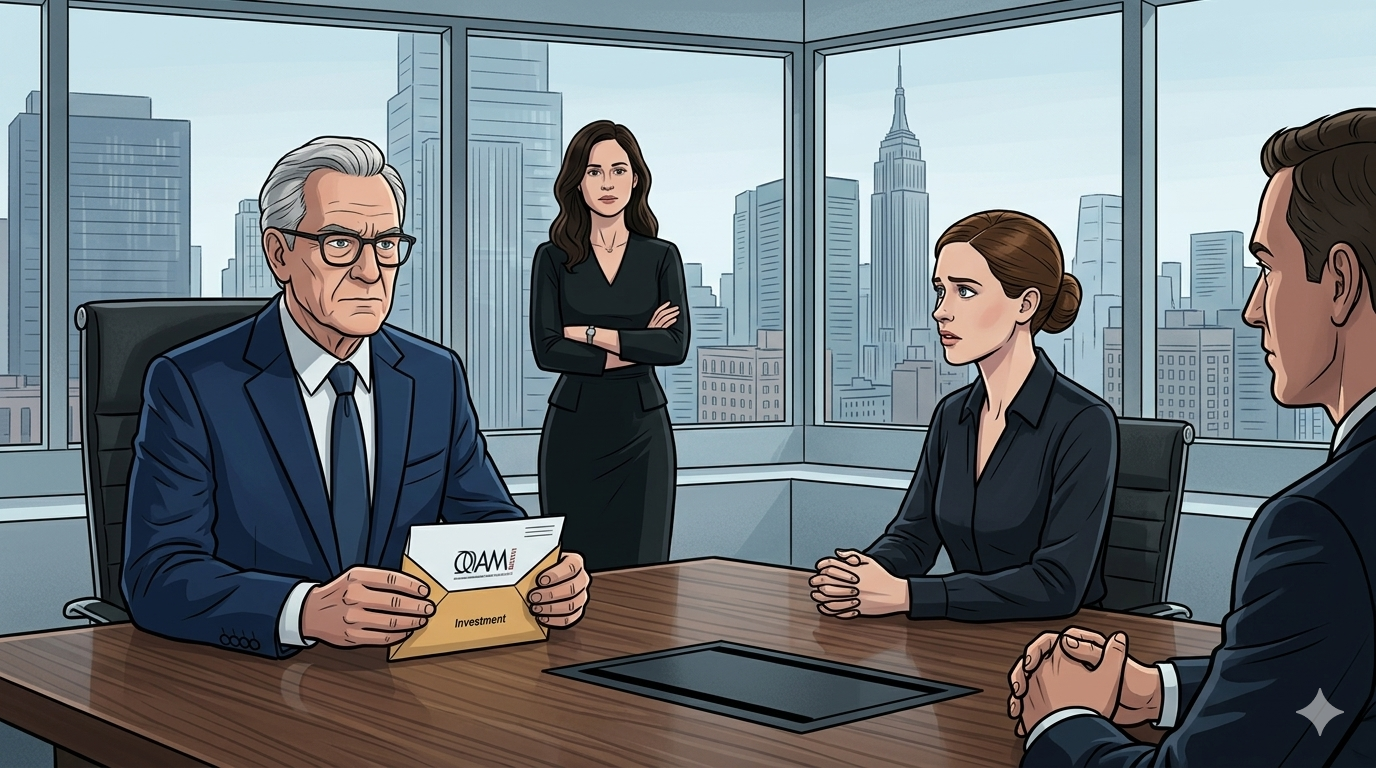
The silence in Martin’s office didn’t break. It settled. Like dust after a long-held breath finally released. Alyssa’s whisper—*I don’t know who I am anymore*—hung in the air, heavy and raw. Vivian didn’t answer. She just stared at the mahogany table, her perfect posture collapsing inch by inch, as if her spine had forgotten how to hold the weight of eighteen years of fiction.
I didn’t gloat. I didn’t speak. I just closed the folder on my lap, feeling the edges of the documents press against my palms. Twelve years of my father’s silence. Twelve years of hidden tests, secret trusts, unopened letters, and a divorce he never announced. All of it folded into manila paper, waiting for this exact moment.
Martin cleared his throat. “I’ll begin the probate process immediately. The will is explicit. The estate transfers to Candace as sole biological heir. Vivian, your divorce was finalized five years ago. You have no legal claim to the property, the accounts, or the trust. Any assets transferred after the decree will be subject to audit and restitution.”
Vivian finally looked up. Her eyes were dry, but her voice cracked. “You think this changes anything? I raised her. I kept that house running. I gave up my life for—”
“For a lie,” I said quietly. “You gave her a script. Not a life.”
Alyssa flinched. Vivian’s mouth closed. No rebuttal. Just the hollow sound of a story ending.
Martin stood, gathering the papers. “I’ll have the preliminary filings ready by Friday. Candace, I’ll need your signature on the transfer documents. Alyssa, I recommend you seek independent legal counsel regarding your status. The will makes no provision for non-biological dependents, but we can explore compassionate options if you choose to pursue them.”
“I don’t want his money,” Alyssa said, voice barely audible. “I just want to know who I’m supposed to be.”
I stood. “Then start there. Not with the will. Not with the name. With the truth.”
I walked out first. The Chicago wind hit my face like a cold hand, but for the first time in my life, I didn’t pull away from it.
—
The weeks that followed were a blur of signatures, appraisals, and quiet reckonings. Martin worked with surgical precision. Vivian’s financial trail was a mess of hastily moved funds, altered beneficiary forms, and shell accounts opened under her maiden name. She’d been preparing for this moment for years, assuming she could outmaneuver a dead man’s wishes. She hadn’t counted on William’s paranoia—or his loyalty to me.
Every unauthorized withdrawal was flagged. Every altered deed was contested. Martin filed injunctions, froze joint accounts, and initiated a forensic audit. Vivian hired a lawyer, of course. A loud, expensive man in a charcoal suit who tried to paint me as a vengeful outsider exploiting a technicality. But the court doesn’t care about theater. It cares about paper. And William’s paper was meticulous.
I didn’t attend the hearings. I stayed in Chicago, running my firm, reviewing spreadsheets, signing documents through secure portals. But I didn’t sleep much. I kept waking at 3 a.m., staring at the ceiling, thinking about a man who loved me from behind locked doors. I thought about the letters I’d written him at sixteen, begging him to call, to visit, to say my name. I thought about him reading them years later, alone, with no one to tell me he had.
I finally understood: his silence wasn’t absence. It was paralysis. And I wasn’t angry anymore. I was just tired of carrying the weight of what he couldn’t say.
Then, a letter arrived.
No return address. Just my name in Alyssa’s handwriting. I opened it at my kitchen table, the morning light cutting through the blinds.
*Candace,*
*I’ve spent three weeks in a motel outside Toledo. Mom won’t answer her phone. The lawyer she hired says I have no legal standing. I don’t care about the money. I care about the lie. I was raised to believe I was the standard, and you were the mistake. I treated you like dirt because I was terrified of being replaced. Now I find out I was never his to begin with. I don’t know how to exist without that foundation.*
*I want to find my biological father. The medical records from the transplant might have donor registry notes. Martin said you have copies. If you’re willing to share them, I’ll understand if you’re not. I don’t expect you to help me. But I’m asking anyway.*
*Alyssa*
I read it twice. Folded it. Put it in my desk drawer.
I didn’t reply right away. I needed to sit with it. The girl who shoved past me in hallways, who laughed when my name was omitted from programs, who demanded a DNA test to erase me… was now asking for help to rebuild herself. It would’ve been easy to say no. To let her drown in the truth she’d helped weaponize.
But I remembered my father’s letter. *I stayed silent because I didn’t want to destroy you.* He’d chosen protection over truth. I wouldn’t make the same mistake.
I copied the transplant records, the donor registry logs, the hospital intake forms. I mailed them to a PO box in Columbus. No note. Just the truth.
—
She found him in six weeks.
David Mercer. Retired high school history teacher. Married. Two grown children. Living in a quiet suburb outside Grand Rapids. He’d never known Vivian. He’d met her at a conference in ’94. A brief, careless weekend. She’d left without a word. When she later claimed she’d miscarried, he’d believed her. He’d moved on.
Alyssa called me from a pay phone outside a diner. Her voice was steady, but thin. “He cried when I showed him the records. His wife held his hand. They asked me to stay for coffee. We talked for three hours. He’s not perfect. He’s just… a person. He didn’t abandon me. He just never knew I existed.”
“What happens now?” I asked.
“I don’t know. But I’m not running anymore. I’m staying in Michigan for a while. Learning how to be someone’s daughter without a script.”
“Good,” I said. “That’s the only way that works.”
We didn’t hug. We didn’t promise to be sisters. But we spoke for twenty minutes. About books. About the weather. About the strange relief of not having to perform. When we hung up, I didn’t feel closure. I felt possibility.
—
Back in Ohio, the house was mine. Legally. Financially. Emotionally, it still echoed with ghosts. I walked through the rooms slowly, listening to the floorboards, remembering the years I’d spent trying to make myself invisible. Vivian’s designer furniture looked like props now. The framed photos of “perfect family” moments felt like exhibits in a museum of fiction.
I hired an estate liquidator. Sold the silver, the crystal, the staged art. Donated the clothes Vivian had bought to maintain appearances. Kept only what mattered: my father’s books, the grandfather clock, the piano my mother played, the brass key Rosa gave me, now resting on my desk like a paperweight.
Rosa stayed. I offered her a contract, a salary, a title: Director of Estate Operations. She cried when I handed it to her. “Your father used to sit in that study and read your letters,” she told me. “He’d trace your handwriting and whisper, ‘She’s so strong.’ He just didn’t know how to be strong enough to open the door.”
I nodded. “He doesn’t have to anymore.”
Eleanor moved into the east wing. Seventy-eight, sharp-tongued, refusing to be treated like fragile glass. “I spent twenty years watching that woman treat you like an inconvenience,” she said, unpacking her suitcase. “I’m not leaving until this house breathes again. And I’m not letting you do it alone.”
So we worked. Together.
I turned the mansion into something William would have recognized, even if he never said it out loud. The consulting grants he’d secretly funded became the Harper Foundation for Women in Leadership. The third-floor study became an archive and reading room, open to scholars, entrepreneurs, women rebuilding after betrayal or systemic exclusion. The grounds were maintained, but shared. We hosted community events, scholarship interviews, quiet retreats.
I didn’t do it for him. I did it for the girl who packed one suitcase at seventeen and told herself she wouldn’t be missed.
I was missed. Just not by the people who mattered.
—
Vivian’s legal case dragged on for eight months. She fought every injunction, contested every audit, hired three different lawyers. But the court doesn’t reward desperation. It rewards evidence. She was ordered to repay $1.4 million in misappropriated funds. The house, the accounts, the trust—all legally mine. The social circle she’d cultivated abandoned her. She moved to a small apartment in Sarasota, where no one knew her name.
I received one letter from her. No apology. Just a list of excuses, half-truths, and thinly veiled attempts to guilt me into sending money. I didn’t respond. I filed it away. Some wounds don’t need closure. They just need to stop bleeding.
Alyssa and I never became sisters in the traditional sense. We were too scarred, too shaped by different truths. But we became something real: allies. Confidantes. Two women who survived the same house, learned different lessons, and chose to build separate lives without burning the bridge between them.
We met once a year. Coffee. No expectations. Just honesty.
I never married. Not because I didn’t want love, but because I finally understood that family isn’t something you’re given. It’s something you choose. And I chose myself. I chose the women who lifted me up. I chose the work that mattered. I chose the quiet dignity of a life built on truth instead of performance.
Sometimes, on rainy afternoons, I’d climb the stairs to the third floor. The study still smelled like old paper and cedar. The photographs of me were gone, replaced by archives of foundation recipients, scholarship essays, letters from women who said we saved their careers, their dignity, their futures.
I’d sit at the desk. Open a notebook. Write.
Not for him. Not for her. For me.
And when I finally closed the book, I’d whisper the words he never got to say out loud:
*You were always enough.*
Then I’d turn off the light, lock the door, and walk downstairs into a house that finally, quietly, belonged to me.
—
Years passed. The foundation grew. We partnered with universities, legal aid organizations, shelters. We funded hundreds of women. We published research on financial literacy, workplace equity, trauma-informed leadership. Rosa trained a new generation of staff. Eleanor served on the advisory board until she passed peacefully at eighty-two, surrounded by people who loved her, not just her name.
Alyssa found her footing. She went back to school. Studied social work. Opened a small practice in Grand Rapids, specializing in family estrangement and identity reconstruction. She sent me a photo once: her office door, a brass plaque that read *Mercer-Harper Counseling*. I taped it to the inside of my desk drawer.
Vivian faded from our orbit. I heard rumors: financial struggles, failed relationships, a quiet life of regret. I didn’t seek her out. I didn’t need to. Some stories end not with confrontation, but with distance. And distance, when chosen intentionally, is its own kind of justice.
One year to the day after my father’s death, I drove to the cemetery. The sky was overcast, the air crisp. I knelt beside his headstone: *William Harper. Beloved Father.*
I placed a single envelope on the grass. Inside was a letter I’d written over three days.
*Dad,*
*I’m not angry anymore. I’m just tired of carrying the weight of what you didn’t say. But I see you now. I see the man who kept every letter. Who tracked my career from afar. Who set up a trust so I’d never have to wonder if I was worthy. Who stayed silent because he was afraid of breaking something he couldn’t fix.*
*I forgive you. Not because you deserved it. But because I deserve peace.*
*I’m turning the house into a place where women don’t have to earn their belonging. Where truth matters more than performance. Where silence isn’t mistaken for love.*
*I’m not your ghost anymore. I’m your daughter.*
*And I’m finally home.*
I stood, brushed the dirt from my knees, and walked back to my car. The road ahead wasn’t perfect. It wouldn’t be. But for the first time in thirty-six years, I wasn’t walking away from it.
I was walking into it….